5082
First MR Images acquisition with decoupled High Temperature Superconducting surface coils1Université Paris-Saclay, BioMaps, ORSAY, France, 2Thales Research & Technology, Palaiseau, France, 3Université Paris-Saclay, CEA, CNRS, Inserm, BioMaps, Orsay, France, 4Université Paris-Saclay, CEA, CNRS, BAOBAB, NeuroSpin, Gif-sur-Yvette, France, 5Unité Mixte de Physique, CNRS, Thales, Université Paris-Saclay, Palaiseau, France
Synopsis
Keywords: Non-Array RF Coils, Antennas & Waveguides, Non-Array RF Coils, Antennas & Waveguides, Superconducting material, Decoupling
A promising strategy to tackle the issue of decoupling High-Temperature Superconducting (HTS) surface coils during emission is to exploit nonlinearities of the HTS coil electromagnetic response. In this work, we present the first Magnetic Resonance Images acquired with a decoupled HTS surface coil and the required coil’s features to obtain these images. The change of the HTS coil Q-factor values leads to different decoupling levels (DL) of the HTS coil and the presence or absence of B1 artifacts on the images.Purpose
The high sensitivity of HTS surface coils is of profound interest as it allows to achieve at 1.5 T a comparable Signal to Noise Ratio to the one at 9T (1) without SAR issues, B1+-transmit field inhomogeneities and with the same NMR contrast as in clinical applications. However, decoupling the HTS coil from the transmit coil remains a major issue to overcome. Since conventional decoupling approaches for copper coils are not suitable for HTS coils, new decoupling strategies are necessary. It has been reported that the Q-factor drops nonlinearly as the transmit RF-field amplitude increases (2-3). Consequently, the Q-factor during transmission Qt, can decrease by several orders of magnitude compared to the one involved during reception Qr. Here, we present a decoupling method exploiting the non-linear electrical properties of HTS coils as a function of B1+, the transmit power level of the body coil, allowing the material to pass from a near zero-resistance state to a dissipative state. The efficiency of the decoupling of the HTS coil with the body coil during transmission is then evaluated using a decoupling level DL (4).Methods
The studied HTS coil is a 6 turn transmission line resonator made of 300 nm thick YBaCuO deposited on a 330 µm thick sapphire r-cut dielectric substrate (Ceraco ceramic coating GmbH, Germany). The HTS coil has been operated in a MR-compatible cryostat (5) after a field-cooling(6). First, Q-factors were directly measured when the HTS coil is placed inside the 1.5T scanner using a Vector Network Analyser (VNA) and the single loop probe of diameter of 5 mm (7). Secondly, MR images of a parallelepipedic Gd-doped water sample (T1 = 0.0952 s) were acquired using the HTS coil during reception. . The sequence parameters used are : repetition time TR = 25.0 ms ; echo time TE = 6.0 ms ; image size : 60 × 144 × 144 voxels ; resolution : 0.5 mm × 0.21 mm × 0.21 mm. Two flips angle, α of 5° and 10°, were used obtained with the following RF pulse parameters, B1+, pulse duration, τ:| α | B1+, τ | B1+, τ |
| 5° | 0.5, 6.5 ×10⁻⁴ s | 1, 3.2 ×10⁻³ s |
| 10° | 1, 6.5 ×10⁻⁴ s | 10, 6.5 ×10⁻⁵ s |
MR signal received by the HTS coil was also computed as a function of B1+-transmit amplitude, sequence parameters and sample properties, using the equations below. The Q-factor values, Qt, Qr, involved in the expression of the Concentration Factor Fc, were then choosen so as to adjust the simulated MR-signal maps to the experimental ones. Obtained Q-factor values are compared to those measured with the VNA.
$$ Signal = |\frac{B_1\times M_0 \times (1-e^{-T_1/T_R})}{\sin(\alpha \sqrt{1+F_c^2 \cos^2(\theta)})\times (1-e^{-T_1/T_R}\cos(\alpha \sqrt{1+F_c^2 \cos^2(\theta)}))}| $$
$$ F_c = \frac{S_{HTS}}{2L_{HTS}}10^{\frac{Q_t}{20 Q_r}} Q_r B_1$$
and $$ \theta = \arctan(\frac{B_x^{HTS}}{B_z^{HTS}})$$
Finally, the decoupling level is defined with values Qr and Qt as :
$$ DL = -20\times \log (\frac{I_{emission}}{I_{reception}})= -20\times \log (\frac{Q_{t}}{Q_{r}})$$
Results / Discussion
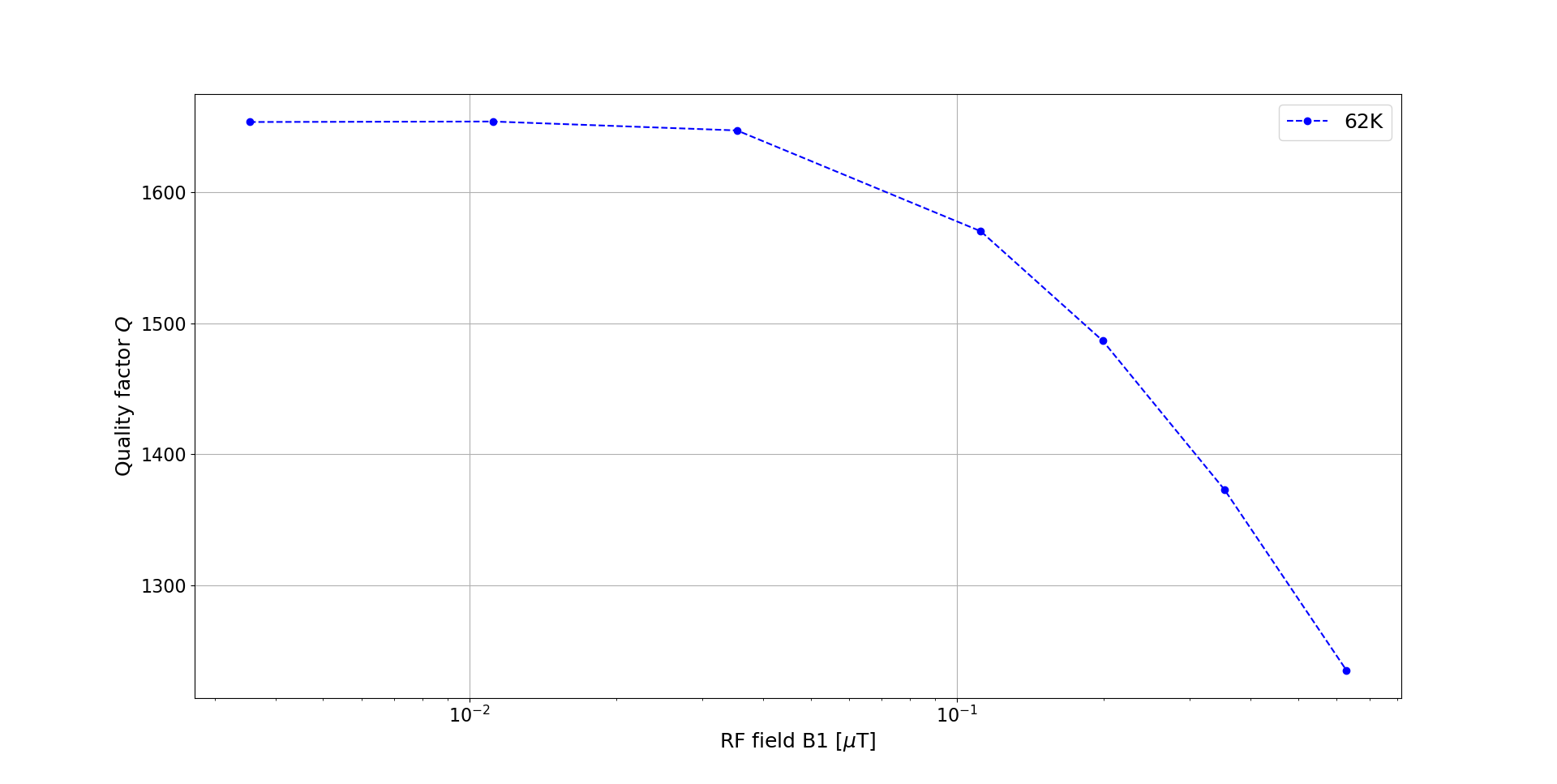
The measured Q-factor variation as a function of the RF-field amplitude produced by the single-loop probe is displayed in figure 1. It is representative for the nonlinear behavior of the HTS resistivity. For B1 < 0.05 µT the Q-factor is constant and sets Qr of 1650. Up to 0.5 µT, the Q-factor decreases down to 1250 at B1 = 0.5 µT.Figure 2 displays the experimental and simulated MR-signal maps, which correspond to different Qt factors and DLs. There is a good agreement between the experimental results and the simulations. For B1 = 0.5 µT extracted Qt value of 1150± 50 obtained to adjust the simulated map is in good agreement with the one directly measured with VNA, equals to 1200. Qt of 850 and 50 were respectively obtained for B1 of 1 µT and10 µT.
For B1 up to1 µT, figure 2 highlights the concentration effect of the RF field by the non-decoupled HTS coil. The darker stripes correspond to a flip angle α equal to nπ rad (with n being an integer) higher than the nominal flip angle of 5.0° or 10.0° (8).
For the smaller Qt, obtained with a B1+ of 10 µT, a DL of 30 dB is then calculated and the effect of the reinduced magnetic field by the HTS coil during thansmission is no longer visible on the SNR map.
Conclusion
For B1 = 0.5 µT, excellent fit between experimental and simulated MRI signal maps is obtained for a Qt value of 1150±50. This value is in good agreement with the measured one of 1250. Figure 2 illustrates the impact of superconducting state of the HTS coil on B1-artifacts. A high dissipative state is reached, leading to the absence of B1-artifacts, corresponding to a Qt of 50 and a DL up to 30 dB.This study confirms that nonlinearities of HTS surface coils electric response can be exploited for decoupling the HTS coil during the transmission. Moreover, this decoupling strategy can be applied independently of the HTS geometry, e.g multi turn multi loop transmission line resonator. Finally, thanks to this essential outcome, quantification sequences requiring a full control of the flip angles can now be used to perform MRI with such HTS surface coils.
Acknowledgements
No acknowledgement found.References
1. Marie Poirier-Quinot, Jean-Christophe Ginefri, Olivier Girard, Philippe Robert, and Luc Darrasse. Performance of a miniature high-temperature superconducting (HTS) surface coil for in vivo microimaging of the mouse in a standard 1.5 T clinical whole-body scanner. Magnetic Resonance in Medicine, 60(4), feb 2008.
2. Olivier Girard, Jean-Christophe Ginefri, Marie Poirier-Quinot, and Luc Darrasse. Method for nonlinear characterization of radio frequency coils made of high temperature superconducting material in view of magnetic resonance imaging applications. Review of Scientific Instruments, American Institute of Physics, 78(12), dec 2007.
3. I. Saniour, G. Authelet, B. Baudouy, R-M. Dubuisson, C. J. van der Beek, L. Darrasse, J. Briatico, J-C. Ginefri, and M. Poirier-Quinot. Novel passive decoupling approach for high resolution HTS RF coils based on the nonlinear electrical properties of superconductors. ESMRMB, Rotterdam, Netherlands, 2019.
4. Sina Marhabaie, Aime Labbe, B. Q., and Marie POIRIER-QUINOT. Quantitative analysis of minimum satisfactory detuning level of receive-only surface coils used in magnetic resonance imaging. Submitted, 2022.
5. Isabelle Saniour, Gilles Authelet, Bertrand Baudouy, Rose-Marie Dubuisson, Georges Willoquet Laurène Jourdain, Luc Darrasse, Jean-Christophe Ginefri, and Marie Poirier-Quinot. A temperature controlled cryogen free cryostat integrated with transceiver-mode superconducting coil for high resolution magnetic resonance imaging. Review of Scientific Instruments.
6. Aime Labbe, Rose-Marie DUBUISSON, Jean-Christophe GINEFRI, Cornelis J. van der BEEK, Luc DARRASSE, and Marie POIRIER-QUINOT. Static field homogeneity artifacts due to magnetic flux expulsion by HTS coils for high-resolution magnetic resonance imaging. Applied Physics Letter, dec 2020.
7. Jean-Christophe Ginefri, Emmanuel Durand, and Luc Darrasse. Quick measurement of nuclear magnetic resonance coil sensitivity with a single-loop probe. Rev. Sci. Instrum. 70, 4730 (1999); doi: 10.1063/1.1150142
8. W.A. EDELSTEIN, C.J. HARDY, and O.M.
MUELLER. Electronic
decoupling of surface-coil receivers for nmr imaging and spectroscopy. Journal of Magnetic Resonance, 67, 1986.
Figures
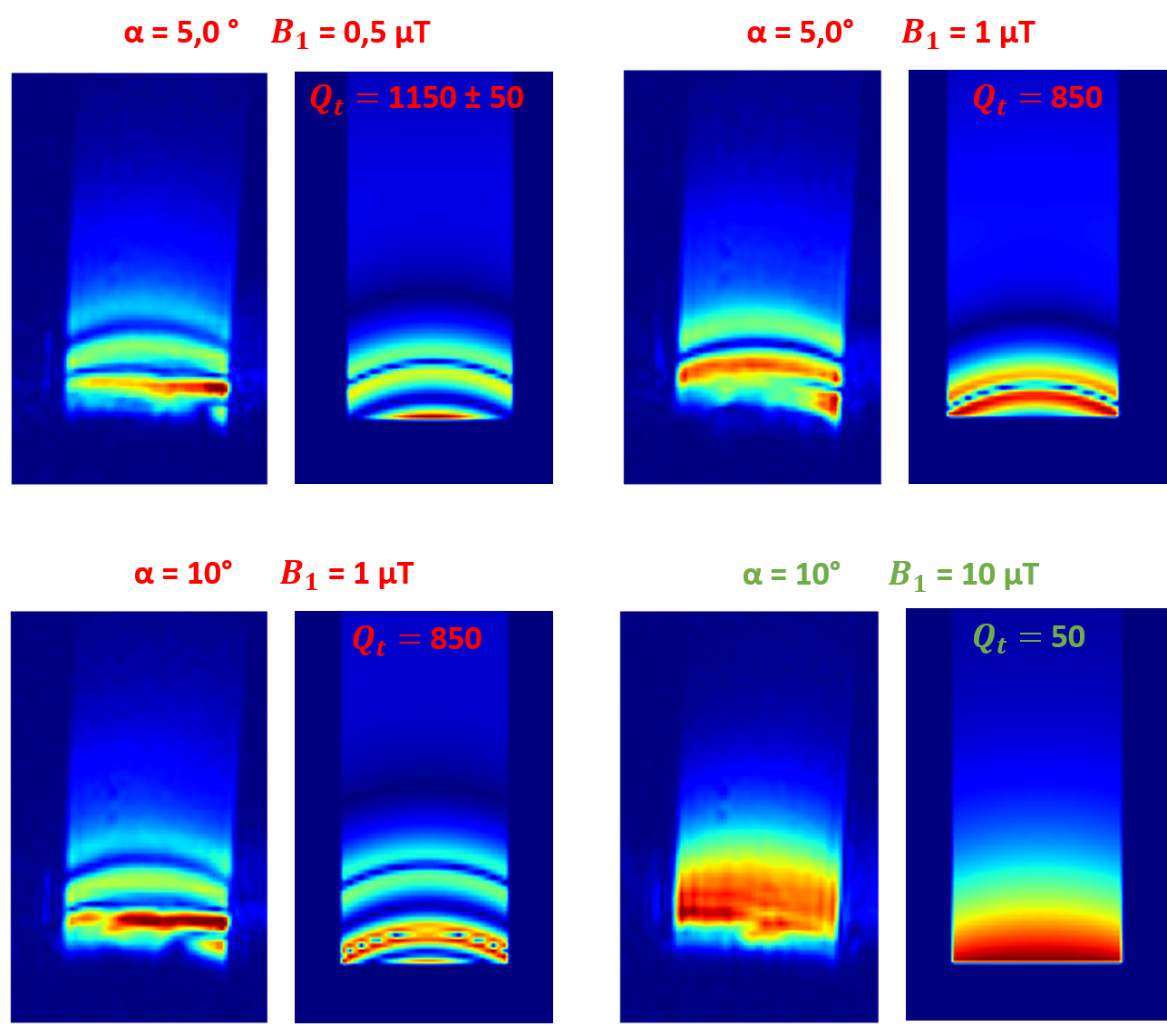
MR signal map, obtained experimentally (left) and by computation (right) of a homogeneous rectangular water sample for different B1 fields and two different flip angles α are presented. The Qt values were extracted so as to adjust the simulated MR signal maps to the experimental ones