5079
A multi-feed, loop-dipole approach to enhance performance of multi-channel dielectric resonator antenna arrays for human brain MRI at 7T
Daniel Wenz1,2 and Thomas Dardano1,2
1CIBM Center for Biomedical Imaging, Lausanne, Switzerland, 2Animal Imaging and Technology, Ecole Polytechnique Federale de Lausanne (EPFL), Lausanne, Switzerland
1CIBM Center for Biomedical Imaging, Lausanne, Switzerland, 2Animal Imaging and Technology, Ecole Polytechnique Federale de Lausanne (EPFL), Lausanne, Switzerland
Synopsis
Keywords: Non-Array RF Coils, Antennas & Waveguides, Non-Array RF Coils, Antennas & Waveguides, Dielectric resonator, loo-dipole
The goal of this work was to demonstrate that performance of multi-channel dielectric resonator antenna arrays for brain MRI at 7T can be substantially improved using a novel multi-feed, loop-dipole coupling mechanism. Simulations were conducted for different rectangular DRA geometries and dielectric constants. Three RF feed types were investigated: loop-only, dipole-only and loop-dipole. 16-channel, loop-dipole rectangular DRA arrays provided significant gains in B1+, SAR efficiency and SNR vs. 8-channel bow-tie antenna array. The feasibility of multi-feed, loop-dipole approach was for a 24-channel DRA array was demonstrated.Introduction
Dielectric resonator antenna (DRA) is a promising alternative for MRI at 7T which requires no additional decoupling circuits and only a minimal number of lumped components1-3. Different RF feed mechanisms can be used to induce transverse electric (TE) modes in a rectangular DRA, e.g. loop coils or dipole antennas. While it was shown, that dipole-fed rectangular DRA can provide a good transmit efficiency in deeper located regions, e.g. prostate4,5, it is unknown whether the same is true for human brain MRI at 7T, mainly due to differences in sample size and the sample-mode interaction6. Multi-channel DRA for brain MRI at 7T was developed by Winter et al.7 A similar idea was found relevant for MRI at 10.5T8. Recently, it was demonstrated for a 16-channel rectangular DRA that by using a combined loop-dipole coupling scheme, a substantial B1+ efficiency gain (35% in the center) can be achieved vs. dipole-only9. That study provided a preliminary evidence that a dipole antenna alone might not be the most favorable coupling mechanism for brain MRI at 7T. Therefore, the goal of this study was to: a) determine which type of RF feed (loop-only, dipole-only or loop-dipole) for a rectangular DRA can provide the best performance in human brain MRI at 7T, and b) how these findings can be translated into novel multi-feed, loop-dipole combined DRA arrays.Methods
Electromagnetic field simulations in a spherical phantom (radius=85mm, εr=56, σ=0.66S/m) and human voxel model Duke were conducted using Sim4Life (Zurich Medtech,Switzerland). 12 different, 16-channel rectangular DRA arrays were studied. For a single block: length a=150mm, width b=70mm while height d varied as follows: 0.125b=8.75mm, 0.25b=17.5mm, 0.5b=35mm, 0.75b=52.5mm. For such defined block geometries, a set of εr (75-300) was investigated. Loss tangent was kept constant in each simulation. Three types of RF feed were considered: loop-only, dipole-only and loop-dipole (Fig.1). The distance between the block and the phantom was constant for each simulation (10mm). In TX, each array was driven in circularly polarized (CP) mode with a phase increment 45º/element. A referential 8-channel bow-tie antenna array was reproduced from previous report7. Finally, multi-feed, loop-dipole combined approach was demonstrated in a 24-channel configuration (3 RF feeds per block: 1 loop element and 2 dipole antennas for εr=275 (d/b=0.25) and compared in RX mode with a 16-channel counterpart. For 24-channel array, 2 dipole antenna elements were positioned in a way that each outer arm of the antenna was 10 mm from the edge of the dielectric block. Transmit field efficiency was defined as B1+/√P, where P is the input power, and SAR efficiency defined as B1+/√SAR10g, where SAR10g is the maximum SAR averaged over 10g. Signal-to-noise ratio (SNR) was evaluated using an implementation of the Roemer’s algorithm10 which was based on the S-matrix formalism proposed earlier11.Results
In all of the cases, the highest B1+ and SAR efficiency in a spherical phantom was observed for the loop-only coupling scheme, while the highest SNR was observed for the loop-dipole coupling scheme (Fig.2). The highest B1+ efficiency (loop-only) in the center was obtained for εr=275 (0.79μT/√W): TE21δ mode. The highest SAR efficiency (loop-only) for: εr=75, d/b=0.75 (1.37 μT/√(W/kg)): TE11δ mode. The highest SNR (loop-dipole) was found for: εr=175, d/b=0.75 (1.38a.u.). For Duke, the highest B1+ efficiency in the center of the head was higher for all three of loop-dipole combined arrays (loop-only used for TX): 1.53- (εr=150 and 175) and 1.49-fold (εr=275) vs. 8-channel bow-tie. The most apparent gain in SAR efficiency vs. bow-tie array was observed for εr=150 (1.23-fold). SNR in the center was higher for all three 16-channel loop-dipole combined arrays: 1.78- (εr=175), 1.71- (εr=275) and 1.63-fold (εr=150). Multi-feed, loop-dipole approach was showed for a 24-channel array (εr=275; d=0.25b). Scattering parameter matrix for the 24-channel array was evaluated demonstrating acceptable level of coupling (Fig.4). SNR for the 24-channel array in the center of the phantom was negligibly higher vs. 16-channel: 1.32 vs 1.31(a.u.) but with a noticeable SNR increase along profiles in two other planes: XZ and YZ (Fig.5).Discussion
This work demonstrates for the first time that multi-feed, loop-dipole combined approach can be used to substantially enhance transmit (and receive) performance of rectangular dielectric resonator antennas for human brain MRI at 7T. The data indicate that loop-only coupling scheme should be used in TX mode to achieve the highest B1+ and SAR efficiency, while the loop-dipole should be the most suitable in the receive mode to obtain the highest SNR in spherical samples which are similar to human head in terms of size and electrical properties. Note that in previous studies, DRAs were fed using just a single element (either loop or dipole) per block, and a multi-feed, loop-dipole approach enabled using the total number of 24 channels instead of 8 as reported before. Moreover, for the 24-channel rectangular DRA, inter-element coupling was found to be acceptable and no additional decoupling methods were necessary. Our goal is to develop a head-adjustable, 8-channel TX and 24-channel RX DRA array for brain MRI at 7T which could find its use in multi-modal imaging, e.g. electroencephalography (EEG) combined with functional MRI.Acknowledgements
The authors acknowledge access to the facilities and expertise of the CIBM Center for Biomedical Imaging, a Swiss research center of excellence founded and supported by Lausanne University Hospital (CHUV), University of Lausanne (UNIL), Ecole polytechnique fédérale de Lausanne (EPFL), University of Geneva (UNIGE) and Geneva University Hospitals (HUG).References
1. Wen et al.,
JMR 1996
2. Aussenhofer and
Webb, MRM 2012.
3. Aussenhofer and
Webb, JMR 2014.
4. Raaijmakers et
al. MRM 2011.
5.
Ipek et al., Concepts Magn Reson Part B 2013.
6. Wenz and Gruetter,
Front Phys 2021.
7. Winter et al.,
Plos One 2013.
8.
Sadeghi-Tarakameh et al., MRM 2022
9.
Wenz, ISMRM 2021.
10.
Roemer et al., MRM 1990.
11. Kuehne et al.
MRM 2015.
Figures
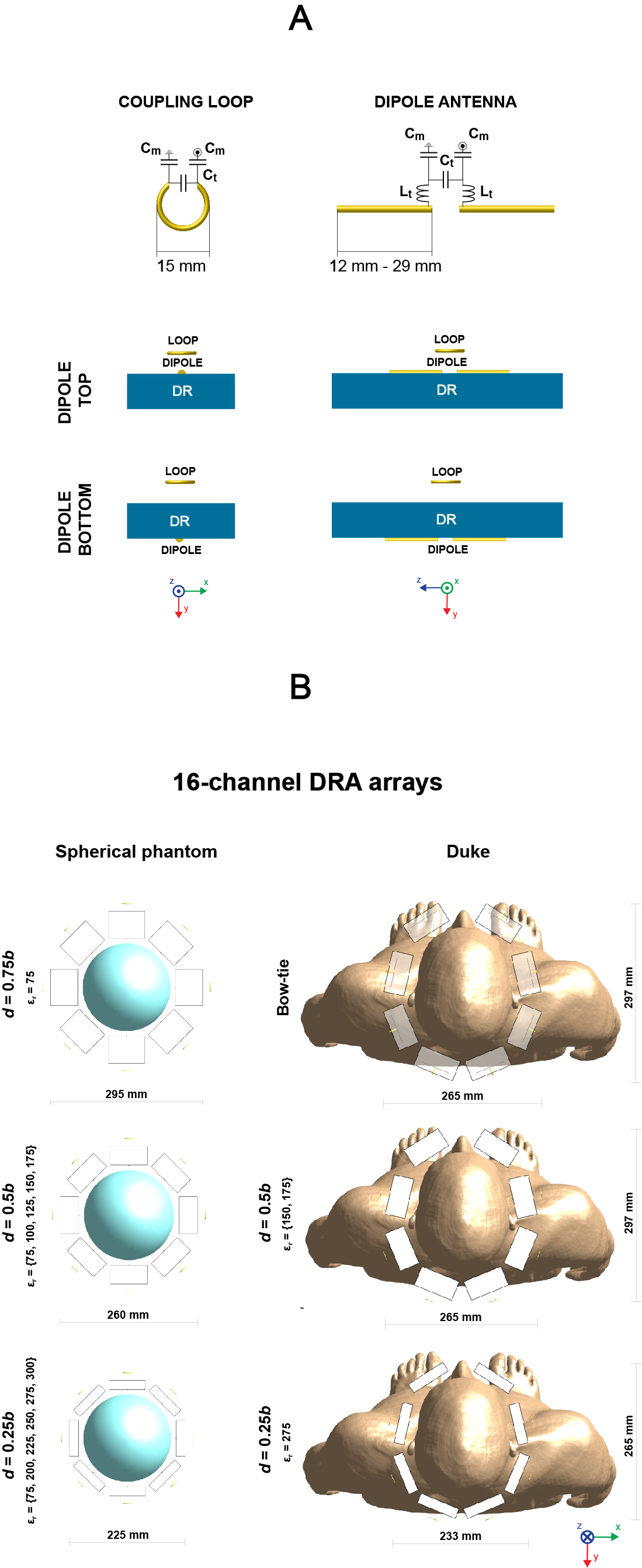
Figure 1: (A) Rectangular DRA with coupling loop and
dipole antenna connected to their corresponding tuning/matching circuits. The
diameter of the loop was constant (15mm) and the length of the dipole antenna
depended on dielectric permittivity of the rectangular block. (B) Schematic
view of 12 different loop-dipole DRA arrays and a bow-tie antenna array.
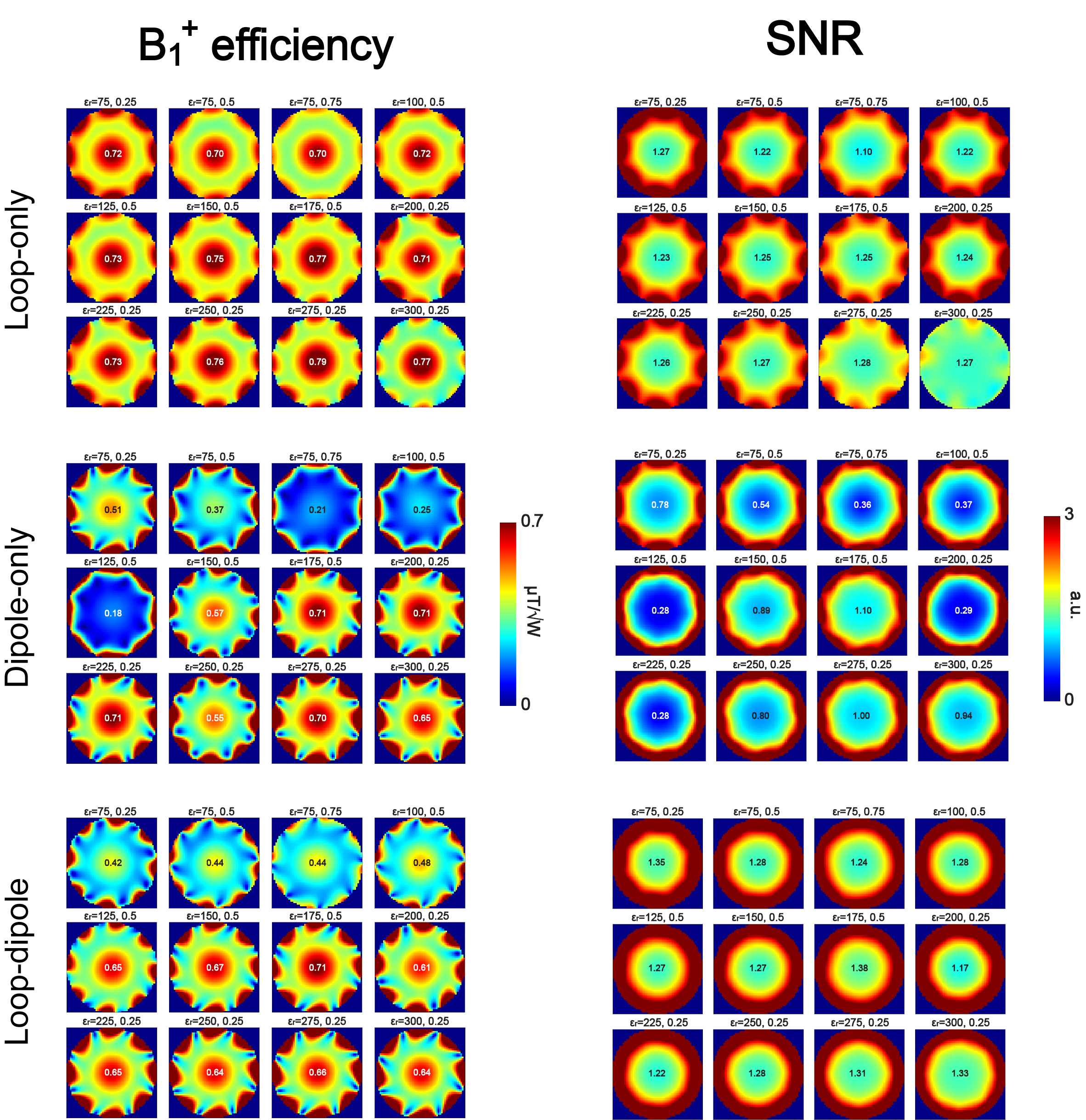
Figure 2: B1+ distribution in
the spherical phantom (central XY plane) for all 12 of the 16-channel,
loop-dipole coupled DRA arrays. The
data showed that loop-only coupling scheme provided the highest B1+
efficiency in the center of the phantom for all of the arrays. The highest B1+
efficiency was observed for: εr = 275, εr = 175 and εr = 300. Right: SNR distribution in the spherical phantom. Loop-dipole coupling
scheme provided the highest SNR in the center of the phantom for all of the
arrays. The highest SNR was observed for: εr = 175; εr = 75, d/b
= 0.25 (1.35 a.u.) and εr = 300.
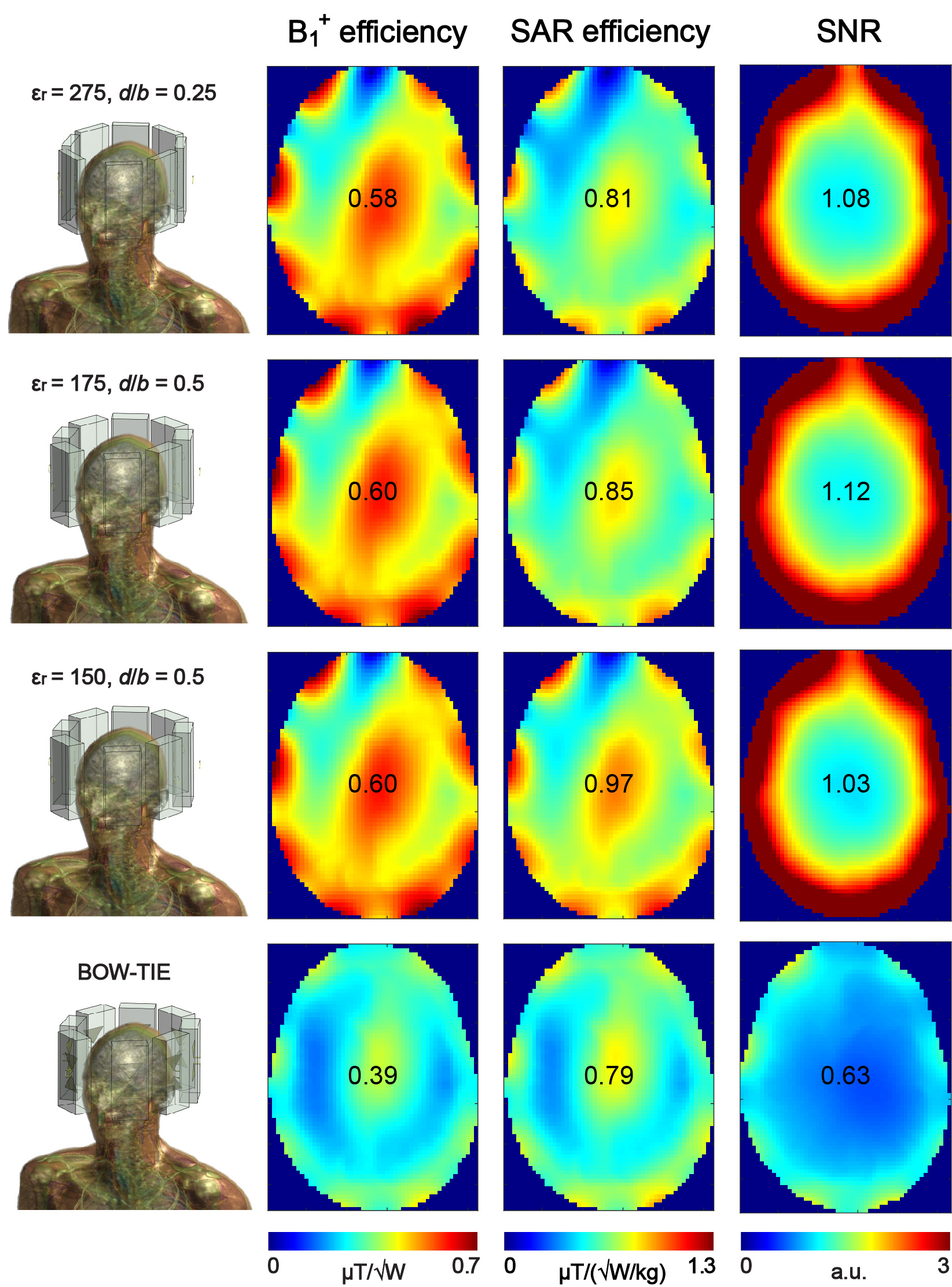
Figure 3: B1+ efficiency, SAR
efficiency and SNR in human voxel model Duke (central XY plane). Three
different loop-dipole coupled rectangular dielectric resonator arrays were
chosen and benchmarked against an 8-channel bow-tie antenna array. Each one of
the loop-dipole coupled arrays (loop-only for transmission, and loop-dipole for
reception) provided substantial B1+ efficiency (1.54-fold
for εr = 175) and SNR (1.77-fold for εr = 175) gain in
the center. SAR
efficiency was also higher especially for εr = 150 (1.23-fold).
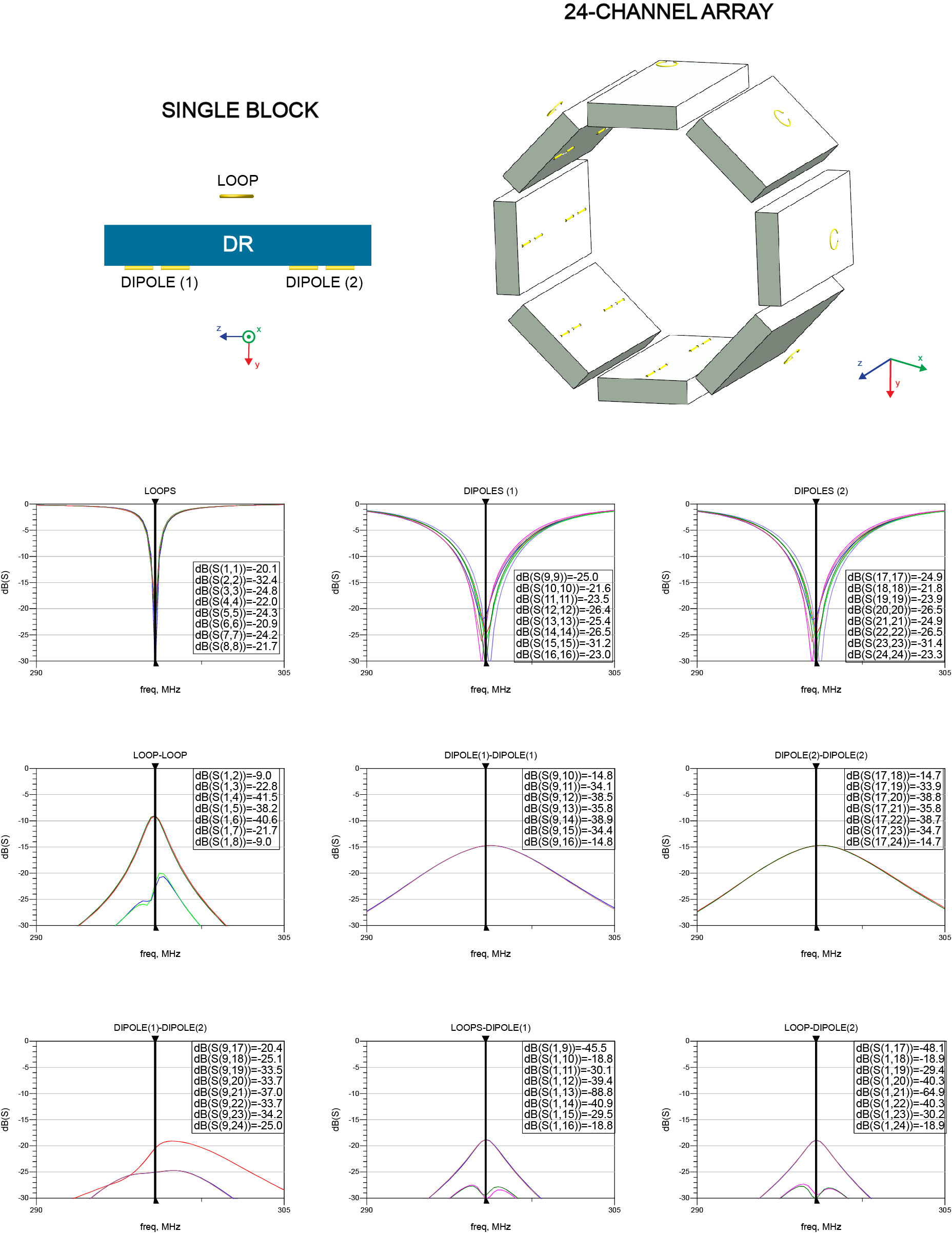
Figure 4: Multi-feed, loop-dipole combined, 24-channel
rectangular dielectric resonator antenna array (εr = 275, d/b
= 0.25). Scattering parameter matrix was evaluated. For the adjacent elements: loop-loop coupling was
-9.0 dB. Dipole-dipole (row 1) coupling was -14.8 dB and -14.7 dB (row 2).
Dipole-dipole coupling between adjacent rows (1 and 2) was below -20 dB. Loop-dipole coupling was -18.8
(row 1) and -18.9 (row 2).
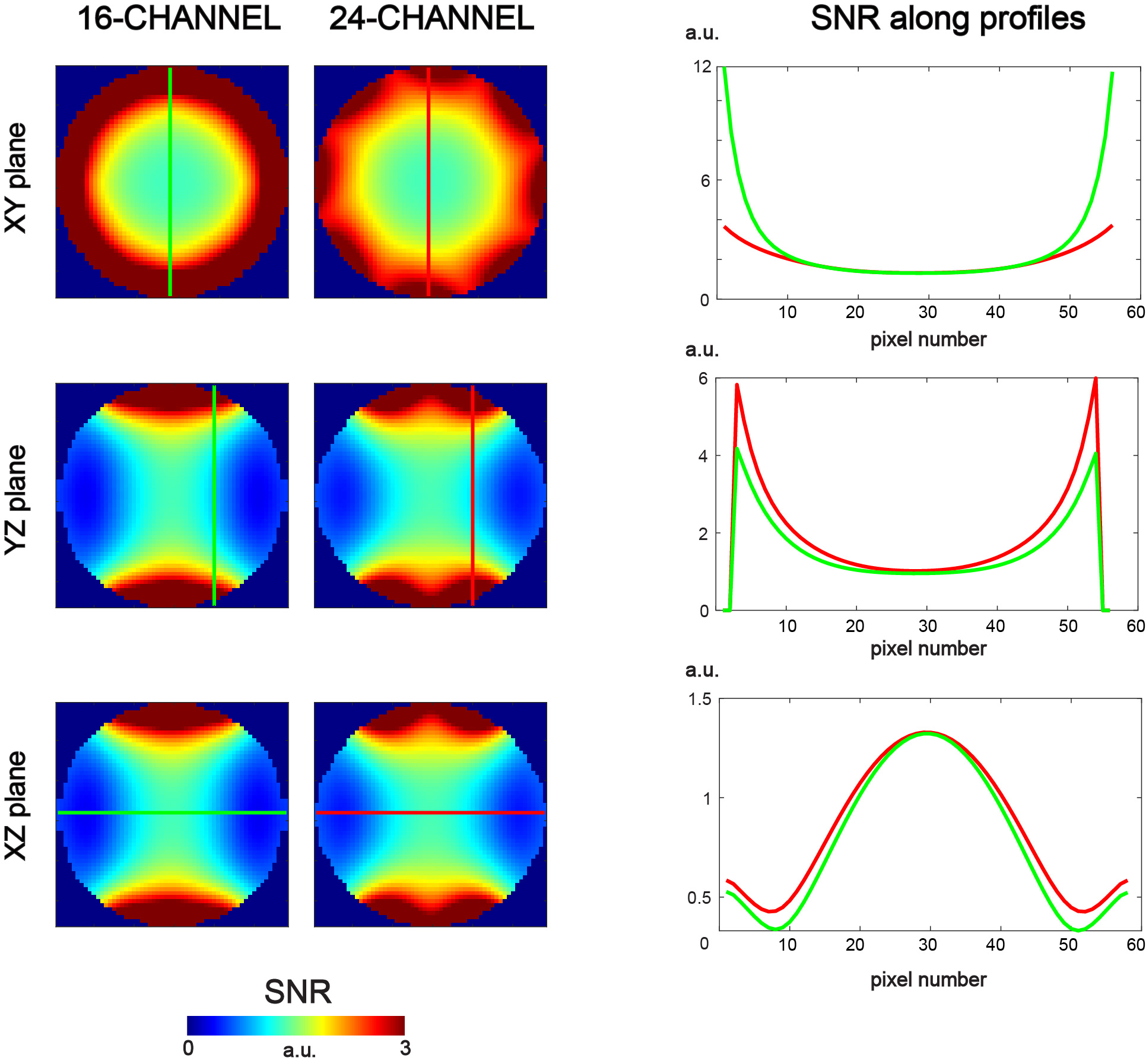
Figure 5: SNR distribution in the spherical phantom
for the 16- and 24-channel rectangular dielectric resonator antenna array. For
the 24-channel array, SNR in the center was slightly higher (1.32 a.u.) than
the one for the 16-channel array (1.31 a.u.). Even though the peripheral SNR in
the XY plane for the 24-channel array was reduced, additional SNR gains in YZ
and XZ planes were observed. SNR along three different profiles (green –
16-channel; red – 24-channel) was compared.
DOI: https://doi.org/10.58530/2023/5079