5078
Wearable and stretchable RF coils using self-decoupling technology1Vanderbilt University Institute of Imaging Science, Vanderbilt University Medical Center, Nashville, TN, United States, 2Department of Radiology and Radiological Sciences, Vanderbilt University Medical Center, Nashville, TN, United States
Synopsis
Keywords: RF Arrays & Systems, RF Arrays & Systems
A novel flexible and stretchable coil based on the self-decoupling technology is proposed. It can be stretched and bent to match the shape of the human anatomy of interest, exhibiting high SNR. A 4 coil array was built and tested at different stretching (horizontally and vertically), and on different anatomies (torse, thigh, head), showing a strong robustness.Background and Significance
Wearable and stretchable RF coils are highly desired in MRI as they can fit as close as possible to target anatomies regardless of patient size [1-4]. For example, in knee imaging, the diameters of most knee coils are >19 cm to accommodate 99% of knee sizes in the US. However, half of the knees have diameters of less than 13.5 cm. Obviously, there is a large SNR penalty when these coils are used for small knees, which impacts image quality and diagnostic accuracy. The main challenge for stretchable coils is that the impedance matching and inter-element isolation degrades when they are bent and/or stretched. Inspired by the self-decoupling techniques described previously [5], we propose a wearable and stretchable coil for practical applications incorporating robust matching and decoupling.Methods
Circuit and robustness bench testFigure 1a shows the circuit of a single wearable and stretchable self-decoupled coil for 7T MRI [6]. The central conductor of an ultra-flexible coaxial cable (Huber+Suhner G_02232_D) was employed as the coil conductor. The mode capacitor (Cmode) was made from two gapped central conductors and an outer sleeve braid. As mentioned in previous works, the mode capacitor (Cmode) determines the decoupling performance but also affects the matching robustness. Here we first investigate how Cmode affects coil decoupling and matching. Three pairs of 10-cm-diameter circular coils were built, with lengths of sleeve braids of 2/3/4 cm (Figures 1b-1d). The measured values of these Cmodes are approximately 0.5/0.7/0.97 pF. To investigate the decoupling robustness, we first tuned (to 298 MHz, Larmor frequency of 7T) and matched (to 50 ohms) two coils separately and then recorded S21 changes when putting them together (Figure 1e). The coil-to-coil distance varies from 13.5 cm to 5.5 cm. To investigate the matching robustness, we first tuned and matched single coils, with the coil 1 cm above the phantom. Then we recorded S11 changes when moving the coil further away from the phantom (Figure 1f).
Single-coil SNR comparison
We measured central SNR maps on a bottle phantom (diameter 15 cm, 3g/L NaCl) using a flat rigid conventional coil, a stretchable coil with the same shape as the rigid coil, and a stretchable coil curved to match the shape of the phantom. All coils are used for RF reception, with a Nova birdcage volume coil used for RF transmission.
4-channel stretchable receive array
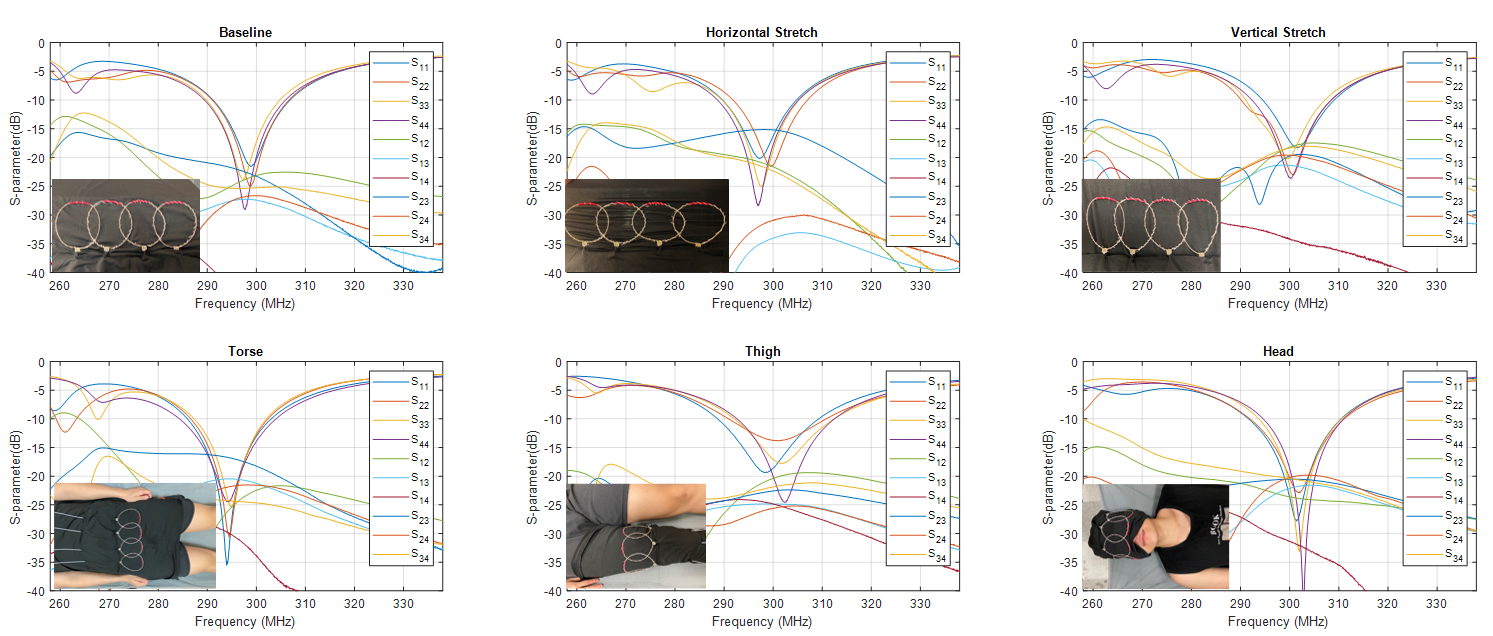
A 4-channel receive-only array with optimal Cmode was built on an elastic and stretchable fabric (90% polyester and 10% spandex) so that it can be easily stretched in both horizontal and vertical directions. To evaluate the performance robustness with respect to stretch, we measured the S-parameter plots with the coil stretched horizontally by 1.2× or vertically by 1.15×. Additionally, we measured the coil robustness with respect to different anatomies, including the torso, thigh, and head.
Results
Coil robustnessFigure 2 (a) showed the robustness of decoupling, while Figure 2 (b) showed the robustness of matching. For coils with a 2-cm-long sleeve braid (Cmode of ~0.47 pF), they always exhibit high isolation, from being spaced to slight overlapping (<15%). This is expected as they are typical self-decoupled coils where the magnitude of electric coupling is the same as that of magnetic coupling and so they cancel out each other. For the coils with the 3/4-cm-long sleeve braid, the magnitude of electric coupling is less than that of magnetic coupling, and coils should slightly overlap to compensate for the residual magnetic coupling. It is noticed that the decoupling robustness is still acceptable when the Cmode is ~0.97 pF. This is mainly because the residual coupling is still much smaller compared to standard coils. As for the matching robustness, a smaller Cmode makes the coil more sensitive to the loading as it is more likely to be affected by the parasitic capacitance between the coil and phantom. We found that simply doubling the value of Cmode (to ~0.97 pF) significantly increases the robustness of the input impedance and thereby could be used in wearable and stretchable coil arrays.
Single-coil SNR comparison
Figures 3a and 3b compared the SNR of a 10-cm diameter conventional rigid coil and the same-sized and same-shaped wearable coil. They exhibit almost the same SNR, which is also consistent with the bench test that the measured unloaded/loaded Q factors of two coils are almost the same (unloaded/loaded Q: 108/14.1 vs. 98/15.3). However, it should be noted that a wearable coil could be formed in any shape to match the imaging sample and maximize the SNR (Figure 3c).
Bench test of 4-channel array
Figure 4a-c showed the measured S-parameter plots (vs. frequency) of original coils that were not stretched in any direction and coils that were stretched horizontally by 1.2× or longitudinally by 1.15×. We notice that the stretch in either direction does not alter the coil impedance or coil-to-coil coupling. Similar results were also found when the coils were put on different anatomies (Figure 4d-f).
Conclusions
We propose a wearable and stretchable RF coil based on self-decoupling technology. It exhibits robust decoupling and matching performance which addresses the most challenging problems in such coils.Acknowledgements
This work is supported by NIH R01 EB 031078.References
1. Nordmeyer‐Massner, Jurek A., Nicola De Zanche, and Klaas P. Pruessmann. "Stretchable coil arrays: Application to knee imaging under varying flexion angles." Magnetic resonance in medicine 67.3 (2012): 872-879.
2. Vincent, Jana M., and Joseph V. Rispoli. "Conductive thread-based stretchable and flexible radiofrequency coils for magnetic resonance imaging." IEEE Transactions on Biomedical Engineering 67.8 (2019): 2187-2193.
3. Motovilova, Elizaveta, et al. "Stretchable self-tuning MRI receive coils based on liquid metal technology (LiquiTune)." Scientific reports 11.1 (2021): 1-10.
4. Port, Andreas, et al. "Elastomer coils for wearable MR detection." Magnetic Resonance in Medicine 85.5 (2021): 2882-2891.
5. Yan, X.; et al. Nature communications, 9(1), 1-12. (2018).
6. Chai S, Zhu Y, Lu M, Gore JC, Yan X. Coaxial Self-decoupled RF Coil, ISMRM, 2022.
Figures
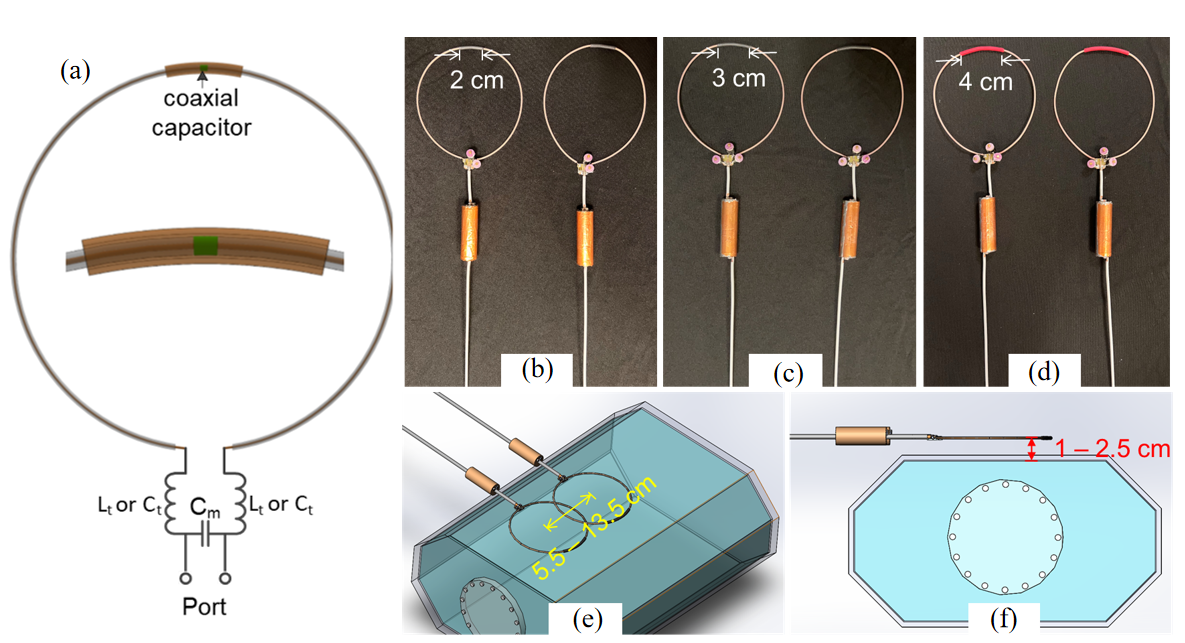
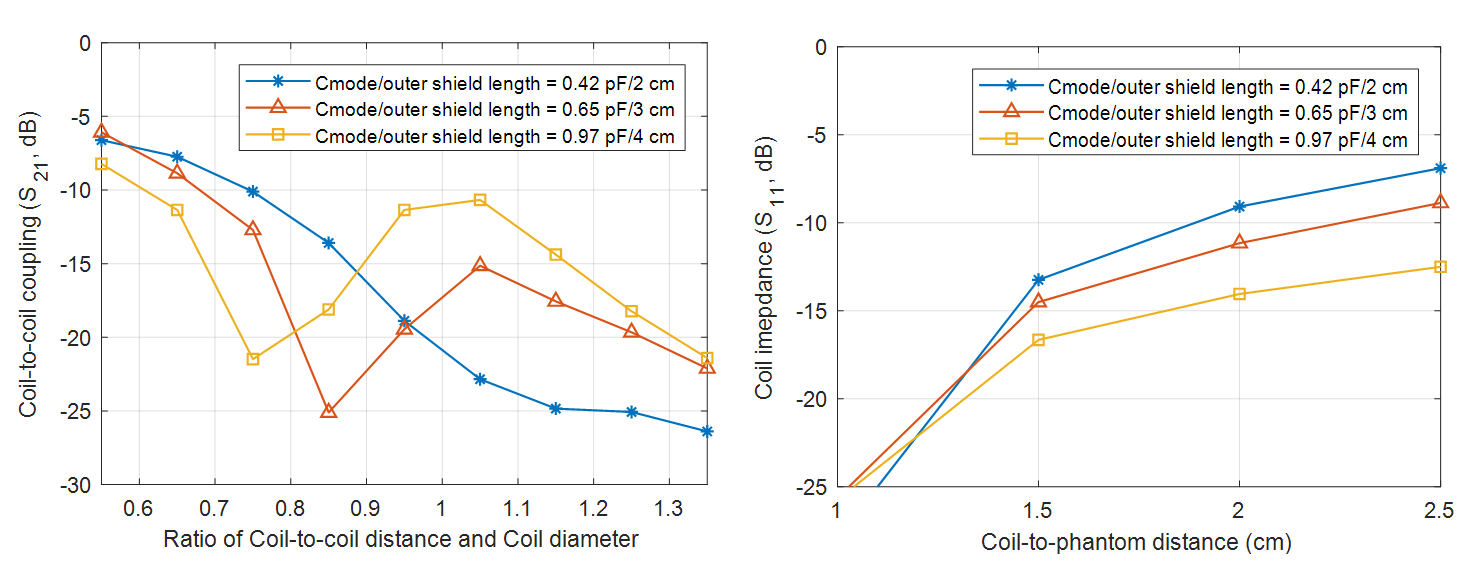
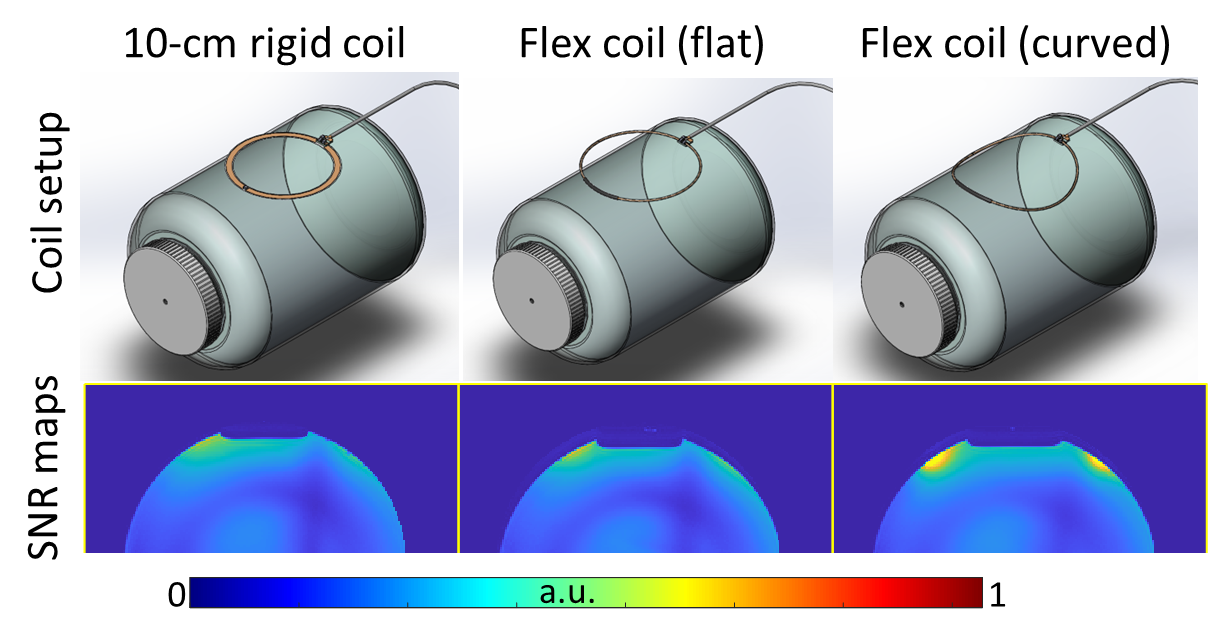
Figure3. Measured SNR maps of 7T coils on a bottle phantom. From left to right: a flat rigid coil, a flexible/wearable coil mounted on a flat board, and a flexible/wearable coil that wrapped on the phantom. SNR was calculated from GRE images and noise-only maps. GRE imaging parameters are: FOV = 200 x 200 mm2, TR/TE = 1000/5 ms, Flip angle = 25 deg, Slice thickness = 3 mm, Voxel size = 1x1 mm2, matrix = 224 x 224.