5075
Xenon-129 Platform for Operating a T/R Coil and Phased Array at 3T1Department of Radiology, Cincinnati Children's Hospital Medical Center, Cincinnati, OH, United States, 2Innovation Ventures, Cincinnati Children's Hospital Medical Center, Cincinnati, OH, United States, 3Philips Healthcare, Best, Netherlands
Synopsis
Keywords: Whole Body, New Devices
A platform was developed for 129Xe applications allowing the use of an insertable whole-body transmit/receive coil by itself or in combination with a 129Xe phased array coil. Experiments were performed in a 3T MRI scanner without modification of the scanner’s 1H body coil. 129Xe imaging was performed with a loader phantom and a xenon Boltzmann phantom in both configurations.
Introduction
Hyperpolarized 129Xe gas imaging has been shown to be safe and well-suited for lung MRI1,2; even detecting COVID-19 related lung damages3. Applications such as tracheal phase contrast 129Xe velocity imaging4 are best served with a large transmit coil and a 129-Xe phased array coil to optimize sensitivity and enable SENSE acceleration.A platform to enable the use of anatomically specific 129Xe phased arrays in combination with a volume birdcage coil was developed. This setup allowed for the operation of a birdcage as a transmit/receive (T/R) coil or with the birdcage as a transmit only coil and the phased array as receiver. In our initial design we built a flexible 6-channel phased array matched in size to average lung anatomy. Imaging experiments were performed with a loader phantom and a pressurized xenon gas cylinder.
Methods
The 129Xe platform was comprised of a T/R switch to deliver the transmit rf pulses to the birdcage and to route received signals to a preamplifier when the birdcage coil is in a T/R configuration. The platform also has a driver circuit board to supply current for PIN diodes on the birdcage coil, and a phased array preamplifier board to amplify the received signal of up to 8 channels from a phased array. All components were housed in a dedicated enclosure with connector sockets for the birdcage and phased array. A fixed cable connected the platform to the MR system, shown in Figure 1a.To achieve detuning of the previously developed asymmetrical birdcage design5,6 a detuning circuit with a PIN diode was added to the center of each rung. The bias voltage applied to each diode was controlled by the MR system. The setup with the birdcage is shown in Figure 1b.
A 6 channel phased array was developed with 3 anterior and 3 posterior elements. Each loop was constructed of flexible circuit board material (Taconic TLX-9) with a 0.015” dielectric substrate thickness and 2oz copper. The coil array measured 385 mm L-R x 341mm H-F from the conductor center. Three loops were overlapped for zero mutual inductance and secured in its location with polyimide tape. Anterior and posterior circuit arrays were partially encased in custom designed 3D printed ULTEMTM 9085 tubes. Those tubes consisted of a bottom plate facing the patient and a hollow U-shaped structure on the top facing the birdcage as shown in the CAD representation in Figure 1c. Both pieces were secured with plastic screws, sandwiching the circuit boards between them.
S-Parameters were measured with a Rohde & Schwarz ZNC3 network analyzer with coils inside the magnet bore. The phased array was loaded with a hollow torso loader phantom.
Imaging experiments were performed on a Philips 3T Ingenia 70cm bore system with the torso loader phantom containing a xenon high‐pressure high‐density polyethylene vessel cylinder filled with 61% Xe and 39% O2 at 11.6 bar7.
A gradient echo sequence was used for birdcage and phased array image acquisition of a single slice in the sagittal plane with TR: 750ms, TE:6.13ms, with one partial echo, flip angle 74°, FOV:440mm x 440mm, NSA:16, slice thickness: 200mm, recon pixel size 6.88mm x 6.88mm, reconstruction matrix 64 x 40.
Results
Phantom MR Images of the xenon high‐pressure high‐density polyethylene vessel confirmed a homogenous B1 imaging profile in the sagittal plane for the birdcage in T/R configuration, shown in Figure 2a. Images obtained with the 6 channel phased array are shown in Figure 2b.SNR maps were generated for the birdcage in a T/R configuration and for the phased array. SNR in the birdcage configuration (Figure 3a) was lower than the SNR measured in the phased array configuration, shown in Figure 3b. Measured S-Parameters are shown in Figure 4a. Best match was found on system channel 3. Channel 6 had the highest mismatch. Highest coupling was measured between channel 2 and 4 and lowest between channel 1 and 3. Noise correlation values were computed and are shown in Figure 4b. Highest noise correlation was found between channel 3 and 5 with 58% and the lowest noise correlation was 6% between channel 2 and 6. Mean noise correlation excluding the diagonal was 30%.
Discussion and Conclusion
Overall the asymmetrical birdcage coil platform allowed for the operation of the birdcage in a T/R configuration and for the use of phased array technology. This platform could also be operated with different T/R coils such as single loop coils, saddle coils, dual loops coils, traditional birdcage coils, etc.In combination with a volume transmit coil this setup allows and enables the use of different sized phased arrays and anatomy specific phased arrays on a Philips Ingenia system for 129Xe.
Such a dedicated platform is not limited to a single nuclei and could easily be adapted to the frequency of another nucleus at any field strength.
SNR of the phased array was higher than in the birdcage configuration, as theoretically anticipated. Impendence mismatch and component coupling on the preamplifier board between different channels contributed to elevated noise correlation values of the phased array.
Acknowledgements
This project is partially funded by the Cincinnati Children’s Innovation Fund and the State of Ohio, Ohio Development Services Agency, Ohio Third Frontier, Grant Control No. TECG2020-0252.
References
1. Walkup LL, Thomen RP, et al. Feasibility, tolerability and safety of pediatric hyperpolarized 129 Xe magnetic resonance imaging in healthy volunteers and children with cystic fibrosis. Pediatr Radiol. 2016 Nov; 46(12): 1651–1662.
2. Thomen RP, Quirk JD, et al. Direct comparison of 129Xe diffusion measurements with quantitative histology in human lungs. Magn Reson Med 77:265–272 (2017).
4. Bates AJ, Willmering MW, et al. In vivo Validation of Upper Airway Respiratory Computational Fluid Dynamics (CFD) with Phase-Contrast MRI of Hyperpolarized 129Xe.ISMRM 2019, #4138.
5. Loew W, Ireland C, Cleveland Z, et al. Development of an Asymmetrical Birdcage Design towards Homogeneous Volume Excitation for Hyperpolarized Xenon-129 Lung Imaging at 3T. ISMRM 2018, #4408.
6. Loew W, Ireland C, Willmering M, et al. Asymmetrical Body Birdcage Coil for Xenon-129 Imaging at 3T. ISMRM 2020, #4100.
7. Bier E A, Nouls J C, Wang Z, et al. A thermally polarized 129Xe phantom for quality assurance in multi‐center hyperpolarized gas MRI studies. Magn Reson Med 82:1961–1968 (2019).
Figures
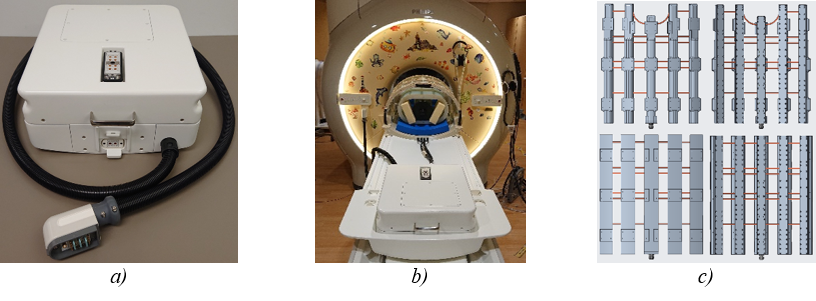
Figure 1: a) Close up view of the enclosure housing the system components, b) setup for the birdcage T/R configuration, and c) 6-channel phased array CAD representation of the anterior and posterior casing with coil conductors.
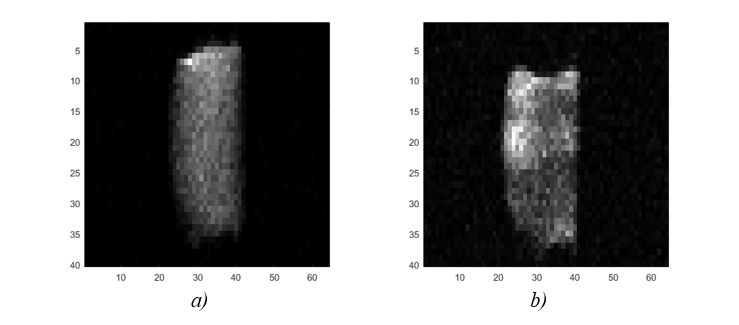
Figure 2: Sagittal image slice of Boltzmann phantom a) acquired with the birdcage coil in T/R configuration, and b) acquired with the 6 channel phased array and sum of square combination.
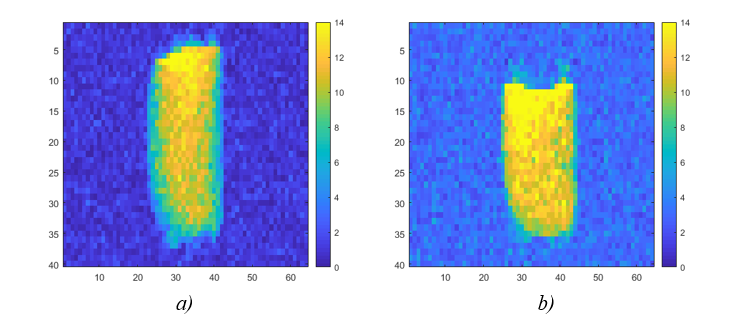
Figure 3: SNR maps of sagittal slice a) with the birdcage coil in T/R configuration and b) with the 6-channel phased array.
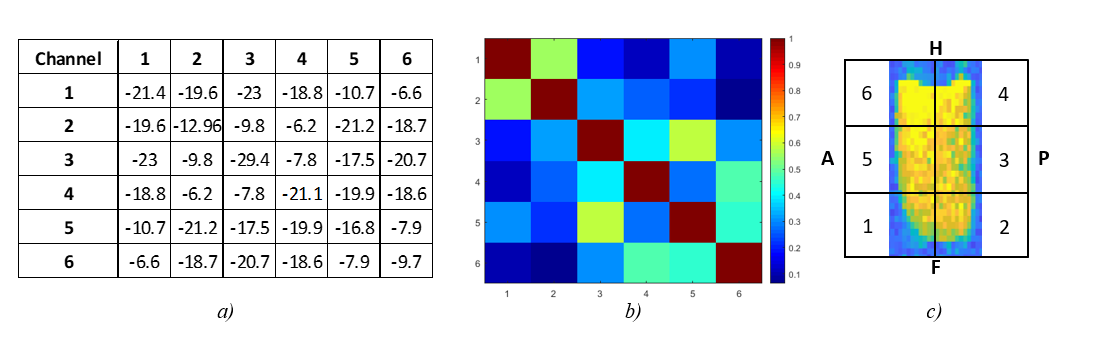
Figure 4: a) S-parameter matrix of the 6-channel phased array measured with cable extensions and not through the preamplifier circuitry, b) noise correlation matrix, and c) orientation and location of channels.