5068
Design and Construction of a quadruple-nuclear transceiver coil array for 1H/19F/23Na/31P MRI at 3T1Paul C. Lauterbur Imaging Research Center, Shenzhen Institutes of Advanced Technology, Chinese Academy of Sciences, Shenzhen, China, Shenzhen, China, 2Key Laboratory for Magnetic Resonance and Multimodality Imaging of Guangdong Province, Shenzhen 518055, Guang Dong, China, Shenzhen, China, 3Department of Biomedical Engineering, State University of New York, Buffalo, NY, United States, Buffalo, NY, United States
Synopsis
Keywords: RF Arrays & Systems, New Devices
Multinuclear MRI has been demonstrated as a crucial tool for comprehensively characterizing tumor pathology and monitoring tumor treatment response as it can provide biochemical, physical, and functional as well as structural information. The objective of this work is to develop a quadruple-nuclear transceiver coil array for 1H/19F/23Na/31P MRI at 3T to simultaneously detect multinucleal signals. The phantom studies were performed on self-developed 3T MRI system to verify the performance. These results proved that uniform excitation and highly sensitive acquisition in the region of interest were achieved by utilizing the proposed RF coil and indicated the fesibility for multinuclear MRI applications.Introduction
Multinuclear MRI technique has been shown to quantify some physiological or pathological indicators such as 19F, 31P and 23Na in tissues in addition to provide high-quality anatomical images, which is widely used in clinical medicine and preclinical medical research owing to noninvasion in obtaining biological information such as tissue anatomy, physiology and metabolism[1-4]. The inherent physical properties of weak nuclides make the imaging challenging at 3T[5]. The ability to detect extremely weak signal depends on the corresponding RF transceiver. As the critical component of MRI systems used to transmit and receive MR signals, RF transceivers were required for higher performance. However, the design of multi-nuclear RF coils is complicated as interactions and electromagnetic interference between each individually tuned coil element must be overcome. The aim of this work is to design and construct a quadruple-nuclear transceiver coil array for 1H/19F/23Na/31P MRI at 3T to meet the requirement of detecting many different sensitive nuclei simultaneously. The bench tests were performed by utilizing the proposed coil array to validate the performance and the feasibility for multi-nuclear MRI.Method
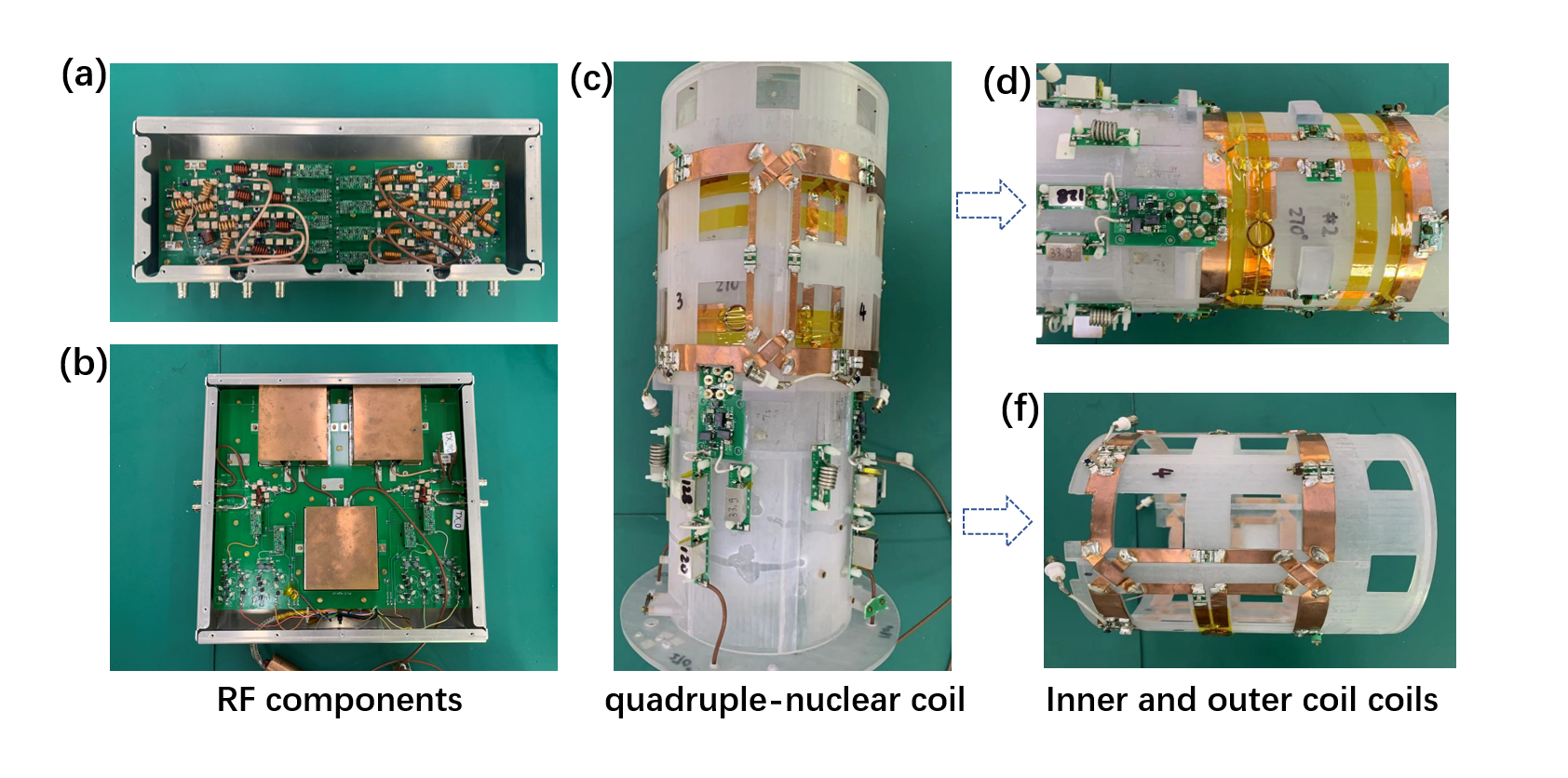
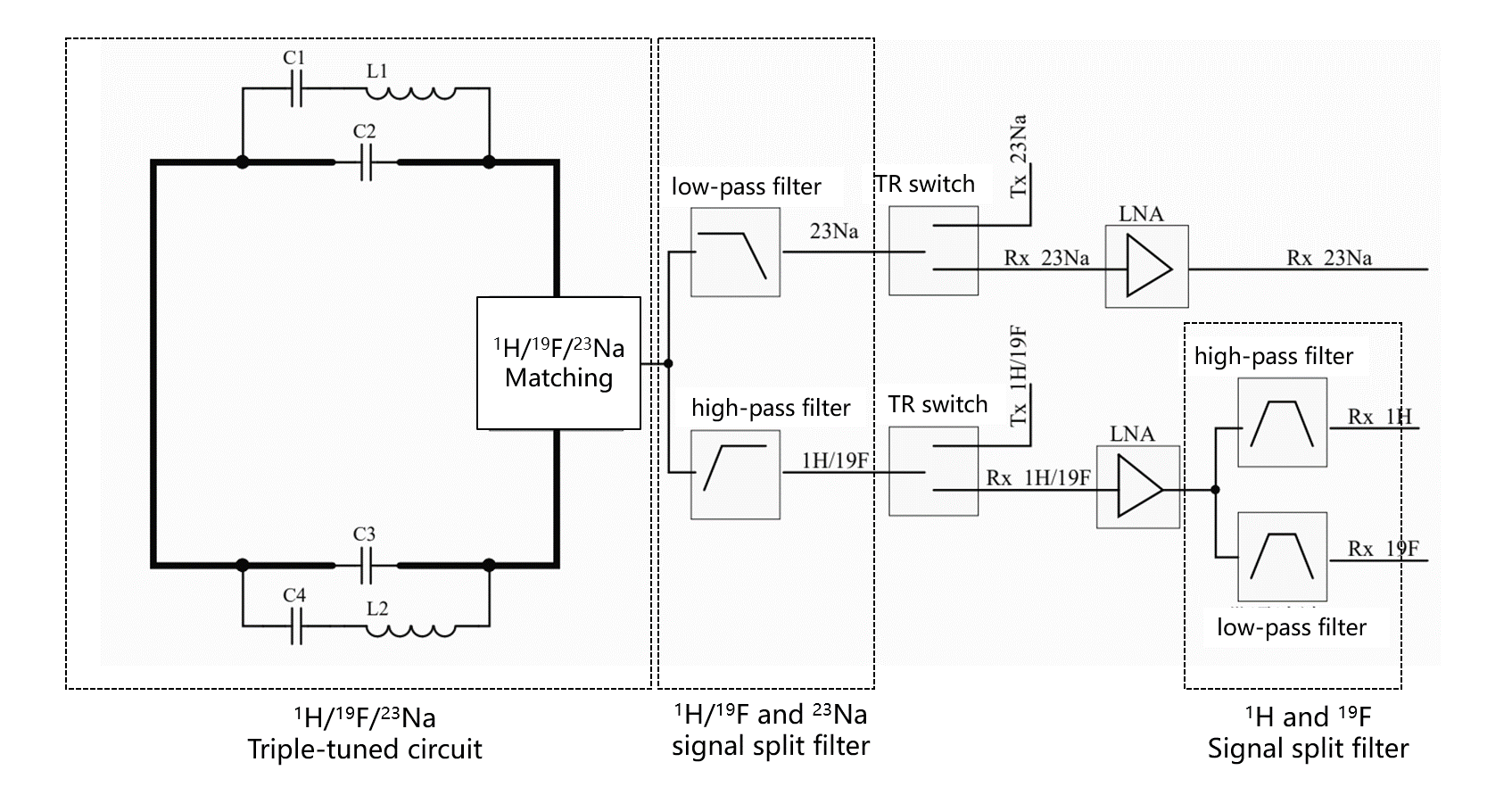
A quadruple-nuclear transceiver coil array was developed for 1H/19F/23Na/31P MRI at 3T and two-layered concentric RF coil arrangement was built as shown in Fig. 1. The outer 180 mm-diameter tube was wrapped by four-loop transceiver coils that resonate at 51.9MHz for 31P imaging, and the loop dimension was 190 mm × 160 mm with a width 5 mm. The inner 160mm-diameter tube wrapped by four triple-tuned loop coils that resonate at 128.2MHz, 120.6MHz and 33.9MHz to allow simultaneous 1H, 19F and 23Na imaging, and the loop dimension was 165mm ×160mm with a width 10mm. The schematic diagram of the triple-tuned circuit was shown in Fig. 2. C1, L1 and C4, L4 is used to tune the frequency of 23Na, C2 and C3 participated in the tuning of 1H and 19F, cooperating with the 1H/19F/23Na matching circuit connected in series at the supply point to make the loop resonated at three frequencies simultaneously. The acquired 1H/19F/23Na signals acquired would be separated by the high-pass and low-pass filters added on each receiving path.To generate circularly polarized B1+ fields, all transceiver arrays were driven through four output signals generated by the corresponding interface circuits with equal magnitude but 90 degree phase increments. To realize a stable power distribution of four channels per nuclide, the amplitude and phase of excitation source in each channel were modulated by quadrature-hybrid (microstrip structure for 1H/19F, LC circuit structure for 23Na and 31P ) and pi phase shifter. The interface circuit of 1H and 19F shared the same transceiver chain using a wide-band design, and was optimized at 124.4 MHz, which can operate properly at 128.2MHz (1H) and 120.6MHz (19F). Two independent transceiver chains were built for 23Na and 31P, which were optimized at 33.9MHz and 51.9MHz, respectively. The decoupling between adjacent channels and next-adjacent channels in the coil array was achieved by adjusting the overlap area. The working state of all the nuclear was controlled by the detune circuits diode connected in series in the loop, which reducing the interference between the inner and outer coils. S-parameters were measured on the bench using the network analyzer to evaluate the match and isolation of the quadruple-nuclear transceiver coil array system.
RESULT
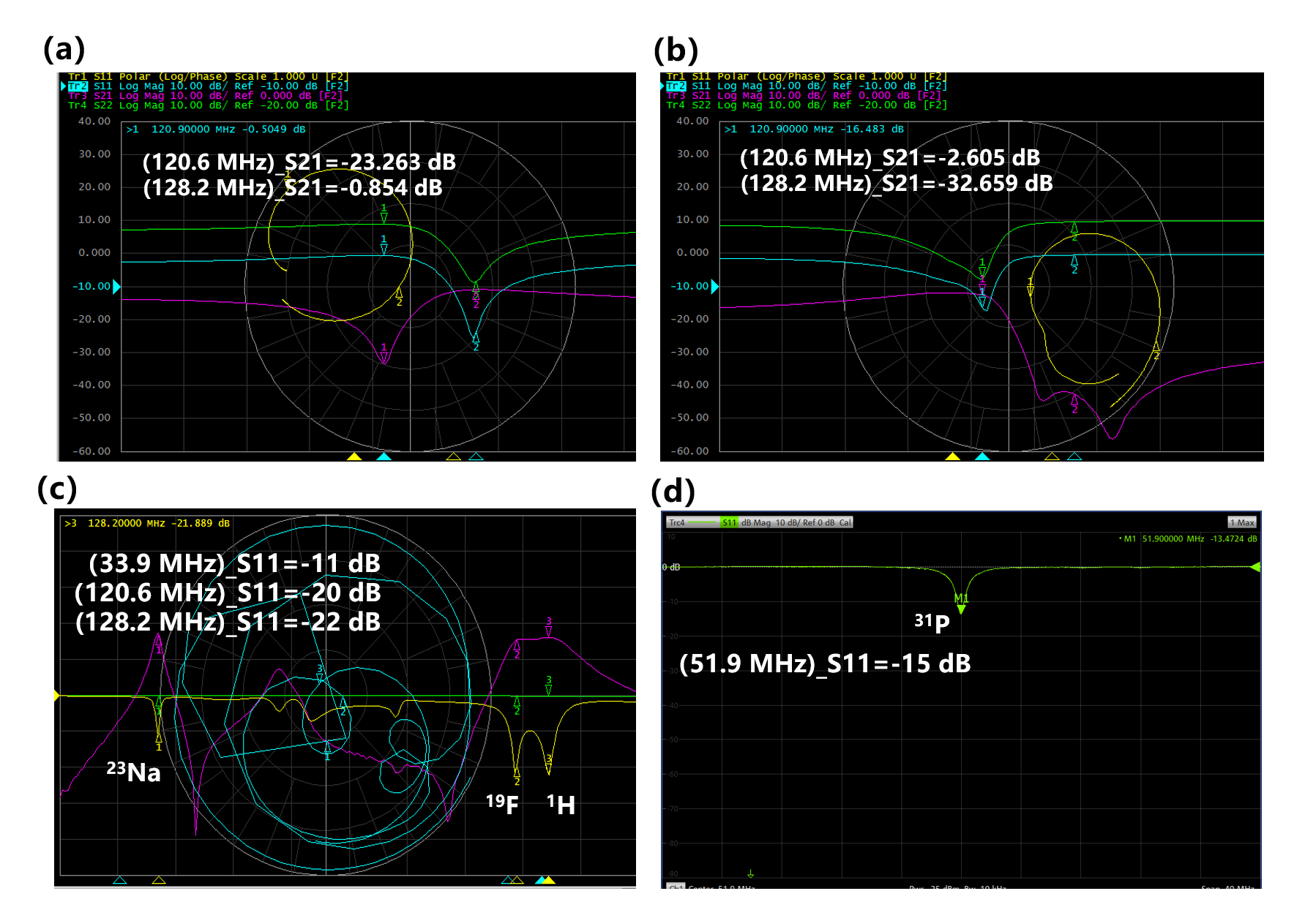
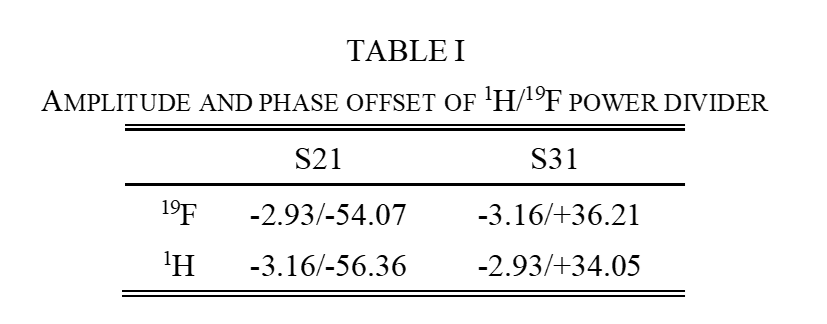
The 1H and 19F signals were separated efficiently by 1H and 19F signals filter respectively, as shown in Fig. 3 (a) and (b). As shown in Fig.3 (a), S21 was -0.85 dB at 128.2 MHz and S21 was -23.26 dB at 120.6 MHz respectively, which indicate that only 1H signal is allowed to pass through. As shown in Fig.3 (b), S21 was -32.65 dB at 128.2 MHz and S21 was -2.6 dB at 120.6 MHz, respectively, which indicate that only 19F signal is allowed to pass through. The measured s-parameters of the 1H/19F/23Na/31P coil were shown as Fig. 3 (c) and Fig. 3 (d), sufficient matching was achieved with the arithmetic maximum of reflection coefficient no larger than -10 dB at 33.9 MHz, -20 dB at 120.6 MHz, 22 dB at 128.2 MHz and -14 dB at 51.9MHz MHz respectively. The designed triple-tuned circuit made the loop resonated at three frequencies simultaneously and the reuse of coil used for 1H/19F/23Na imaging was achieved, resulting in the elimination of the electromagnetic interference between 1H/19F/23Na.The relevant amplitude and phase offset of power divider for 1H/19F frequencies were well balanced with the absolute amplitude and phase offsets standard deviations were smaller than 0.2 dB and 0.5 degree respectively (Table I).
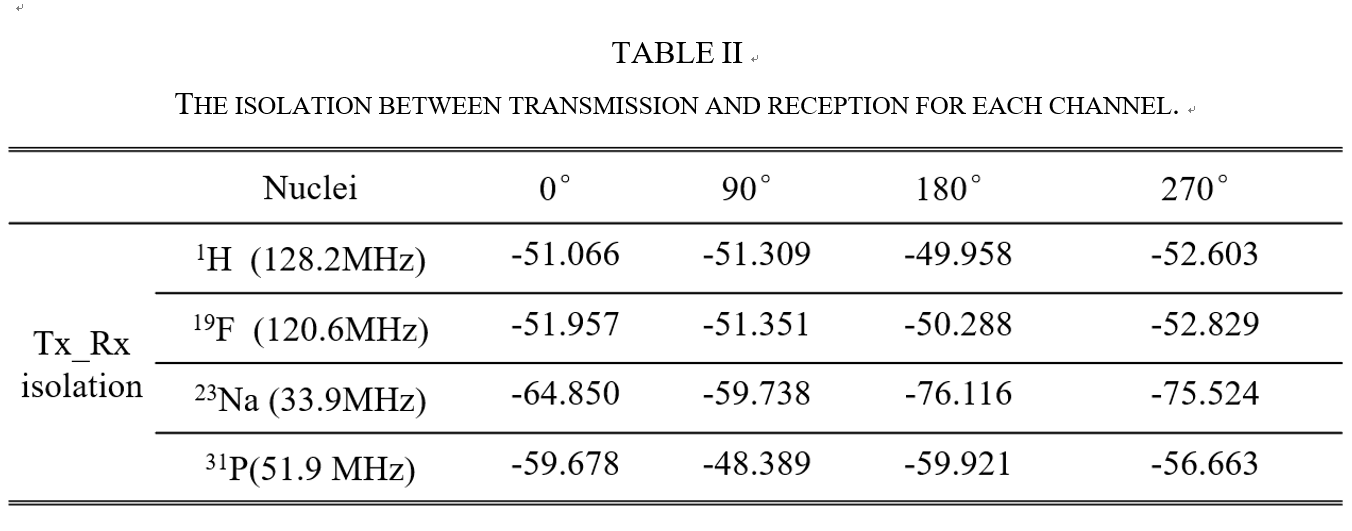
Table II summarizes the isolation of T/R switches for all channels. The sufficient isolation between transmission and reception for all operating frequencies was achieved with the arithmetic maximum of reflection coefficient no larger than -50 dB.
Conclusion
In this study, a quadruple-nuclear transceiver coil array was designed and constructed for 1H/19F/23Na/31P imaging at 3T. Our performance evaluations showed that the proposed coil array system was sufficiently matched, detuned and decoupled when working simultaneously, thus can be expected to generate high SNR images for simultaneous 1H/19F/23Na/31P. In future work, phantom and animal study on a self-made 3T multinuclear MR system will be performed.Acknowledgements
1. Dong-Ho Ha, Sunseob choi, Jong Young Oh, et al. Application of 31P MR Spectroscopy to the Brain Tumors. Korean J Radiol. 2013 May-Jun; 14(3): 477–486.
2. Madelin, G, Regatte, R. R, et al. Biomedical applications of sodium MRI in vivo . J. Magn. Reson. Imaging 2013;38:511–529
3. Straathof, M., et al. "Deuterium Metabolic Imaging of the Healthy and Diseased Brain." Neuroscience 9(2021).
4. Feng Du, Shengping Liu,et al. "Numerical Simulation and Evaluation of a Four-Channel-by-Four-Channel Double-Nuclear RF Coil for 1HMRI and 31P MRSI at 7 T" IEEE Trans. Magn., vol. 54, no. 11, Nov. 2018, Art. No. 5101105
5. de, Graaf Robin A., et al. " On the magnetic field dependence of deuterium metabolic imaging." NMR Biomed 33.3(2020): e4235.
References
This work is supported by National Key Research and Development Program of China, 2021YFE0204400; NSFC grant 81627901; the Strategic Priority Research Program of Chinese Academy of Sciences, XDB25000000; National Natural Science Foundation of China, U22A20344; Youth Innovation Promotion Association of CAS No. Y2021098; Key Laboratory Project of Guangdong Province, 2020B1212060051; Shenzhen city grant, RCYX20200714114735123.Figures