5064
Investigation of Triple-Tuned Trap Designs1Biomedical Engineering, Texas A&M University, College Station, TX, United States, 2Electrical and Computer Engineering, Texas A&M University, College Station, TX, United States
Synopsis
Keywords: Non-Array RF Coils, Antennas & Waveguides, Non-Array RF Coils, Antennas & Waveguides
Multi-frequency coils are typically known to have substantial losses as compared to their single-tuned counterparts. Here we investigate sensitivity tradeoffs of triple-tuned (1H-23Na-31P) trap designs on receive coils in a tightly controlled experiment to isolate the sensitivity effects of the traps. Triple-tuned LCC traps were shown to have significant improvement in sensitivity for 23Na and 1H as compared to an LC trap design. The increase came at the expense of 31P sensitivity, however continued optimization of the trap design will likely further improve the final experimental SNR.Introduction
Multinuclear NMR experiments require the application of specialized multi-tuned coils with high receive sensitivity to compensate for the inherently low SNR (signal to noise ratio) of these X-nuclei. Several approaches are taken to multi-nuclear tuning including nesting coils1-3, and switching designs4,5, but one of the most common approaches is the use of traps6,7. Traps benefit from the elimination of redundant coils of nested designs while still allowing for true simultaneous multi-tuning which can enable applications that include proton decoupling and the nuclear Overhauser effect. The use of LC trap circuits for multi-tuned coils is well established6, and double-tuned LCC traps more recently have been shown to increase efficiency by minimizing the effects of the resistive losses of inductors7. To the authors’ knowledge the application of LCC traps has yet to be extended to triple-tuned designs. The work presented here investigates the potential applications and benefits of LC and LCC traps for triple-tuned receive coils.Methods
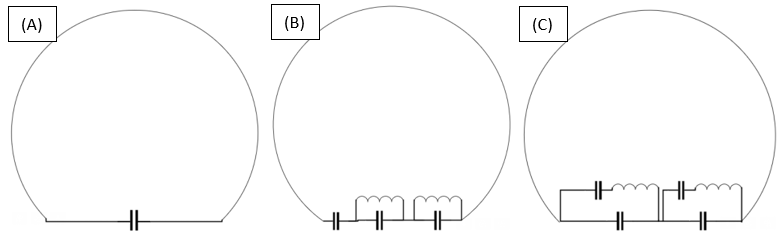
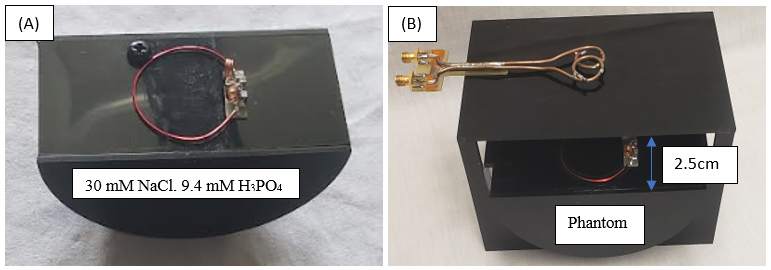
Triple-tuned 4cm diameter loop coils were designed for 1H (200MHz), 31P (81MHz) and 23Na (53MHz) at 4.7T using 18AWG polyurethane coated wires soldered to tune networks designed on milled 1oz copper clad FR4 boards. Identical board designs were used for all three configurations with traces appropriately left open and shorted to remove the effects of varied board impedance on the sensitivity measurements. Single-tuned reference coils were coarsely tuned using fixed tuning capacitors (Passive Plus 1111C Series) and finely tuned using variable trimmer capacitors (Sprague Goodman, SG3C Series) using the circuit schematic shown in Fig. 1A. Triple-tuned networks were designed using series LC traps (Fig. 1B), and series LCC traps (Fig. 1C) to compare the benefits of a triple-tuned LCC network to those of an LC trap design. Inductors were hand wound using 24AWG polyurethane coated wire with varying diameters to achieve the desired inductance and positioned orthogonally on the coil boards to limit coupling. To compare relative sensitivity of the different tune networks a custom test platform was designed to place each coil design repeatably in the same position over a phantom (Fig. 2A) of physiological sodium and phosphorus concentrations (30 mM NaCl and 9.4 mM H3PO4). Crossed (i.e. decoupled) double loop probes were used to measure the relative sensitivities at a depth of 2.5 cm away from the coil (Fig. 2B) via an S21 measurement at each resonant frequency of the coils.Results
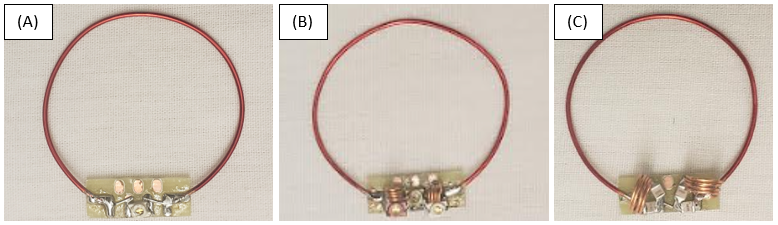
Photographs of the coils with representative single-tuned (Fig. 3A), triple-tuned LC (Fig. 3B) and triple-tuned LCC (Fig. 3C) traps are shown. Relative sensitivity measurements (Table 1) show that LCC traps produce a roughly 4dB improvement in sensitivity as compared to an LC design for 1H. When compared to a single-tuned coil, the LC trap showed a 12.4 dB and 6 dB loss in sensitivity for the lowest and middle frequency respectively whereas the LCC trap design showed a 5.6 dB and 13.6 dB loss in sensitivity for the lowest and middle frequency respectively. The test platform with decoupled double-loop probes was used to consistently compare coil sensitivity, allowing for a uniform comparison of relative coil sensitivities across the different coil/trap designs and ensure any measured difference in sensitivity is a result of the trap designs only.Discussion
While the frequency requirements of triple-tuned circuits further constrain the valid inductance combinations in series traps, complicating their optimization as compared to similar double-tuned experiments, the implementation of LCC traps substantially improved the sensitivity at two out of three frequencies in the triple-tuned configuration as compared to an analogous LC trap design. Although this improvement is at the expense of the middle frequency, the design increased sensitivity for the other two nuclei allowed for a net improvement in sensitivity over the LC trap design. Quantification of trap sensitivities can be further used to motivate/inform the number of array elements necessary to recover the losses associated with the triple-tuning circuitry. While implementation of multi-frequency matching networks will be added for the final coil design, the methods used here for testing the sensitivity without this added complexity allowed for a purer measure of the effects of the trap design on the coil sensitivity. Further optimization of the design is needed to improve sensitivity at the middle frequency, but potential studies for varied inductance combinations and the possibility to combine the LC and LCC traps for triple-tuning circuitry to maximize their respective benefits offers tremendous potential.Conclusion
Two port measurements on resonant coils without the additional matching network components, a physical platform for repeatable measurements, and identically designed PCBs for the trap configurations likely allowed for a more independent indicator of true trap performance. While it is noted that matching networks will be needed in future works, these methods allow for separate analysis of losses associated with each component of the coil and allow for more thorough optimization of triple-tuned designs. While further sensitivity improvements of trapping circuitry to benefit all frequencies simultaneously is needed, the work here presents valuable insight into the optimization of traps for simultaneously triple-tuned coils.Acknowledgements
The authors gratefully acknowledge funding for this project provided by NIH grant number R01EBO28533.References
1. Busher, J., Valle, E., Wright, S. M. & McDougall, M. P. in Proceedings from the ISMRM ESMRMB Joint Annual Meeting.
2. Augath, M., Heiler, P., Kirsch, S. & Schad, L. R. In vivo 39K, 23Na and 1H MR imaging using a triple resonant RF coil setup. Journal of Magnetic Resonance 200, 134-136 (2009).
3. Du, F. et al. in 2019 IEEE International Conference on Real-time Computing and Robotics (RCAR). 598-603 (IEEE).
4. Carrell, T., Bosque, R. D., Wilcox, M. & McDougall, M. P. in Proceedings of the ISMRM 27th Annual Meeting.
5. Maunder, A., Rao, M., Robb, F. & Wild, J. M. Comparison of MEMS switches and PIN diodes for switched dual tuned RF coils. J Magnetic resonance in medicine 80, 1746-1753 (2018).
6. Schnall, M. D., Harihara Subramanian, V., Leigh, J. S. & Chance, B. A new double-tuned probed for concurrent 1H and 31P NMR. Journal of Magnetic Resonance (1969) 65, 122-129, doi:10.1016/0022-2364(85)90380-4 (1985).
7. Meyerspeer, M., Seres Roig, E., Gruetter, R. & Magill, A. W. An improved trap design for decoupling multinuclear RF coils. Magn Reson Med 72, 584-590, doi:10.1002/mrm.24931 (2014).
Figures