5063
Low-Loss Switches for Multinuclear MRI/S Using Stimuli-Responsive Polymer Materials1Electrical and Computer Engineering, Texas A&M University, College Station, TX, United States, 2Biomedical Engineering, Texas A&M University, College Station, TX, United States, 3Materials Science & Engineering, Texas A&M University, College Station, TX, United States
Synopsis
Keywords: Non-Array RF Coils, Antennas & Waveguides, Hybrid & Novel Systems Technology
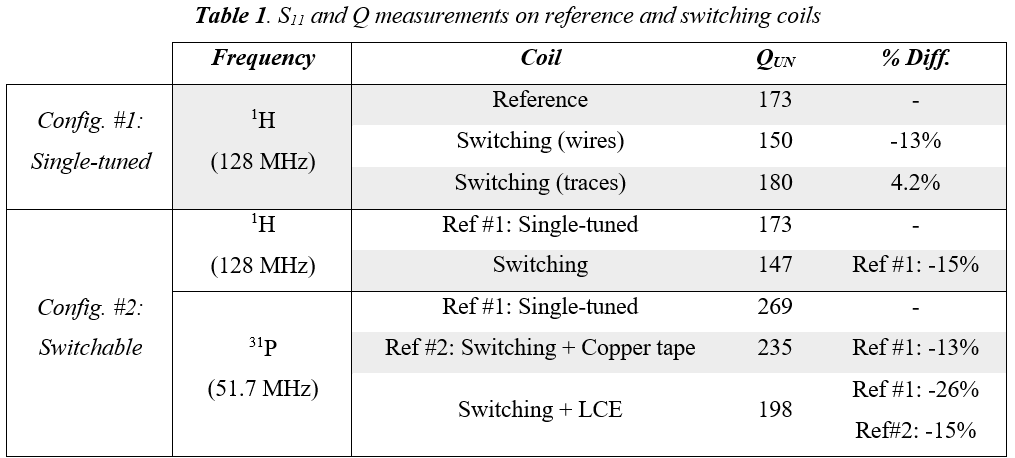
The development of highly sensitive multinuclear RF coils for MRI/S is challenging because most current multi-tuning techniques involve the addition of lossy components. Although it is possible to optimize for a particular nucleus, usually non-1H, multinuclear coils have lower SNR than their single-tuned counterparts. We investigate a novel switching system that uses stimuli-responsive materials. The coils with the proposed switching method had a decrease of <26% in Q when compared to single-tuned coils. As a result, we demonstrated a promising alternative to traditional switching techniques.Introduction
Multinuclear NMR is a useful tool for many research areas. However, hardware challenges and the inherent low sensitivity of non-proton nuclei hinder its widespread use in clinical settings. Therefore, developing multinuclear RF coils with high sensitivity is necessary to improve SNR. Current methods typically involve the incorporation of lossy components that lead to decreased sensitivity for at least one of the nuclei when compared to their single-tuned counterpart1-4. Specifically, switching configurations implemented in multinuclear designs have reported losses between 30-75% in Q and 30-45% in SNR5,6 for the worst-case nucleus. The application of frequency switching has the unique characteristic of not being time sensitive which opens the option to use novel stimuli-sensitive materials to actuate variable conducting paths with switching times of up to tens of seconds. We developed a novel switching method that incorporates liquid crystal elastomers (LCE). LCEs are materials that can be programmed to have reversible shape changes in response to stimuli such as light, heat, and current7-9. The LCE in our system is actuated by a remote infrared mechanism10,11, which provides the potential to change the frequency of interest at any point with negligible impact on positioning and scan time.Methods
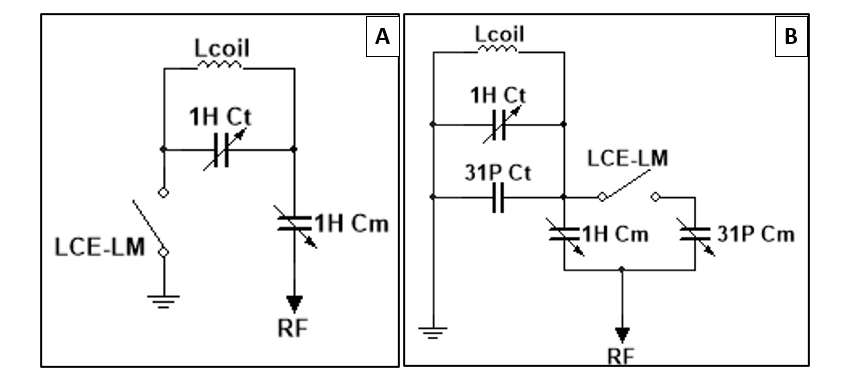
Hardware and MaterialsThe proposed switching system is composed of a coil with capacitive tune-and-match circuitry, an LCE, a liquid metal alloy (LM), and a light source. To test the system, four 4-cm loop coils were built using 18 AWG enameled copper wire. The tune-and-match networks were designed based on a switchable network previously developed by our group12. However, the PIN diodes and DC lines were replaced by a discontinued trace path (Figure 1).
The LCE was developed using two-step thiol-ene click reaction13 with embedded 0.4 wt% of light-absorbing carbon black (CB) particles. The incorporation of CB particles enables shape change upon exposure to near-infrared (NIR) light illumination. To program the desired shape change, a 10 mm disk was 3D printed with an azimuthal print path. A small droplet of LM was placed in the center of the LCE. Finally, the light source consisted of a NIR chip onboard LED.
Actuation Testing
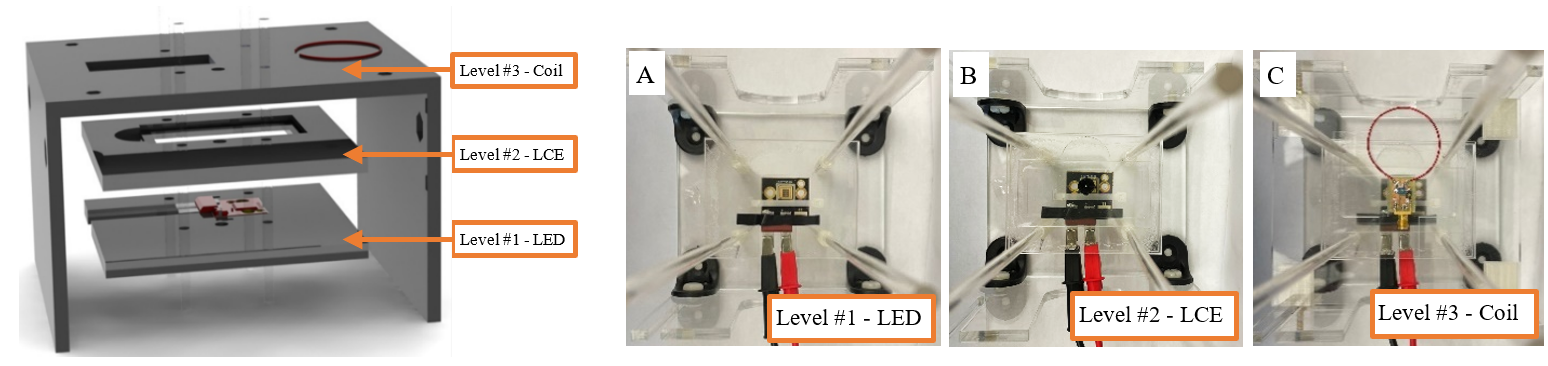
A testing platform was designed to align the components in the system and enable coil tuning. The light source was placed at the bottom, the LCE in the middle, and the coil on top. The LCE was aligned with the LED, and the break on the coil trace path was aligned with the LM droplet (Figure 2).
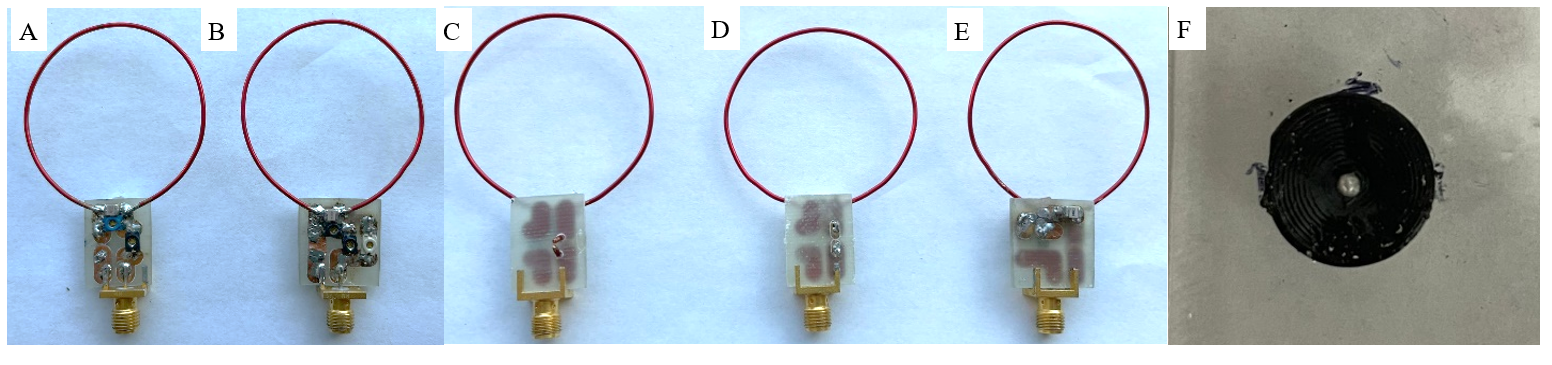
To evaluate the feasibility and performance of the proposed switching system, testing was performed in two coil configurations. The first configuration consisted of a single-tuned 1H loop coil for 3T (128MHz) with a trace break on the ground line to open the circuit. For initial testing and to facilitate the connection, two wires were connected to each side of the break. These wires protruded on the underside of the board. Once the setup was tested, a double-sided board was used for testing. An identical coil but without any trace breaks served as a reference. The second configuration consisted of the switchable circuit (Figure 1). The second path on the circuit was designed to tune the coil to 31P (51.7MHz). A single-tuned 31P coil was used as a reference. To estimate the losses from a larger circuit board with more components, the same coil was evaluated with the 31P path soldered using copper tape rather than the LM connection. Coil configurations and the LCE-LM system are shown in Figure 3. To assess coil performance, all bench measurements (S11 and Q) were acquired on the same platform with the LED power supply on.
Results
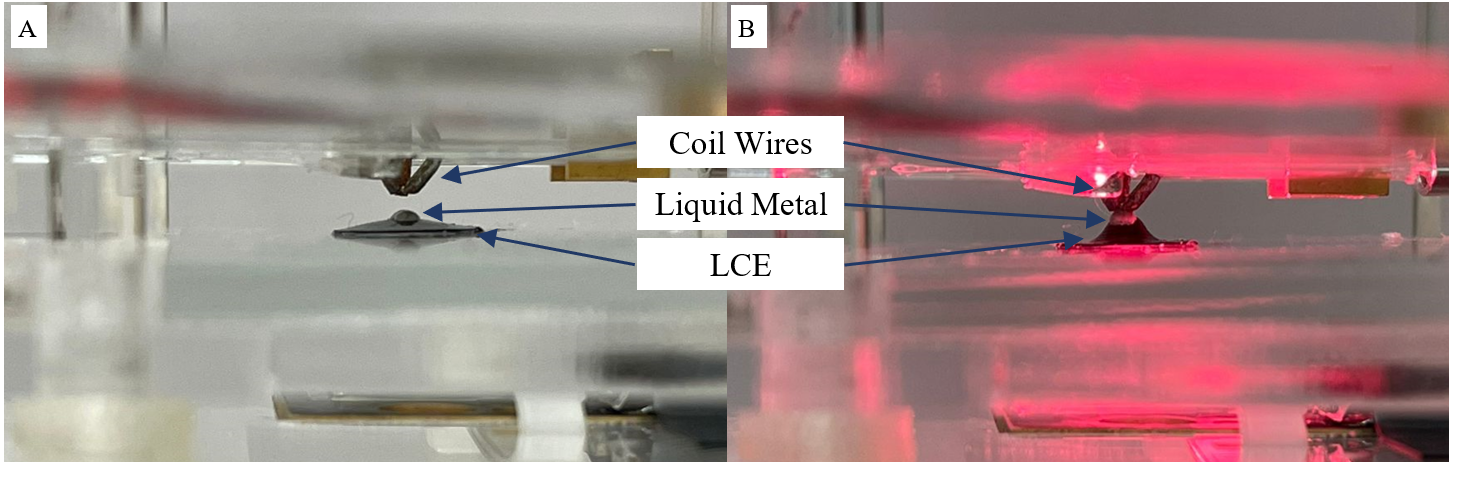
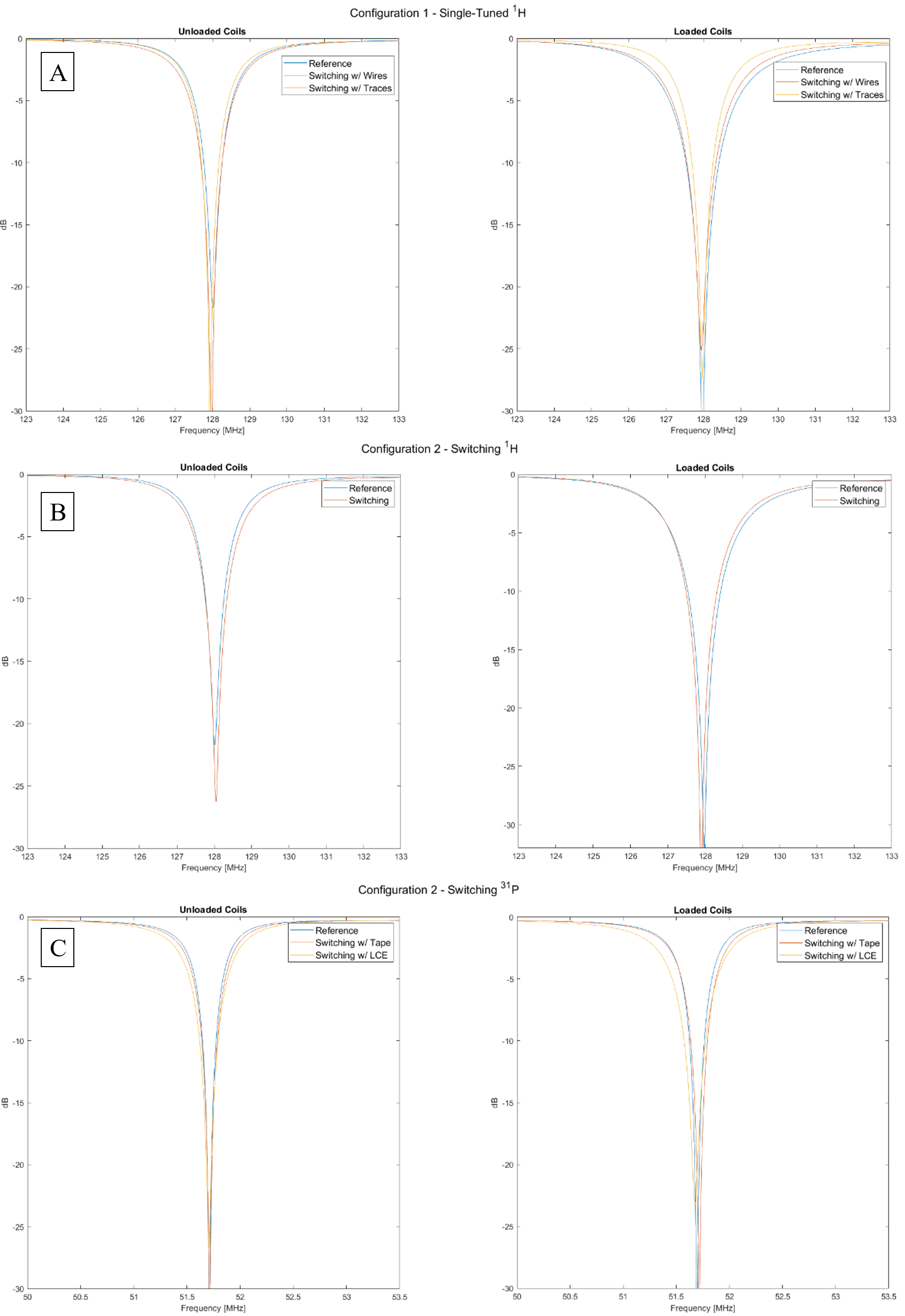
Upon activation of the light source, the thin LCE-CB disk morphed into a cone shape, allowing the LM to close the connection on the corresponding coil circuit (Figure 4). In Configuration #1, the LCE coil was successfully tuned to 128 MHz. In Configuration #2, the frequency of the LCE coil was successfully switched from 51.7 MHz in ~20 seconds. The S11 plots of the switching and reference coils are shown in Figure 5. The Q unloaded/loaded measurements are shown in Table 1. A de-identified video of the coils switching frequency is available at https://youtu.be/spkKGvOMLSs.Discussion
The operation of the switching design was successfully demonstrated for 1H and 31P at 3T. This design can be implemented for any field strength and combination of nuclei. Furthermore, this switching system resulted in smaller differences in Q (switching vs single-tuned) when compared to switching techniques reported in the literature. These losses can be explained by the additional components and the board size. Furthermore, we observed variations with different LM droplet sizes, the contact pressure with the board, and positioning. Immediate future work includes optimization of these features, refinements in circuit design, and imaging comparisons. Further developments of this technique will be tailoring the setup to be more realistically implemented on a patient in a scanner, including incorporating an MR-compatible light source, out-of-bore activation, and a multi-platform strategy for various coil orientations.Conclusion
As demonstrated in this work, the lower loss in Q and the potential to incorporate out-of-bore actuation of the LCE switch make this system an attractive alternative to current techniques.Acknowledgements
The authors gratefully acknowledge funding for the project given through NIH grant R01EB028533 and R01EB028533-02S1.References
1. Choi CH, Hong SM, Felder J, et al. The state-of-the-art and emerging design approaches of double-tuned RF coils for X-nuclei, brain MR imaging and spectroscopy: A review. Magn Reson Imaging 2020;72:103-116.
2. Meyerspeer M, Roig ES, Gruetter R, et al. An Improved Trap Design for Decoupling Multinuclear RF coils Magnetic Resonance in Medicine 2014;72:584-590.
3. Schnall MD, Harihara Subramanian V, Leigh JS, et al. A new double-tuned probed for concurrent 1H and 31P NMR. Journal of Magnetic Resonance (1969) 1985;65(1):122-129.
4. Maunder A, Rao M, Robb F, et al. Comparison of MEMS switches and PIN diodes for switched dual tuned RF coils. Magnetic Resonance in Medicine 2018;80(4):1746-1753.
5. Lim H, Thind K, Martinez-Santiesteban FM, et al. Construction and evaluation of a switch-tuned<sup>13</sup>C -<sup>1</sup>H birdcage radiofrequency coil for imaging the metabolism of hyperpolarized<sup>13</sup>C-enriched compounds. Journal of Magnetic Resonance Imaging 2014;40(5):1082-1090.
6. Choi CH, Hong SM, Ha Y, et al. Design and construction of a novel (1)H/(19)F double-tuned coil system using PIN-diode switches at 9.4T. J Magn Reson 2017;279:11-15.
7. Ambulo CP, Burroughs JJ, Boothby JM, et al. Four-dimensional Printing of Liquid Crystal Elastomers. ACS Appl Mater Interfaces 2017;9(42):37332-37339.
8. Ambulo CP, Ford MJ, Searles K, et al. 4D-Printable Liquid Metal–Liquid Crystal Elastomer Composites. ACS Appl Mater Interfaces 2021;13(11):12805-12813.
9. Kularatne RS, Kim H, Boothby JM, et al. Liquid crystal elastomer actuators: Synthesis, alignment, and applications. Journal of Polymer Science Part B: Polymer Physics 2017;55(5):395-411.
10. Zhang W, Nan Y, Wu Z, et al. Photothermal-Driven Liquid Crystal Elastomers: Materials, Alignment and Applications. Molecules 2022;27(14):4330.
11. Liu W, Guo L-X, Lin B-P, et al. Near-Infrared Responsive Liquid Crystalline Elastomers Containing Photothermal Conjugated Polymers. Macromolecules 2016;49(11):4023-4030.
12. Carrell T, Del Bosque R, Wilcox M, et al. A three-element triple-tuned array implemented with switchable matching and tuning. 2019 May 2019; Montreal, CA.
13. Saed MO, Ambulo CP, Kim H, et al. Molecularly‐Engineered, 4D‐Printed Liquid Crystal Elastomer Actuators. Advanced Functional Materials 2019;29(3):1806412.
Figures