5061
Long-term effects of childhood trauma subtypes on adult brain function1Department of Radiology, Tongji Hosptial, Tongji Medical College, Huazhong University of Science and Technology, Wuhan, China, 2MR Research, GE Healthcare, Beijing, China
Synopsis
Keywords: Psychiatric Disorders, Trauma, childhood trauma.
Childhood trauma is prevalent in our society, but little is known about why and how different forms of early traumatic experiences exert long-term effects on differential brain function in adulthood. This study aimed to measure experience-specific neural correlates of distinct subtypes of childhood trauma. Our data showed the differential associations of abusive and neglectful experiences with brain function in adulthood. These experience-specific associations could underpin potentially differential risks of specific forms of psychiatric sequelae in adulthood. More attention to maltreated children and timely psychological treatment are needed to reduce the incidence of psychosis.Background and Purpose
Childhood trauma is associated with a predisposition to serious long-term mental and physical ill-health . More than 1 billion children and adolescents across the world are exposed to violent behavior [1]. Individuals who experience adverse conditions during childhood exhibit greater vulnerability to psychological illnesses including depression, post-traumatic stress disorder (PTSD), bipolar and anxiety disorders, psychosis and schizophrenia in adulthood[2]. The high prevalence of childhood trauma and its long-lasting impact on mental and physical health make it necessary to better understand the pathogenesis and development process, which is essential for early diagnostics, and for the development of interventions that can attenuate or overcome these pathologies. Therefore, the key to understand biological development process is to comprehensively explore the children-trauma-affected brain regions, facilitating better intervention strategies for those who have experienced trauma.Numerous neuroimaging studies indicated that childhood trauma could lead to detrimental alterations in brain regions and greater vulnerability for developing mental disorders later in adult [3]. Alters structural and functional brain regions, particularly in the amygdala, hippocampus, prefrontal cortex, insular, and cingulate gyrus, might imply that reward processing, emotional stimulation, cognitive regulation, and executive function are modulated [4].
Functional magnetic resonance imaging (fMRI) is a prominent tool which helps in the non-invasive examination and localization of the intrinsic activity within the brain. In this study utilizing graph analysis, we used resting-state fMRI data from a large community sample to delineate distinct impacts of different subtypes of childhood trauma on brain network connectivity properties.
Materials and Methods
A total of 216 right-handed healthy young adults were recruited in this study. All subjects completed a structured clinical interview with the Chinese version of the Mini International Neuropsychiatric Interview. Participants were carefully screened to ensure that they had no history of genetic diseases, psychiatric or neurological illness, head trauma, psychiatric treatment, drug or alcohol abuse, and that they had no contraindications to MRI examination.In the present study, maltreatment experiences during childhood were assessed by administering the Chinese version of the Childhood Trauma Questionnaire (CTQ) that assesses childhood experiences of abuse or neglect in adults.All scans were performed on a 3.0-Tesla MR system (Discovery MR750, General Electric, Milwaukee, WI, USA). Resting-state fMRI data were obtained using single-shot echo-planar imaging (SS-EPI) ,and to better coregister the fMRI data, sagittal 3D T1-weighted images were acquired using a brain volume (BRAVO) sequence.
Results
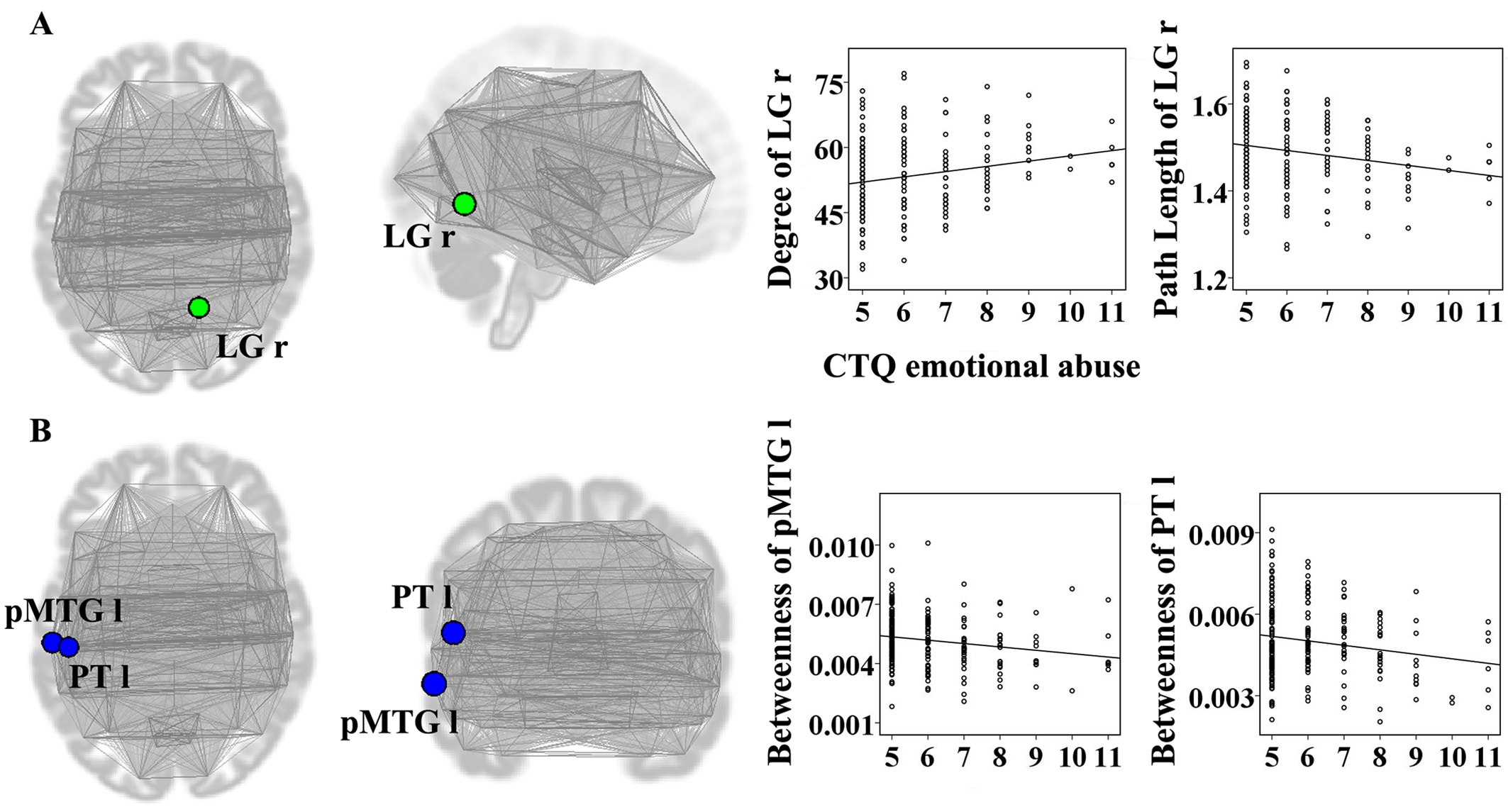
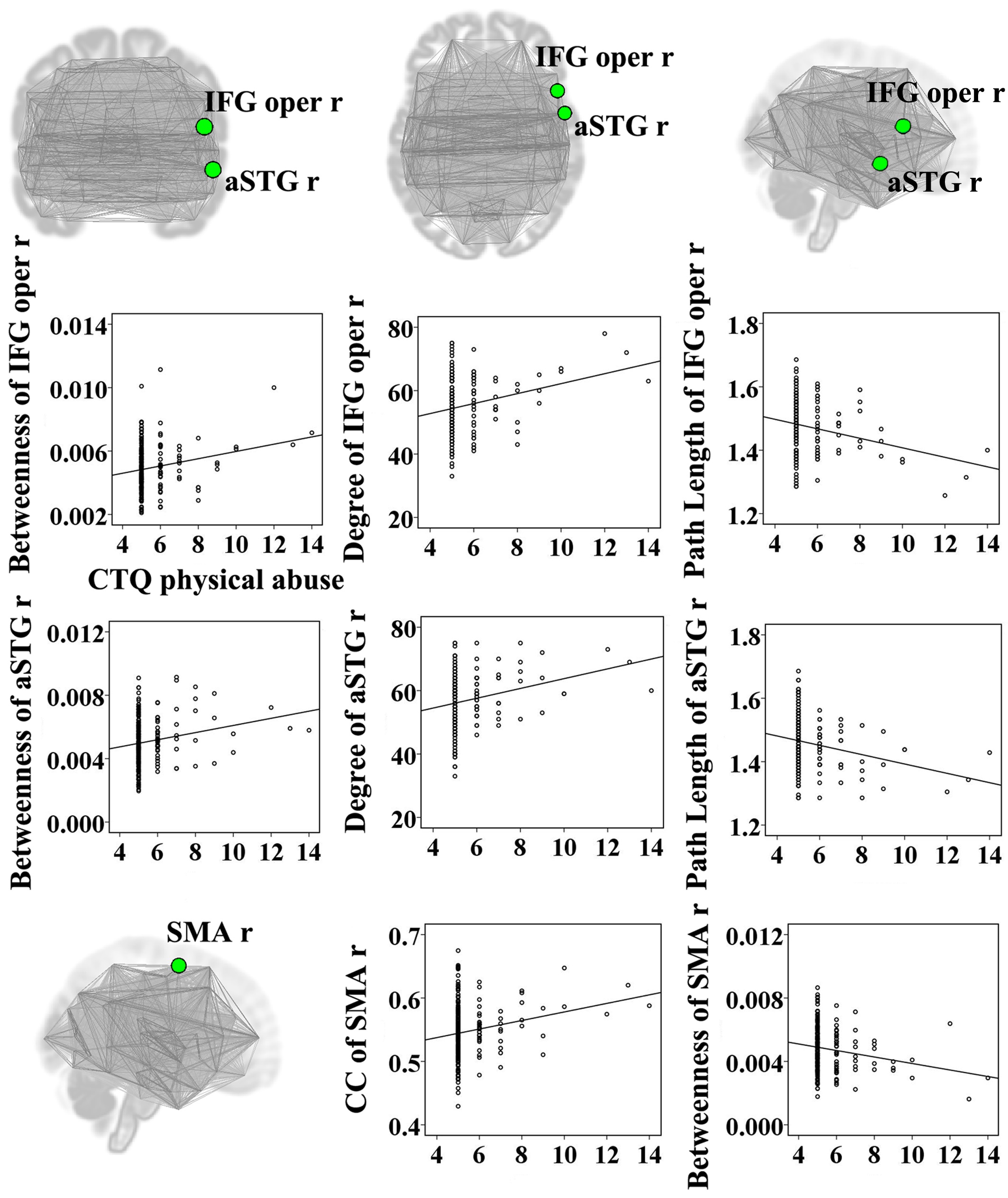
For Pearson correlation analysis, CTQ-sum scores were correlated with the STAI scores (p < 0.001, r = 0.382), and four of the five CTQ subtypes were correlated positively with the STAI scores: emotional abuse (p < 0.001, r = 0.344), emotional neglect (p < 0.001, r = 0.301), physical abuse (p = 0.009, r = 0.180), and physical neglect (p < 0.001, r = 0.245).Multiple linear regression models were used to assess the unique influences of CTQ scores on network properties, there were no significant effects of CTQ subtypes on the network global efficiency, local efficiency, clustering coefficient, shortest path length, and small-world parameters. For regional nodal characteristics, different CTQ subtypes were respectively associated with values of different network properties. he emotional abuse score was positively associated with degree of the right lingual gyrus , path length of the right lingual gyrus, betweenness of the left posterior middle temporal gyrus and betweenness of the left planum temporale (all p < 0.05) were negatively correlated with the emotional abuse score (Figure 1). The physical abuse score was positively associated with betweenness (t = 3.04, p = 0.003) and degree (t = 3.36, p = 0.001) of the right inferior frontal gyrus opercularis, as well as betweenness (t = 2.77, p = 0.006) and degree (t = 3.25, p = 0.001) of the right anterior superior temporal gyrus; clustering coefficient of the right supplementary motor cortex was positively correlated with the physical abuse score (t = 2.84, p = 0.005); path length of the right inferior frontal gyrus opercularis (t = -3.36, p = 0.001), path length of the right anterior superior temporal gyrus (t = -3.25, p = 0.001), and betweenness of the right supplementary motor cortex (t = -2.64, p = 0.009) were negatively correlated with the physical abuse score (Figure 2).
Conclusion
Early trauma in the life of a child can have long-term effects on his or her mental health later in adulthood. The study showed that both neglect and abuse factors dominantly affects brain several regions involved in cognitive and executive function and information processing such as visual and auditory perception, linguistic comprehension, and movement. In addition, severe abuse even lead to isolated communication between brain regions[5].Our study show that childhood neglect affected subregions in involvement of cognition and executive function while childhood abuse induced altered brain regions related to ego defense system and emotion representation. Different experiences of childhood trauma biases distinct development of brain function processing and underpin potentially differential risks of specific forms of psychiatric sequelae in adulthood, implicating better intervention strategies for children who exposed to trauma.
Acknowledgements
We thank Weiyin Vivian Liu (GE Healthcare) for providing supportReferences
1. Klaming, R., et al., Expansion of hippocampal and amygdala shape in posttraumatic stress and early life stress. Neuroimage Clin, 2019. 24: p. 101982.
2. De Bellis, M.D., et al., A Pilot Study of Neurocognitive Function and Brain Structures in Adolescents With Alcohol Use Disorders: Does Maltreatment History Matter? Child Maltreat, 2019: p. 1077559518810525.
3. Opel, N., et al., Childhood maltreatment moderates the influence of genetic load for obesity on reward related brain structure and function in major depression. Psychoneuroendocrinology, 2019. 100: p. 18-26.
4. Tendolkar, I., et al., Physical neglect during childhood alters white matter connectivity in healthy young males. Hum Brain Mapp, 2018. 39(3): p. 1283-1290.16.
5. Monteleone, A.M., et al., The effects of childhood maltreatment on brain structure in adults with eating disorders. World J Biol Psychiatry, 2019. 20(4): p. 301-309.
Figures