5044
Diffusion kurtosis and elastography of uncinate fasciculus relate to dysfunctional emotion regulation and anxiety in youth1Psychological and Brain Sciences, University of Delaware, Newark, DE, United States, 2Biomedical Engineering, University of Delaware, Newark, DE, United States
Synopsis
Keywords: Psychiatric Disorders, Adolescents, anxiety
Mechanistic theories seeking to explain the onset of anxiety in adolescence propose that delayed myelination of the uncinate fasciculus (UF) confers risk for anxiety onset through, in part, deficits in regulation of emotions. Thus, we examined the relationship between two independent assays of UF structural integrity and measures of both dysfunctional emotion regulation and anxiety. We found that less UF structural integrity is related to more dysfunctional emotion regulation and anxiety. Furthermore, we found that dysfunctional emotion regulation mediates the relationship between UF structural integrity and anxiety.Introduction
Adolescence is a critical developmental period during which neural plasticity is high and risk for the onset of anxiety pathology increases1,2. Delayed maturation of key white matter tracts, particularly the uncinate fasciculus (UF), may contribute to the onset of such psychopathology during this time3. Although prior work has related anxious pathology to UF structural integrity4, this has work relied on conventional diffusion tensor imaging metrics, which index only the rate and coherence of diffusion. Diffusion kurtosis imaging, which quantifies non-Gaussian diffusion, reflects separate aspects of tissue microstructural complexity5. Magnetic resonance elastography measures aspects of the mechanical properties of tissue6. One aspect is stiffness which reflects tissue composition and is particularly sensitive to myelination. Thus, diffusion kurtosis and stiffness may each provide unique insights into the white matter disturbances that lead to adolescent anxiety. Furthermore, emotion regulation is also associated with UF integrity7 and is disrupted in those with anxiety, and thus, engagement in emotion regulation behaviors may serve as an intervening mechanism contributing to the relationship between UF structure and anxiety3. Diffusion kurtosis and stiffness have not yet been examined in the context of adolescent anxiety. Thus, our first goal was to examine the relationship between UF mean kurtosis and anxiety in early adolescence. Higher kurtosis indicates restricted diffusion, which is expected in white matter, and thus lower kurtosis reflects disturbances in this tissue. Thus, we hypothesized that higher anxiety would be associated with lower UF kurtosis. Our second goal was to examine the association of UF stiffness and anxiety. Higher stiffness values suggest greater myelination of white matter. Thus, we hypothesized that higher anxiety would be associated with lower UF stiffness. Lastly, we tested emotion regulation as a mediator of associations between UF kurtosis/stiffness and anxiety. We hypothesized that lower UF kurtosis and stiffness would predict greater dysfunctional emotion regulation which, in turn, would predict greater anxiety.Methods
Early adolescents (n=105, 54.3% female, age: M=12.2, SD=.96) completed the Screen for Anxiety Related Emotional Disorders8, the Regulation of Emotions Questionnaire9 and a diffusion-weighted imaging scan10. A subset of these individuals also completed a magnetic resonance elastography scan11 (n=58, 51.7% female, age: M=12.2, SD=.95). The relationship between anxiety and mean UF kurtosis was examined via tract-based spatial statistics and permutation-based analysis in FSL12. The relationship between (i) UF stiffness and anxiety, (ii) UF kurtosis and emotion regulation, and (iii) UF stiffness and emotion regulation were examined with partial correlations in SPSS. Mediation analyses were conducted in SPSS, using the PROCESS macro13.Results
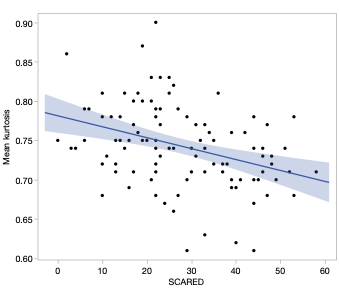
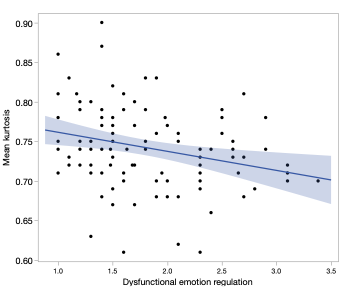
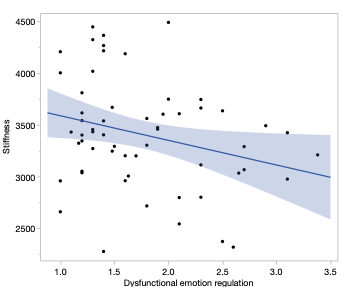
We detected a significant inverse relationship between anxiety and mean kurtosis in an area of the right UF, reflecting a lack of barriers to diffusion and reduced cellular complexity (t = 3.88; mean p = .045). For this area of the right UF, kurtosis (r = -.292; p = .003) and stiffness (r = -.276; p = .040) were negatively related to dysfunctional emotion regulation. However, UF stiffness values were not related to anxiety, and thus, mediation analyses were only conducted for UF kurtosis. Dysfunctional emotion regulation significantly mediated the association between mean kurtosis and anxiety (β = -55.3; CI = [-21.01, -88.12]; p = .002) such that lower kurtosis was related to more dysfunctional emotion regulation which, in turn, was related to more anxiety.Discussion
Together, our results indicate that the structural integrity of the UF is important to dysfunctional affective processes. We found that anxiety and dysfunctional emotion regulation was related to a lack of barriers to diffusion and reduced cellular complexity in the UF. In addition, dysfunctional emotion regulation was related to reduced stiffness of the UF. One potential interpretation of these findings is that this area of right UF is not well-myelinated in adolescents reporting higher levels of dysfunctional emotion regulation and anxiety, given that myelination should lead to higher kurtosis and tissue stiffness. Lastly, we found that engagement in dysfunctional emotion regulation behaviors mediated the relationship between reduced cellular complexity (kurtosis) of the UF and anxiety. Thus, present findings suggest that myelination of the right UF is particularly important for reducing engagement in maladaptive strategies for coping with emotions, and that both reduced myelination of the right UF and engagement in dysfunctional emotion regulation appear critical to the presence of anxiety. The current study advances knowledge of how anxiety develops by examining, in early adolescence, two independent measures of white matter microstructure which each represent improvements over the conventional diffusion tensor model. In particular, examination of specific pathways using MRE (stiffness) is enabled by recent innovations.Conclusion
Our results provide support for mechanistic theories proposing that delayed myelination of the UF confers risk for the onset of anxiety in adolescence3. Detecting relationships between anxiety, dysfunctional emotion regulation, and UF integrity in early adolescents underscores the posited importance of the UF in the development and maintenance of anxiety and suggests that interventions that boost UF integrity/myelination may interrupt the onset of clinical levels of anxiety. Furthermore, our finding that dysfunctional emotion regulation mediates the UF – anxiety association suggests that targeting children’s and early adolescent’s emotion regulation skills may be an effective prevention strategy.Acknowledgements
NIMH 1 R01MH123470-01A1; NIGMS 5P20GM103653References
1. Tottenham, N. & Galván, A. Stress and the adolescent brain: Amygdala-prefrontal cortex circuitry and ventral striatum as developmental targets. Neuroscience & Biobehavioral Reviews 70, 217–227 (2016).
2. Kessler, R. C., Petukhova, M., Sampson, N. A., Zaslavsky, A. M. & Wittchen, H.-U. Twelve-month and lifetime prevalence and lifetime morbid risk of anxiety and mood disorders in the United States. Int J Methods Psychiatr Res 21, 169–184 (2012).
3. Spielberg, J. M., Schwarz, J. M. & Matyi, M. A. Anxiety in transition: Neuroendocrine mechanisms supporting the development of anxiety pathology in adolescence and young adulthood. Frontiers in Neuroendocrinology 55, (2019).
4. Tromp, D. P. M. et al. Reduced structural connectivity of a major frontolimbic pathway in Generalized Anxiety Disorder. Archives of General Psychiatry 69, 925 (2012).
5. Jensen, J. H., Helpern, J. A., Ramani, A., Lu, H. & Kaczynski, K. Diffusional kurtosis imaging: The quantification of non-gaussian water diffusion by means of magnetic resonance imaging. Magnetic Resonance in Medicine 53, 1432–1440 (2005).
6. Hiscox, L. V. et al. Magnetic resonance elastography (MRE) of the human brain: Technique, findings and clinical applications. Phys Med Biol 61, R401–R437 (2016).
7. Olson, I. R., Von Der Heide, R. J., Alm, K. H. & Vyas, G. Development of the uncinate fasciculus: Implications for theory and developmental disorders. Developmental Cognitive Neuroscience 14, 50–61 (2015).
8. Birmaher, B. et al. The Screen for Child Anxiety Related Emotional Disorders (SCARED): Scale construction and psychometric characteristics. Journal of the American Academy of Child & Adolescent Psychiatry 36, 545–553 (1997).
9. Phillips, K. F. V. & Power, M. J. A new self-report measure of emotion regulation in adolescents: The Regulation of Emotions Questionnaire. Clinical Psychology & Psychotherapy 14, 145–156 (2007).
10. Van Essen, D. C. et al. The Human Connectome Project: A data acquisition perspective. NeuroImage 62, 2222–2231 (2012).
11. McGarry, M. D. J. et al. Multiresolution MR elastography using nonlinear inversion. Med Phys 39, 6388–6396 (2012).
12. Jenkinson, M., Beckmann, C. F., Behrens, T. E. J., Woolrich, M. W. & Smith, S. M. FSL. NeuroImage 62, 782–790 (2012).
13. Hayes, A. F. Introduction to mediation, moderation, and conditional process analysis: A regression-based approach. (Guilford Press, 2013).
Figures