4984
Off-resonance encoded fat suppression methods for 5D whole-heart free-running cardiac MRI at 1.5T
Yasaman Safarkhanlo1,2, Jerome Yerly3,4, Mariana Falcao3, Adèle LC Mackowiak2,3,5, Davide Piccini3,6, Matthias Stuber3,4, Bernd Jung2,5, Christoph Gräni1,2, and Jessica AM Bastiaansen2,5
1Department of Cardiology, University Hospital Bern, Inselspital, Bern, Switzerland, 2Translation Imaging Center (TIC), Swiss Institute for Translational and Entrepreneurial Medicine, Bern, Switzerland, 3Department of Diagnostic and Interventional Radiology, Lausanne University Hospital (CHUV), Lausanne, Switzerland, 4Center for Biomedical Imaging, Lausanne, Switzerland, 5Diagnostic, Interventional and Pediatric Radiology (DIPR), University Hospital Bern, Inselspital, Bern, Switzerland, 6Advanced Clinical Imaging Technology, Siemens Healthineers International AG, Lausanne, Switzerland
1Department of Cardiology, University Hospital Bern, Inselspital, Bern, Switzerland, 2Translation Imaging Center (TIC), Swiss Institute for Translational and Entrepreneurial Medicine, Bern, Switzerland, 3Department of Diagnostic and Interventional Radiology, Lausanne University Hospital (CHUV), Lausanne, Switzerland, 4Center for Biomedical Imaging, Lausanne, Switzerland, 5Diagnostic, Interventional and Pediatric Radiology (DIPR), University Hospital Bern, Inselspital, Bern, Switzerland, 6Advanced Clinical Imaging Technology, Siemens Healthineers International AG, Lausanne, Switzerland
Synopsis
Keywords: Heart, Fat, data acquisition, data analysis, image reconstruction, low-field MRI
The presence of fat signals around the heart can affect the diagnostic quality of cardiovascular MR images. There are multiple fat-suppression pulses, such as FISS, and off-resonance water-excitation (WE) pulses, such as BORR, LIBRE, and LIBOR, that have been developed for the free-running balanced Steady-State Free-Precession (bSSFP) sequences at low-field MRI (1.5T). These fat-suppression pulses have never been thoroughly compared to each other, therefore, in this work, we implemented four different fat-suppression pulses and validated their performance on phantoms and healthy volunteers. Our results indicated LIBOR provided better fat suppression compared to BORR and LIBRE, while having fast acquisition time.INTRODUCTION
Unsuppressed fat signals in cardiac MRI (CMR) can impact the visualization of anatomical structures hampering diagnostic image quality (1). Because of fast T1 recovery of fat, and k-space center dominated MRI signal weighting, fat signal suppression is challenging in non-Cartesian MRI. Therefore, approaches that focus on water excitation (WE) are favored over fat saturation. Free-running CMR at 1.5T typically uses radial trajectories and is based on bSSFP acquisitions (2,3). The reconstructed cardiac and respiratory motion-resolved whole-heart data (5D CMR) allow for determining cardiac function and coronary artery imaging (2,3). Several methods were developed for fat suppression, such as Fast Interrupted Steady-State (FISS) (4,5), which uses an interruption of the bSSFP steady state to generate a wide off-resonance signal stop-band, and short off-resonance WE pulses such as Binomial Off-Resonant Rectangular (BORR) (6), Lipid Insensitive Binomial off-Resonant RF Excitation (LIBRE) (7,8), and an RF-power-optimized Lipid Insensitive Binomial Off-Resonant (LIBOR) (9). Aforementioned RF pulses can be shortened by increasing their off-resonance frequency, requiring an increase in RF power which can be problematic when combined with bSSFP. Therefore, the aim of this work was to implement BORR and the RF-power-optimized LIBOR pulse and compare them with LIBRE and FISS for free-running CMR at 1.5T.
METHODS
Phantom measurements
Research free-running bSSFP sequences using off-resonant LIBOR, BORR, and LIBRE pulses, as well as free-running FISS, were implemented and tested on a 1.5T clinical MRI scanner (MAGNETOM Sola, Siemens Healthcare, Erlangen, Germany). The water and fat signals were quantified as a function of pulse frequency, which was varied from 250 to 340 Hz for LIBOR, and from 400 to 600 Hz for BORR and LIBRE. Since LIBOR is tuned by the phase difference between two subpulses, phase offset was swept from 250 to 340° to confirm previous findings (9). Additionally, water and fat signals were measured as a function of RF excitation angle, which was varied from 50 to 100° for LIBOR, 90 to 180° for BORR, and 50 to 180° for LIBRE pulse sequence. All measurements were repeated at different dates (n=3). Pulse duration of LIBOR and BORR was fixed to 2.6 ms, to match LIBRE (8).Remaining sequence parameters were the same, unless specified, for all 4 acquisitions as follows: 2.0 mm3isotropic resolution, bandwidth of 992 Hz/pixel, echo time (TE) 2.46 ms, and repetition time (TR) 4.9 ms. FISS TR was 2.47 ms. Acquisition time for phantom studies was around 30 seconds per sequence.
Free-running CMR in volunteers
Four different free-running acquisitions, LIBOR, BORR, LIBRE, and FISS were acquired in healthy volunteers (n=4) who gave written informed consent. Acquisition parameters were identical to phantom comparison experiments besides increasing the number of k-space lines to ~45k. Images were reconstructed with compressed-sensing framework described by Di Sopra et al. (3). Scan time for in vivo studies was 3:40 minutes per off-resonance WE sequences and 2:55 minutes for FISS.Image analysis
Data were analyzed using MATLAB (R2022a, The MathWorks) and ImageJ (NIH, Wisconsin University). Regions of interest (ROIs) were drawn in water and fat vials, and in the background noise. In vivo, ROIs were drawn in chest fat, ventricular blood pool, lungs, and myocardium. Signal-to-noise ratio (SNR) was computed by dividing the average ROI signal by the standard deviation of background noise. To compare different acquisitions in the phantom, contrast-to-noise ratio (CNR) was calculated by subtracting water SNR from fat SNR.Gridded reconstructions were used for quantitative in vivo comparisons and CNR was calculated between ventricular blood and chest fat (CNRBlood-Fat), as well as blood and myocardium (CNRBlood-Myocardium).
RESULTS and DISCUSSION
The LIBOR phase offset, frequency, and flip angle impact fat signal suppression. Maximum CNR was found with a phase offset of 280°, a frequency of 270 Hz, and a flip angle of 55° for LIBOR (Fig. 1), pulse frequency of 500 Hz and a flip angle of 90° for BORR, and frequency of 520 Hz and flip angle of 60° for LIBRE (Fig. 2). These findings corroborate the expected theoretical range of required RF amplitudes (9).In phantoms, LIBOR provided the largest CNR of all compared techniques, while FISS had the lowest CNR, which indicates that LIBOR efficiently suppresses fat signal without reducing or having a significant impact on water signal (Fig. 3).
For in vivo free-running CMR, LIBRE has the highest SNR in ventricular blood pool, and LIBOR has the lowest SNR in chest fat. LIBRE displayed the highest CNRBlood-Fat and CNRBlood-Myocardium values (Fig 4). Across watery tissues, no significant differences were observed between these techniques, as expected. Nevertheless, because chest fat falls outside the shim volume, pericardial fat signals may provide a more stable and appropriate metric for fat signal suppression, which will be further investigated in a larger volunteer cohort. In whole-heart imaging data, a big difference in fat suppression can be observed across techniques and anatomical regions (Fig. 5).
CONCLUSION
Different off-resonance water-excitation methods were compared in free-running CMR at 1.5T and are the first report on both LIBOR and BORR pulses. LIBOR enabled effective fat suppression while maintaining a short TR and reducing RF power compared with BORR and LIBRE, conversely, FISS demonstrated the highest CNR of blood and myocardium.Acknowledgements
The present study was funded by the Swiss National Science Foundation (grant number: 197754).References
- Munoz C, Bustin A, Neji R et al. Motion-corrected 3D whole-heart water-fat high-resolution late gadolinium enhancement cardiovascular magnetic resonance imaging. Journal of Cardiovascular Magnetic Resonance 2020;22:1-13.2.
- Feng L, Coppo S, Piccini D et al. 5D whole-heart sparse MRI. Magn Reson Med 2018;79:826-838.3.
- Di Sopra L, Piccini D, Coppo S, Stuber M, Yerly J. An automated approach to fully self-gated free-running cardiac and respiratory motion-resolved 5D whole-heart MRI. Magn Reson Med 2019;82:2118-2132.4.
- Bastiaansen JAM, Piccini D, Di Sopra L et al. Natively fat-suppressed 5D whole-heart MRI with a radial free-running fast-interrupted steady-state (FISS) sequence at 1.5T and 3T. Magn Reson Med 2020;83:45-55.5.
- Koktzoglou I, Edelman RR. Radial fast interrupted steady‐state (FISS) magnetic resonance imaging. Magnetic resonance in medicine 2018;79:2077-2086.6.
- Ye Y, Hu J, Haacke EM. Robust selective signal suppression using binomial off-resonant rectangular (BORR) pulses. J Magn Reson Imaging 2014;39:195-202.7.
- Bastiaansen JAM, Stuber M. Flexible water excitation for fat-free MRI at 3T using lipid insensitive binomial off-resonant RF excitation (LIBRE) pulses. Magn Reson Med 2018;79:3007-3017.8.
- Masala N, Bastiaansen JAM, Di Sopra L et al. Free-running 5D coronary MR angiography at 1.5T using LIBRE water excitation pulses. Magn Reson Med 2020;84:1470-1485.9.
- Bastiaansen J, Piccini D, Mackowiak A. Fat-free MRI with fast and power-optimized off-resonant LIBOR pulses. 2022.
Figures
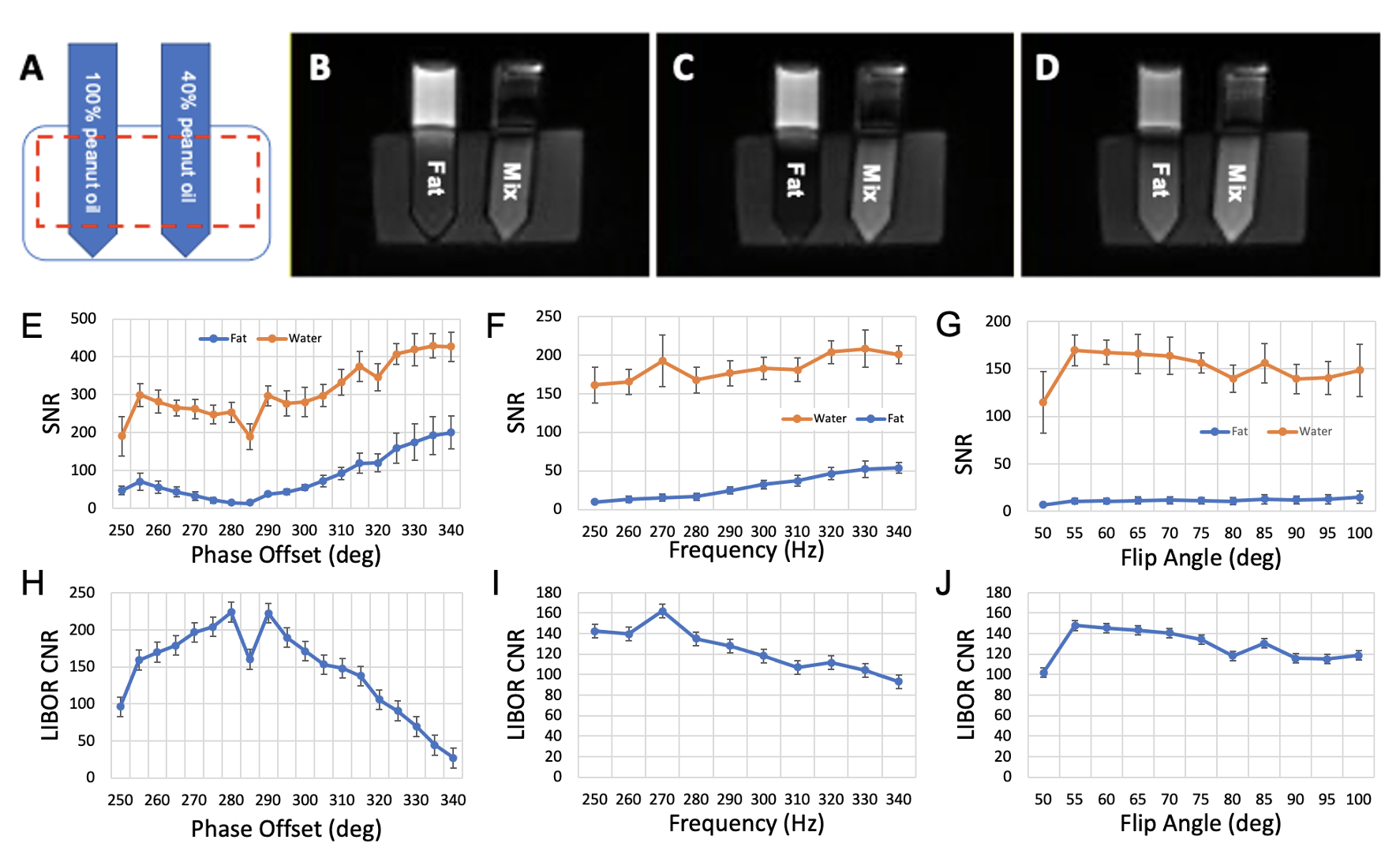
(A) Illustration and LIBOR acquisitions with phase offset of (B) 250°, (C) 285°, and (D) 270°. Red dashed lines indicate the shimming box. Fat and water SNR changes with different phase offsets (fixed frequency of 270Hz and a 78° flip angle) (E), frequencies (fixed phase offset 285° and a 78° flip angle) (F), and flip angles (fixed phase offset of 285° and a frequency of 270Hz) (G). CNR for different phase offsets (H), RF excitation frequencies (I), and flip angles (J). The CNR outlier was a result of noise spike in that particular experiment (E, H).
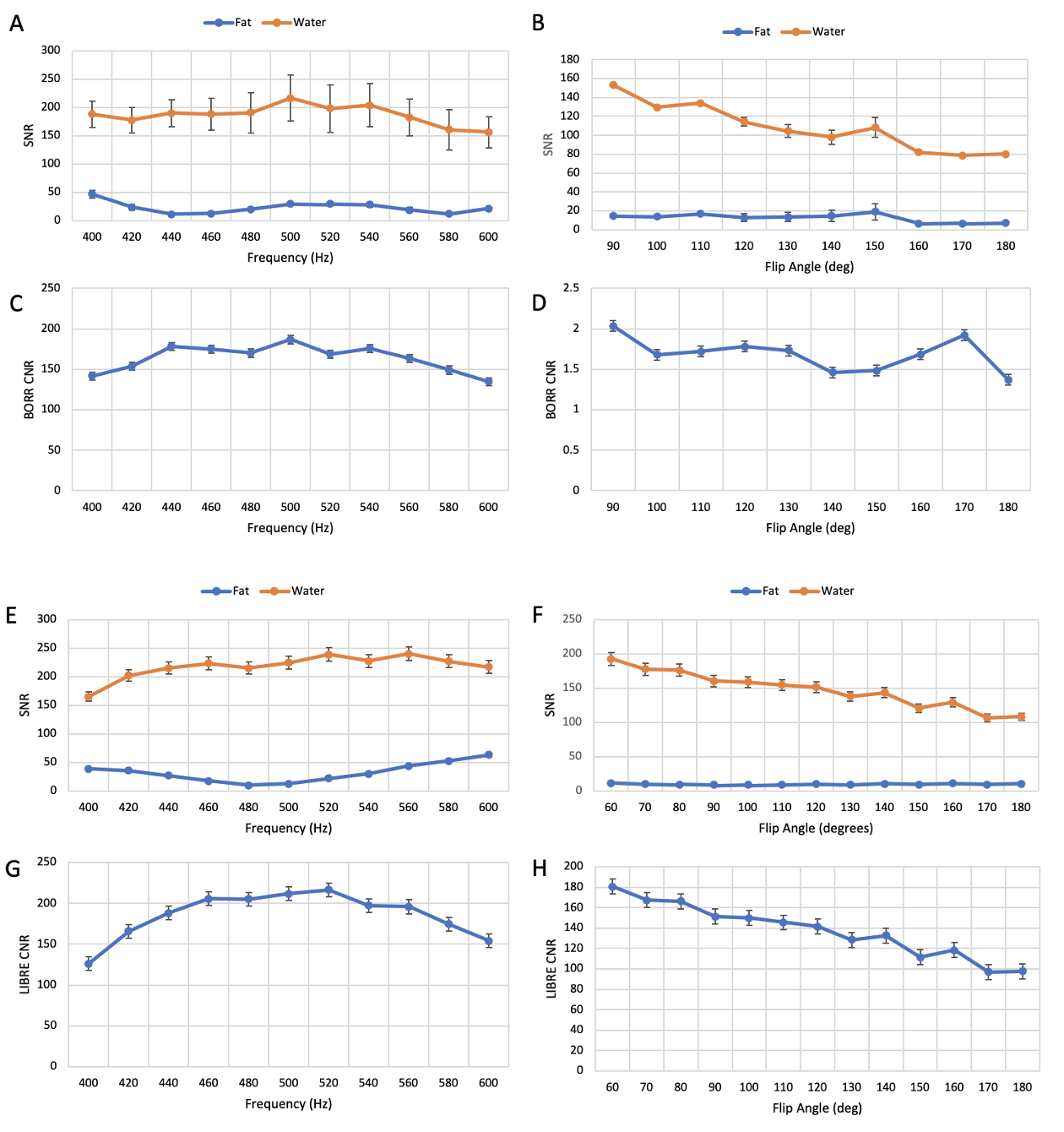
Measured fat and water signal-to-noise ratios (SNR) with different (A) frequencies and constant flip angle of 141°, and (B) different flip angles and constant frequency of 600 Hz. The calculated CNR for BORR sequence with different (C) frequencies, and (D) flip angles. Measured fat (blue) and water (orange) SNR with different (E) frequencies and constant flip angle of 124°, and (F) flip angles and fixed frequency of 500 Hz. The calculated CNR for LIBRE sequence with different (G) frequencies, and (H) flip angles.
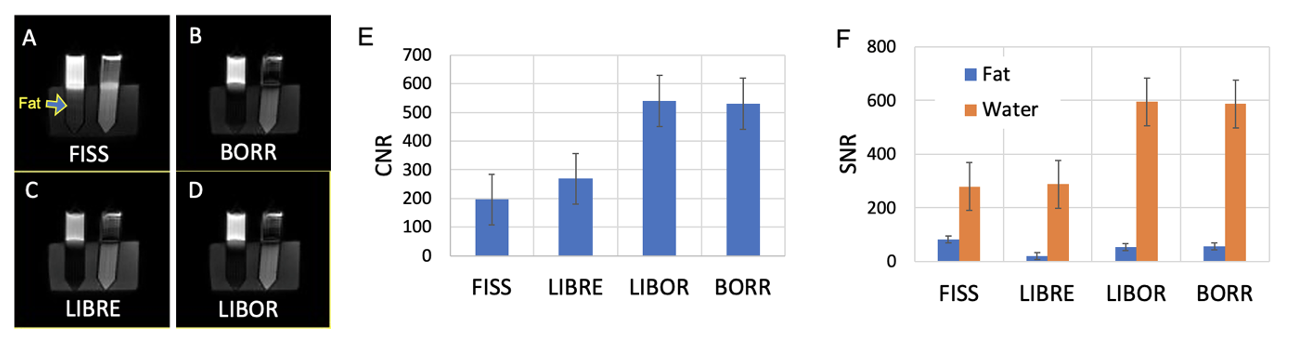
Four different fat-suppression methods, (A) FISS, (B) BORR, (C) LIBRE, and (D) LIBOR, and their (E) CNR and (F) SNR.
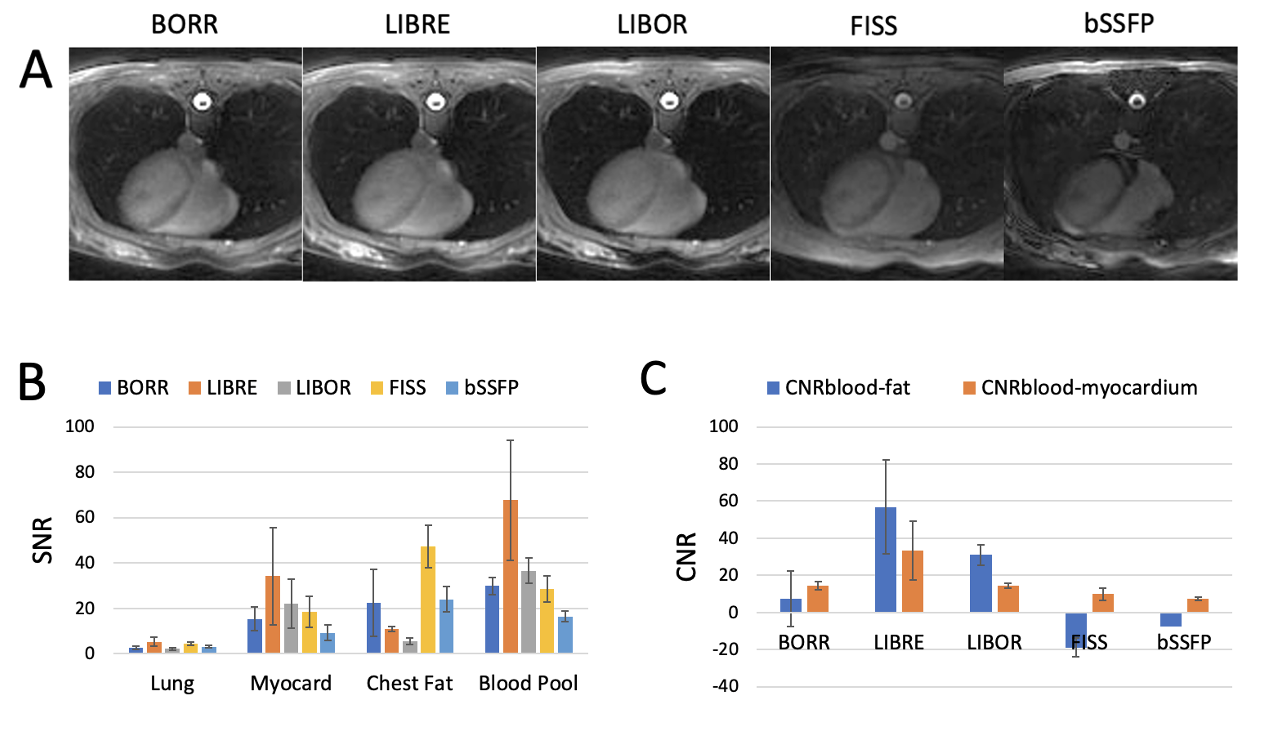
(A) Volunteer data acquired with FISS, BORR, LIBRE, LIBOR, and bSSFP. (B) Signal intensity of lung, myocardium, chest fat, and ventricular blood pool for different acquisition. (C) CNRBlood-Fat calculated by subtracting SNRBlood Pool from SNRChest Fat and CNRBlood-Myocardium calculated by subtracting SNRBlood Pool from SNRMyocardium.
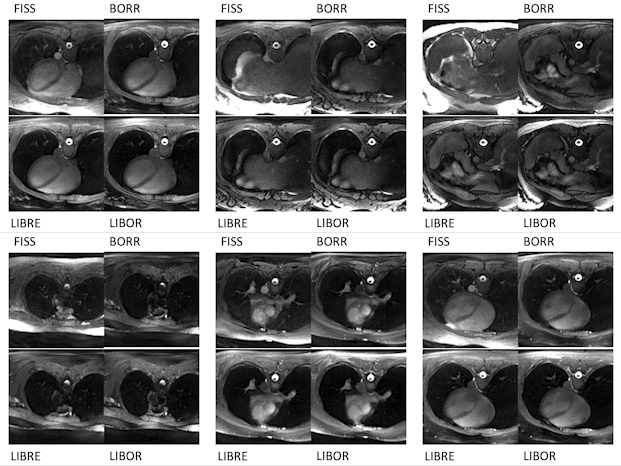
Volunteer data acquired with FISS, BORR, LIBRE, and LIBOR sequences (animation).
DOI: https://doi.org/10.58530/2023/4984