4953
Complex Quasi-Newton Proximal Methods for the Image Reconstruction in Compressed Sensing MRI1Department of Radiology, University of Michigan, Ann Arbor, MI, United States, 2Department of Electrical and Computer Engineering, University of Michigan, Ann Arbor, MI, United States
Synopsis
Keywords: Image Reconstruction, Data Processing, Fast reconstruction algorithm
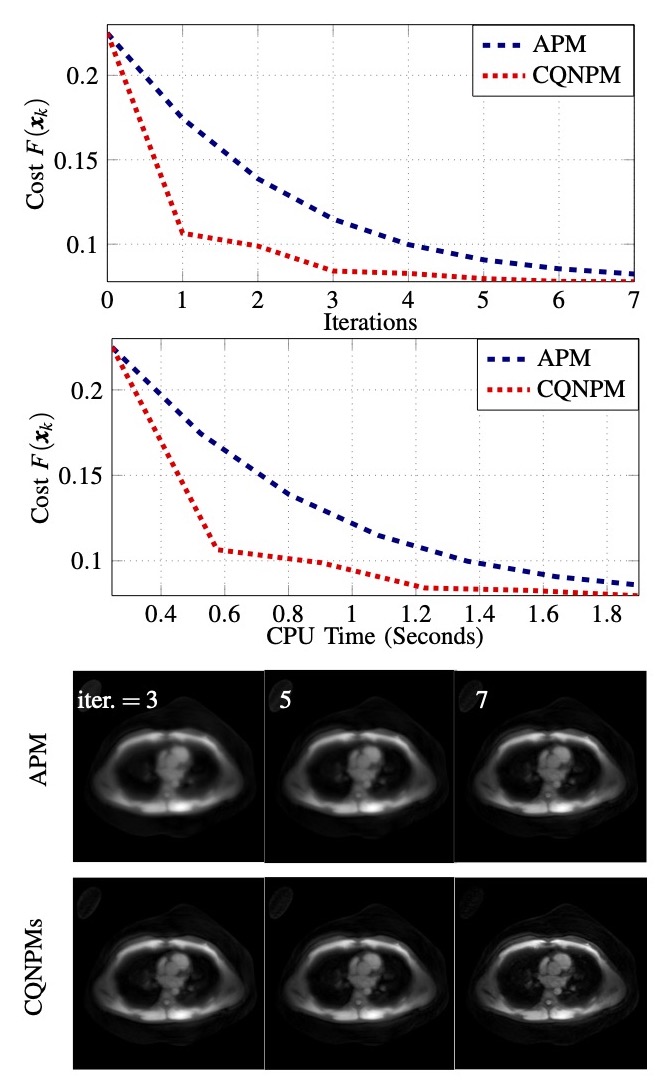
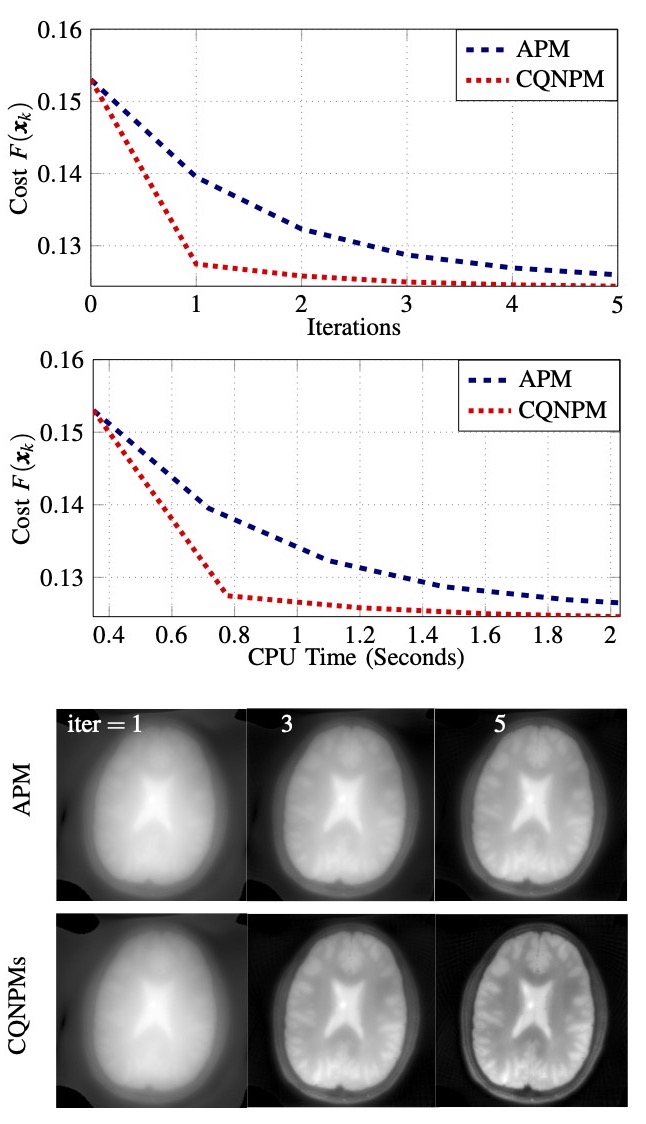
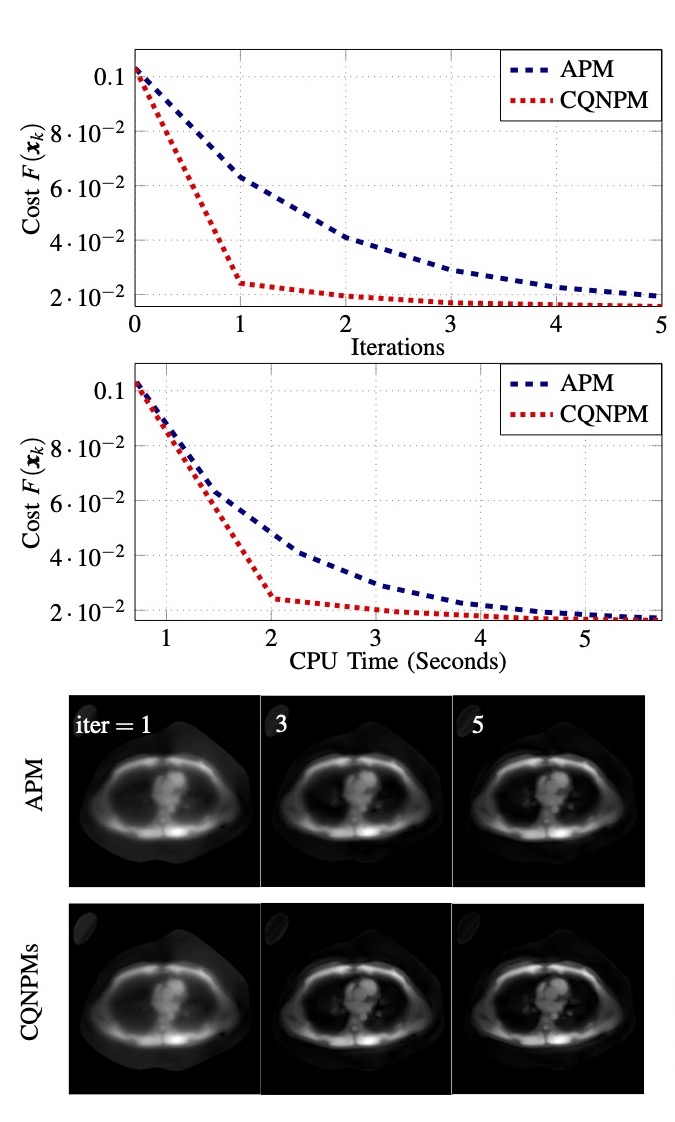
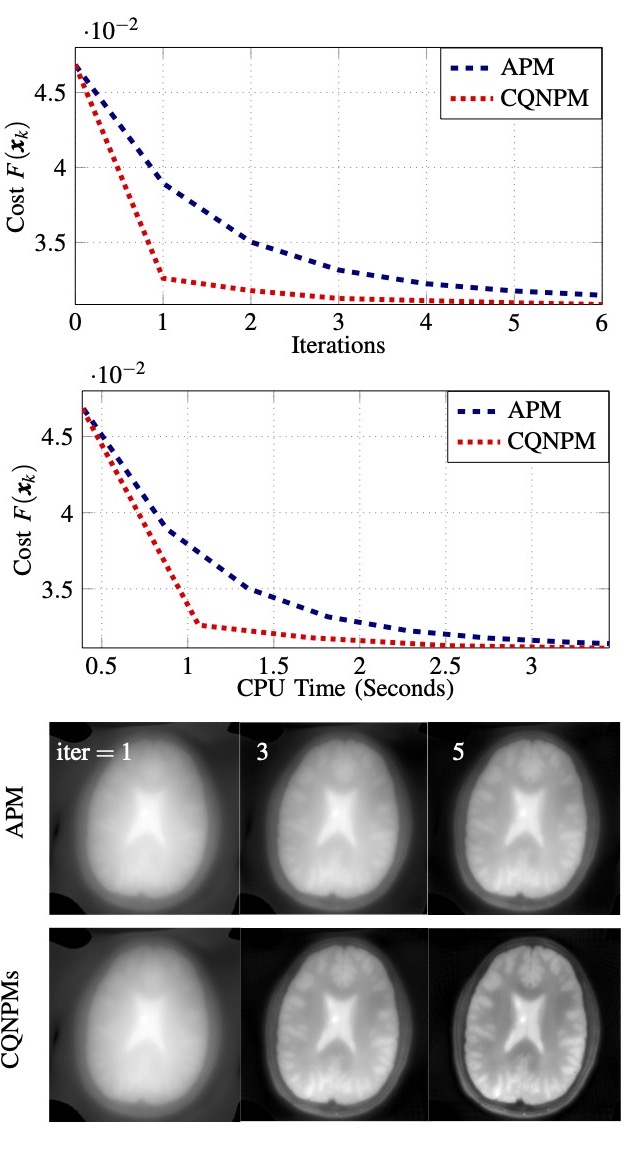
This work studies a complex quasi-Newton proximal method (CQNPM) for MRI reconstruction using wavelets or total variation (TV) based regularization. Our experiments show that our method is faster than the accelerated proximal method [1,2] in terms of iteration and CPU time.Introduction
The reconstruction of compressed sensing MRI can be formulated as the following minimization problem: $$\min_{x\in\mathbb C^N}F(x),~F( x) \equiv \underbrace{\frac{1}{2}\|Ax-y\|_2^2}_{f(x)} + \lambda \, h(x),~~~~~~~~~(1)$$where $$$A\in \mathbb C^{M\times N}$$$ refers to the forward model describing a mapping from the signal $$$x$$$ to the acquired data $$$y$$$ and $$$\lambda>0$$$ is the trade-off parameter. Here, we focus on $$$h(x)=\|T x\|_1$$$ for a wavelet transform $$$T$$$, or $$$h(x) = \text{TV}(x)$$$. Traditionally, one can use the accelerated proximal method (APM) [1,2] to solve (1). Here we propose a complex quasi-Newton proximal method to solve (1) even faster.
Methods
Denote a weighted proximal operator by $$\mathrm{Prox}_{\lambda h}^{W}(v)\equiv\arg\min_{x\in\mathbb C^{N}} \frac{1}{2}\|x-v\|_{W}^2 +\lambda h(x)~~~~~~~~~(2)$$ where $$$W\in \mathbb C^{N\times N}$$$ is a Hermitian positive definite matrix and $$$\|x\|_{W} = \sqrt{x'Wx}$$$ denotes the $$$W$$$-weighted Euclidean norm. When $$$W=I$$$, (2) becomes the well-known proximal operator. At the $$$k$$$th iteration, the CQNPM update is: $$x_{k+1} = \text{Prox}_{a_k\lambda h}^{B_k}\left(x_k-a_kB_k^{-1}\nabla_{x} f(x_k)\right)$$ where $$$a_k$$$ denotes the step-size. Here, the symmetric rank-$$$1$$$ method is used to compute $$$B_k$$$ [3] so that $$$B_k\in\mathbb C^{N\times N} \equiv D_k \pm u_k u_k'$$$ with $$$D_k$$$ a diagonal matrix and $$$u_k\in\mathbb C^{N}$$$.For $$$h(\bar x)=\|\bar x\|_1$$$,one can solve (2) efficiently through the following lemma:
Lemma 1 [4]:
Let $$$W = D\pm uu'$$$. Then, $$\text{Prox}_{\lambda h}^{W}(x)=\text{Prox}_{\lambda h}^{D}(x\mp D^{-1}u\alpha^*),$$ where $$$\alpha^*\in\mathbb C$$$ is the unique zero of the following nonlinear equation $$$\mathbb J(\alpha):u'\left(x-\text{Prox}_{\lambda h}^{D}(x\mp D^{-1}u\alpha)\right)+\alpha.$$$
We solve $$$\mathbb J(\alpha) = 0$$$ using ``SciPy'' library in Python. When $$$h(x)=\|T x\|_1$$$ where $$$T$$$ is an invertible transform, we can rewrite (1) as $$$\frac{1}{2}\|AT^{-1}x-y\|_2^2 + \lambda \, \|x\|_1$$$ that Lemma 1 is still appliable.
For $$$h(x)=\text{TV}(x)$$$, we transform (2) to the following dual problem that is differentiable $$\begin{array}{rl} (P_1^*,Q_1^*,P_2^*,Q_2^*) =\arg\min\limits_{\substack{(P_1,Q_1)\in \mathcal P\\(P_2,Q_2)\in \mathcal P}} &\left\| \varphi (P_1,Q_1,P_2,Q_2)\right\|^2_{\tilde W}\end{array},~~~~~~~~~(4)$$
where $$${\tilde W}=\begin{bmatrix} \Re({W}) & -\Im({W}) \\ \Im({W}) & \Re({W}), \end{bmatrix},$$$ $$$\mathcal P$$$ denotes a set of real matrix-pairs $$$(P,Q)$$$ that satisfy $$\begin{array}{rl} P_{i,j}^2+Q_{i,j}^2\leq 1&~~\text{isotropic TV,}\\ |P_{i,j}|\leq1,~|Q_{i,j}|\leq1 & ~~\text{anisotropic TV},\end{array}$$ $$$\varphi(P_1,Q_1,P_2,Q_2)=\begin{bmatrix} \Re{(v)}\\ \Im{{(v)}} \end{bmatrix}-\lambda\left( \tilde{W}\right)^{-1} \begin{bmatrix}\text{vec}(\mathcal L(P_1,Q_1))\\ \text{vec}(\mathcal L(P_2,Q_2))\end{bmatrix},$$$ and $$$\mathcal L(P,Q)_{i,j}=P_{i,j}+Q_{i,j}-P_{i-1,j}-Q_{i,j-1}.$$$ Note that $$$\Re(\cdot)$$$ (respectively, $$$\Im(\cdot)$$$) refers to an operator to take the real (respectively, imaginary) partand $$$\text{vec}(\cdot)$$$ denotes the vectorization of a matrix. We compute $$$(\tilde{W})^{-1}$$$ in $$$\varphi(P_1,Q_1,P_2,Q_2)$$$ efficiently through the Schur complement since $$$W = D\pm u u'$$$. After solving (4), we reach
$$\begin{bmatrix} \Re(\text{Prox}_{\lambda h}^{W}(v))\\ \Im(\text{Prox}_{\lambda h}^{W}(v)) \end{bmatrix}=\varphi(P_1^*,Q_1^*,P_2^*,Q_2^*).$$
Results
All experiments are implemented in SigPy [5]. We used the data from [6]. Figures 1-4 show the results and experimental details.Conclusion
For a general matrix $$$W$$$, solving (2) would be as hard as the original problem (1). By using the structure of $$$W$$$, i.e., $$$W=D\pm u u'$$$, we propose efficient approaches to address (2) when $$$h(x)=\|Tx\|_1$$$ or $$$\text{TV}(x)$$$. Compared with the computational cost in the proximal operator, i.e., $$$W=I$$$, the increased computation in (2) is insignificant, as illustrated by our CPU time comparisons.Acknowledgements
This work is supported in part by R01 NS 112233.References
[1] A. Beck and M. Teboulle, ``A fast iterative shrinkage-thresholding algorithm for linear inverse problems," SIAM Journal on Imaging Sciences, vol. 2, no. 1, pp. 183–202, 2009.
[2] A. Beck and M. Teboulle, ``Fast gradient-based algorithms for constrained totalvariation image denoising and deblurring problems," IEEETransactions on Image Processing, vol. 18, no. 11, pp. 2419–2434, 2009.
[3] J. Nocedal and S. J. Wright, Numerical Optimization.Springer, 2006.
[4] S. Becker, J. Fadili, and P. Ochs, ``On quasi-Newtonforward-backward splitting: Proximal calculus and con-vergence," SIAM Journal on Optimization, vol. 29, no. 4, pp. 2445–2481, 2019.
[5] F. Ong and M. Lustig, ``Sigpy: a python package forhigh performance iterative reconstruction," in Proceedingsof the ISMRM 27th Annual Meeting, Montreal, Quebec, Canada, vol. 4819, 2019.
[6] S. S. Iyer, F. Ong, X. Cao, C. Liao, D. Luca, J. I.Tamir, and K. Setsompop, ``Polynomial preconditionersfor regularized linear inverse problems," arXiv preprintarXiv:2204.10252, 2022.
Figures