4947
Scaling nuFFT Memory-Overhead Down to Zero: Computational Trade-Offs and Memory-Efficient PICS-Reconstructions with BART1Institute for Diagnostic and Interventional Radiology, University Medical Center Göttingen, Göttingen, Germany, 2Institute of Biomedical Imaging, Graz University of Technology, Graz, Austria
Synopsis
Keywords: Image Reconstruction, Software Tools
We propose a new decomposition of the nuFFT algorithm, allowing for a zero-memory-overhead implementation of the (adjoint-)nuFFT. With one grid-sized buffer, the decomposition allows for a memory efficient nuFFT with negligible computational overhead compared to a two-fold oversampled conventional nuFFT - to the prize of less efficient parallelization on many-threads CPU systems. We reduce memory requirements of 3D non-Cartesian PICS-reconstructions in BART by a factor up to ten, allowing for GPU acceleration of reconstructions with eight coils and matrix size 256x256x256 on a 4GB consumer-level GPU.Introduction
The non-uniform FFT (nuFFT) is at the heart of any non-Cartesian MRI reconstructions. Usual implementations of the nuFFT require an oversampled grid to prevent aliasing artifacts from the nuFFT itself, leading to a $$$(oN)^D$$$-memory overhead in D dimensions, such that especially 3D reconstrauctions are limited by the nuFFT memory requirement. In this work, we propose a decomposition of the nuFFT resulting either in a zero-memory-overhead nuFFT or a nuFFT using one buffer of size $$$N^D$$$ with theoretically no computational overhead compared to a $$$o=2$$$ oversampled nuFFT. The low-memory nuFFT is implemented in the BART [1] toolbox and, hence, can be used to reduce the memory-overhead of generic 3D-non-Cartesian Parallel-Imaging-Compressed-Sensing (PICS) reconstructions.Theory
Implementations of the nuFFT usually employ the convolution theorem to split the non-uniform DFT into the application of a Cartesian FFT and a direct convolution with a small gridding kernel $$$W$$$, typically a Kaiser-Bessel window.[2, 3] In the continuous case, the forward mode of the non-uniform Fourier transform corresponds to$$ \mathbf{\hat{f}}(k) = \left(W \ast \tilde{f}\right)(k) \qquad\text{with}\qquad \tilde{f}(x) = \frac{f(x)}{{\color{#E41A1C}{\hat{W}(x)}}}\;.$$
In the discretized setting, the field of view needs to be zero-padded by a factor $$$o$$$ to prevent aliasing artifacts, resulting in a memory overhead of $$$(oN)^D$$$. For $$$D=1$$$, the discretized nuFFT of the zero-padded vector $$$\tilde{f}_m'$$$ is then computed by
$$\begin{aligned}\hat{f}(k)&={}\sum_l{}W(k-l){}\sum_{m=0}^{oN}{}\exp\left(-\frac{2\pi{}i}{oN}l\left(m-\frac{oN}{2}\right)\right)\tilde{f}'_m\\&={}{\color{#FF7F00}{\sum_l{}W(k-l)}}{}{\color{#4DAF4A}{\exp\left(\pi{}i{}l\right)}}{}{\color{#377EB8}{\sum_{m=0}^{oN}{}\exp\left(-\frac{2\pi{}i}{oN}lm\right)}}{\color{#E41A1C}{\tilde{f}_m'}}\,,\end{aligned}$$
here the colors correspond to the operations visualized in Figure 1A). Instead of zero-padding $$$\tilde{f}_m$$$ in memory, we consider only the non-zero coefficients of $$$\tilde{f}'_m$$$ by restricting the sum of the factor $$$o=2$$$ oversampled FFT. By splitting even and odd frequencies, the FFT of size $$$2N$$$ is decomposed into two FFTs of size $$$N$$$[4], i.e. $$\begin{aligned}\hat{f}(k)&={}\sum_l{}W(k-l){}\sum_{m=0}^{N}{}\exp\left(-\frac{2\pi{}i}{2N}l\left(m-\frac{N}{2}\right)\right)\tilde{f}_m\\&={}{\color{#FF7F00}{\sum_{l'}{}W(k-2l')}}{}{\color{#4DAF4A}{\exp\left(-\frac{2\pi{}i}{2N}l'\right)}}{}{\color{#377EB8}{\sum_{m=0}^{N}{}\exp\left(-\frac{2\pi{}i}{N}l'm\right)}}{\color{#E41A1C}{\tilde{f}_m}}\\&+{}{\color{#FF7F00}{\sum_{l''}{}W(k-2l''{}-{}1)}}{}{\color{#4DAF4A}{\exp\left(-\frac{2\pi{}i}{2N}l''\right)}}{}{\color{#377EB8}{\sum_{m=0}^{N}{}\exp\left(-\frac{2\pi{}i}{N}l''m\right)}}{\color{#984EA3}{\exp\left(-\frac{2\pi}{2N}m{}+{}\frac{\pi{}i}{2}\right)}}{\color{#E41A1C}{\tilde{f}_m}}\,.\end{aligned}$$ In this equation, all phase-multiplications and the FFTs are linear, invertible, and can be performed in-place on the grid. Hence, by sequentially computing both interpolations, no memory buffer is required. Alternatively, the inversion steps can be skipped using one additional buffer of size $$$N^D$$$ as visualized in Figure 1B). The same decomposition can be used to save memory in the adjoint nuFFT or the Toeplitz-mode[5,6] of the forward-adjoint nuFFT. In $$$D$$$ dimensions, the nuFFT can be decomposed in $$$2^D$$$ steps which are computed sequentially.
Methods
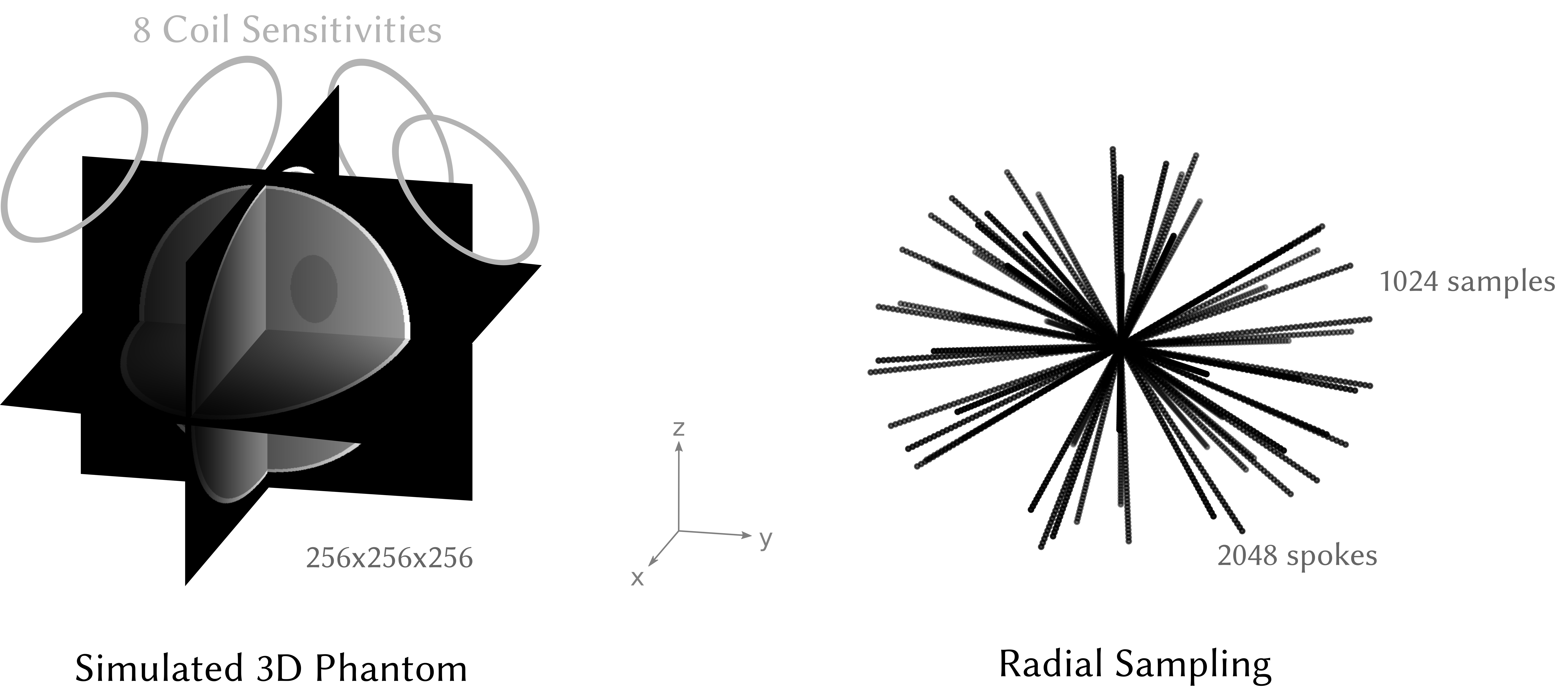
Comparison of nuFFT-ImplementationsWe evaluate the zero-overhead nuFFT implementation on a 256x256x256 voxel 3D Shepp-Logan phantom with $$$N_C=8$$$ coils, as visualized in Figure 2. We measure peak-memory and run-time of the CPU-implementations for the (adjoint-)nuFFT of BART with zero-memory-overhead, FINUFFT[7] and SigPy[8] on an Intel Xeon Gold 6132 processor using 32 threads. Similarly, we measure run-time and peak-memory for the GPU implementations of BART, gpuNUFFT[9], and SigPy on an Nvidia Tesla V100 GPU (32GB).
Low-Memory Modes in BART
We integrated the low-memory nuFFT implementation in the PICS tool to inverse problems of the form$$\mathbf{x}^*{}={}\text{argmin}_{\mathbf{x}}{}\sum_{i=1}^{N_C}\lVert{}\mathcal{PFC_i}{}\mathbf{x}{}-{}\mathbf{y}_i{}\rVert{}_2^2{}+{}\mathcal{R}(\mathbf{x})\;.$$Here, $$$\mathbf{x}$$$ is the volume to be reconstructed, $$$\mathcal{C}_i$$$ are the coil-sensitivity maps, $$$\mathbf{y}_i$$$ is the k-space data, $$$\mathcal{FP}$$$ is the non-Cartesian Fourier transform, and $$$\mathcal{R}(x)$$$ is the regularization. Typical iterative PICS reconstructions involve once the application of the adjoint $$$\mathcal{C}^H\mathcal{F}^H\mathcal{P}^H\mathbf{y}$$$ and afterwards multiple applications of the normal operator $$$\mathcal{C}^H\mathcal{F}^H\mathcal{P}^H\mathcal{PFC}$$$ in the iterations. The memory required for applying the normal operator with different implementations of the nuFFT is visualized in Figure 1. We measure peak-memory and reconstruction time for a CG-SENSE reconstruction with 30 CG-steps using four different modes, i.e.
- Normal: as in Figure 1C), but computing all phases in parallel;
- Low-mem: as in Figure 1C);
- Coil-Stack: as Low-mem but $$$N_C=1$$$ by looping over coils;
- Coil-Stack + No-Toeplitz: as in Figure 1B) with $$$N_C=1$$$.
Results
Comparison of nuFFT ImplementationsFigure 3 presents the nuFFT performance measurements of the respective nuFFT implementations. The BART zero-memory-overhead implementation uses only 1.46GB memory. The FINUFFT is significantly faster but uses more memory.
On the GPU, BART requires additionally 1GB of memory as internal working space for the CUDA-FFT. BART and gpuNUFFT have similar computational performance and memory footprint.
Low-Memory Modes in BART
Memory and run-time measurements of the CG-SENSE reconstructions are presented in Figure 4. On the Xeon Gold 6132, each memory optimization increases the reconstruction time due to less efficient parallelization. On the i7-6700K, the same effect is observed for the Coil-Stacking vs. Low-mem mode. On the Tesla V100, the different modes behave similar, while CPU gridding is still dominated by the less efficient CPU parallelization. Memory optimizations allow for GPU acceleration on the GTX 670 GPU with 4GB, speeding-up the reconstruction by a factor of two compared to the CPUs.
Discussion and Conclusion
In this work, we presented a decomposition of the nuFFT algorithm allowing for a zero-memory-overhead implementation of the (adjoint-)nuFFT. Comparisons with state-of-the-art implementations show that BART's GPU-nuFFT is computationally competitive to the gpuNUFFT, while the CPU-nuFFT of BART has room for improvements. By integration of the low-memory implementation of the nuFFT and memory optimizations in the SENSE model, we have reduced the memory requirements of CG-SENSE reconstructions by a factor of up to ten, enabling non-Cartesian 3D reconstructions on consumer-level GPUs.Acknowledgements
We acknowledge funding by the "Niedersächsisches Vorab" funding line of the Volkswagen Foundation. This work is funded in part by NIH under grant U24EB029240.
References
[1] M. Uecker et al. Software Toolbox and Programming Library for Compressed Sensing and Parallel Imaging. ISMRM Workshop on Data Sampling and Image Reconstruction, Sedona 2013.
[2] Fessler, J. A., & Sutton, B. P. (2003). Nonuniform fast Fourier transforms using min-max interpolation. IEEE transactions on signal processing, 51(2), 560-574.
[3] Beatty, P. J., Nishimura, D. G., & Pauly, J. M. (2005). Rapid gridding reconstruction with a minimal oversampling ratio. IEEE transactions on medical imaging, 24(6), 799-808.
[4] Ong, F., Uecker, M., Jiang, W., & Lustig, M. (2015). Fast Non-Cartesian Reconstruction with Pruned Fast Fourier Transform. Proc. Intl. Soc. Mag. Reson. Med. 23, 3639.
[5] Fessler Jeffrey A, Lee Sangwoo, Olafsson Valur T, Shi Hugo R, Noll Douglas C. Toeplitz-based iterative image reconstruction for MRI with correction for magnetic field inhomogeneity. IEEE Trans. Signal Processing. 2005;53(9):3393–3402.
[6] Uecker M., Zhang S., Frahm J.. Nonlinear inverse reconstruction for real-time MRI of the human heart using undersampled radial FLASH. Magn. Reson. Med.. 2010;63(6):1456–1462.[9] Fessler Jeffrey A, Lee Sangwoo, Olafsson Valur T, Shi Hugo R, Noll Douglas C. Toeplitz-based iterative image reconstruction for MRI with correction for magnetic field inhomogeneity. IEEE Trans. Signal Processing. 2005;53(9):3393–3402.
[7] Barnett, A., & Magland, J. F. (2017). FINUFFT: a fast and lightweight non-uniform fast Fourier transform library. cit. on, 3695.
[8] Ong, F., & Lustig, M. (2019, May). SigPy: a python package for high performance iterative reconstruction. In Proceedings of the ISMRM 27th Annual Meeting, Montreal, Quebec, Canada (Vol. 4819).
[9] Knoll, F., Schwarzl, A., Diwoky, C., & Sodickson, D. K. (2014, May). gpuNUFFT-an open source GPU library for 3D regridding with direct Matlab interface. In Proceedings of the 22nd annual meeting of ISMRM, Milan, Italy (p. 4297).
Figures
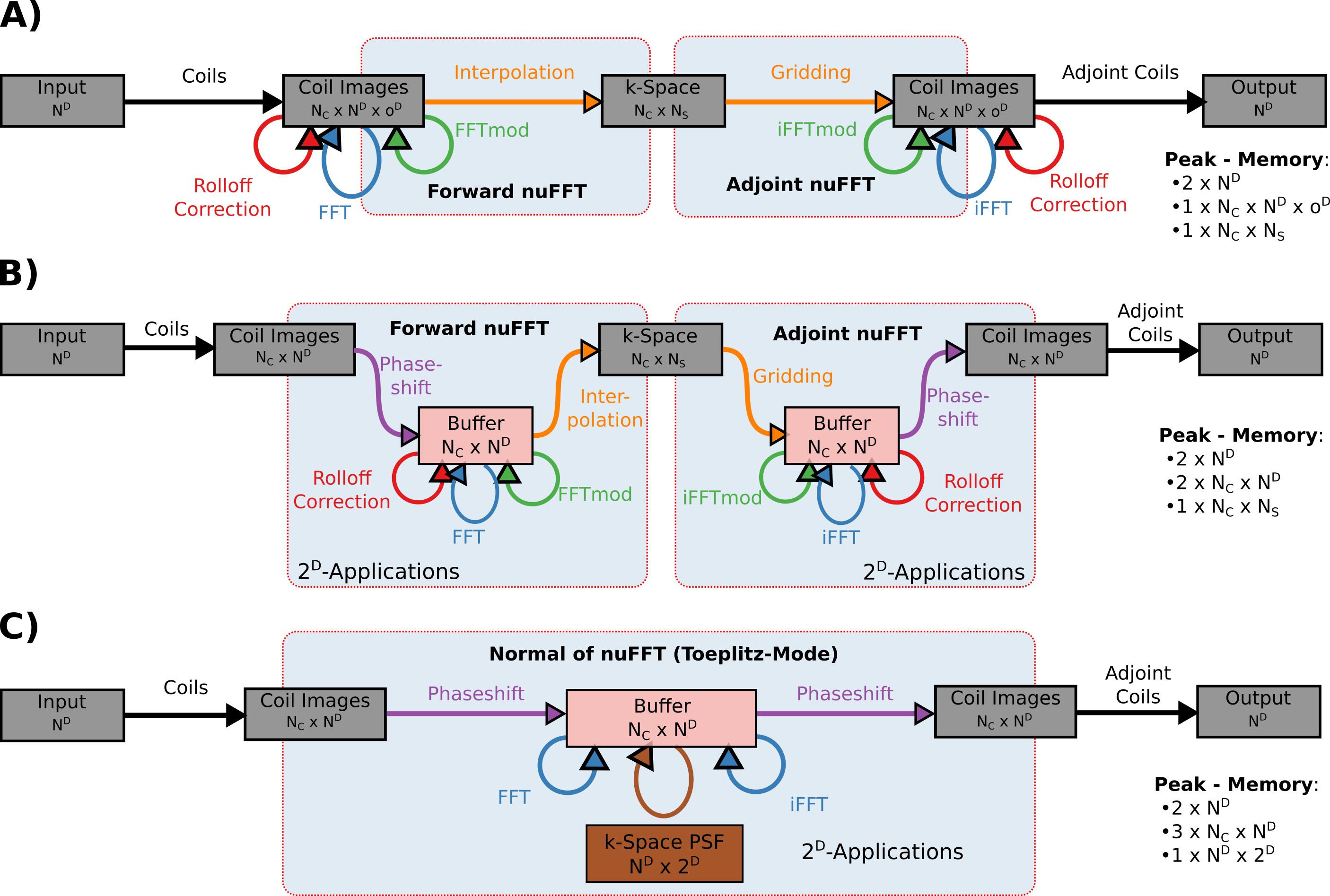
Different implementations and respective peak-memory requirements of the SENSE normal operator. A) Usual implementation on an oversampled grid as in Eq. 2. B) Decomposed nuFFT as in Eq. 3. As all operations on the buffers are linear and invertible, the coil-images can be used instead to implement a zero-overhead version. C) Toeplitz-mode implementation which does not require gridding or interpolation but needs to hold the point-spread-functions on a $$$2^D$$$ oversampled grid.
By computing the operator for all coils sequentially, the peak-memory is reduced to $$$N_C=1$$$.
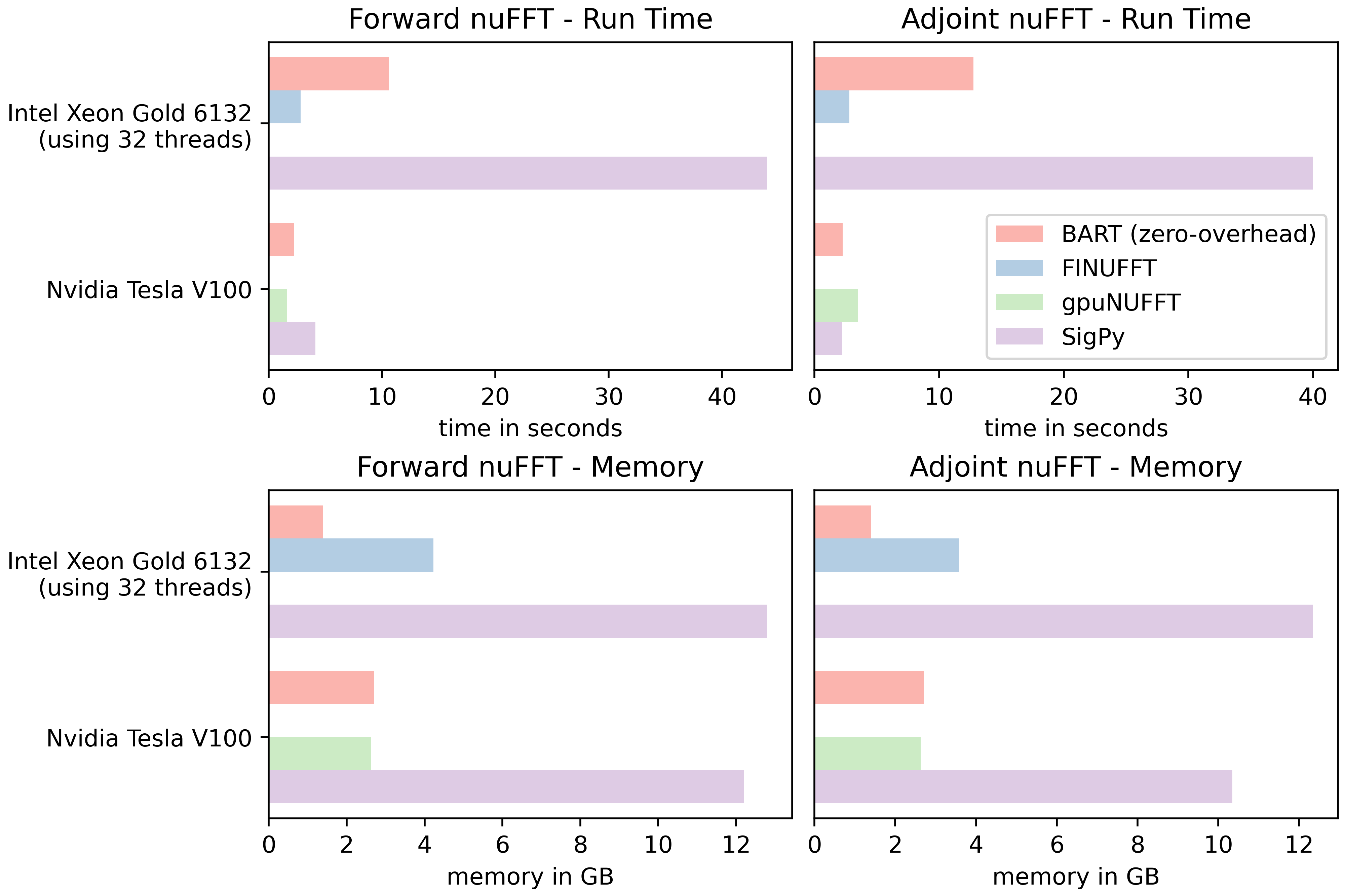
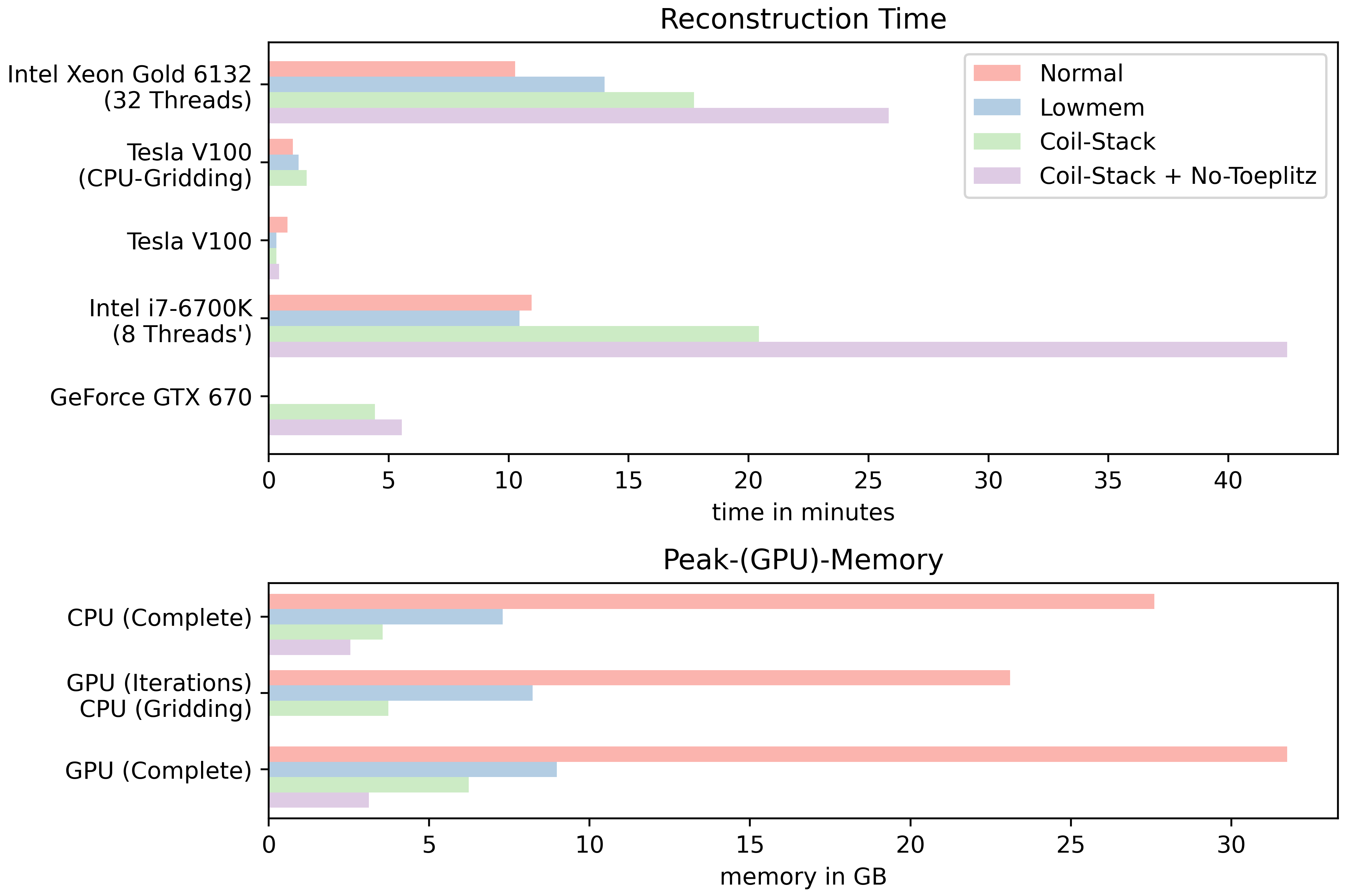
Run-time and memory requirements of the different CG-SENSE reconstructions in BART on different CPUs and GPUs. The 32-thread-CPU reconstructions are affected by the low-memory modes due to less efficient parallelization, while the same effect only takes place for the 8-thread reconstruction for looping over the coils. The memory-optimizations reduce the required memory from 28GB down to 2.7GB, enabling the reconstruction on the 4GB GTX 670 GPU, which halves the reconstruction time compared to the CPUs.