4946
Neurochemical effects of intrusive thinking in pathological and non-pathological worriers: A combined MRS, functional connectivity study1Bambino Gesù Pediatric Hospital, Rome, Italy, 2Sapienza University of Rome, Rome, Italy, 3IRCCS Santa Lucia Foundation, Rome, Italy, 4Centro Ricerche Enrico Fermi, Rome, Italy
Synopsis
Keywords: Psychiatric Disorders, Brain, Spectroscopy; GABA; Glx
The present study combined magnetic resonance spectroscopy, resting state functional connectivity and ecological momentary assessment to support the view that intrusive thinking may be pathologically maintained via negative reinforcement, namely a reduction in autonomic arousal that prevents the transition from a relaxed state to a spike of activation.
Introduction
Excessive worry is a core symptom of generalized anxiety disorder (GAD; DSM-V) and has been conceptualized as a chain of thoughts and images, negatively affect-laden and relatively uncontrollable1. However, worry is definitely not restricted to psychopathology, in fact it can be extremely pervasive also in people who do not meet a former diagnosis of GAD2. Intrusive Thinking (IT) has been shown to be a key factor in anxiety and a good predictor of both maintenance and relapse of depression and anxiety disorders3,4.Alterations in neurotransmission mediated by gamma-amino-butyric acid (GABA) and glutamate (Glx), respectively the main inhibitory and excitatory neurotransmitters, are posited to play a pathophysiological role in stress-related disorders. Evidence, however, comes from comparisons between pathological and healthy samples at rest, making it difficult to understand the processes underlying this assumption. The study aims to bridge this important gap and exploit MRS and fMRI connectivity to elucidate the effect of IT induction in two cohorts of subjects.Methods
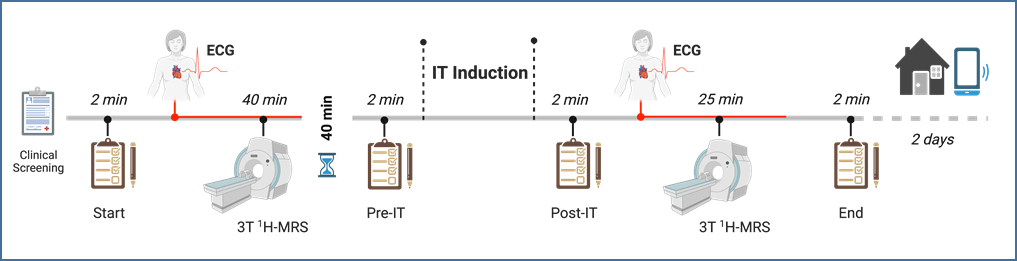
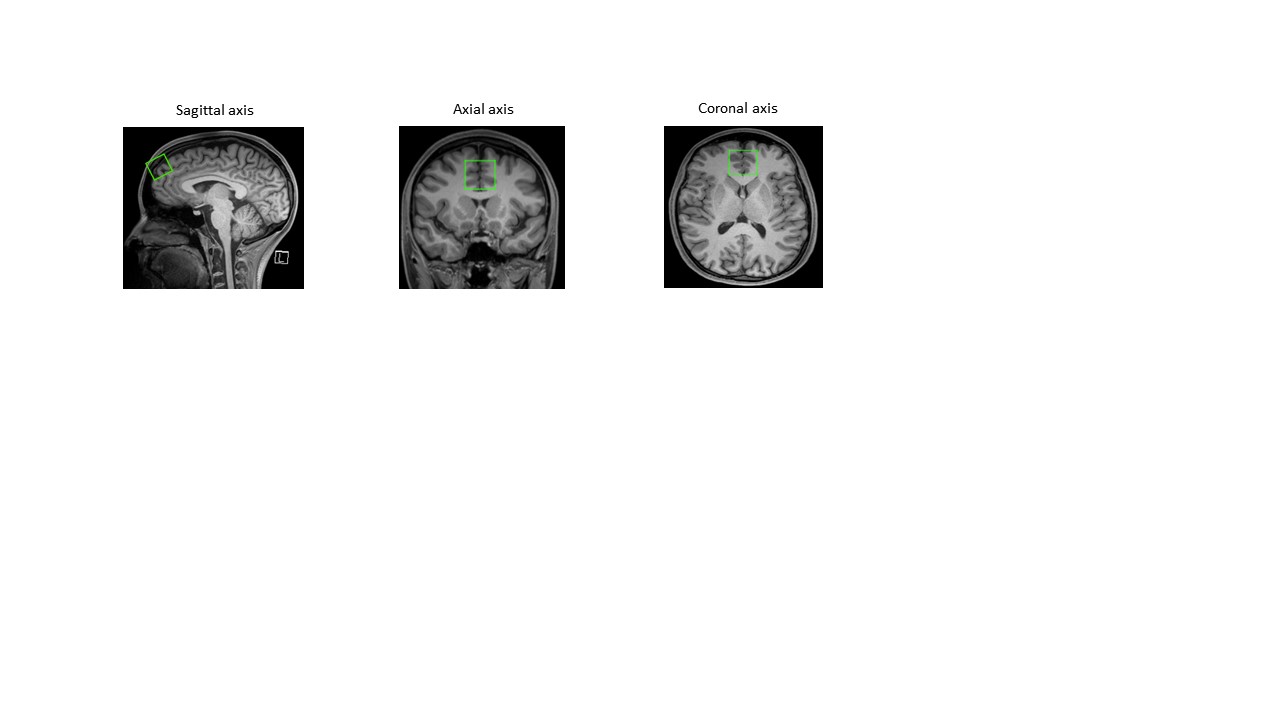
The present study exploited magnetic resonance spectroscopy and fMRI to investigate the effects of an experimental induction of intrusive thinking on brain connectivity as well as on GABA and Glx concentrations in the Anterior Cingulate Cortex (ACC) of pathological worriers (n = 29; 11 males) and controls (n = 29; 16 males). All participants underwent to two MRI scan (Siemens Prisma 3T) with same protocol interleaved by an Intrusive thinking induction. During such task they were asked to recall and describe an episode/image/memory that had been recently intruding in their mind over and over without them wanting this to happen. The procedure was performed according to the protocol reported in figure 1. To perform GABA and Glx concentration measurements in ACC area, MEGA-PRESS (Meshcher-Garwood Point RESolved Spectroscopy) sequence was used (figure 2). Each acquisition was then followed by a matched water-unsuppressed acquisition for phase and eddy-correction and water scaled quantification. All MRS images were acquired with TE=68 ms, 64 averages per OFF and ON respectively. Functional connectivity data consisted of EPI-bold sequence (TR=800ms, TE=30ms MB=2; 1.5x15x1.5 mm3) and two spin-echo (SE) EPI blip-up/blip-down for distortion correction purpose (TE = 80 ms, TR = 7,660 ms, matrix = 94×94 mm, FOV = 208x182 mm, resolution = 2.2×2.2×2.2 mm, flip angle = 90°). For each subject physiological signals were recorded for denoising purposes. A structural T1w acquisition was also included in the protocol (TR=800ms, TE=30ms). Distortion correction and preprocessing was performed by using with Human Connectome Project (HCP)’s Preprocessing Pipelines 5 as implemented in qunex (https://qunex.yale.edu/source/). After preprocessing, a parcellation was conducted to extract the connectivity between ACC and insula (INS) region was computed along with all brain areas included in the central autonomic network (ACC, INS, Amygdala and brainstem).The MRS data were preprocessed with GANNET toolbox6 correcting the data for T2 water relaxation time as well as for tissue composition. The spectrum was fitted with lcmodel software. A repeated measure with time and group and their interaction as factors was applied. A further t-test was also run. A t-test was then conducted to evaluate differences in ACC-rINS connectivity between groups for pre and post-induction separetlyResults
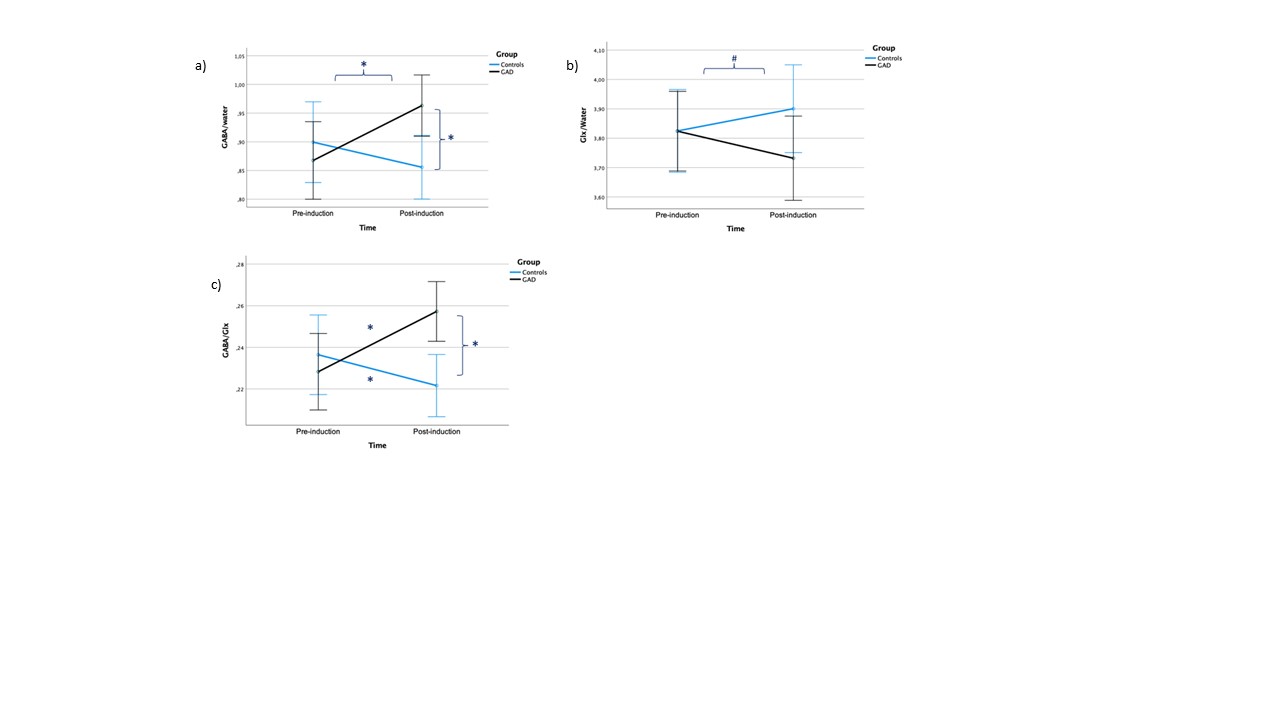
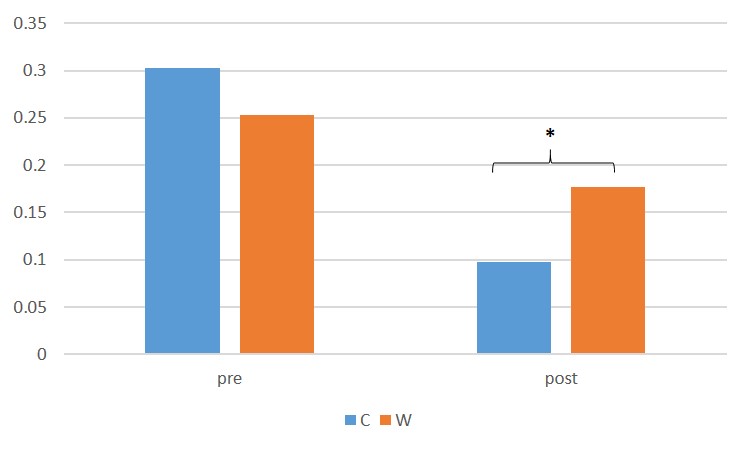
As in figure 3.a statistically significant increase in GABA/water between pre and post-induction was seen in pathological worriers group,(W) while, on the other hand, an inverse trend was seen for control group (C) (p = .02). Comparison in pre-induction status between the two groups didn’t show any statistical significance (p >.05), while concentrations in post-induction were significantly different (p = .01). As can be seen in Figure 3.b, an increase in Glx/water between pre and post-induction in C and a decrease were seen for W, both not statistically significant (p = .08). Concentration comparison in post-induction was not statically significant.Tha analysis for GABA/Glx (figure 3.c) trend showed a similar trend to the one observed for the GABA/water. A significant increase and decrease between pre and post-induction was observed in W and C respectively (p = .001). Only in post-induction a significant difference was observed (p = .001). In figure 4 the result of the t-test between ACC-INS connectivity: only in post status a significant difference was seen (p<.05) with a higher connectivity concentration in W than C one.
Discussion
While increase in GABA was elicited in pathological worriers, an opposite pattern emerged for Glx, with an increase in controls and a decrease in high worriers. Notably, the pre-to post induction increase in GABA that occurred in pathological worriers was associated with a dampened concomitant autonomic arousal and increased resting state functional connectivity within areas belonging to the Cent Autonomic Network. Moreover, resting levels of GABA and Glx resulted capable of predicting subjective responses to the induction, namely levels of intrusiveness and repetitiveness. The validity of the results has been supported by other studies on intrusive thinking whereby disruption in the synaptic balance between inhibitory gamma-aminobutyric acid (GABA) and excitatory glutamate-mediated neurotransmission is considered to play a leading role in the pathophysiology of depression and anxiety.Conclusions
Current results are in line with the view of intrusive thinking as a “better safe than sorry” strategy that aims to avoid the transition from a relaxed state to a spike of autonomic activation.Acknowledgements
No acknowledgement found.References
1. Borkovec TD, Robinson E, Pruzinsky T, DePree JA. Preliminary exploration of worry: Some characteristics and processes. Behav Res Ther. 1983;21(1):9–16.
2. Ruscio AM, Borkovec TD, Ruscio J. A taxometric investigation of the latent structure of worry. J Abnorm Psychol. 2001;110(3):413–22.
3. Spinhoven P, Drost J, van Hemert B, Penninx BW. Common rather than unique aspects of repetitive negative thinking are related to depressive and anxiety disorders and symptoms. J Anxiety Disord [Internet]. 2015;33:45–52. Available from: http://dx.doi.org/10.1016/j.janxdis.2015.05.001
4. Spinhoven P, van Hemert AM, Penninx BW. Repetitive negative thinking as a predictor of depression and anxiety: A longitudinal cohort study. J Affect Disord [Internet]. 2018;241:216–25. Available from: https://doi.org/10.1016/j.jad.2018.08.037
5. Glasser MF, Sotiropoulos SN, Wilson JA, Coalson TS, Fischl B, Andersson JL, et al. The Minimal Preprocessing Pipelines for the Human Connectome Project and for the WU-Minn HCP Consortium. Neuroimage. 2013;80:105–12404.
6. Edden RAE, Puts NAJ, Harris AD, Barker PB, Evans CJ. Gannet: a batch-processing tool for the quantitative analysis of GABA-edited MRS spectra. J Magn Reson Imag. 2011;4(164):1445–52.
7. Makovac E, Fagioli S, Rae CL, Critchley HD, Ottaviani C. Can’t get it off my brain: Meta-analysis of neuroimaging studies on perseverative cognition. Psychiatry Res - Neuroimaging [Internet]. 2020;295(November 2019):111020. Available from: https://doi.org/10.1016/j.pscychresns.2019.111020
Figures