4918
Free water imaging parameter estimation by combination of synthetic q-space learning and conventional fitting: a hybrid approach1Department of Radiorogy, Juntendo University graduate School of Medicine, Tokyo, Japan, 2Department of Radiological Science, Tokyo Metropolitan University, Tokyo, Japan, 3Tohoku University graduate School of Medicine, Miyagi, Japan, 4Graduate School of Infomation Sciences, Hiroshima City University, Hiroshima, Japan, 5Hiroshima Heiwa Clinic, Hiroshima, Japan
Synopsis
Keywords: Machine Learning/Artificial Intelligence, Machine Learning/Artificial Intelligence
Free water imaging (FWl), among the diffusion MRI (dMRI) family, is an extended version of the single diffusion tensor model by adding the isotropic diffusion compartment. Generally, FWI parameters have been estimated by fitting of signal model to measured DWI signals. Recently, machine learning techniques have shown promising results also in dMRI parameter inference.In this study, we aimed at development of a hybrid approach for FWI parameter estimation based on synthetic q-space learning (synQSL) and conventional fitting.Our approach was validated by comparison with the conventional fitting method based on quantitative and visual evaluation and computation time.Introduction
Among the diffusion MRI (dMRI) model family, free water imaging (FWI) is an extended version of the diffusion tensor imaging (DTI) model by adding the isotropic and constant diffusion compartment1. The use of DTI metrics is restricted by the partial volume effect of extracellular free water (FW) in a voxel. Recently, bi-tensor FWI has been developed to quantify the contribution of FW and to eliminate the influence of extracellular FW on DTI metrics1. The signal decay ratio of FWI; E(b, g) is expressed as;E(b, g) = (1- 𝑓)exp(-b・gT Dg)+ 𝑓exp(-b ・ d𝑓w) ・・・ (1)
where b is the b-value, g is MPG direction, D is 2nd-order diffusion tensor with free water elimination, f is volume fraction of isotropic diffusion compartment, and d𝑓w is the fixed value of diffusion coefficient of free water; 3.0 × 10⁻³ mm2/s.
Currently, the bi-tensor model fitting method used to estimate FWI parameters is a challenge for clinical applications because it requires a large amount of computation time.
Recently, machine learning (ML) techniques have shown promising results in dMRI parameter inference2. Especially, training with synthetic data based on signal model equations and noise simulation showed certain advantages, which is called synthetic q-space learning (synQSL)3,4.
We have been studying FWI parameter estimation by using the synQSL and found that the FW volume fraction f is the most reliable among the estimated parameters. Therefore, we developed a hybrid approach, in which only f is estimated by synQSL, and the others are estimated by conventional fitting to free water eliminated DWI signals. The elimination of free water compartment from DWI signals is performed is described in the next section.
In this study, we validated our hybrid approach for FWI parameter estimation by comparison with the conventional fitting method based on quantitative and visual evaluation and computation time.
Materials and Methods
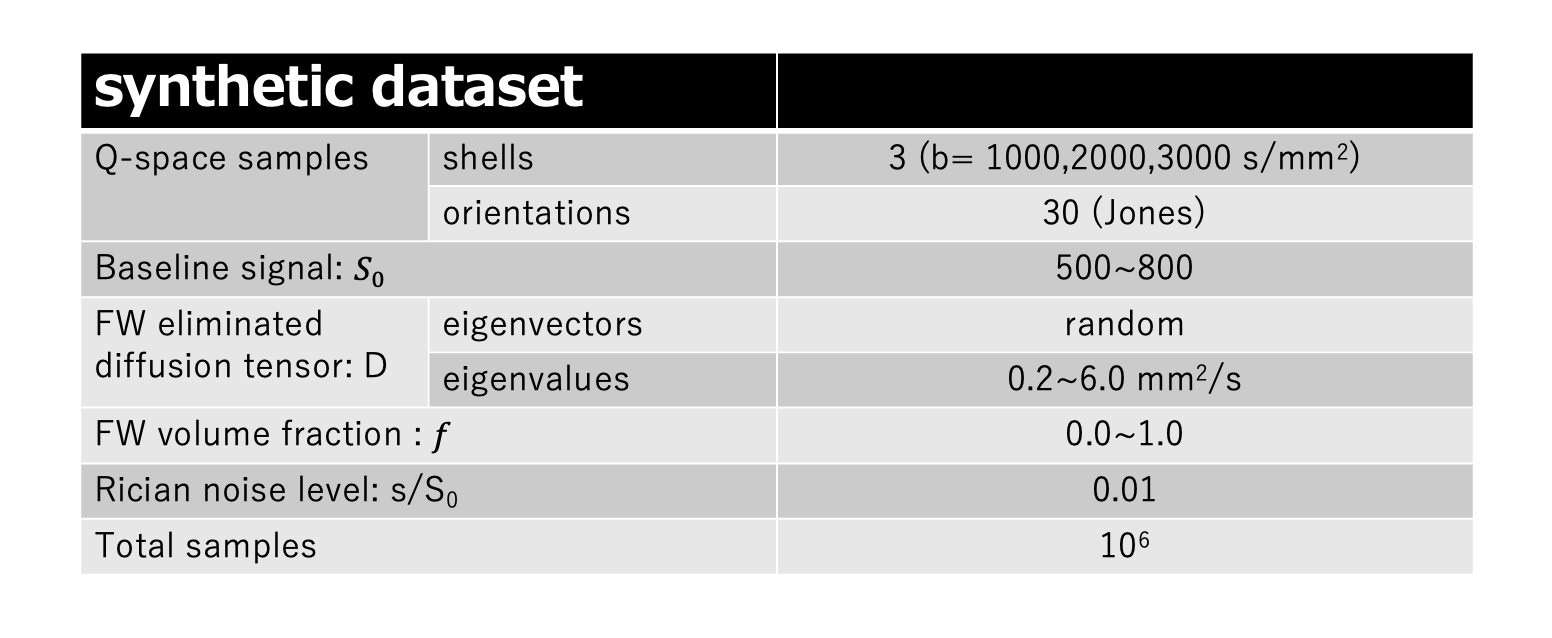
We used the dMRI data sets of 10 healthy 28-year-old men from the Human Connectome Project taken with a 3T MRI scanner and a 32-channel head coil. The Q-space sample size is 288, with 3-shell with b-values of 0, 1000, 2000, and 3000 s/mm2.The synthetic dataset used in synQSL for this study are shown in Table.1.
In the synQSL method, the above synthetic dataset was used for training of multilayer perceptron (MLP) to estimate FW volume fraction (FW), FW-corrected fractional anisotropy (FAt), FW-corrected mean diffusivity (MDt), FW-corrected axial diffusivity (ADt), and FW-corrected radial diffusivity (RDt).
For the hybrid approach, only FW result is used and the FW compartment elimination, that is extraction of restricted diffusion signal, is performed as follows.
The equation (1) is rewritten for the measured signal value of DWI; S(b,g) by multiplying the measured signal value S0 for b = 0 as;
S(b,g) = (1- 𝑓)・S0 exp(-b gTDg)+ 𝑓・S0 exp(-b ・ d𝑓w) ・・・ (2)
If the FW; 𝑓 is given by synQSL, the restricted diffusion signal; Srw(b,g) = S0 exp(-b・gTDg) is separated from the free water signal; S𝑓w(b)= S0 exp(-b ・ d𝑓w) as;
Srw(b,g) = {S(b,g) - 𝑓・S𝑓w (b)}/(1- 𝑓) ・・・ (3)
Then, the fitting for restricted diffusion signal was performed to obtain D by least square method with singular value decomposition5. Finally, FAt, MDt, ADt, and RDt are calculated from the eigenvalues of D.
For the conventional fitting method, we used the "Diffusion Imaging in Python"6 to calculate FWI parameters of FW, FAt, MDt, ADt, RDt.
Results and Summary
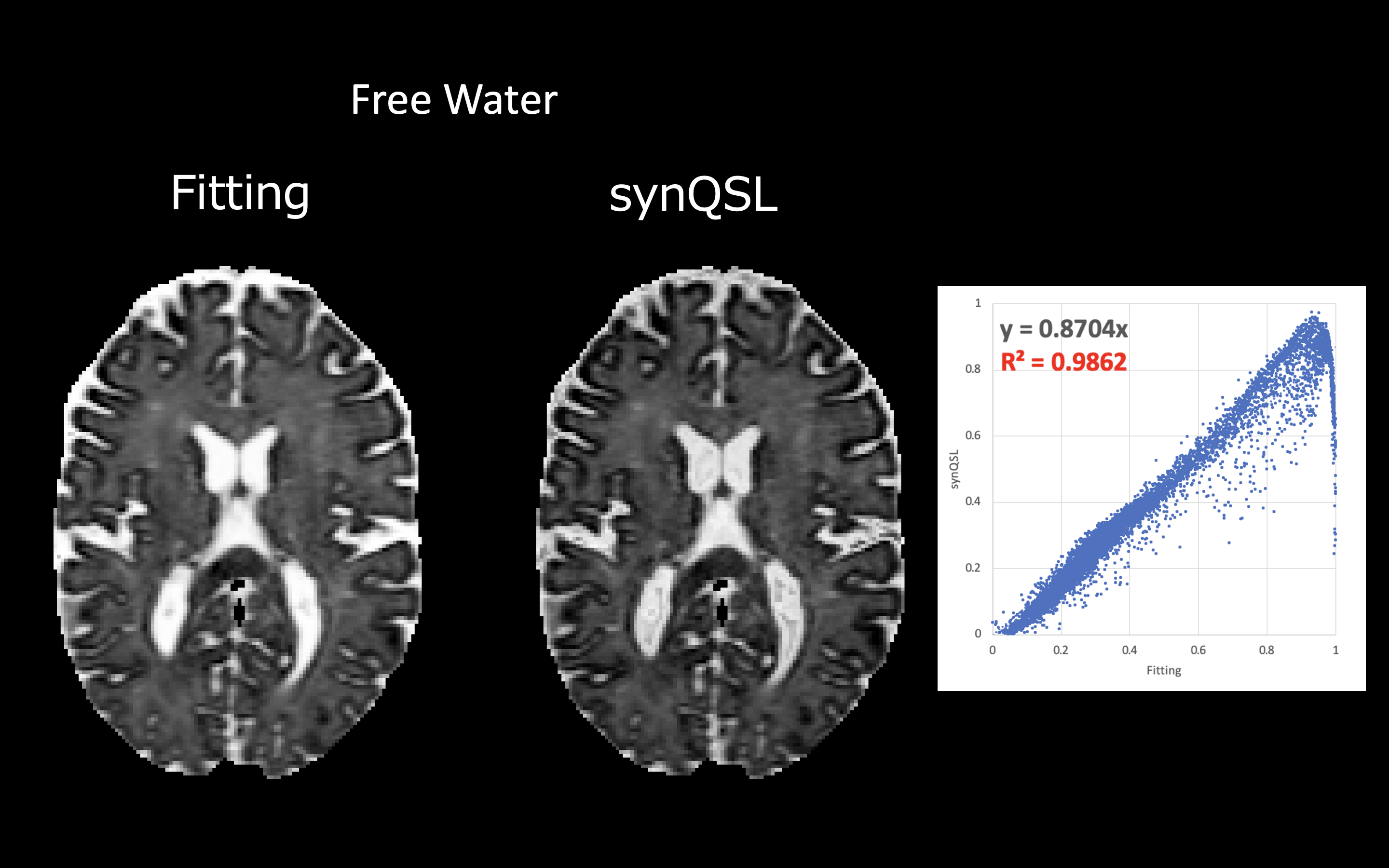
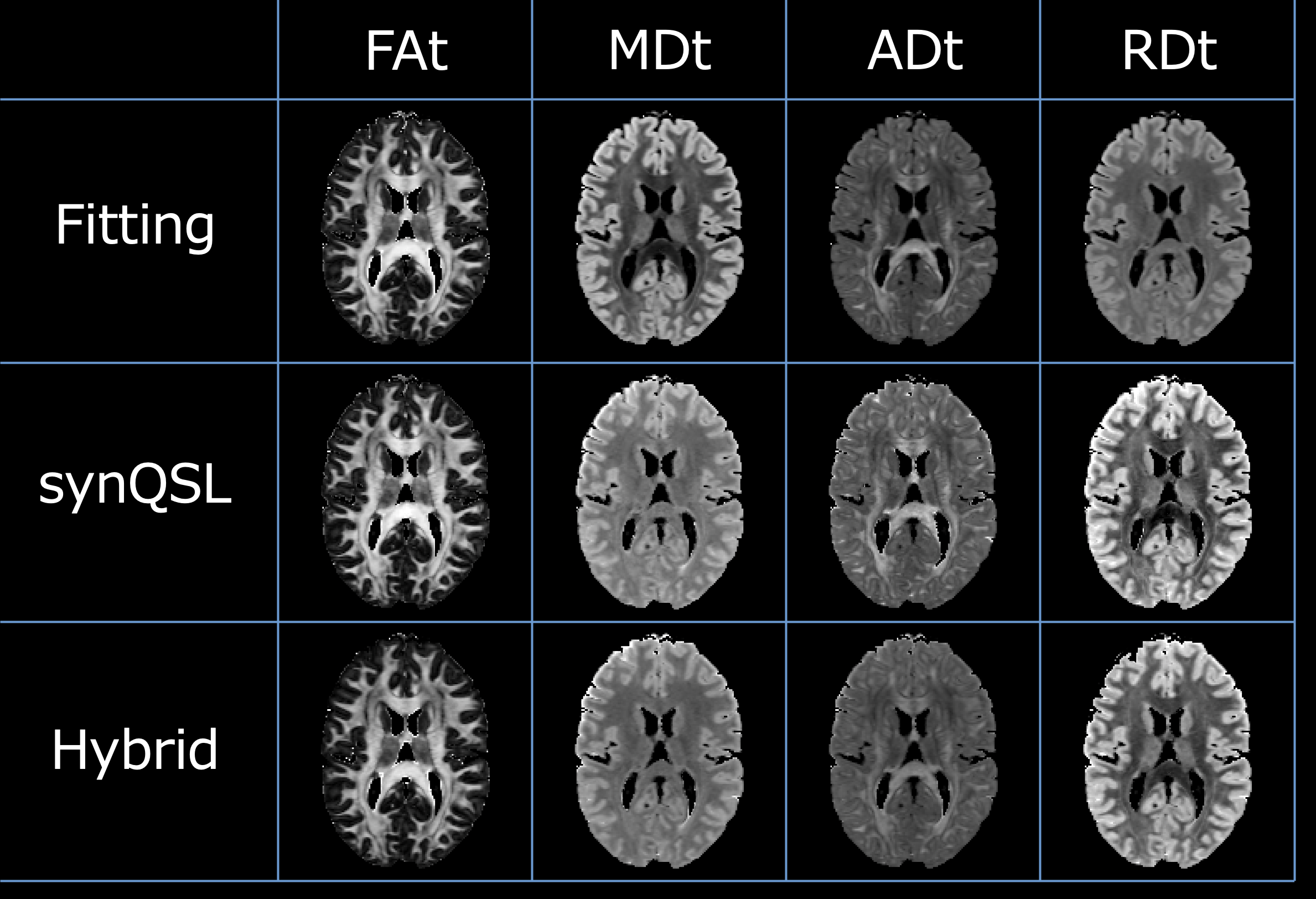
Fig.1 shows that there is little difference between FW values by the conventional fitting and the synQSL visually and quantitatively (voxel-by-voxel correlation coefficient: R2 = 0.986). It indicates that the FW parameter estimation by synQSL is almost equivalent to the conventional fitting.In Fig.2, the visual comparison results are shown by conventional fitting, synQSL only and hybrid approach for the four parameters; FAt, MDt, ADt, and RDt. The same contrast scale was used for each parameter. A certain difference in the high signal value of extracellular free water was observed. The contrast of hybrid approach results were similar to those of conventional fitting, while the synQSL only showed a low contrast in MDt and ADt.
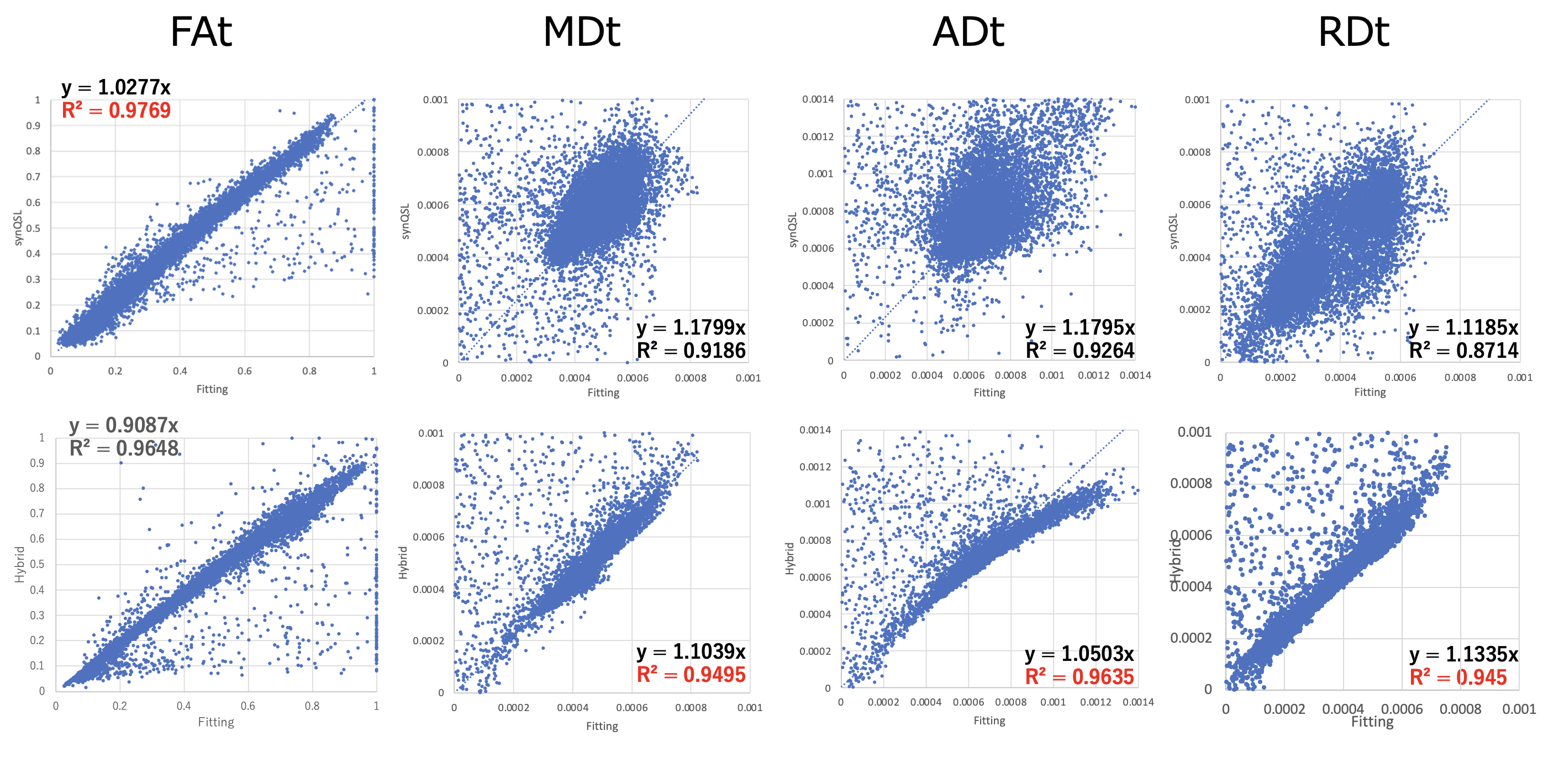
Quantitative evaluation was performed by comparison of conventional fitting vs synQSL only, and conventional fitting vs hybrid approach (Fig.3) with correlation coefficient. There was value deviation in synQSL only result, especially in RDt, with low correlation coefficients.The results by hybrid approach showed a high correlation for all parameters (R2>0.945). It observed that MDt, ADt, and RDt values showed slightly higher estimation trends than conventional fitting mostly in the ventricular area.
The computation time was also compared. About 30 hours per case for conventional fitting, 25 minutes for synQSL only, and 10 minutes for hybrid approach. Both synQSL only and hybrid approach could save a significant amount of time.
In summary, our hybrid approach is superior to synQSL only in FWI parameter estimation quantitatively. In addition, our study shows that our hybrid approach can estimate the parameters of FWI much faster than the other two methods, and it implies its potential usefulness in clinical applications.
Further studies will be conducted using a larger number of data sets and various training settings.
Acknowledgements
The authorrs are grateteful for all the research collaborators for valuable comments, advice and discussion.References
1. Pasternak O, et al. Free water elimination and mapping from diffusion MRI. Magn Reson Med. 2009 Sep;62(3):717-30.
2. V. Golkov et al. q-Space Deep Learning: Twelve-Fold Shorter and Model-Free Diffusion MRI Scans. IEEE Trans Med Imaging. 2016 May;35(5):1344-1351
3. Ye C, et al. q-Space learning with synthesized training data. Computational Diffusion MRI (MICCAI workshop), 2019
4. Masutani Y. Recent Advances in Parameter Inference for Diffusion MRI Signal Models. Magn Reson Med Sci. 2022 Mar 1;21(1):132-147.
5. Masutani Y, et al., MR Diffusion Tensor Imaging: Recent Advance and New Techniques for Diffusion Tensor Visualization. Eur J Radiol 46:53-66, 2003
6. Garyfallidis E, et al. Dipy Contributors. Dipy, a library for the analysis of diffusion MRI data. Front Neuroinform. 2014 Feb 21;8:8.
Figures