4916
Trading Streamlines in Tractography using Autoencoders (TINTA)
Jon Haitz Legarreta1, Laurent Petit2, Pierre-Marc Jodoin1, and Maxime Descoteaux1
1Computer Science, Université de Sherbrooke, Sherbrooke, QC, Canada, 2Université Bordeaux, Bordeaux, France
1Computer Science, Université de Sherbrooke, Sherbrooke, QC, Canada, 2Université Bordeaux, Bordeaux, France
Synopsis
Keywords: Machine Learning/Artificial Intelligence, Tractography & Fibre Modelling
Current tractography methods have a limited ability to accurately reconstruct the long-range brain white matter fiber pathways. Local orientation propagation methods provide tractograms with a non-negligible amount of implausible streamlines. In this work, we propose an artificial intelligence model to recover long-range white matter tracks that are potentially missed in conventional streamline propagation. Our method uses the generative ability of an autoencoder to propose new, plausible streamlines that are subsequently exchanged, according to a given similarity index, with the implausible streamlines in a given tractogram. This allows to potentially improve the reliability of the reconstructed fiber pathways.Introduction
Current tractography methods have a limited ability to accurately reconstruct the long-range anatomical projections of the human brain white matter (WM) fiber pathways. A non-negligible proportion of the seeds used by conventional streamline propagation methods give raise to implausible streamlines1. Such streamlines are a result of prematurely terminated propagation courses or are attributed to non-existing fiber trajectories. Ultimately, this results in tractograms with a poor trade-off between sensitivity and specificity2, 3, 4. We propose a deep learning-based method to recover the plausible streamlines potentially underlying the implausible streamlines in order to improve the reliability of the reconstructed fiber pathways. We name our method TINTA, Trading Streamlines in Tractography using Autoencoders.Methods
We use a deep convolutional autoencoder5 to solve the generative tractography task. The autoencoder is trained on a set of streamlines from a given tractography dataset using the mean-squared error (MSE) as the loss function:$$MSE = \frac{1}{M}\sum_{i=1}^{M} (\hat{s}_{i} - s_{i})^{2}$$
where $$$M$$$ is the total number of streamlines, $$${s}_{i}$$$ is the $$$i$$$-th streamline, and $$$\hat{s}_{i}$$$ is the reconstructed streamline at the output of the autoencoder.
The generative streamlines are reconstructed globally, without propagating local orientations, using the GESTA method6: the trained autoencoder is used to extract new streamlines bundle-wise by sampling the latent space using the rejection sampling method. A set of previously identified plausible streamlines5 are used to seed the rejection sampling procedure. The plausibility of the newly generated streamlines is assessed according to anatomical occupancy, diffusion signal fit, and global geometric criteria. Implausible streamlines from a given tractogram are then projected to the latent space using the encoder model. Each implausible streamline is then substituted by its nearest neighbor streamline in the Euclidean sense from the set of latent-generated plausible streamlines. Figure 1 summarizes this process.
Experiments
We use the "Fiber Cup"7 and the ISMRM 2015 Tractography Challenge (ISMRM 2015) datasets2 in our experiments. Local probabilistic tractography data are prepared and filtered according to5; 10% of the available plausible streamlines are randomly selected to seed the sampling process, and 2000 streamlines are generated from the latent space for each bundle of the "Fiber Cup" dataset, and 15000 for each bundle in the ISMRM 2015 dataset. The streamline evaluation framework used in this work includes anatomical, diffusion signal, streamline geometry, and connectivity (ADGC) criteria6: at least 95% of the streamline vertices must lie in the WM mask; the streamline local orientation alignment with respect to the closest fiber Orientation Distribution Function peak needs to be <30° in, at least, 75% of the traversed voxels; the streamline length is bound to the 20-220 mm range and the winding is upper bounded to 330°; and streamlines are required to end in the gray matter (GM). A dilation is allowed for the WM and GM masks in the ISMRM 2015 dataset. Results are evaluated using the "Tractometer" tool8, and the bundle volume overlap (OL) and overreach (OR), valid bundle (VB), invalid bundle (IB), valid connection (VC), invalid connection (IC), and no connection (NC) rates, as well as the total number of valid streamlines (VC_count) and the total number of streamlines (Strml_count) are reported.Results
Figures 2 and 3 show a subset of the implausible streamlines contained in the raw tractogram of each dataset, and the latent-generated plausible streamlines they are traded to using TINTA. Table 1 shows the measures corresponding to the initial, raw tractogram, and the values obtained after applying the filtering and trading processes on each dataset: all measures are improved for the "Fiber Cup" dataset; the OL is improved for the ISMRM 2015 dataset, but a larger proportion of NC's are reported.Discussion
Results across both datasets show that TINTA successfully increases the white matter volume coverage, and does not introduce new invalid connections, which might be considered8 as the most problematic, or new invalid bundles. This suggests that the generative process is able to extract new plausible streamlines with a high degree of guarantee. The decrease in the VC (paired with an increase in NC) with respect to the filtering step for the ISMRM 2015 dataset stems from the use of dilated GM masks in the plausibility assessment framework.TINTA is a directed deep tractography method: it selectively replaces implausible streamlines in a raw tractogram by their nearest neighbor latent-generated plausible streamlines. In the current proposal, the streamline exchange framework operates in a non-specific way; as the generative process takes place offline, a given implausible streamline is traded to a plausible streamline without exploring further the latent space between them. Future work includes extracting generative streamlines dynamically, and investigating constraints to maximize the overlap provided by the latent-generated streamlines.
Conclusion
We have presented TINTA, Trading Streamlines in Tractography using Autoencoders, a method to trade implausible streamlines to plausible streamlines in tractography using a deep autoencoder. We demonstrate that substituting implausible streamlines with latent space-generated plausible streamlines offers an effective way to increase the white matter volume coverage. Altogether, our findings suggest that our method could potentially provide tractograms that more faithfully represent the long-range structural connectivity of the brain.Acknowledgements
This work has been partially supported by the Centre d'Imagerie Médicale de l'Université de Sherbrooke (CIMUS); the Axe d'Imagerie Médicale (AIM) of the Centre de Recherche du CHUS (CRCHUS); and the Réseau de Bio-Imagerie du Québec (RBIQ)/Quebec Bio-imaging Network (QBIN) (FRSQ - Réseaux de recherche thématiques File: 35450). This research was enabled in part by support provided by Calcul Québec (www.calculquebec.ca) and the Digital Research Alliance of Canada Advanced Research Computing service (www.alliancecan.ca). We also thank the research chair in Neuroinformatics of the Université de Sherbrooke.References
- L. Petit et al. "Half of the streamlines built in a whole human brain tractogram is anatomically uninterpretable". In: 25th Annual Meeting of The Organization for Human Brain Mapping (OHBM). Abstract #Th785. The Organization for Human Brain Mapping. Rome, Italy, June 2019.
- K. H. Maier-Hein et al. "The challenge of mapping the human connectome based on diffusion tractography". In: Nature Communications 8.1349 (Nov. 2017), pp. 1–13.
- K. G. Schilling et al. "Limits to anatomical accuracy of diffusion tractography using modern approaches". In: NeuroImage 185 (Jan. 2019), pp. 1–11.
- C. Thomas et al. "Anatomical accuracy of brain connections derived from diffusion MRI tractography is inherently limited". In: Proceedings of the National Academy of Sciences 111.46 (Nov. 2014), pp. 16574–16579.
- J. H. Legarreta et al. "Filtering in tractography using autoencoders (FINTA)". In: Medical Image Analysis 72 (Aug. 2021), p. 102126.
- J. H. Legarreta et al. "Generative sampling in tractography using autoencoders (GESTA)". Preprint. Paper under review. Preprint. Paper under review. Apr. 2022.
- P. Fillard et al. "Quantitative evaluation of 10 tractography algorithms on a realistic diffusion MR phantom". In: NeuroImage 56.1 (May 2011), pp. 220–234.
- M.-A. Côté et al. "Tractometer: Towards validation of tractography pipelines". In: Medical Image Analysis 17.7 (Oct. 2013). Special Issue on the 2012 Conference on Medical Image Computing and Computer Assisted Intervention, pp. 844–857.
Figures
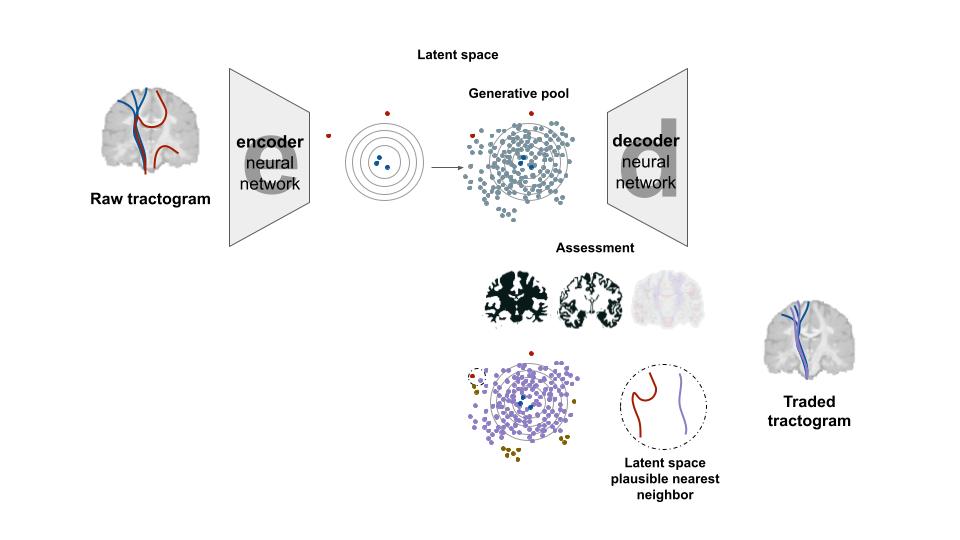
Figure 1: The TINTA framework. A raw tractogram containing a population of plausible (blue) and implausible (red) streamlines is projected into the latent space of a trained autoencoder. The plausible streamlines identified with a given filtering method are used as seeds to extract new streamline candidates; their plausibility is evaluated, and the plausible candidates (purple) are kept. The implausible streamlines in the raw tractogram are traded to the nearest neighbor latent-generated plausible streamlines.
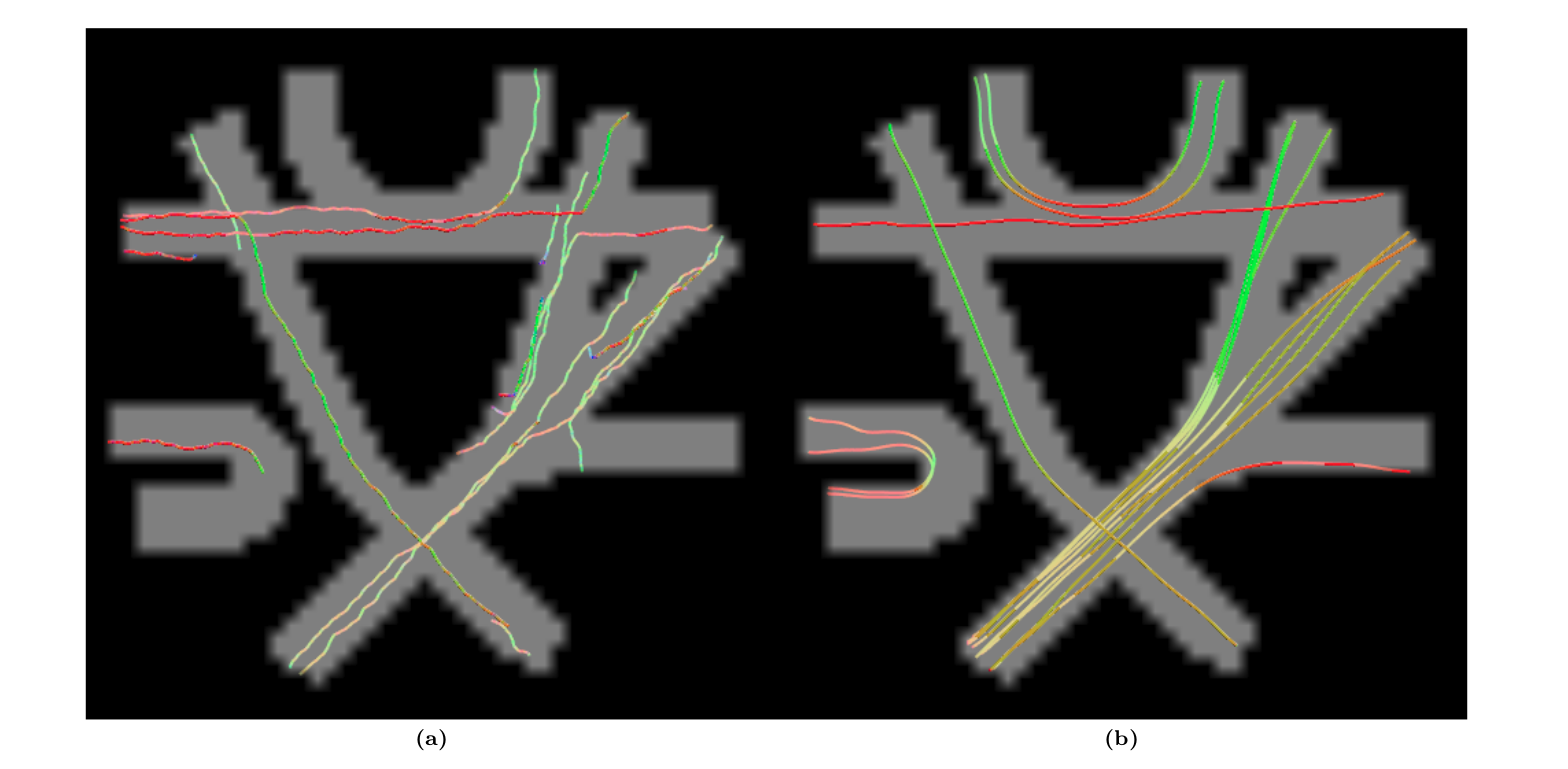
Figure 2: TINTA’s streamline trading on the "Fiber Cup" dataset. In (a) is a subset of the implausible streamlines (b) substituted by plausible streamlines generated from an autoencoder’s latent space.
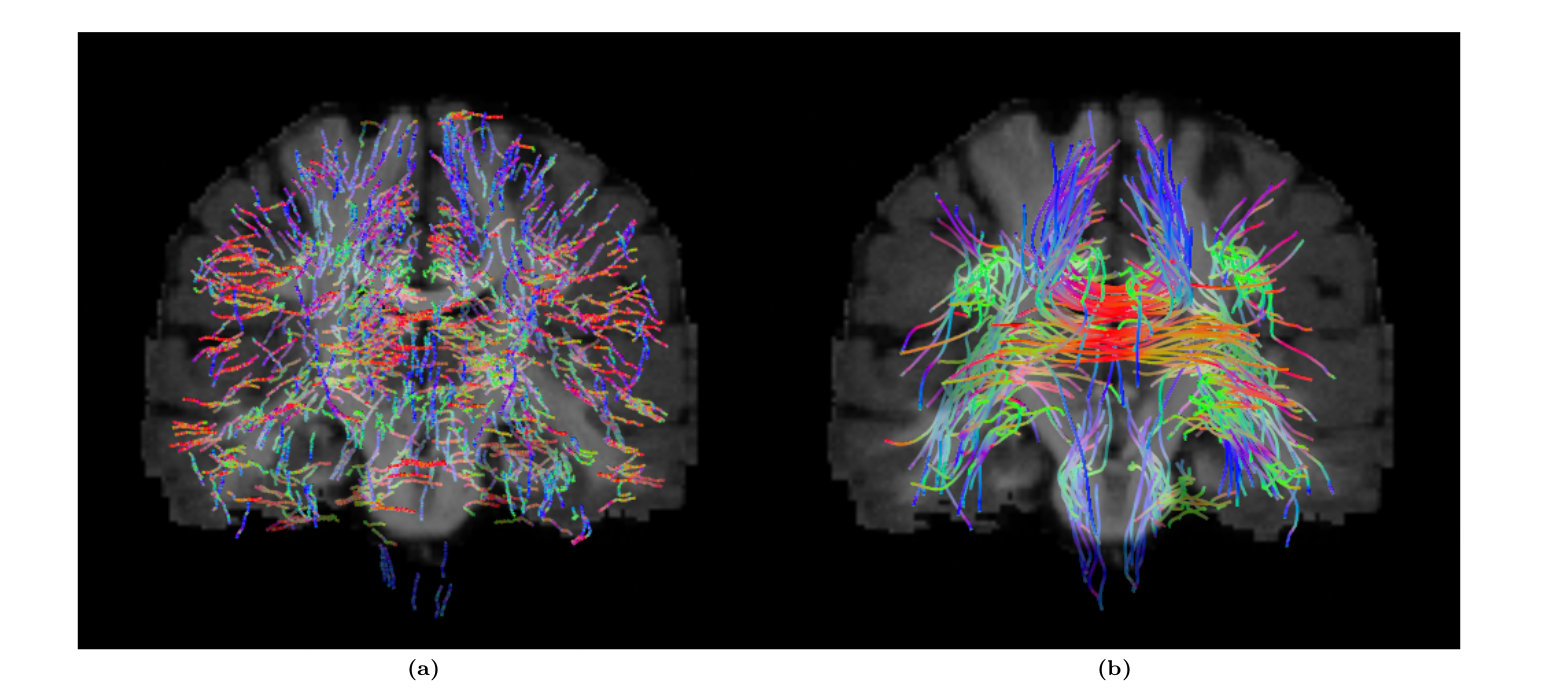
Figure 3: TINTA’s streamline trading on the ISMRM 2015 dataset. In (a) is a subset of the implausible streamlines (b) substituted by plausible streamlines generated from an autoencoder’s latent space.
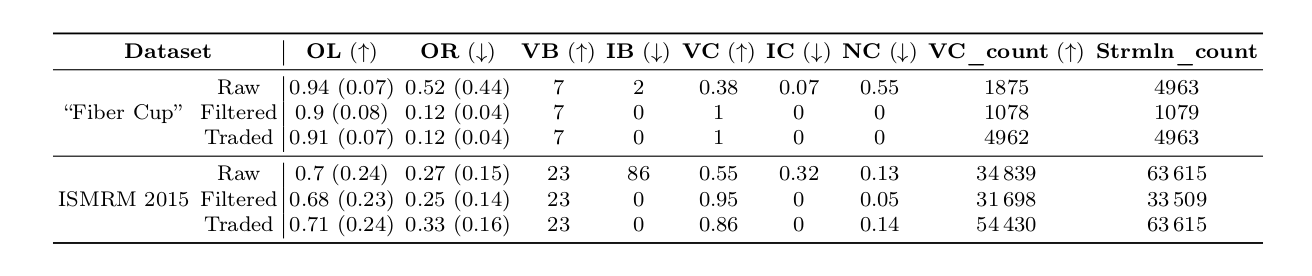
Table 1: Tractography streamline trading measures for the "Fiber Cup" and ISMRM 2015 datasets. Mean and standard deviation values across bundles (where applicable).
DOI: https://doi.org/10.58530/2023/4916