4791
Real-time MRI with Simultaneous Multi-slice and Compressed Sensing1School of Physics, Engineering and Technology, University of York, York, United Kingdom, 2York Cross-disciplinary Centre for Systems Analysis, University of York, York, United Kingdom, 3York Neuroimaging Centre, University of York, York, United Kingdom, 4Institute of Sport, Manchester Metropolitan University, Manchester, United Kingdom
Synopsis
Keywords: Data Acquisition, Data Acquisition
Real time (rt) MRI is currently predominantly a single slice acquisition technique. We show that, by combining compressed sensing, simultaneous multi-slice acquisition and interleaved data ordering with a highly undersampled radial trajectory, multi-slice rtMRI images with a high temporal resolution can be acquired. This offers new opportunities, for example, the non-invasive monitoring of oral and maxillo facial dynamics.
Introduction
Fast switching gradients on modern MRI scanners, alongside iterative image reconstruction, now permit deployment of real time imaging methodologies 1 in clinical and material science applications.Alongside important cardiac applications, real time (rt) MRI offers new opportunities for the non-invasive functional monitoring of the mechanics of speech, swallowing and breathing, including pre-surgical planning, rehabilitation and monitoring for tumour recurrence. This requires MRI sequences with high temporal resolution to image the dynamics of these functions.
Currently most real time MRI studies acquire a single slice with a highly undersampled non-Cartesian trajectory. Combining multiband excitation with this approach allows for multiple slices to be simultaneously acquired 2. Here we present an rtMRI approach which uses a highly undersampled radial trajectory with a compressed sensing reconstruction framework and multiband excitation with CAIPIRINHA phase shifts 3.
Methods
Data acquisition was conducted on a 3T scanner (Siemens, Magnetom Prisma) with a 64 channel rx head/neck coil. We used an RF‐spoiled radially encoded FLASH sequence with a base resolution of 144 points per read direction (oversampling factor = 2) with TR = 2.5ms; TE= 1.21ms and flip angle = 5o. A 5 shot and 19 segment encoding scheme results in 95 spokes covering k-space every 243ms, this is repeated for a user defined number of repetitions. This results in a 4 frame per second (FPS) temporal resolution. To increase the temporal resolution to 70FPS an interleaved sliding window approach was used to combine k-space from adjacent repetitions (Fig.1). Multiband acquisition used CAIPIRINHA phase shifts to improve slice separation.The angle, αs, between segments was distributed using the equation below, where s is the current segment ranging from 1 to S and Nsp is the number of spokes.
$$\alpha_{s}= (s-1) \cdot \frac{\pi}{N_{sp} \cdot S}$$
Reconstruction was performed using a non-linear Conjugate Gradient algorithm 4. A wavelet transform was used to promote sparsity. Fessler’s non-uniform FFT (NUFFT) software package in conjunction with Ram-Lak density compensation is used for gridding 5.
Results
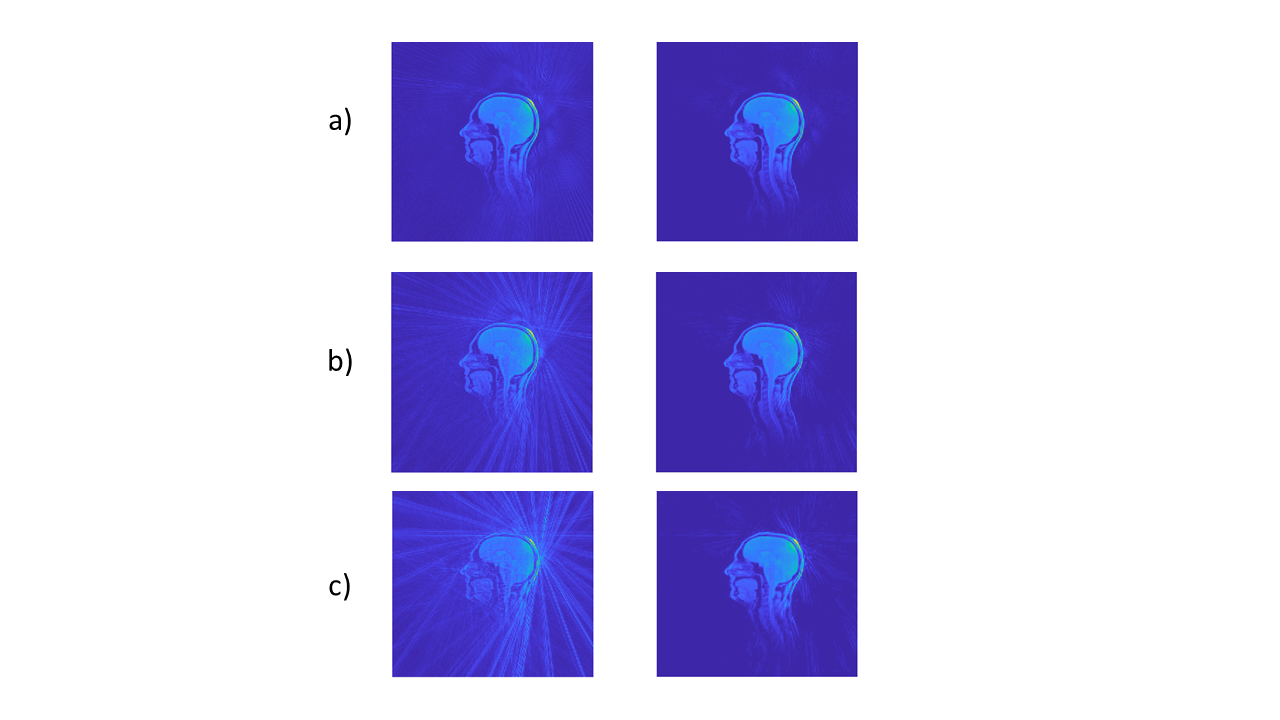
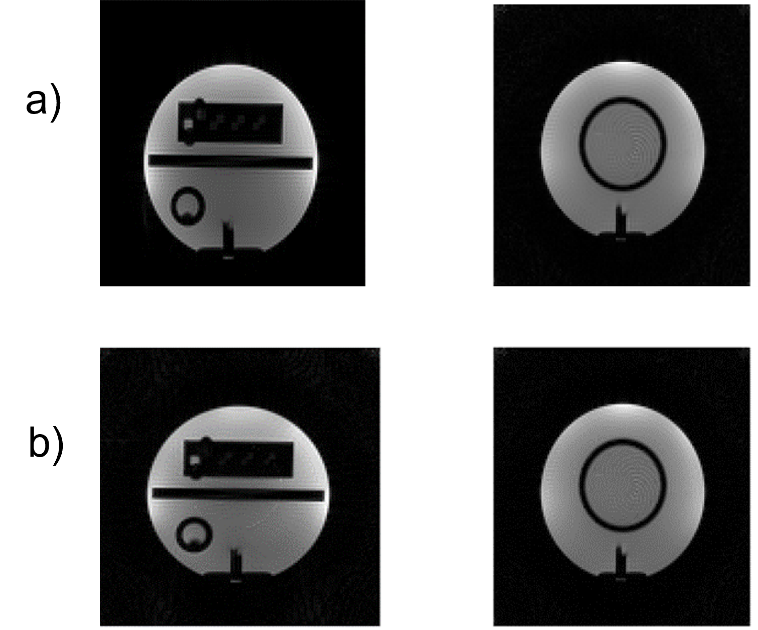
The interleaved reconstruction approach is applied to a variety of oral and maxillofacial rtMRI applications (such as speech, tongue movement).The use of compressed sensing reconstruction for non-Cartesian data is an established approach. Here we apply it to interleaved rtMRI data of the oral cavity. We show that compressed sensing reconstruction results in improved image quality for highly undersampled interleaved radial rtMRI data. Results from radial multiband acquisition are shown in Fig.3, compared against standard sequential slice imaging (20mm gap between slices), we show that the image quality is very similar, but the acquisition time for multiband imaging is nearly half that of the sequential slice approach.
Discussion
Fig.2 illustrates the improvement in image quality using compressed sensing reconstruction compared to a single step NUFFT approach. The gain in image quality does result in increased reconstruction time because of the iterative nature of compressed sensing reconstruction. This introduces the current requirement of offline image reconstruction. To reduce reconstruction times, a Principle Component Analysis (PCA) coil compression scheme is used to generate a reduced set of virtual coils 6. Multiband acquisition allows for the acquisition of multiple slices simultaneously, as shown in Fig.3, but does require a short pre-scan to obtain accurate coil sensitivity maps. Reducing scan time with multiband acquisition will improve patient comfort and provides more extensive anatomical coverage when imaging the dynamics of the oral cavity. Reconstruction times can also be reduced by using GPU acceleration.Outlook
Incorporating sparsity transforms across the temporal dimension may further improve image quality, allowing for higher undersampling. The current need for a pre-scan could be removed by estimating coil sensitivity from the oversampled centre of k-space as radial data has an intrinsic oversampling in this central k-space region. The increase in heating caused by using multiband excitation would be reduced by using more sophisticated RF pulse design techniques which minimise the energy of multiband pulses 7.Acknowledgements
We are grateful to our volunteers for their patience and cooperation with our numerous scanning requests.References
1. Nayak, K.S., Lim, Y., Campbell-Washburn, A.E. and Steeden, J. Real-Time Magnetic Resonance Imaging. J Magn Reson Imaging. 2020.
2. Rosenzweig S, Holme HCM, Wilke RN, Voit D, Frahm J, Uecker M. Simultaneous multi-slice MRI using cartesian and radial FLASH and regularized nonlinear inversion: SMS-NLINV. Magn Reson Med. 2018 Apr;79(4):2057-2066.
3. Yutzy SR, Seiberlich N, Duerk JL, Griswold MA. Improvements in multislice parallel imaging using radial CAIPIRINHA. Magn Reson Med. 2011 Jun;65(6):1630-7.
4.Fessler JA. Optimization Methods for Magnetic Resonance Image Reconstruction: Key Models and Optimization Algorithms. IEEE Signal Process Mag. 2020 Jan;37(1):33-40
5. J. A. Fessler and B. P. Sutton. Nonuniform fast Fourier transforms using min-max interpolation. IEEE Transactions on Signal Processing. 2003; 51: 560-574.
6. Huang F, Vijayakumar S, Li Y, Hertel S, Duensing GR. A software channel compression technique for faster reconstruction with many channels. Magn Reson Imaging. 2008; 26: 133-41.
7. Sbrizzi A, Poser BA, Tse DH, Hoogduin H, Luijten PR, van den Berg CA. RF peak power reduction in CAIPIRINHA excitation by interslice phase optimization. NMR Biomed. 2015 Nov;28(11):1393-401.
Figures
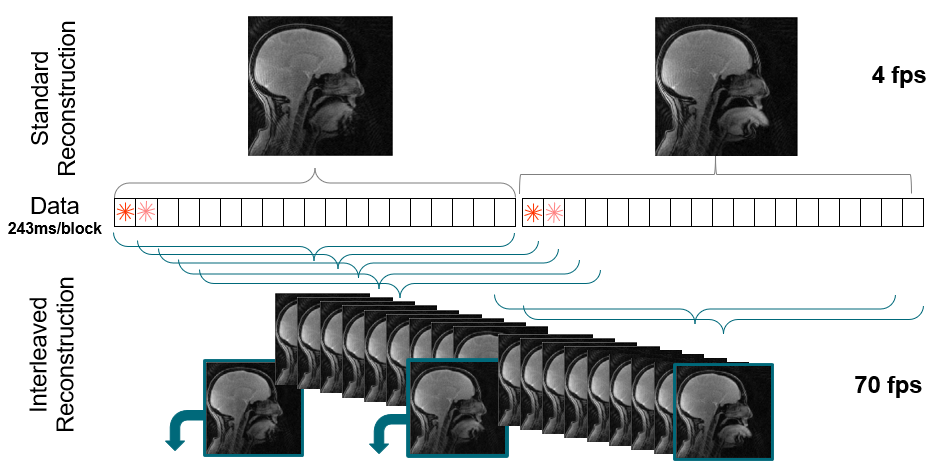
Figure 1 Each data block (centre) consists of 19 segments. In standard reconstruction, each data block is treated independently to generate a frame. In interleaved reconstruction a sliding window is used to combine data from adjacent data blocks.