4779
Fast spatio-temporal subspace reconstruction of 3D-MRF with B0 correction and deep-learning-initialized compressed sensing (Deli-CS)
Natthanan Ruengchaijatuporn1,2, Siddharth Srinivasan Iyer3,4,5, Sophie Schauman3,4, Quan Chen3,4, Xiaozhi Cao3,4, Itthi Chatnuntawech6, and Kawin Setsompop3,4
1Center of Excellence in Computational Molecular Biology, Faculty of Medicine, Chulalongkorn University, Bangkok, Thailand, 2Center for Artificial Intelligence in Medicine, Faculty of Medicine, Chulalongkorn University, Bangkok, Thailand, 3Department of Radiology, Stanford University, Stanford, CA, United States, 4Department of Electrical Engineering, Stanford University, Stanford, CA, United States, 5Department of Electrical Engineering and Computer Science, MIT, Cambridge, MA, United States, 6National Nanotechnology Center, National Science and Technology Development Agency, Pathum Thani, Thailand
1Center of Excellence in Computational Molecular Biology, Faculty of Medicine, Chulalongkorn University, Bangkok, Thailand, 2Center for Artificial Intelligence in Medicine, Faculty of Medicine, Chulalongkorn University, Bangkok, Thailand, 3Department of Radiology, Stanford University, Stanford, CA, United States, 4Department of Electrical Engineering, Stanford University, Stanford, CA, United States, 5Department of Electrical Engineering and Computer Science, MIT, Cambridge, MA, United States, 6National Nanotechnology Center, National Science and Technology Development Agency, Pathum Thani, Thailand
Synopsis
Keywords: Sparse & Low-Rank Models, Machine Learning/Artificial Intelligence
Recent advances in spatio-temporal subspace reconstruction has enabled accurate reconstruction from highly accelerated scans. Nevertheless, such methods suffer from being computationally intensive due to their iterative nature coupled with the large dimensionality of the problem, especially when imperfection correction is incorporated into the formulation. This abstract proposes deep-learning-initialized compressed sensing (Deli-CS) to accelerate such spatio-temporal reconstruction by providing it with a deep-learning-reconstructed initial solution, reducing the number of iterations required. Using MRF as an example, Deli-CS reconstructs data from a rapid 1-mm isotropic whole-brain TGAS-SPI-MRF with time-segmented B0 correction at 3x faster speed compared to FISTA.Introduction
Spatio-temporal low-rank subspace reconstruction1 has enabled high quality reconstruction for highly accelerated spatio-temporal data. The technique has been used for many acquisitions2-4, including magnetic resonance fingerprinting (MRF)5,6. Such reconstruction can be very computationally intensive, particularly for non-separable 3D non-cartesian cases with acceleration along all spatial dimensions with locally-low-rank (LLR) regularization. This issue is further exacerbated when k-space time-segmented modeling is incorporated into the subspace reconstruction to correct for imperfections from e.g. B0 inhomogeneity and concomitant fields.Unrolled deep learning7-9 is a promising direction to improve the reconstruction quality and speed of such applications, but an unrolled network for large 4D (3D + subspace) problems is extremely computationally challenging to train and deploy. We propose deep-learning-initialized compressed sensing (Deli-CS) to speed up large-scale 3D subspace reconstructions and demonstrate its benefits in 3D-MRF application10 with time-segmented B0 correction, where Deli-CS achieved ~3x speed up with comparable reconstruction quality to state-of-the-art FISTA-LLR iterative reconstruction. With Deli-CS, deep learning (DL) is used to initialize an iterative reconstruction instead of being used as the final output, which guards against hallucinations. This is an extension of our previous work, SMILR11.
Methods
Deli-CS: The subspace reconstruction pipeline using Deli-CS consists of three steps (Figure 1): i) a fast SENSE-like conjugate-gradient (CG) reconstruction of a compressed physic model (e.g. with high level of coil compression, and without incorporation of B0 inhomogeneity time-segmentation), followed by ii) a data-driven deep-learning prediction to denoise and dealias the CG-reconstructed images with inhomogeneity mitigation, and iii) a compressed sensing certification, which is a refinement step that performs the full subspace reconstruction using the output from DL-prediction for initialization to achieve fast convergence. Below, we describe the application of Deli-CS for 3D-MRF with B0 time-segmented correction.Acquisition: MRF data were acquired from 13 healthy volunteers with an IRB approval using the TGAS-SPI-MRF acquisition12 on a 3T Premier MRI scanner (GE Healthcare, Waukesha, WI) equipped with 48-channel head coils with the following parameters: 500 TRs, 1-mm isotropic voxel size, and 220-mm isotropic field-of-view. The acquisition time was six minutes per volunteer. The 6-minute data were considered as ground truth for DL training. The undersampled data, denoted as 1-minute data, were simulated by retrospectively undersampling the 6-minute data by a factor of six.
Reconstruction: The following problem (Eq.1) is solved in three steps:
$$min_c ||D(A \Phi c - y)||^2_2 + \lambda LLR(c)$$
where $$$y$$$ is the acquired spatio-temporal data in k-space; $$$A$$$ represents the SENSE forward operator that includes a time-segmented B0 correction, where each spiral interleaf (6.7 ms) is divided into 6 time segments with appropriate phase $$$e^{i \gamma \pi T_{seg}}$$$ added, followed by the non-Cartesian SENSE operator; $$$\Phi$$$ denotes the low-rank basis extracted from the simulated MRF dictionary12; $$$c$$$ denotes the basis coefficients; $$$D$$$ is the polynomial preconditioner13; $$$LLR$$$ is the locally low-rank regularization. First, we solve Eq. (1) without B0 correction in $$$A$$$ using CG for 6 iterations with $$$\lambda=0$$$ and the zero-filled data as an initial solution. The CG-reconstructed data and corresponding B0 map were then processed by a deep residual U-Net (ResUNet)15 that alleviates the aliasing and inhomogeneity artifacts11. Finally, we refine the DL-reconstructed data based on Eq. (1) using FISTA15 and B0 correction to ensure that the final solution is governed by MR-physics.
Dictionary matching: T1 and T2 maps were estimated directly from $$$c$$$ using a standard dictionary matching process with the same parameters as in prior work12.
Experiments: We used the data from 9 volunteers as training data, 2 volunteers as validation data, and 2 volunteers as test data. We compared Deli-CS with B0 correction to that without B0 correction. We also solved the same problem using FISTA for comparison. All methods were implemented in Python16,17 and run on a single GPU.
Results and Discussion
Figure 2A shows a comparison of reconstructed subspace coefficient maps obtained from FISTA reconstruction of 6-minute and 1-minute data and Deli-CS reconstruction of 1-minute data. Deli-CS was able to reconstruct the 1-min data ~3x faster while providing improved quality, particularly in the later hard-to-reconstruct coefficients. This is achieved through leveraging the denoising from DL-prediction and employing early stopping in the refinement step. Figure 2B shows the Deli-CS reconstruction where CG-reconstructed coefficient maps and B0-map are fed to a prediction network to obtain denoised and dealiased coefficient maps, which are then refined in the FISTA-based refinement step. Figure 3 shows the 3rd coefficient map from the 1-minute data for various reconstruction cases. The incorporation of B0-information is shown to mitigate blurring-artifacts in a large B0 region (red-arrow), with Deli-CS providing improved reconstruction at 3x faster speed. Figures 4 and 5 show T1 and T2 maps obtained from FISTA reconstruction of 6-minute data and Deli-CS reconstruction of 1-minute data for two test subjects, where good correspondence can be observed.Conclusion
This work has enabled improved reconstruction of a rapidly-acquired, 1-mm whole-brain TGAS-SPI-MRF12 data with time-segmented B0 correction in 29 minutes using a single GPU. Future work aims to incorporate parallel GPU reconstruction as described in Ref13 to enable this complex large-scale reconstruction to be performed in a few minutes. Due to its application-agnostic nature, the proposed DL-initialized pipeline also lends itself well to other MR applications with different types of imperfection corrections.Acknowledgements
This work was supported in part by NIH research grants: R01-EB020613, R01-EB019437, R01-MH116173, P41EB030006, and U01-EB025162, and GE Healthcare.References
- Liang ZP. Spatiotemporal imagingwith partially separable functions. In2007 4th IEEE international symposium on biomedical imaging: from nano to macro 2007 Apr 12 (pp. 988-991). IEEE.
- Zhao B, Setsompop K, Adalsteinsson E, Gagoski B, Ye H, Ma D, Jiang Y, Ellen Grant P, Griswold MA, Wald LL. Improved magnetic resonance fingerprinting reconstruction with low-rank and subspace modeling. Magnetic resonance in medicine. 2018 Feb;79(2):933-42.
- Assländer J, Cloos MA, Knoll F, Sodickson DK, Hennig J, Lattanzi R. Low rank alternating direction method of multipliers reconstruction for MR fingerprinting. Magnetic resonance in medicine. 2018 Jan;79(1):83-96.
- Tamir JI, Uecker M, Chen W, Lai P, Alley MT, Vasanawala SS, Lustig M. T2 shuffling: sharp, multicontrast, volumetric fast spin-echo imaging. Magnetic resonance in medicine. 2017 Jan;77(1):180-95.
- Christodoulou AG, Shaw JL, Nguyen C, Yang Q, Xie Y, Wang N, Li D. Magnetic resonance multitasking for motion-resolved quantitative cardiovascular imaging. Nature biomedical engineering. 2018 Apr;2(4):215-26.
- Echo planar time-resolved imaging with subspace reconstruction and optimized spatiotemporal encoding. Magnetic resonance in medicine. 2020 Nov;84(5):2442-55.
- Deep ADMM-Net for compressive sensing MRI. Advances in neural information processing systems. 2016;29.
- Learning a variational network for reconstruction of accelerated MRI data. Magnetic resonance in medicine. 2018 Jun;79(6):3055-71.
- Aggarwal HK, Mani MP, Jacob M. MoDL: Model-based deep learning architecture for inverse problems. IEEE transactions on medical imaging. 2018 Aug 13;38(2):394-405.
- Ma D, Gulani V, Seiberlich N, Liu K, Sunshine JL, Duerk JL, Griswold MA. Magnetic resonance fingerprinting. Nature. 2013 Mar;495(7440):187-92.
- Iyer SS, Sandino CM, Yurt M, Cao X, Liao C, Schauman S, Setsompop K. SMILR - Subspace MachIne Learning Reconstruction. In Proceedings of the ISMRM 30th Annual Meeting, London, England, UK 2022 May.
- Optimized multi-axis spiral projection MR fingerprinting with subspace reconstruction for rapid whole-brain high-isotropic-resolution quantitative imaging. Magnetic Resonance in Medicine. 2022 Jul;88(1):133-50.
- Iyer SS, Ong F, Setsompop K. Polynomial Preconditioning for Accelerated Convergence of Proximal Algorithms including FISTA.
- Zhang Z, Liu Q, Wang Y. Road extraction by deep residual u-net. IEEE Geoscience and Remote Sensing Letters. 2018 Mar 8;15(5):749-53.
- Beck A, Teboulle M. A fast iterative shrinkage-thresholding algorithm for linear inverse problems. SIAM journal on imaging sciences. 2009;2(1):183-202.
- Ong F, Lustig M. SigPy: a python package for high performance iterative reconstruction. In Proceedings of the ISMRM 27th Annual Meeting, Montreal, Quebec, Canada 2019 May (Vol. 4819).
- Paszke P. An imperative style, high-performance deep learning library. Adv. Neural Inf. Process. Syst.(32):8026.
Figures
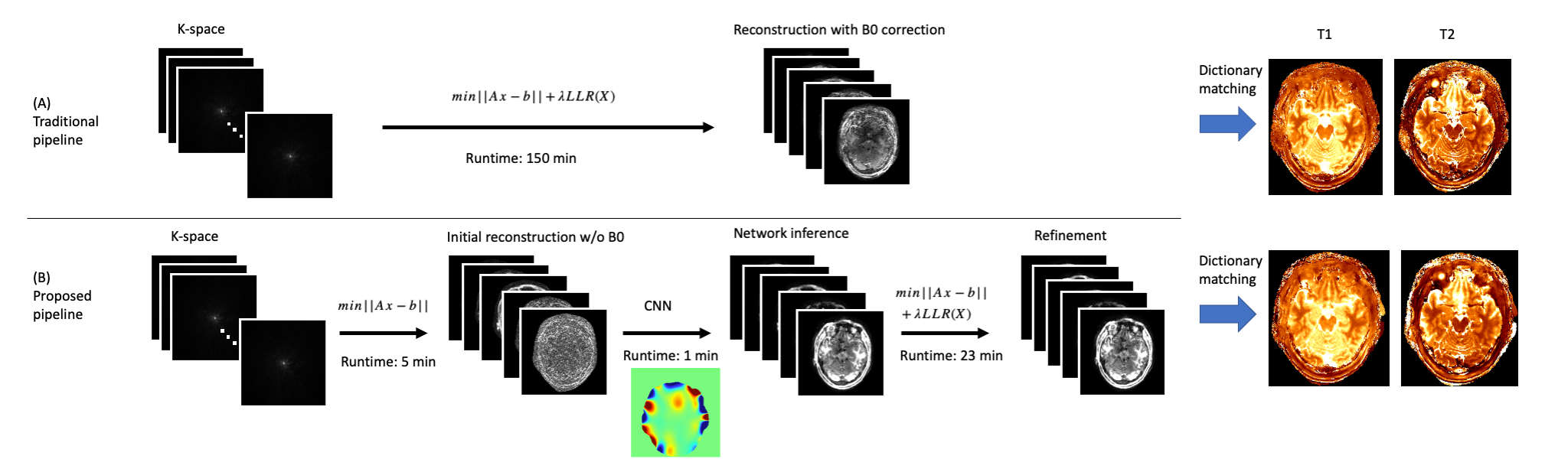
Figure 1. Comparison between traditional pipeline reconstruction using FISTA and the proposed pipeline.
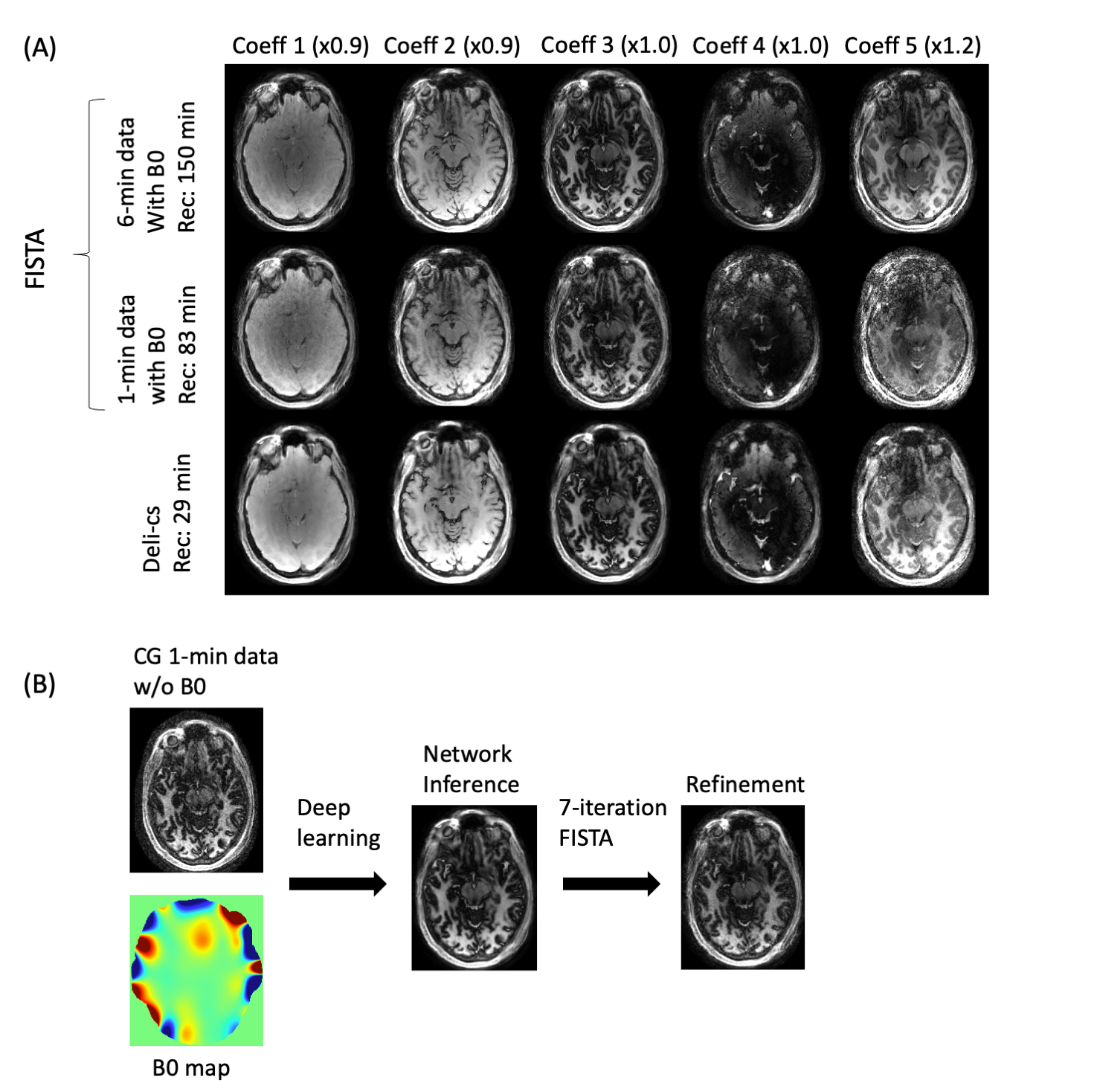
Figure 2. (A) Comparison of reconstructed subspace coefficient maps using FISTA on 6-minute and 1-minute MRF data and using Deli-CS on the 1-minute data. When compared to FISTA, Deli-CS provides improved reconstruction of the 1-minute data at approximately 3x faster speed. (B) Deli-CS reconstruction, where the coefficient maps from CG reconstruction and B0 map are fed to a prediction network to provide improved coefficient maps which are then used to initialize the final FISTA-based refinement step.
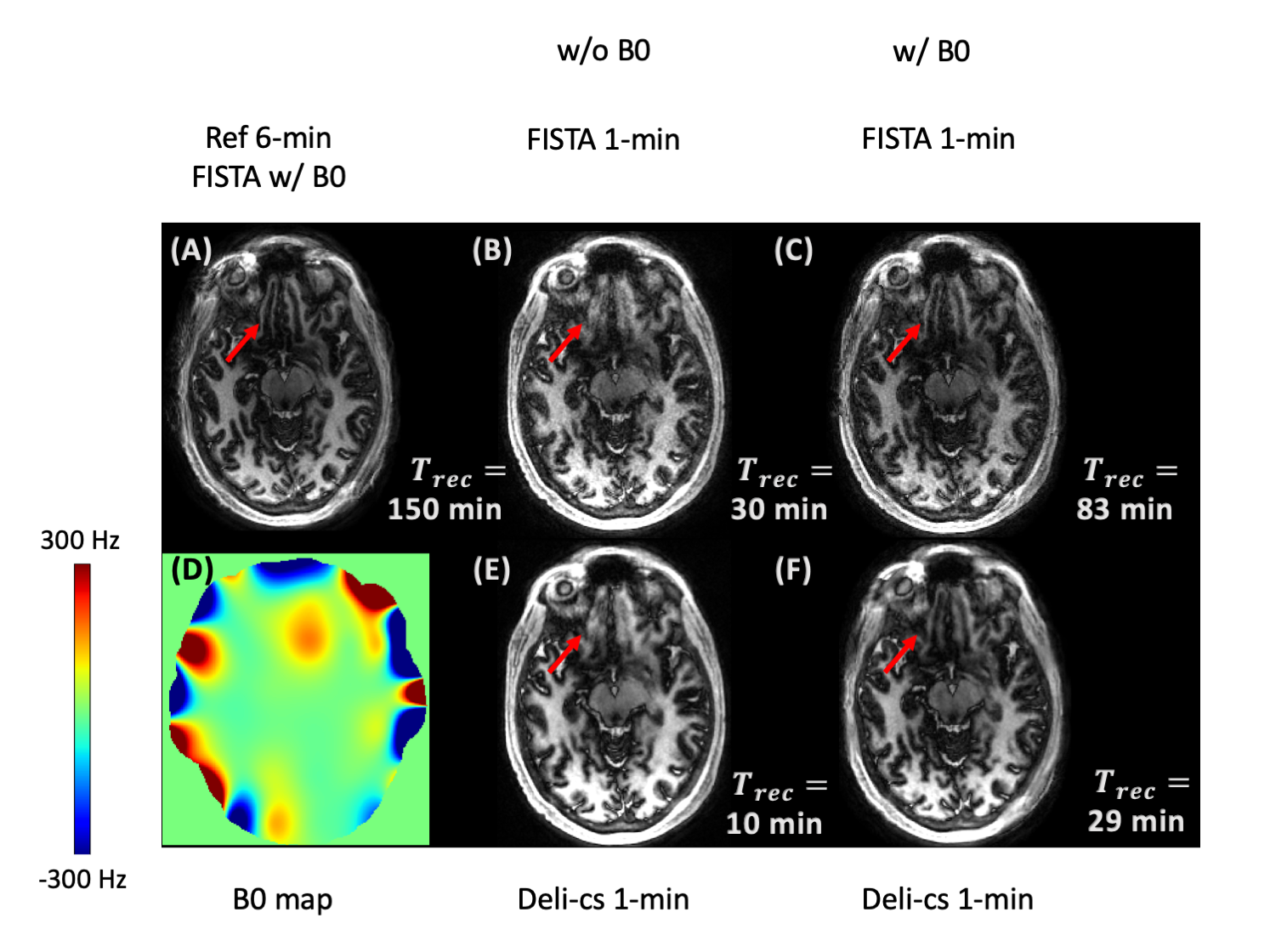
Figure 3. The third coefficient of various reconstruction. (A) is the reconstruction of FISTA that incorporated B0 correction with 6-min data. (B) is the reconstruction of FISTA from 1-min data without B0 correction. (C) is the reconstruction of FISTA from 1-min data with B0 correction. (D) is corresponding B0 map. (E) is the reconstruction of Deli-CS from 1-min without B0 correction. (F) is the reconstruction of Deli-CS from 1-min with B0 correction.
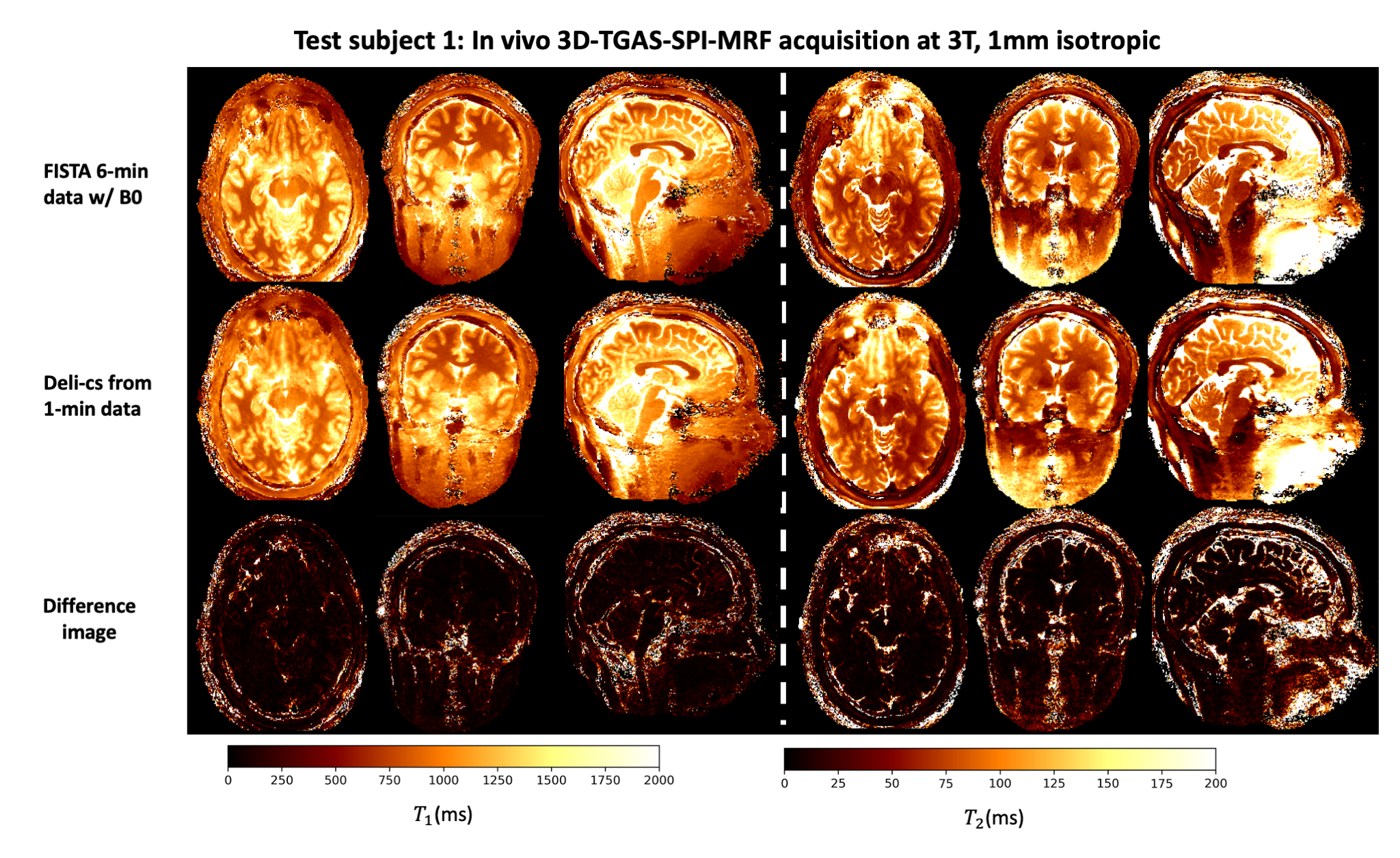
Figure 4. The T1 and T2 parameter fitting reconstructions of test subject 1 obtained from FISTA with 6-min data that incorporated B0 correction and Deli-CS with 1-min data.
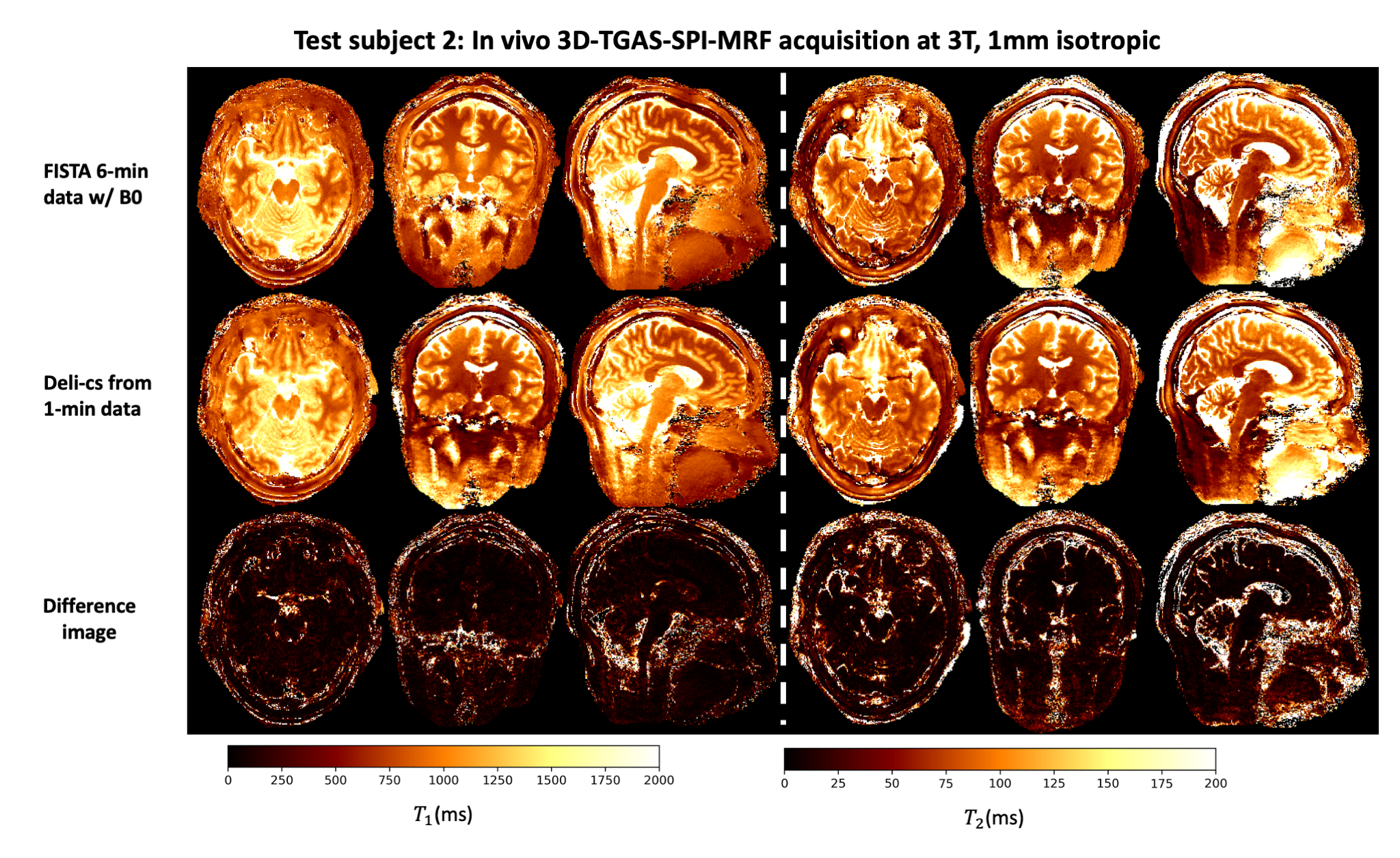
Figure 5. The T1 and T2 parameter fitting reconstructions of test subject 2 obtained from FISTA with 6-min data that incorporated B0 correction and Deli-CS with 1-min data.
DOI: https://doi.org/10.58530/2023/4779