4715
Accelerated Enhanced Simultaneous Single-Quantum and Triple-Quantum-Filtered Sodium MRI Using Compressed Sensing at 7T1Institute of Neuroscience and Medicine 4, Forschungszentrum Jülich GmbH, Jülich, Germany, 2Faculty of Medicine, RWTH Aachen University, Aachen, Germany, 3Institute of Neuroscience and Medicine 11, Forschungszentrum Jülich GmbH, Jülich, Germany, 4JARA–BRAIN–Translational Medicine, Aachen, Germany, 5Department of Neurology, RWTH Aachen University, Aachen, Germany
Synopsis
Keywords: Non-Proton, Pulse Sequence Design, Multiple-quantum filtering; Sodium MRI
Enhanced simultaneous single-quantum and triple-quantum-filtered imaging of 23Na (SISTINA) enables images to be weighted towards restricted sodium, a promising biomarker for clinical practice, but suffers from long acquisition times and low image quality. However, this can be alleviated by applying compressed sensing (CS). This work establishes a novel enhanced SISTINA sequence using FLORET sampling at 7T and demonstrates that CS can accelerate SISTINA acquisitions with less noise and better structure preservation than non-uniform fast Fourier transform while maintaining proper weightings towards total, non-restricted, and restricted sodium. The reduced acquisition time facilitates the clinical transition of enhanced SISTINA.Introduction
Intracellular sodium is sensitive to metabolic cellular dysfunction, whereas extracellular sodium remains stable due to tissue perfusion.1 It is assumed that single quantum (SQ) coherences originate from both non-restricted (predominantly extracellular) and restricted (primarily intracellular) environments, whereas triple quantum (TQ) coherences generally evolve in a restricted, mainly intracellular environment only.2,3 Enhanced simultaneous single-quantum and triple-quantum-filtered imaging of 23Na (SISTINA) enables compartmental discrimination between non-restricted and restricted sodium but suffers from clinically infeasible acquisition times and low image quality.4,5 Compressed sensing (CS) has been shown to accelerate the acquisition and improve the quality of sodium images by exploiting image sparsity to compensate for incoherent undersampling artefacts.6,7 Here, enhanced SISTINA acquisitions at 7T are retrospectively accelerated by applying CS without significant visual loss of information. The reduction in acquisition times is expected to facilitate the applicability of enhanced SISTINA in clinical routine.Methods
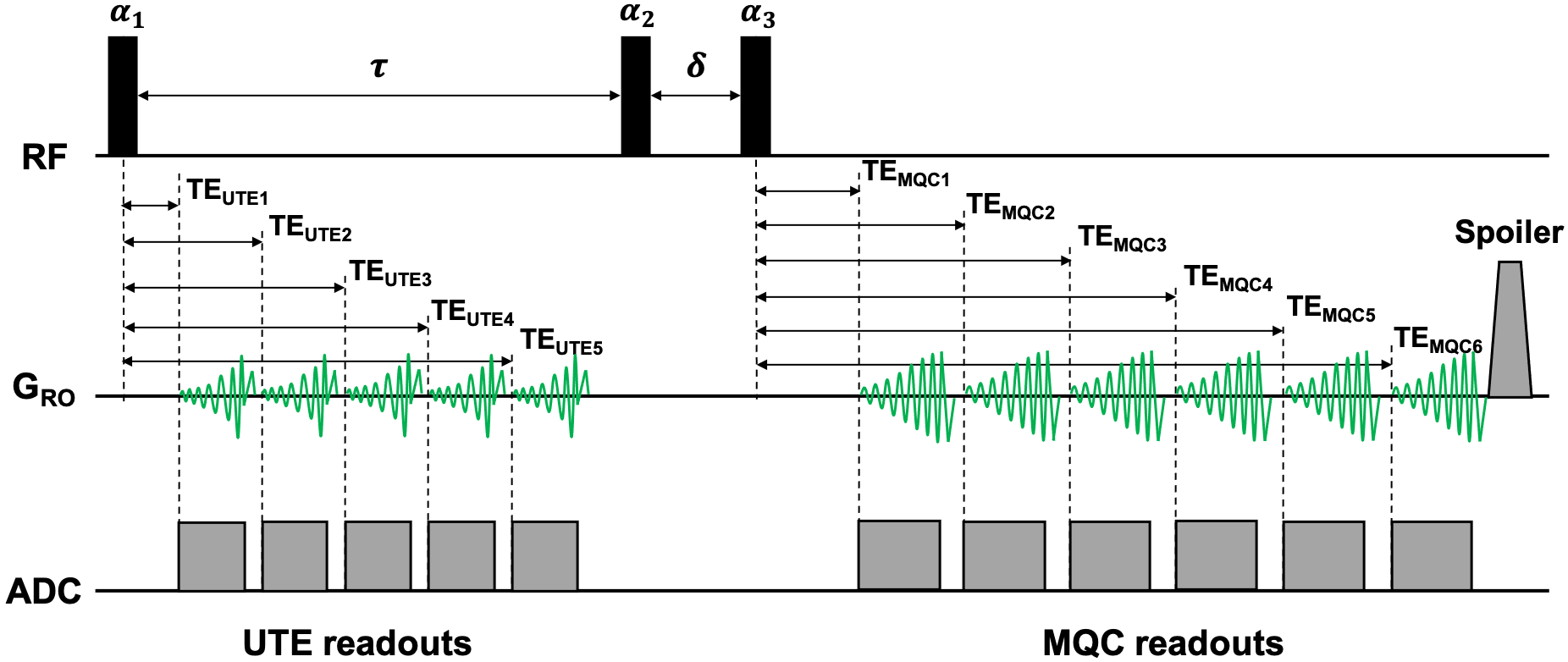
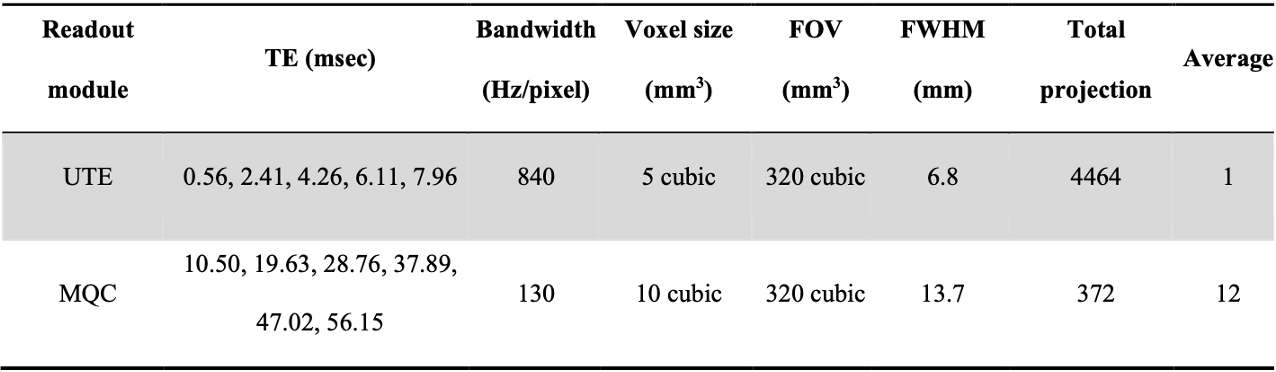
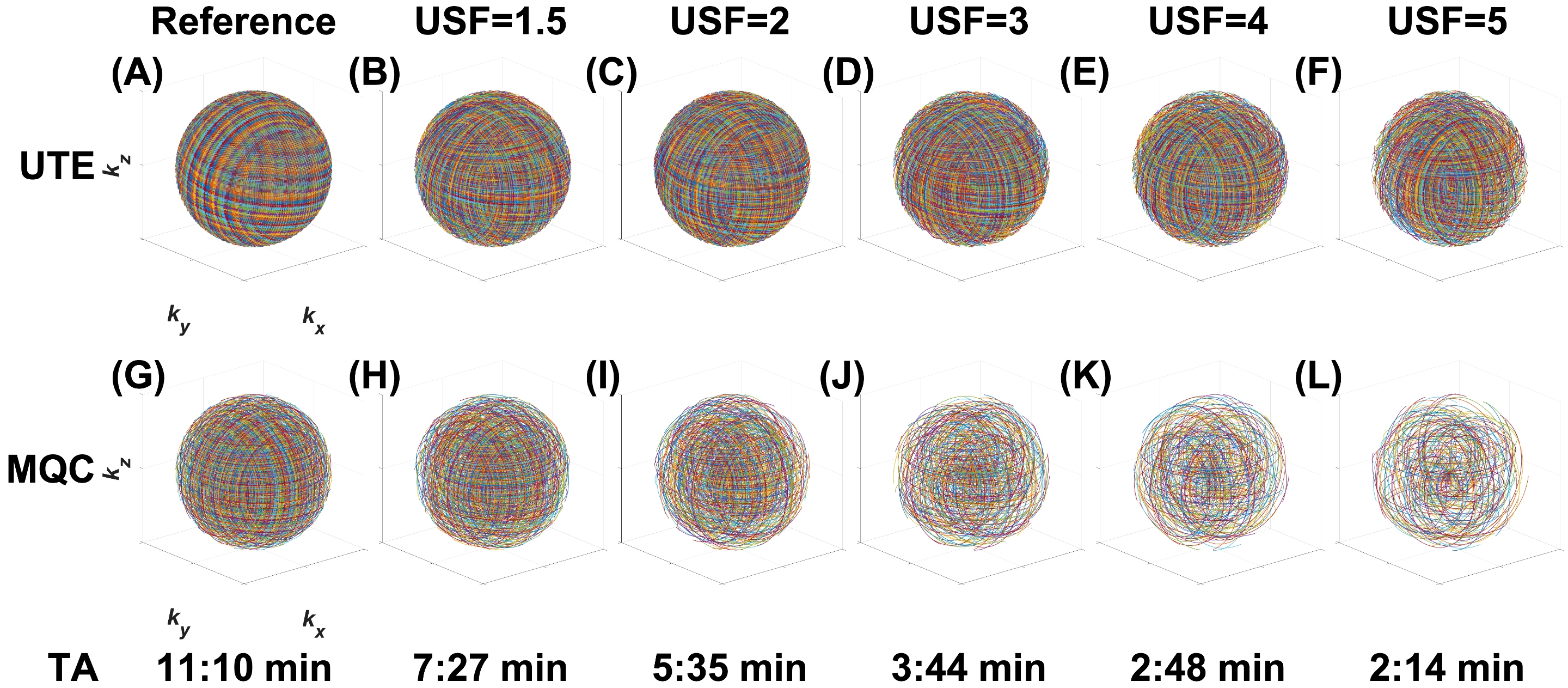
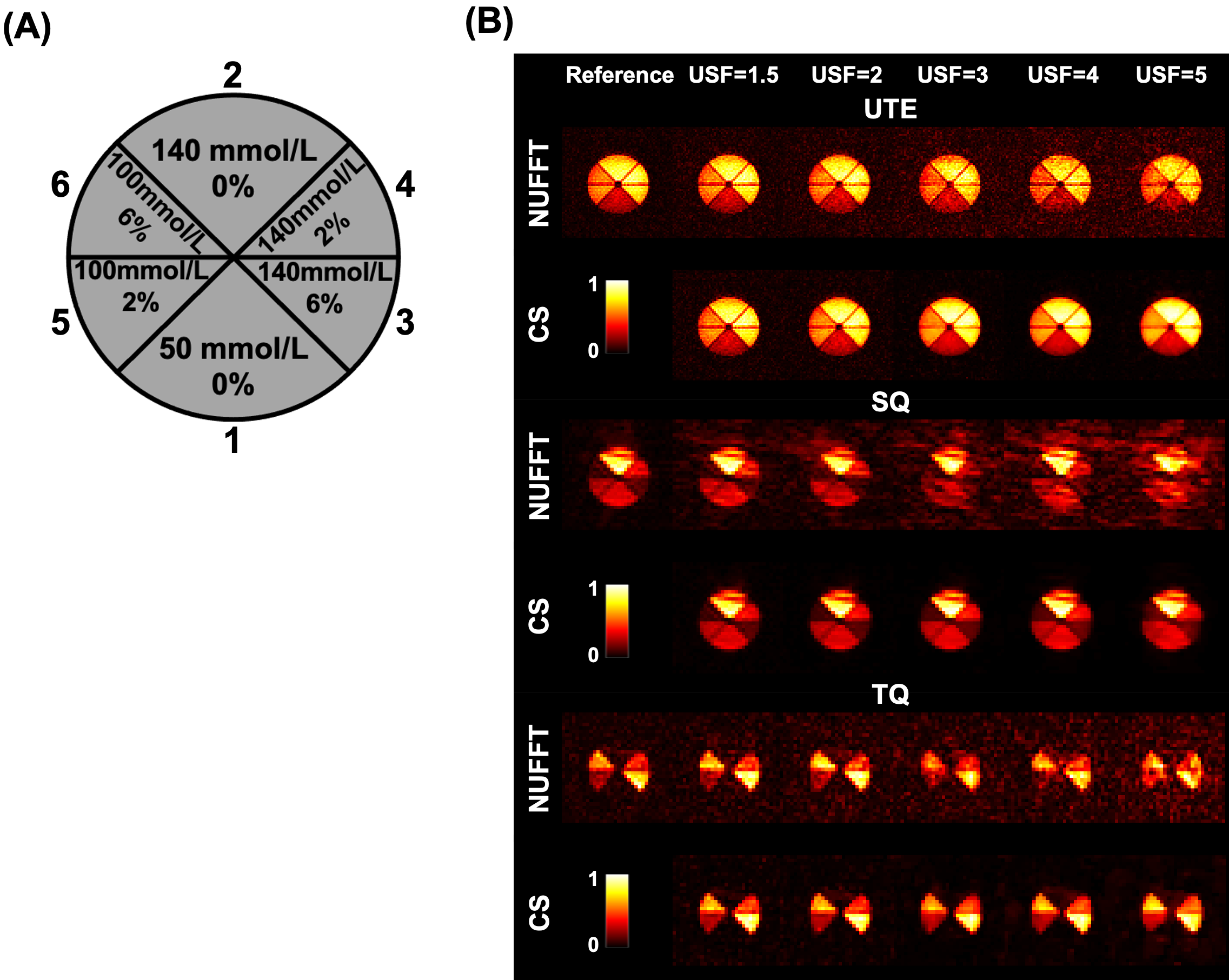
A novel enhanced SISTINA sequence (Fig.1) comprising two sets of 3D spiral-based Fermat looped, orthogonally encoded trajectories (FLORET) featuring high sampling efficiency and attractive potential for incoherent undersampling8 was developed and implemented on a Siemens Terra 7T scanner (SIEMENS Healthineers, Erlangen, Germany). The sequence parameters are shown in Table 1. The triple quantum filter consists of three hard pulses ($$$\alpha_1$$$=$$$\alpha_2$$$=$$$\alpha_3$$$=90°) separated by $$$\tau$$$=9.5ms and $$$\delta$$$=60us and a twelve-step phase cycling scheme to generate SQ and TQ coherences. The ultrashort echo time (UTE) readout train provides information on total sodium content, while the multiple quantum coherence (MQC) readout train yields information about SQ and TQ coherences. Fully sampled SISTINA datasets were acquired from a phantom (Fig.3A) and ten healthy subjects (three females, 29.6±3.8 years of age) using a single-channel transmit/receive dual-tuned 1H/23Na birdcage coil (RAPID Biomedical, Germany). The phantom contained six compartments with various sodium and agarose concentrations to simulate non-restricted (compartments 1-2) and variously restricted environments (compartments 3-6). As shown in Fig.2, the original, fully sampled UTE, SQ, and TQ k-space data were retrospectively undersampled by factors of 1.5, 2, 3, 4, and 5 in a pseudo-random way. The undersampled k-space data was reconstructed by solving the CS optimisation problem:9$$ \hat{x}=\arg \min _x\left\{\left\|y-F_u x\right\|_2^2+\lambda_1\|\Psi x\|_1+\lambda_2 T V(x)\right\}, $$where $$$\|\cdot\|_1$$$ and $$$\|\cdot\|_2$$$ signify the L1- and L2-norms, respectively; $$$x$$$ is the reconstructed image; $$$y$$$ is the undersampled k-space data; $$$F_u$$$ is the undersampled non-uniform fast Fourier transform (NUFFT) operator; $$$\Psi$$$ is the sparsity transform operator; $$$\lambda_1$$$ and $$$\lambda_2$$$ are the weighting factors of the transform sparsity and total variation ($$$TV$$$), respectively. In this study, the above equation was solved in 320 iterations using a nonlinear conjugate gradient method9 with Wavelet sparsity transform.The CS undersampled reconstructions were compared with fully sampled and undersampled NUFFT10 reconstructions in terms of noise level and structure preservation. The fully sampled UTE, SQ, and TQ images reconstructed by NUFFT were set as references. All reconstructions were performed offline in MATLAB 2019a (Mathworks, Natick, MA, USA).
Results
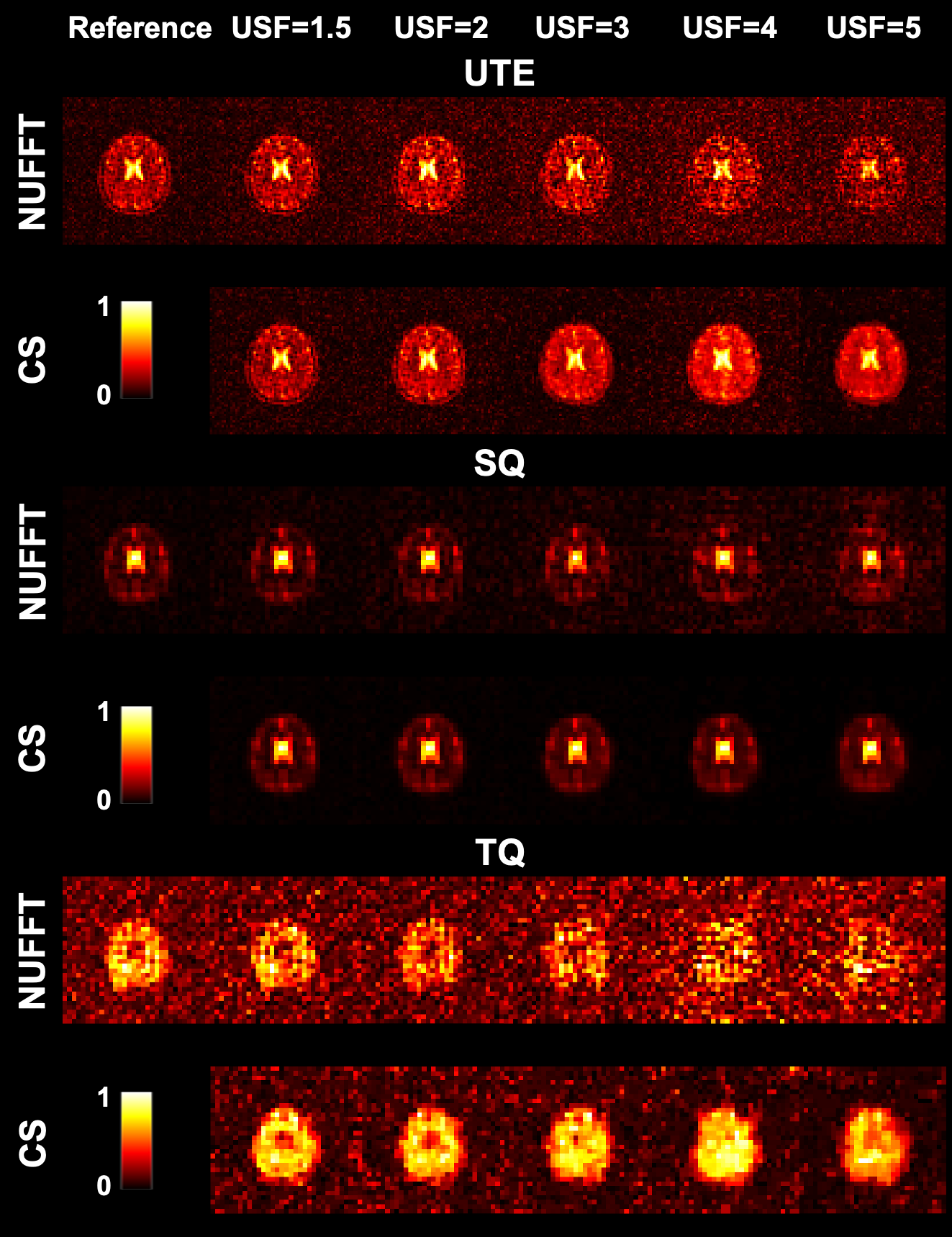
Fig.3B shows the NUFFT and CS reconstructions of the first-echo phantom data with various undersampling factors (USFs). CS yields noticeable visual improvements compared to NUFFT over all USFs, with less noise and better structural delineation. Moreover, most CS undersampled reconstructions lead to a reduced noise level compared to the corresponding reference reconstructions. Furthermore, in both NUFFT and CS reconstructions, UTE images show contrast proportional to the sodium concentration, independent of the agarose percentage, while SQ and TQ images are weighted towards non-restricted (e.g. 0% agarose) and restricted (e.g. 6% agarose) sodium, respectively.Fig.4 shows the NUFFT and CS reconstructions of representative first-echo in vivo data with various USFs. CS outperforms NUFFT with better noise suppression and preservation of structures present in the reference images over five USFs. Moreover, CS-based SQ/TQ images and highly undersampled UTE images show a lower noise level than the corresponding reference images. The cerebrospinal fluid (CSF) region composed of a non-restricted environment with a high sodium concentration exhibits high UTE and SQ signal intensities and yet a TQ signal drop, as expected. Additionally, brain tissues (e.g. white matters) with both non-restricted and restricted environments yield a higher TQ signal intensity than CSF despite the relatively low tissue sodium concentration. These observations align with the phantom results.
Discussion
This work investigated the effect of CS on the quality of retrospectively undersampled SISTINA images. Compared to NUFFT, CS leads to significant noise suppression due to its denoising nature, which facilitates the recovery of structures present in the reference images. In addition, the phantom and in vivo results suggest that with CS acceleration, the enhanced SISTINA sequence can maintain its performance in yielding weightings towards total sodium in UTE images, non-restricted sodium in SQ images, and restricted sodium in TQ images.In future, a proper USF will be determined after further reconstruction performance analysis by calculating the signal-to-noise ratio, structural similarity to the reference image, and quantitative parameters (e.g. fast and slow transversal relaxation times).
Conclusion
This work establishes a novel enhanced SISTINA sequence incorporating a FLORET sampling scheme at 7T. The experimental results on retrospectively undersampled phantom and in vivo k-space data demonstrate that CS enables acceleration of enhanced SISTINA acquisitions with reduced noise and better structure preservation compared to NUFFT while maintaining proper weightings towards total, non-restricted, and restricted sodium.Acknowledgements
This work is considered to be part of the doctoral thesis (Dr. rer. medic.) of Qingping Chen at Faculty of Medicine, RWTH Aachen University, Germany. Qingping Chen was funded via the Jülich - University of Melbourne Postgraduate Academy (JUMPA).References
1. Madelin G, Lee JS, Regatte RR, Jerschow A. Sodium MRI: methods and applications. Prog Nucl Magn Reson Spectrosc. 2014;79:14-47.
2. Jaccard G, Wimperis S, Bodenhausen G. Multiple-quantum NMR spectroscopy of S=3/2 spins in isotropic phase: a new probe for multiexponential relaxation. J Chem Phys. 1986;85(11):6282-6293.
3. Rooney WD, Springer CSJ. A comprehensive approach to the analysis and interpretation of the resonances of spins 3/2 from living systems. NMR Biomed. 1991;4:209-226.
4. Fiege DP, Romanzetti S, Mirkes CC, Brenner D, Shah NJ. Simultaneous single-quantum and triple-quantum-filtered MRI of 23Na (SISTINA). Magn Reson Med. 2013;69(6):1691-1696.
5. Worthoff WA, Shymanskaya A, Shah NJ. Relaxometry and quantification in simultaneously acquired single and triple quantum filtered sodium MRI. Magn Reson Med. 2019;81:303-315.
6. Chen Q, Shah NJ, Worthoff WA. Compressed Sensing in Sodium Magnetic Resonance Imaging: Techniques, Applications, and Future Prospects. J Magn Reson Imaging. Published online 2021:1-17.
7. Donoho DL. Compressed sensing. IEEE Trans Inf Theory. 2006;52(4):1289-1306.
8. Pipe JG, Zwart NR, Aboussouan EA, Robison RK, Devaraj A, Johnson KO. A new design and rationale for 3D orthogonally oversampled k-space trajectories. Magn Reson Med. 2011;66(5):1303-1311.
9. Lustig M, Donoho D, Pauly JM. Sparse MRI: the application of compressed sensing for rapid MR imaging. Magn Reson Med. 2007;58(6):1182-1195.
10. Fessler JA, Sutton BP. Nonuniform fast Fourier transforms using min-max interpolation. IEEE Trans Signal Process. 2003;51(2):560-574.
Figures