4687
Three-dimensional left ventricular torsion after pulmonary valve replacement in repaired tetralogy of Fallot: motion tracking analysis
Yurie Shirai1, Michinobu Nagao2, Atsushi Yamamoto1, Kei Inai3, Takeshi Shinkawa4, Seiko Shimizu5, and Shuji Sakai1
1Diagnostic Imaging and Nuclear Medicine, Tokyo Women’s Medical University, Shinjuku, Japan, 2Tokyo Women’s Medical University, Shinjuku, Japan, 3Pediatric Cardiology, Tokyo Women’s Medical University, Shinjuku, Japan, 4Cardiovascular Surgery, Tokyo Women’s Medical University, Shinjuku, Japan, 5Canon Medical, Chuo, Japan
1Diagnostic Imaging and Nuclear Medicine, Tokyo Women’s Medical University, Shinjuku, Japan, 2Tokyo Women’s Medical University, Shinjuku, Japan, 3Pediatric Cardiology, Tokyo Women’s Medical University, Shinjuku, Japan, 4Cardiovascular Surgery, Tokyo Women’s Medical University, Shinjuku, Japan, 5Canon Medical, Chuo, Japan
Synopsis
Keywords: Heart, Cardiovascular
In patients with repaired tetralogy of Fallot (TOF), pulmonary regurgitation is a frequent complication, resulting in right heart failure. Pulmonary valve replacement (PVR) should be performed before irreversible heart failure occurs. Pulmonary regurgitation disappears and RV volume decreases with PVR. Interventricular interactions are expected to improve left ventricular (LV) function, but in some cases LV function is not restored. We analyzed pre- and post-PVR cine cardiac MRI (CMR) with a motion tracking technique to quantitatively assess LV deformity in three dimensions. As a result, a decrease in preoperative LV torsion was a useful predictor of postoperative worsening LV function.Introduction
In patients with repaired tetralogy of Fallot (TOF) at remote stage, pulmonary valve regurgitation is a frequent complication, resulting in right ventricular (RV) enlargement and right heart failure. Pulmonary valve replacement (PVR) should be performed without delay before irreversible heart failure occurs. Pulmonary regurgitation disappears and RV volume decreases with PVR. Interventricular interactions are expected to improve left ventricular (LV) function, but the mechanism is not yet clear, and in some cases LV function is not restored. We focus on the LV torsion among the LV functions and analyze the changes in it using a motion tracking method of cardiac cine MRI before and after PVR. We analyze the changes in three-dimensional LV deformation using a motion tracking method of cine cardiac MRI (CMR) before and after PVR in repaired TOF.Methods
Thirteen patients (mean age, 35.5years) with repaired TOF who underwent CMR with 3 tesla scanner (Ingenia 3T CX, Philips Healthcare) before and after PVR were enrolled in this study. Global strain and LV torsion in the LV short and long axes were automatically calculated from motion tracking analysis of cine CMR (Ref. 1, 2). In addition, the left ventricular ejection fraction (LVEF, %), RVEF, and RV end-diastolic volume index (RVEDVi, ml/m2) was calculated from the ventricular volumetry. Pulmonary regurgitant fraction (PRF, %) was measured using 2D phase-contrast imaging.Results & Discussion
1. Change in RV function pre- and post-PVRAfter PVR, RVEDVi was significantly reduced (201ml/m2 vs. 105 ml/m2) and PRF was significantly decreased (43.3% vs. 6.3%). There was no difference in RVEF pre- and post-PVR (46.7% vs. 46.1%).2. Changes in LV function and deformation pre- and post-PVRAlthough there was a trend toward improvement in both LV torsion and strain, there were no significant differences in LVEF (40.1 % vs. 42.2 %), LV torsion (1.12 degree/cm vs. 2.4 degree/cm), global circumferential strain (-15.1% vs. -17%), global 2-channel longitudinal strain (16.7% vs. -15.8%), and global 4-channel longitudinal strain (-14.9% vs. -13.7%) between pre- and post-PVR. Three cases of LVEF <40% (23%) were observed after PVR. Their preoperative LV torsion was significantly lower than those of patients with LVEF >=40% (0.71 degree/cm vs. 1.32 degree/cm). No significant difference in preoperative circumferential and longitudinal strain was found between the two groups.
LV torsion plays an important role in maintaining LV pump function. However, it could not be easily calculated because it requires integrated analysis of the LV short axis rotation information from the LV base to the apex. This analytic technique integrates cine CMR into the entire LV and automatically calculates the torsion. This is expected to elucidate pump function in various heart diseases.
Conclusion
PVR for repaired TOF patients, about 20% of patients did not improve LV function, and preoperative LV torsion was a useful indicator for predicting these patients.Acknowledgements
No acknowledgement found.References
1. Umiko Ishizaki, Michinobu Nagao, Yumi Shiina, et al. Global strain and dyssynchrony of the single ventricle predict adverse cardiac events after the Fontan procedure: analysis using feature-tracking cine magnetic resonance imaging. Journal of Cardiology 73; 163-170: 20192.
2. Risako Nakao, Michinobu Nagao, Satoshi Higuchi, et al. Relation of Left Atrial Flow, Volume, and Strain to Paroxysmal Atrial Fibrillation in Patients With Hypertrophic Cardiomyopathy The American Journal of Cardiology 166; 72-80: 2022.
Figures
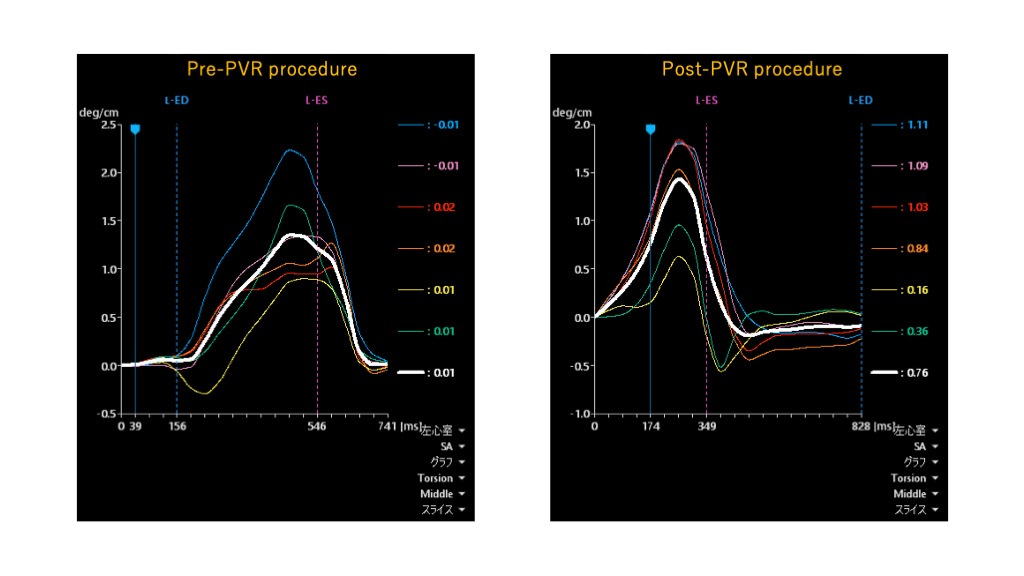
Time curve of LV torsion throughout a cardiac cycle pre- and post-PVR.
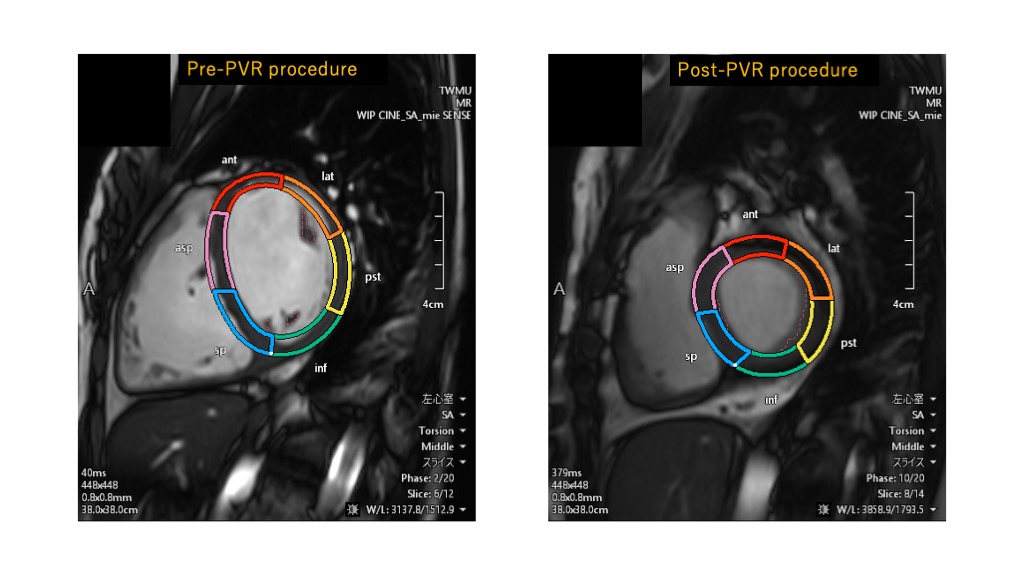
LV torsion automatically calculated from motion tracking method of cine imaging of the entire LV. Right ventricular volume has seemingly reduced in post procedure.
DOI: https://doi.org/10.58530/2023/4687