4636
FSE Dixon with bandwidth-matched asymmetric readouts tailored for real-valued fat/water estimates1Clinical Neuroscience, Karolinska Institutet, Stockholm, Sweden, 2Karolinska Institutet, Stockholm, Sweden, 3Karolinska University Hospital, Stockholm, Sweden
Synopsis
Keywords: Pulse Sequence Design, Fat, Dixon
A novel asymmetric readout waveform for Dixon FSE imaging is presented for efficient sampling, tailored for real-valued estimation of fat/water estimates.Introduction
Fast spin echo sequences in combination with Dixon-based fat/water separation is considered a state-of-the-art technique, with many applications, and is offered by all major vendors. Besides a superior fat suppression, the benefits of Dixon imaging over RF based fat saturation include less patient heating and compatibility with most image contrasts. Perhaps the most limiting incompatibility is with inversion recovery based fat suppression techniques, where there is a risk of suppressing contrast media uptake.The downside of Dixon imaging is mainly the additional scan time required to acquire all echoes. Two point methods have a clear advantage as they impose the minimum demand on extra scan time. Compared to a conventional acquisition with two signal averages, the scan time penalty from acquiring an additional echo is only dependent on the dead time caused by the required chemical shift (1). This penalty is typically around 20-30 % in a clinical protocol, but can be eliminated by using asymmetric readout gradients (2).
Our previous work on asymmetric readout gradients used a continuously varying receiver bandwidth to achieve its asymmetry. This posed a problem in reconstruction in that the image domain distortions are different, which disturbs the residual calculations. Furthermore, gradient fidelity is likely a larger problem compared to conventional trapezoids.
The previous waveform had no constraints on the bandwidth, resulting in source images with colored noise, which propagates to the estimates. Although a varying bandwidth is required for asymmetry in the waveform, real valued estimates in the fat/water separation can counteract noise coloring in the estimates if the waveform is more carefully designed.
This work investigates if a piecewise asymmetric readout waveform (PWL3) with matched central bandwidth can improve the image quality compared to our previously proposed spline-based readout (2).
Methods
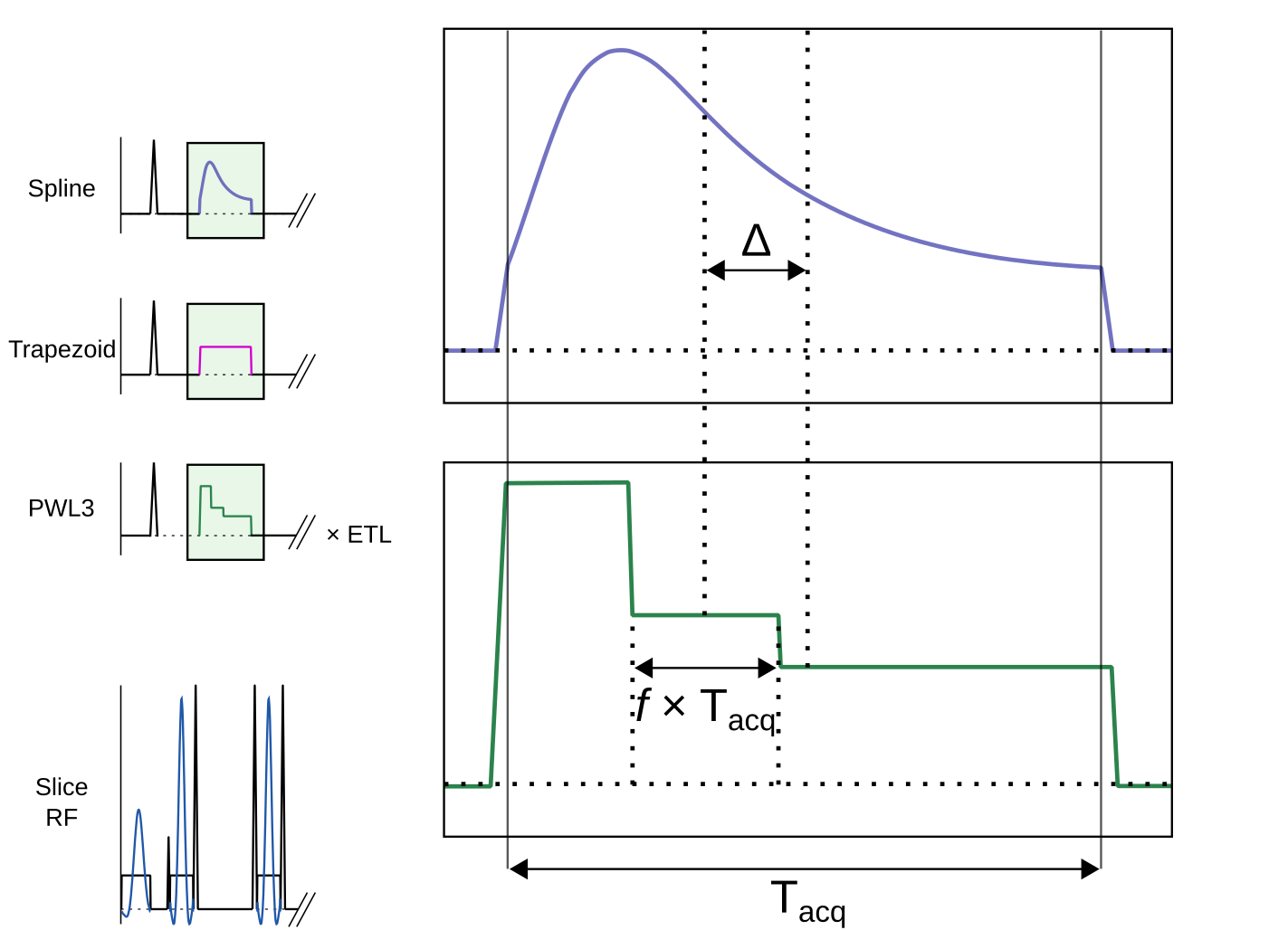
Odd excitations acquired in-phase echoes, while even excitations acquired chemical shift encoded (CSE) echoes, each with the same phase encoding. The waveforms are shown in magenta and green in Figure 1, respectively.The available acquisition time, $$$T_\text{acq}$$$, is determined from the user supplied bandwidth ($$$bw$$$) together with the matrix size $$$N_x$$$: $$$T_\text{acq} = {N_x \over bw}$$$. The central bandwidth is the same for both waveforms. To achieve the desired chemical shift encoding delta, the second plateau is offset as shown in Figure 1. A user-defined fraction f determines the duration of the second plateau and was chosen to 0.25. Given these inputs, the duration of the first and third plateau are constrained. An additional constraint is that the area must be equal between the in-phase and CSE echo. With this design, the combined dwell time of each sample and its conjugate is kept constant for the entire readout, except for ramps. This is beneficial for real-valued estimation of fat and water where k-space symmetry is exploited to improve the inverse problem conditioning. The waveform was implemented in a fast spin echo sequence using the KS Foundation framework (3). Field map estimation was performed on bandwidth-matched samples, i.e. those acquired during the second plateau.
Images were acquired on a GE Signa Premier 3T system, using a 16 ch Tx/Rx knee coil. Relevant scan parameters were TR/TE = 3000/37 ms, 32 slices, $$$T_\text{acq} = 6.0$$$ ms, matrix size 512$$$\times$$$768, 2.5 mm slice thickness, FOV 14$$$\times$$$21, $$$\Delta = -1.0$$$ ms. For these parameters the asymmetric readouts have a 23% reduced scan time when compared to shifted trapezoids. A healthy volunteer gave informed written consent to be included in the study.
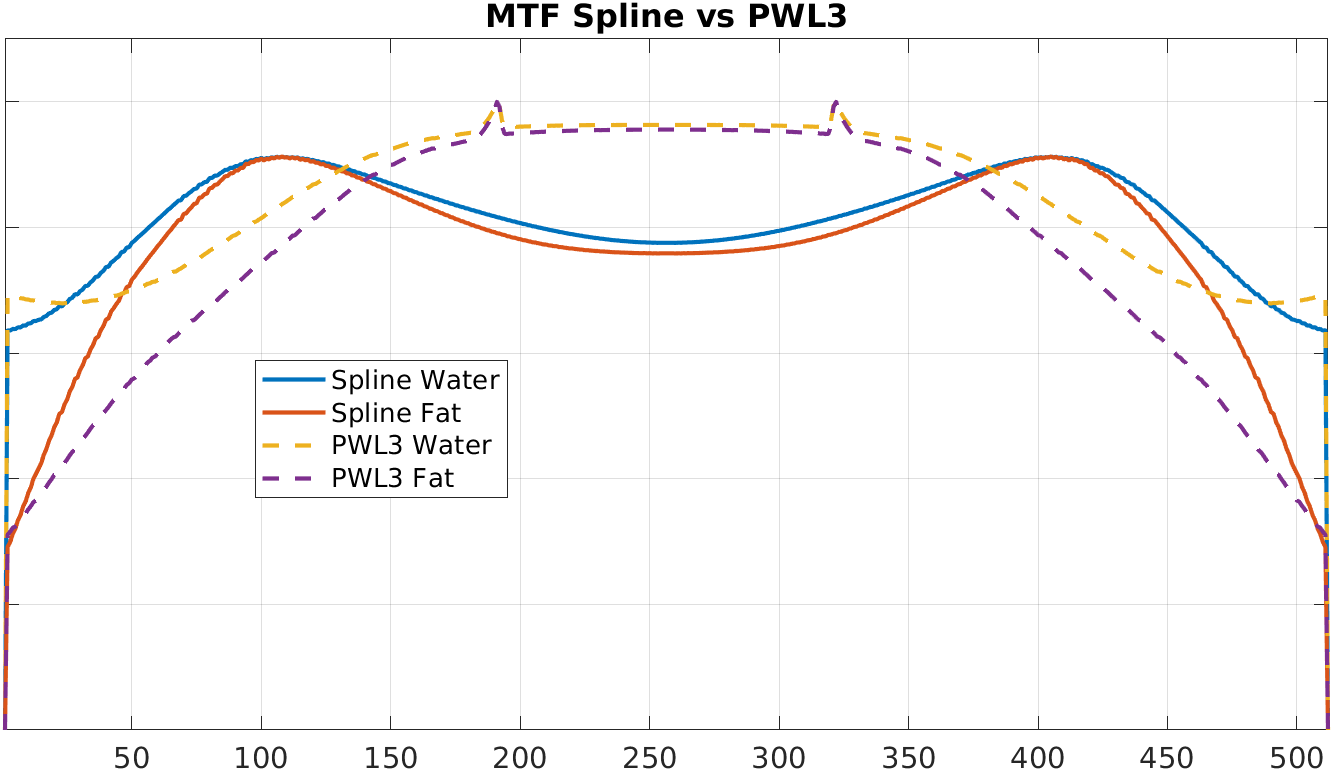
Fat/water separation was done in k-space with real-valued estimates according to (4) with noise-whitening regularization as described in (5). The trade-off between white noise and suppression of certain frequencies is described in the modulation transfer function (MTF), which was calculated according to (2). The effective dwell times as a function of k-space index was calculated from the resampling matrices associated with each waveform.
Results
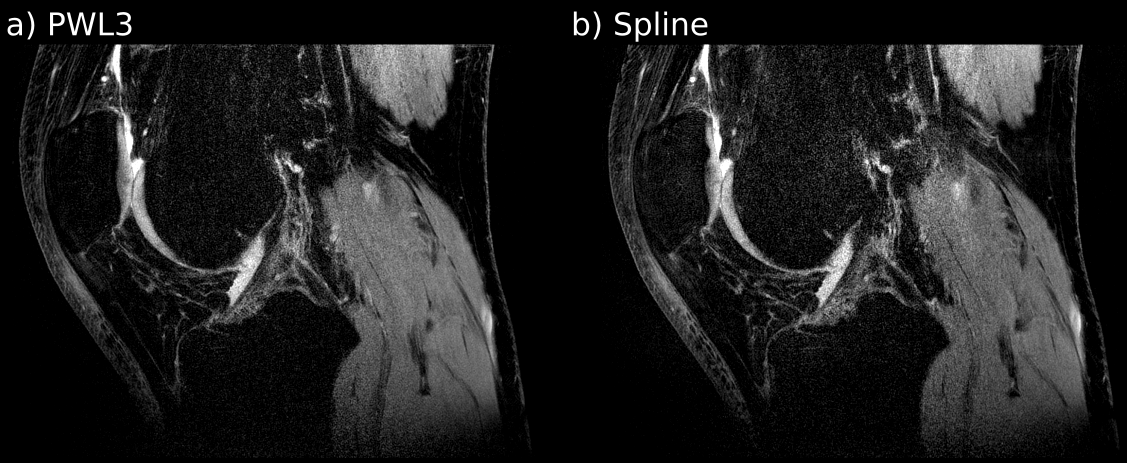
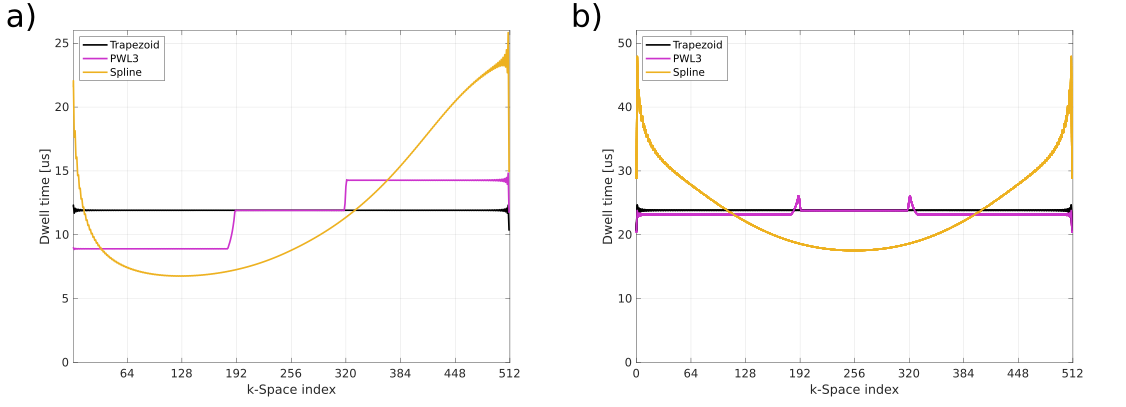
Both scans were successfully fat/water separated in all slices. The PWL3 dataset had a higher apparent SNR, clearly seen in Figure 2. We attribute this to the lower bandwidth of the PWL3 waveform at k-space center.Modulation transfer functions (Figure 4) of the two scans reveal that PWL3 outperforms the spline waveform at lower frequencies, at the cost of suppression of higher frequencies. This is also reflected in the dwell time plots in Figure 3.
Discussion
Apparent SNR was improved with PWL3. MTF analysis indicates a loss of sharpness compared to the spline waveform, but was hard to discern in the reconstructed images.Real-valued estimates equalizes the effective dwell time across the samples with the PWL3 readout, while the spline readout overemphasizes high frequency content. Our previous approach to counteract the non-uniform dwell times with asymmetric readouts was to adjust the in-phase waveform. Specifically, a quadratic in-phase waveform was designed to achieve a combined dwell time equivalent to two conventional trapezoids at k-space center. The PWL3 waveform achieves this uniformity for all samples while maintaining the same distortion levels between the two echoes for low frequencies.
Conclusion
Asymmetric readouts effectively removes the scan time penalty associated with shifted trapezoidal readouts. PWL3 renders source images with identical distortion levels for field map estimation. In combination with real valued estimates, the effective dwell times are kept uniform.Acknowledgements
No acknowledgement found.References
1. Eggers, Holger. Variable Bandwidth Turbo Spin-Echo Dixon Imaging. In: Proceedings of the 23rd Annual Meeting of ISMRM, Milan, Italy. ; 2014. p. 1657.
2. Rydén H, Norbeck O, Avventi E, et al. Chemical shift encoding using asymmetric readout waveforms. Magn. Reson. Med. 2020;42:963.
3. Skare S, Avventi E, Norbeck O, Rydén H. An abstraction layer for simpler EPIC pulse programming on GE MR systems in a clinical environment. In: Proceedings of the 25th Annual Meeting of the ISMRM, Honolulu, Hawaii. ; 2017. p. 3813.
4. Berglund J, Rydén H, Avventi E, Norbeck O, Sprenger T, Skare S. Fat/water separation in k-space with real-valued estimates and its combination with POCS. Magn. Reson. Med. 2020;83:653–661.
5. Rydén H, Berglund J, Avventi E, Sprenger T, Norbeck O, Skare S. T1-weighted bipolar fat/water separated spin-echo PROPELLER acquired with dual bandwidths. In: Proceedings of the 26th Annual Meeting of ISMRM, Paris, France. ; 2018. p. 2673.
Figures