4565
Design and Optimization of a MultiPINS Prepulse for Two-dimensional Ultrashort Echo Time Simultaneous Multi-slice Pulse Sequences1Computer Science, Mathematics, Physics and Statistics, University of British Columbia, Kelowna, BC, Canada, 2UBC MRI Research Centre, Department of Radiology, Faculty of Medicine, University of British Columbia, Vancouver, BC, Canada, 3SFU ImageTech Lab, Simon Fraser University, Surrey, BC, Canada, 4Philips Canada, Mississauga, ON, Canada, 5Biomedical Engineering and Imaging Institute, Icahn School of Medicine at Mount Sinai, New York, NY, United States
Synopsis
Keywords: RF Pulse Design & Fields, RF Pulse Design & Fields
It has been challenging to achieve ultrashort echo times with two-dimensional acquisitions. However, the use of a prepulse and a whole volume hard excitation may address these limitations. In addition, such a pulse sequence would allow for the use of simultaneous multi-slice pulses to reduce scan times. We aim to design a low specific absorption rate, short duration MultiPINS prepulse that excites a slice profile with sharp, narrow slice gaps. Optimization suggests that a pulse with time bandwidth product (TBW) of 49.43 is optimal, but further investigation suggests that a pulse with TBW as low as 36 may be feasible.Introduction
Ultrashort echo time (UTE) pulse sequences used in magnetic resonance imaging (MRI) are pulse sequences in which acquisition begins immediately after excitation (with a minimal time delay due to the transmit/receive switching time)1. UTE pulse sequences are used for MRI of short T2 species such as cortical bone and sodium, which require sub-millisecond echo times1,2. To achieve UTEs, hard excitation pulses are frequently used due to their short duration3-6. Slice select gradients used for two-dimensional (2D) acquisitions prevent UTEs from being achieved, motivating centre-out three-dimensional (3D) acquisitions that have achieved echo times of 0.2 ms and scan times of 10-18 min3-6.To achieve 2D acquisition with UTE, a prepulse can be used to excite the majority of the magnetization, while leaving specific bands of magnetization along the longitudinal axis. Then, spoiler gradients can be used to dephase the unwanted transverse magnetization and a hard excitation can be used to excite the remaining longitudinal magnetization. Such a pulse sequence must have a short duration to minimize T1 recovery, while remaining below the specific absorption rate (SAR) limit. Preparation pulses could be used to acquire a single slice or to acquire multiple slices, thereby reducing scan times.
Simultaneous multi-slice (SMS) pulses have been used to excite multiple slices at the same time7,8. However, SMS pulse sequences frequently make use of a multiband (MB) pulses, which have a high specific absorption rate (SAR) and require a slice select gradients7,8. SAR has been reduced, albeit at the cost of longer pulse durations, with power independent of number of slices (PINS) pulses7,8. The trade-off between SAR and pulse duration may be exploited with combined MB and PINS (MultiPINS) pulse8. We investigate the optimization of MultiPINS pulses for application in UTE SMS MRI.
Objective
We aim to design a low SAR, short duration MultiPINS prepulse that produces a transverse magnetization profile with narrow slice gaps.Methods
Prepulse design was carried out to meet the hardware specifications of a Philips Ingenia Elition X which allows for a minimum dwell time of 6.4 µs, maximum gradient strength of 45 mT/m, and maximum slew rate of 220 T/m/s. The maximum magnetic field strength was limited to 6.5 µT to prevent head SAR limits from being exceeded during the pulse sequence. MultiPINS prepulses were designed in MATLAB using a modified Multiband RF Toolbox with time bandwidth products (TBWs) ranging from 12 to 72, multiband factors of 4, mixing ratios of 0.05, and linear phase8,9. Slice thicknesses and separations were chosen to achieve slice gaps as close to 1 mm as possible without overlapping adjacent bands and to allow for 3 slices to be acquired over 18 cm.Head SAR and longitudinal magnetization recovered during the pulse (Mzr) due to T1 decay with a time constant of 25 ms (for sodium) was estimated2,10. Transverse magnetization profiles were simulated in MATLAB and used to evaluate the sharpness of slice gaps by calculating the average ratio of the full width at 90% maximum to full width at 10% maximum within the slice gaps (FW90:10). SAR, Mzr, and FW90:10 were scaled by the range of the data and integrated into a regression cost function with a target value of 0 for SAR, 0 for Mzr, and 1 for FW90:10. SAR and Mzr were given twice the weight as FW90:10 to identify an optimal MultiPINS prepulse.
Results
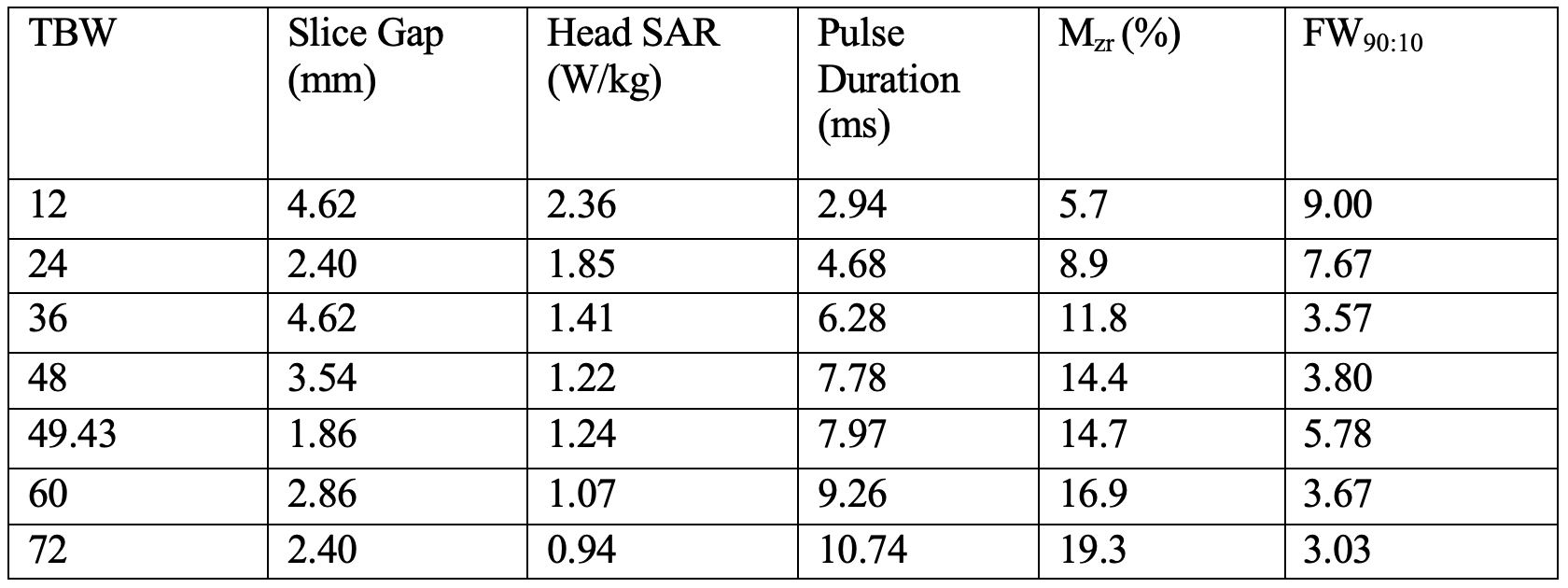
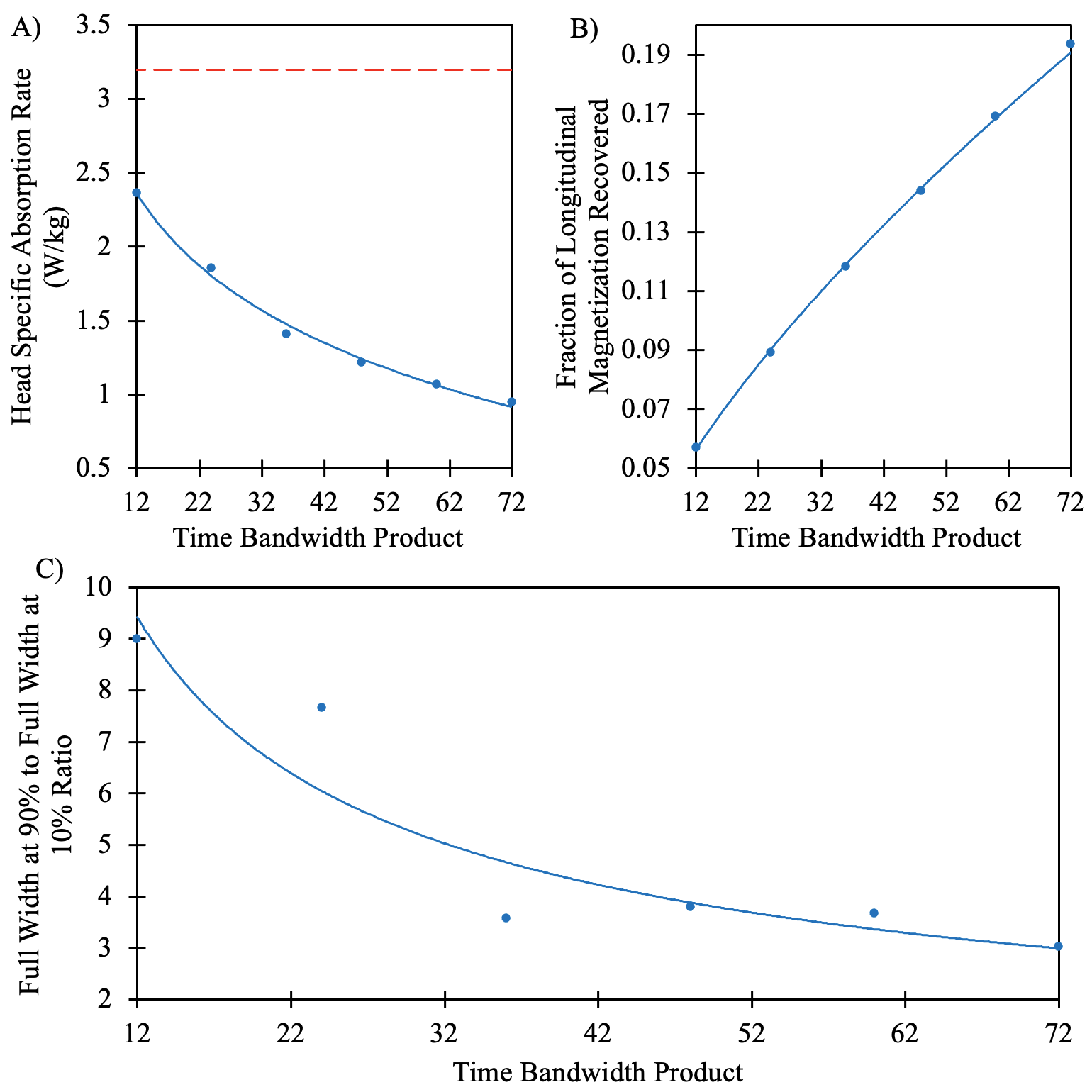
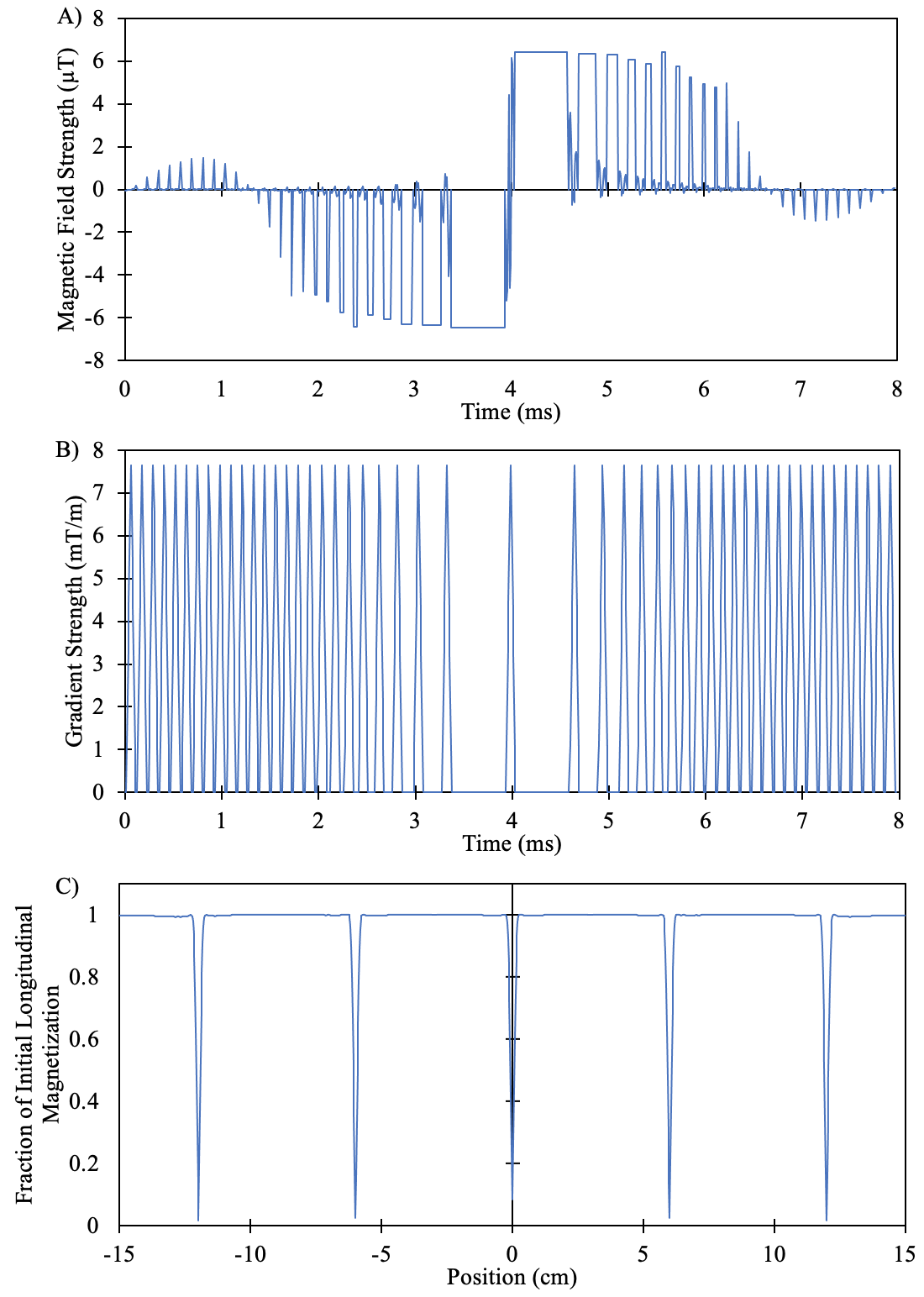
Head SAR was found to decrease from 2.36 to 0.94 W/kg, while Mzr was found to increase from 5.71 to 19.3 % for TBWs increasing from 12 to 72. FW90:10 was found to decrease from 9.00 for a TBW of 12 to 3.03 for a TBW of 72. SAR, Mzr, and FW90:10 for each of the pulses are tabulated in Figure 1 and plotted in Figure 2. A MultiPINS prepulse with a TBW of 49.43 and slice thickness of 1.86 mm was identified as optimal. The optimal pulse had a SAR of 1.24 W/kg, an Mzr of 15.3 %, and a FW90:10 of 5.78. The corresponding MultiPINS prepulse, gradient, and simulated transverse magnetization profile are shown in Figure 3.Discussion
Typically, PINS pulses are not designed with high TBWs due to gradient slew rates beyond hardware limitations that are required to maintain short pulse durations and narrow slice profiles8,11. The high TBWs result from the wide selection bands and narrow slice gaps of the MultiPINS prepulses. Further, pulse duration is less important for the prepulses as signal is constrained by T1 recovery as opposed to T2 decay. Thus, the MultiPINS prepulses may use high TBWs to achieve a low SAR and sharp slice profile at the cost of longitudinal magnetization recovery.Exploring the trade-offs beyond the trendlines in Figure 2 suggests that a TBW as low as 36 may be feasible. The MultiPINS prepulse with a TBW of 36 exhibits a low FW90:10 of 3.57 with an Mzr of 11.8 % and a SAR of 1.41 W/kg that are close to the predictions of the trendlines. The FW90:10 data points do not follow a smooth curve and the jump between TBWs of 24 and 36 suggests that the evaluation of pulse designs in this range of TBWs may yield useful results.
Acknowledgements
We acknowledge the support of a Natural Sciences and Engineering Research Council of Canada (NSERC) Discovery Grant and a Canada Foundation for Innovation (CFI) John R Evans Leaders Fund.
References
1. Larson PEZ, Han M, Krug R et al. Ultrashort echo time and zero echo time MRI at 7T. Magn Reson Mater Phys. 2016;29(3):359-370.
2. Madelin G and Regatte RR. Biomedical Applications of Sodium MRI in Vivo. J Magn Reson Imaging. 2013;38(3):511-529.
3. Riemer F, Solanky BS, Stehning C, et al. Sodium (23Na) ultra-short echo time imaging in the human brain using a 3D-Cones trajectory. Magn Reson Mater Phys. 2014;27(1):35-46.
4. Milani B, Delacoste J, burnier M, and Pruijm M. Exploring a new method for quantitative sodium MRI in the human upper leg with a surface coil and symmetrically arranged reference phantoms. Quant Imaging Med Surg. 2019;9(6):985-999.
5. Nielles-Vallespin S, Weber MA, Bock M, et al. 3D Radial Projection Technique with Ultrashort Echo Times for Sodium MRI: Clinical Applications in Human Brain and Skeletal Muscle. Magn Reson Med. 2007;57(1):74-81.
6. Bangerter NK, Tarbox GJ, Taylor MD, and Kaggie JD. Quantitative sodium magnetic resonance imaging of cartilage, muscle, and tendon. Quant Imaging Med Surg. 2016;6(6):699-714.
7. Norris DG, Koopmans PJ, Boyacioglu R, and Barth M. Power Independent of Number of Slices (PINS) Radiofrequency Pulses for Low-Power Simultaneous Multislice Excitation. Magn Reson Med. 2011;66(5):11234-1240.
8. Eichner C, Wald LL, and Setsompop K. A Low Power Radiofrequency pulse for Simultaneous Multislice Excitation and Refocusing. Magn Reson Med. 2014;72(4):949-958.
9. Seada SA, Price AN, Schneider T, Hajnal JV, and Malik SJ. Multiband RF pulse design for realistic gradient performance. Magn Reson Med. 2019;81(1):362-376.
10. Collins CM and Wang Z. Calculation of radiofrequency electromagnetic fields and their effects in MRI of human subjects. Magn Reson Med. 2011;65(5):1470-1482.
11. Koopmans PJ, Boyacioglu R, Barth M, Norris DG. Whole brain, high resolution spin-echo resting state fMRI using PINS multiplexing at 7T. Neuroimage. 2012;62(3):1939-1946.
Figures