4505
Hyperpolarized 129Xe Magnetic Resonance Dual Signal Probe Based on CB[6] Nanoparticles for Precise Drug Delivery Monitoring1Key Laboratory of Magnetic Resonance in Biological Systems, State Key Laboratory of Magnetic Resonance and Atomic and Molecular Physics, National Center for Magnetic Resonance in Wuhan, Wuhan Institute of Physics and Mathematics, Innovation Academy for Precision Measurement Science and Technology, Chinese Academy of Sciences – Wuhan National Laboratory for Optoelectronics, Wuhan 430071, P. R. China, WUHAN, China
Synopsis
Keywords: Hyperpolarized MR (Gas), Hyperpolarized MR (Gas), 129Xe,Hyper-CEST
We synthesized an ultrasensitive 129Xe NMR probe with dual signals. It is a hollow nanoparticle composed of water-soluble CB[6]. It has two different hydrophobic cavities. Two 129Xe NMR signals with different chemical shifts can appear in a single detection, effectively avoiding the occurrence of false positive and false negative in complex biological environment detection, improving the accuracy and sensitivity of single detection, and has broad application prospects.Introduction
When the probe responds, it is difficult to eliminate the effects of unexpected errors if only a single signal source is used as the basis for judgment. As a result, false positive or false negative test results occur, leading to bias and misjudgment of the final experimental results. These results can be effectively avoided when a molecular probe response can produce two signals at the same time. We recently developed a hyperpolarized 129Xe nuclear magnetic resonance (NMR) probe based on a nanoparticle formed by an amphiphilic cucurbit[6]uril (CB[6]) derivative.1 The probe exhibites good water solubility and unique internal hydrophobic cavities through hydrophobic interactions in aqueous solution. In combination with the CB[6]’s own cavity, there are dual signal changes in single NMR test.Methods
we combined CB[6] with long-chain PEG to prepare amphiphilic compounds. CB[6] nanoparticles (CB[6] NPs) were prepared by dissolving the amphipathic monomer in the smallest volume of ethanol and spinning it into a thin film. Water was added and sonicated for 30 min. The hyperpolarized magnetic resonance experiments were performed on the home-built instrument.Results and Discussion
The probe is a hollow nanoparticle formed by water-soluble CB[6], which has two kinds of hydrophobic cavities, one is inside CB[6] itself,2 the other is inside the nanoparticle. The transmission electron microscopy (TEM) image shows that the probe is relatively regular spherical with an average particle size of 100 nm. (Fig. 1A). When the probe is dispersed in aqueous solution for hyperpolarized 129Xe NMR experiment, two signals will appear in two different chemical shifts of about 100 ppm and about 200 ppm (Fig. 1B), respectively corresponding to the NMR signals of 129Xe in its two different cavities. When it is used to load hydrophobic drugs such as paclitaxel (Fig. 1C) for intracellular drug delivery (Fig. 1D), these two signals will change significantly at the same time during drug loading and releasing, providing a basis for accurately judging whether the system delivers drugs successfully.Conclusion
In a single NMR test, both the cavity of CB[6] itself and the cavity inside the nanoparticle can generate magnetic resonance signals. And the dual signals will change at the same time when the nanoparticle loads or releases the hydrophobic molecule. This property helps us to make an accurate judgment on the delivery of a specific compound, and to avoid the possibility of false positive or false negative signals to a certain extent.Acknowledgements
This work is supported by National Key R&D Program of China (2018YFA0704000), National Natural Science Foundation of China (82127802, 21921004, 82001923, 81971705), Key Research Program of Frontier Sciences, CAS (ZDBS-LY-JSC004), Hubei Provincial Key Technology Foundation of China (2021ACA013), X. Zhou acknowledges the support from the Tencent Foundation through the XPLORER PRIZE.
References
[1] Park, K. M.; Suh, K.; Kim, K, et al. Cucurbituril-based nanoparticles: a new efficient vehicle for targeted intracellular delivery of hydrophobic drugs. Chemical Communications 2009, (1), 71-73.
[2] Kunth, M.; Witte, C.; Schroder, L, et al. Identification, classification, and signal amplification capabilities of high-turnover gas binding hosts in ultra-sensitive NMR. Chemical Science 2015, 6 (11), 6069-6075.
Figures
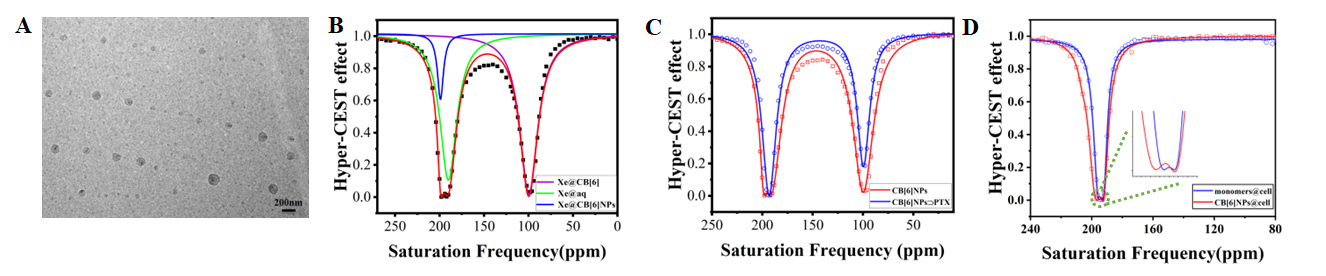
Fig 1. (A) TEM image of CB[6] NPs. (B) Hyper-CEST frequency-scan profile of 2 mg/mL CB[6] NPs in pH 7.2 water at 298 K. (C) Hyper-CEST frequency-scan profile of 2 mg/mL CB [6] NPs and CB [6] NPs⊃paclitaxel in pH 7.2 water at 298 K. (D) Hyper-CEST frequency-scan profile of A549 cell co-incubation with monomers of CB [6] NPs and CB [6] NPs⊃ PTX in pH 7.2 PBS at 298 K. irradiation. The squares show the experimental data, and the lines show the exponential Lorentzian fits.