4504
Direct detection of polarization transfer from hyperpolarized 129Xe to thermally polarized 1H at 2 mT1University of North Carolina at Chapel Hill, Chapel Hill, NC, United States
Synopsis
Keywords: Hyperpolarized MR (Gas), Hyperpolarized MR (Gas)
We present a simple protocol for polarizing 1H at ultra-low field. By simply bubbling hyperpolarized Xe gas in a solution containing thermally polarized 1H spins, the proton thermal polarization can be enhanced by more than 100-fold. This enhancement is clearly observed, even in absence of saturation pulses, at ultra-low field where thermal polarization is close to background noise levels. Simultaneous detection of 1H and 129Xe magnetizations shows that the transfer of polarization from 129Xe to 1H spins is a continuous process that lasts until the dissolved-phase 129Xe polarization is relaxed back to thermal equilibrium.Introduction
By bringing spins out of thermal equilibrium, hyperpolarization techniques can enhance the NMR signal by several orders of magnitude. Hyperpolarization methods are particularly advantageous at low magnetic field strengths, where thermal polarization may fail to bring the NMR signal above noise levels. Here we demonstrate the ability to directly transfer spin polarization from hyperpolarized (HP) 129Xe spins to thermally polarized 1H via the nuclear Overhauser effect (SPINOE). While previous works have used the freeze-thaw method to enhance the polarization transfer between hyperpolarized 129Xe spins and thermally polarized 1H spins1–3, here we simply bubble hyperpolarized 129Xe gas in solution. We show that after a single bubbling of HP 129Xe gas in solution, the proton signal can be increased by more than 100-fold. At low field, where thermal polarization may fail to bring the NMR signal above noise level, simultaneous detection of 129Xe and 1H resonances enables one to watch the full spin dynamics of the polarization transfer in real time.Methods
All measurements were performed on a lab-built NMR spectrometer operating at 2.1 mT using a dual-tuned volume coil. Before each acquisition, HP 129Xe gas was bubbled into solution in a 5 mm NMR tube for 6 seconds. After a set delay, τ, the spectrometer acquisition was triggered to simultaneously excite and detect 129Xe and 1H resonances (6 s bubble – τ – 90°(129Xe/1H) – acquire). Because at 2.1 mT thermal polarization is on the order of 10-9, no presaturation pulses were needed to destroy the thermal magnetization of 1H. After each acquisition, remaining 1H/129Xe magnetizations were destroyed using a train of RF pulses. Measurements were repeated for 2 ml samples of toluene, pentane, and cyclohexane, which have a measured 1H T1 of 5.6, 3.8, and 1.9 s, respectively, at room temperature. Measurements were also repeated with an extended bubbling time of 18 s and at lower temperatures.Results and Discussion
Figure 1 shows the experimental setup used for these experiments, while Figure 2 shows spectra acquired from a sample of pentane before and after bubbling HP 129Xe gas in solution. In addition to the expected dissolved-phase xenon resonance, we observed also a 1H resonance well above noise level. Spectra acquired after a single dissolution of hyperpolarized xenon gas show that the transfer of polarization from the long-lived dissolved-phase hyperpolarized 129Xe spins in solution to the fast relaxing 1H spins is a continuous process that leads to an observable 1H signal enhancement up to four minutes after a single delivery of HP 129Xe gas (Figure 3). Signal averaging over this time can effectively increase the observable 1H signal (Figure 4), which appears to relax with a T1 that qualitatively agrees with what is predicted by the Solomon relaxation theory4,5:$$S_{1H}(t)\propto e^{-R_{Xe}t}-e^{-R_{H}t},$$
where,
$$R_{Xe(H)} = \frac{1}{T_1^{Xe(H)}}\pm\frac{\sigma_{XeH}\sigma_{HXe}}{1/T_1^{Xe}-1/T_1^{H}},$$
and σ is the cross-relaxation rate between the two spins. This implies the maximum signal enhancement can be obtained at a time,
$$t_m=\frac{1}{R_H-R_{Xe}}\ln{\frac{R_H}{R_{Xe}}}.$$
Experiments performed at lower temperatures show a decrease in the value of tm, which could be attributed to a decrease in T1 as expected for small molecules. A concurrent increase in the overall polarization enhancement may be attributed to the known increase in xenon solubility at low temperatures, leading to an enhancement in the cross-relaxation rate (Figures 3 and 5).
Conclusions
We demonstrate that transfer of spin order from hyperpolarized 129Xe gas to thermally polarized 1H spins can be obtained from simply bubbling 129Xe in a solution containing 1H spins. The transfer of polarization is a continuous process that lasts for the entire lifetime of the dissolved-phase 129Xe hyperpolarized state, leading to observed enhancement of the 1H polarization up to several minutes after xenon dissolution.Acknowledgements
This work was supported by the National Institute of Biomedical Imaging and Bioengineering grant R21EB031319 and by the National Institutes of Diabetes and Digestive and Kidney Diseases grants R01DK108231and R01DK12306.References
1. Fitzgerald, R. J., Sauer, K. L. & Happer, W. Cross-relaxation in laser-polarized liquid xenon. Chem. Phys. Lett. 284, 87–92 (1998).
2. Rõõm, T. et al. Enhancement of surface NMR by laser-polarized noble gases. Phys. Rev. B - Condens. Matter Mater. Phys. 55, 11604–11610 (1997).
3. Appelt, S., Haesing, F. W., Baer-Lang, S., Shah, N. J. & Blümich, B. Proton magnetization enhancement of solvents with hyperpolarized xenon in very low-magnetic fields. Chem. Phys. Lett. 348, 263–269 (2001).
4. Song, Y. Q. Spin polarization-induced nuclear Overhauser effect: An application of spin-polarized xenon and helium. Concepts Magn. Reson. 12, 6–20 (2000).
5. Solomon, I. Relaxation Processes in a System of Two Spins. Phys. Rev. 99, 559–566 (1955).
Figures
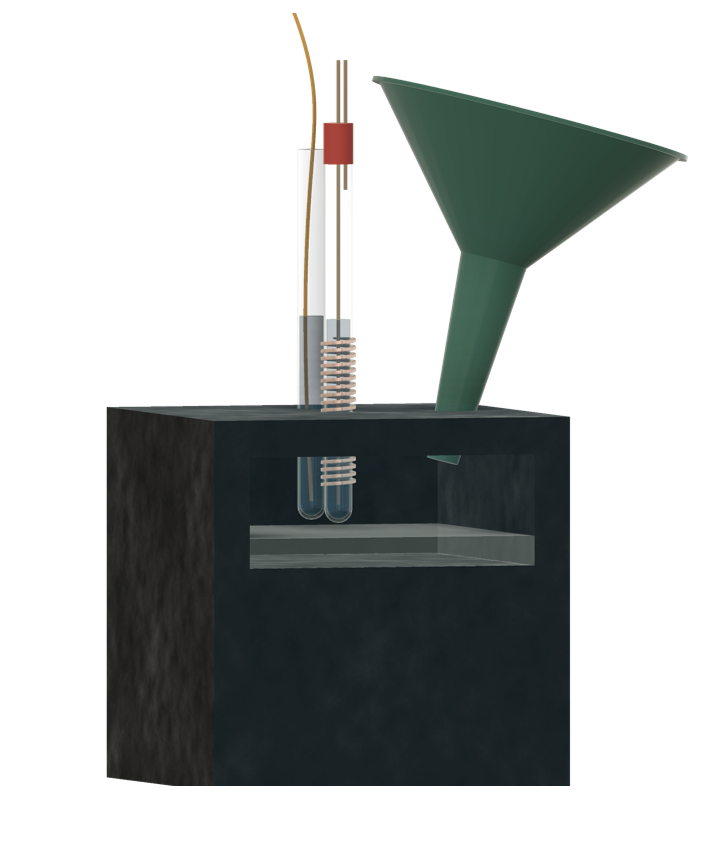
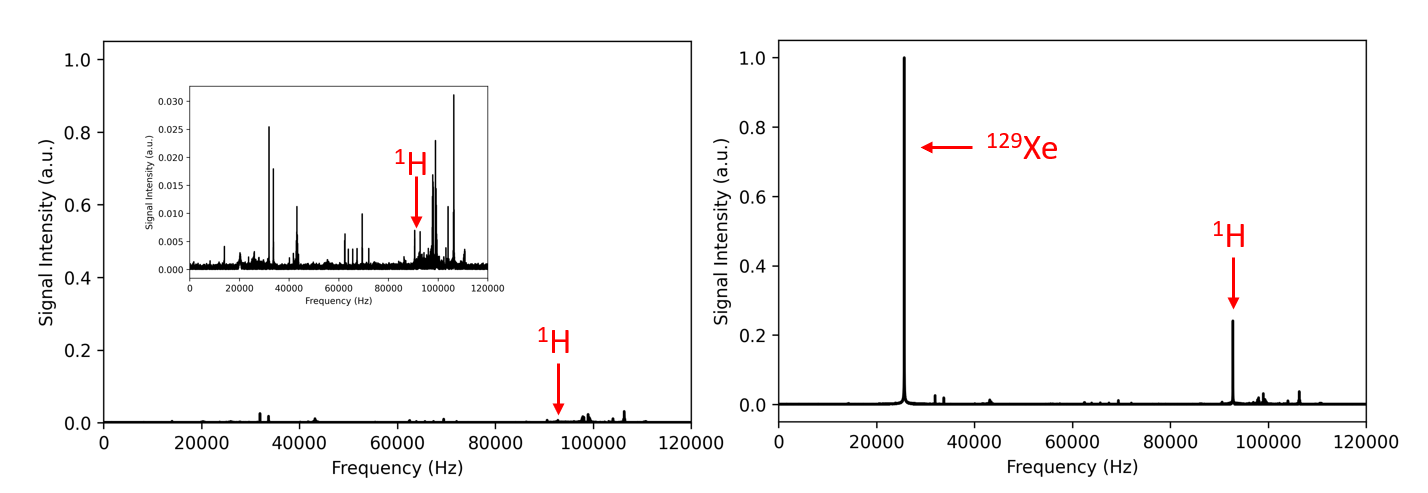

Figure 3 SPINOE in toluene, pentane, and cyclohexane after a 6 second period of bubbling HP 129Xe in the solvent. (Left column) Measurements at room temperature. One can easily see that the T1 of 1H is extended due to transfer of polarization from HP 129Xe. The maximum enhancement occurs for 1H between 30-40 s. (Right column) Measurements obtained from the same sample at -30 °C and -80 °C. The T1’s of 1H and 129Xe have both decreased leading to a more rapid cross-relaxation rate. Maximum 1H polarization occurs around 20 s.


Figure 5 1H enhancement of ≈170-fold is observed at 2.1 mT in a sample of pentane at -90 °C, 10 s after hyperpolarized xenon had been bubbled in solution for 18 second. A greater enhancement can be clearly obtained by bubbling in solution of 100% xenon gas. Enhancement was calculated by comparing relative integrated areas of the SPINOE and thermal peaks.