4467
Utility of single breath-hold compressed sensing cine imaging in optimizing clinical cardiac magnetic resonance scanning procedure1Department of Radiology, Sir Run Run Shaw Hospital, Zhejiang University School of Medicine, Hangzhou, China
Synopsis
Keywords: Quantitative Imaging, Cardiovascular, compressed sensing
The main goal of this study is to evaluate the practicability of a single breath-hold whole-heart coverage compressed sensing cine sequence in daily CMR examination, moreover, to optimize the scanning procedure for patients with different kinds of cardiac dysfunction. For patients, especially those are diagnosed with chronic heart failure, the single breath-hold CS cine can substantially shorten scanning time and provide reliable cardiac function parameters comparing with routine bSSFP cine. This single breath-hold CS cine sequences is recommended to be used before contrast injection because of gadolinium agent induced reduction of end-systolic/diastolic volume and image contrast.Introduction
Compressed sensing (CS) cine could shorten scan time and provide comparable images as multi-breath-hold balanced steady-state free precession (bSSFP) cine in a number of published studies1, 2. However, most of these studies only focused on patients with certain kinds of heart disease or healthy participants, to test the consistency between CS cine and routinely used bSSFP cine3, 4. The aim of this study was to evaluate the practicability of a single breath-hold CS cine (equipped with VAriable spatial-temporal LAtin hypercube and echo-Sharing (VALAS) technique) sequence in daily clinical use, moreover, to optimize the scanning procedure for patients with different kinds of cardiac dysfunction.Methods
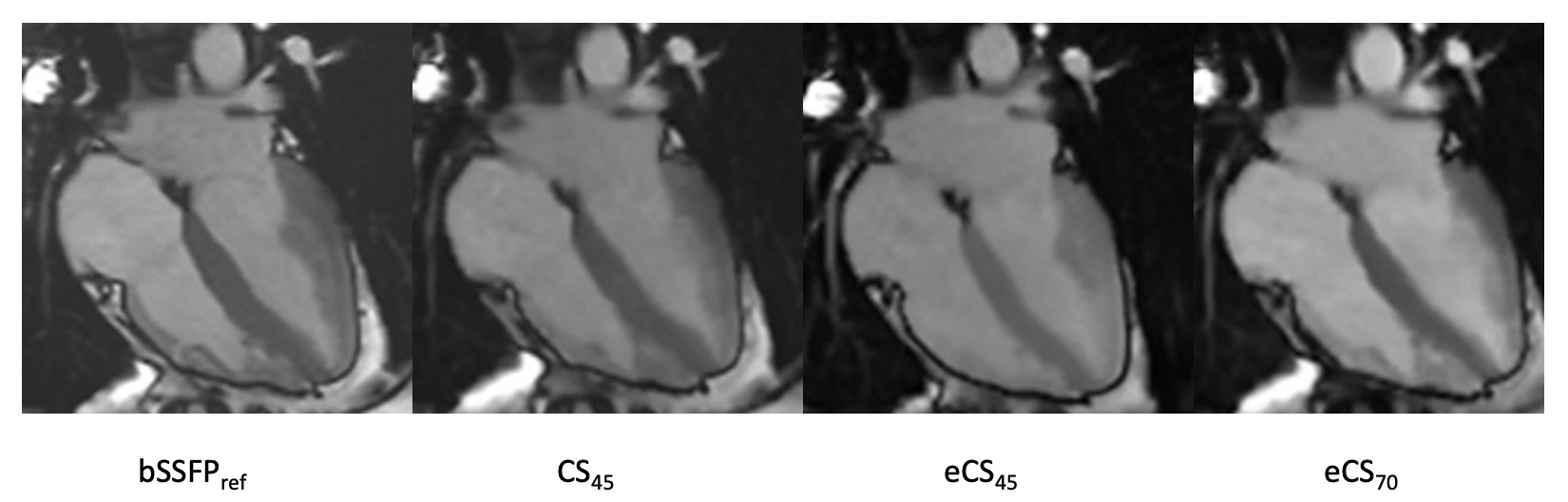
One hundred and four patients (75 men and 29 women with a mean age of 46.5 ± 17.1 (SD) years) were recruited with the approval of local ethics Committee, covering 12 different cardiovascular etiologies. Each patient underwent four consecutive cine sequences providing the same slices, including the reference multi-breath-hold bSSFP (bSSFPref) cine, the single breath-hold CS cine with the same flip angle as bSSFPref before (CS45) and after (eCS45) contrast enhancement, the same CS cine (eCS70) with larger flip angle after contrast enhancement (Fig. 1). Paired t-test and Wilcoxon signed-rank test was performed on bSSFPref and all CS cine images, to measure the accordance of functional parameters and image related rating scores.Results
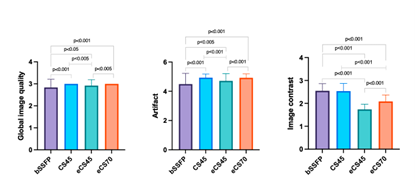
Single breath-hold CS cine sequences had a much shorter acquisition time compared with routine bSSFPref cine (18.2 ± 3.2 (SD) s vs 119.7 ± 23.3 (SD) s, p < 0.001). bSSFPref cine had a little higher left ventricular ejection fraction (LVEF) than all CS cine sequences (49.2 ± 16.9 (SD), 48.3 ± 16.5 (SD), 48.2 ± 16.1 (SD), 48.2± 16.1 (SD), respectively, all p < 0.001), no statistical difference in LVEF was found among three CS cine sequences. After contrast injection, the right ventricular ejection fraction (RVEF) of CS cine became lower than the cine sequences without contrast agent (42.9 ± 13.5 (SD), 42.8 ± 13.5 (SD), 41.8 ± 13.2 (SD), 42.0 ± 13.0 (SD), respectively, p < 0.001), end-systolic/diastolic volume (ESV/EDV) of both ventricular increased (p < 0.001), but no significance was found between eCS45 cine and eCS70. The single breath-hold CS cine had higher global image quality (p < 0.05) and fewer artifacts than bSSFPref cine (p < 0.005), CS45 and eCS70 cine had higher global image quality than other cine sequences (p < 0.005). The gadolinium agent decreased the image contrast of CS cine (p < 0.001) (Fig. 2).Discussion
Single breath-hold CS cine could drastically decrease the scanning time of short-axis stack in one-breath-hold, this finding is in line with previously published studies1, 2. It could be a reliable alternative to routine bSSFP cine, especially for patients who could not hold their breath and or also with mild arrhythmia. Although bSSFPref cine had higher LVEF than all CS cine sequences, the mean difference was only 1 percent, such distinction would not affect its clinical use5. Contrast agent decreased RVEF of CS cine, accompanied by increased ESV/EDV of both ventricular. This might be explained by myocardium/blood pool contrast reduction, and the post-processing software was unable to accurately detect endocardium boundaries automatically. After enhancement agent injection, LVEF and RVEF were not affected by the flip angle regardless of image contrast increment, but we still recommend a larger flip angle in future CMR cine scanning6.Conclusion
For patients with different causes of heart diseases ( especially those diagnosed with chronic heart failure) who request clinical CMR examination, the single breath-hold CS cine can substantially shorten scanning time and provide reliable cardiac function parameters comparing with routine bSSFP cine. Gadolinium agent affects end-systolic/diastolic volume assessment and image contrast of CS cine images, this single breath-hold CS cine sequences should be used before contrast injection.Acknowledgements
We thank Mr. Shuheng Zhang from United Imaging Healthcare (UIH) for his technical support.References
1. Vincenti G, Monney P, Chaptinel J, et al. Compressed sensing single-breath-hold CMR for fast quantification of LV function, volumes, and mass. JACC Cardiovascular imaging 2014;7(9):882-92.
2. Wang J, Li X, Lin L, et al. Diagnostic efficacy of 2-shot compressed sensing cine sequence cardiovascular magnetic resonance imaging for left ventricular function. Cardiovascular diagnosis and therapy 2020;10(3):431-41.
3. Longère B, Pagniez J, Coisne A, et al. Right Ventricular Volume and Function Assessment in Congenital Heart Disease Using CMR Compressed-Sensing Real-Time Cine Imaging. Journal of clinical medicine 2021;10(9)
4. Chen Y, Qian W, Liu W, et al. Feasibility of single-shot compressed sensing cine imaging for analysis of left ventricular function and strain in cardiac MRI. Clin Radiol 2021;76(6):471 e1-71 e7.
5. Steeden JA, Kowalik GT, Tann O, et al. Real-time assessment of right and left ventricular volumes and function in children using high spatiotemporal resolution spiral bSSFP with compressed sensing. J Cardiovasc Magn Reson 2018;20(1):79.
6. Kuetting D, Feisst A, Dabir D, et al. The effects of flip angle optimization on the precision and reproducibility of feature tracking derived strain assessment in contrast enhanced bSSFP cine images. European journal of radiology 2018;102:9-14.
Figures