4429
Design Optimization of an Hybrid Multi-Coil Array for In Vivo Human Brain B0 Shimming
Sebastian Theilenberg1, Carlotta Ianniello1, Kay C Igwe1, Adam M Brickman2,3,4, and Christoph Juchem1,5
1Biomedical Engineering, Columbia University in the City of New York, New York, NY, United States, 2Taub Institute for Research on Alzheimer’s Disease and the Aging Brain, Vagelos College of Physicians and Surgeons, Columbia University, New York, NY, United States, 3Gertrude H. Sergievsky Center, Vagelos College of Physicians and Surgeons, Columbia University, New York, NY, United States, 4Department of Neurology, Columbia University Medical Center, New York, NY, United States, 5Radiology, Columbia University Medical Center, New York, NY, United States
1Biomedical Engineering, Columbia University in the City of New York, New York, NY, United States, 2Taub Institute for Research on Alzheimer’s Disease and the Aging Brain, Vagelos College of Physicians and Surgeons, Columbia University, New York, NY, United States, 3Gertrude H. Sergievsky Center, Vagelos College of Physicians and Surgeons, Columbia University, New York, NY, United States, 4Department of Neurology, Columbia University Medical Center, New York, NY, United States, 5Radiology, Columbia University Medical Center, New York, NY, United States
Synopsis
Keywords: Shims, Brain
The multi-coil (MC) technique utilizing a set of individually driven non-specific coils outperforms traditional spherical harmonics B0 shimming in rodent and human brains. MC designs consisting of dedicated MC elements have shown the best shim performance, while designs utilizing a DC current on the RD coil of RF coil arrays have slightly lower performance but need significantly less physical space. Here, we optimized the number, size and placement of dedicated MC elements to be used in combination with RF-DC coils in a hybrid MC shim system for B0 shimming of the human brain in a clinical 3 T MR scanner.Introduction
Most MRI acquisition schemes rely on high degrees of B0 homogeneity across the region of interest (ROI) as inhomogeneities result in artifacts like signal dropout or image distortions. This is especially true in brain imaging, where the susceptibility differences between the air in the sinuses and the ear canals and the brain tissue create strong local inhomogeneities in the prefrontal cortex and medial temporal lobes, respectively. Traditionally, B0 homogeneity is maximized via dedicated shim coils that generate spherical harmonic (SH) fields, typically up to 2nd order. The multi-coil (MC) technique, which uses a set of non-specific coils driven individually, outperforms SH shimming in rodent1,2 and human brains3. While early MC setups used dedicated coils that need additional space and can affect SNR, especially when placed inside the RF coil, some MC setups used the RF coil elements for MC shimming4,5, which provides an elegant solution to minimize space requirements. However, since RF loops consist of only one turn of wire with limited maximum DC current, and, moreover, since the RF coil geometry is not optimized for B0 control, the shim capabilities of such a system are reduced compared with dedicated MC-only systems.In this work, we integrated both approaches by adding dedicated MC shim elements to a 16-channel MC capable RF coil, optimizing the size, location, and number of MC elements via Biot-Savart simulations based on a set of 139 in vivo brain B0 maps.
Methods
A cylindrical 16-channel head receive array was the basis of this analysis. All RF+MC elements were assumed to be able to carry ±1 A direct current (DC) for B0 shimming.Figure 1 summarizes our approach. Five basic geometries with 2-6 rings with 8-16 MC elements each were created with varying coil diameter, distance between adjacent coils and the position of the rings along the z-axis and added to the 16 RF+MC elements. Dedicated MC elements were modeled as circular coils of 50 turns of wire each on a cylindrical surface carrying ±1 A maximum current. Coil fields in Hz/A for each of the total 400 discrete geometries were calculated using Biot-Savart simulations6.
The performance of each geometry was tested on 139 B0 field maps acquired in the adult human brain at 3 T (56 ± 12 years, 87 women, 52 men). These maps were acquired as part of the Offspring Study7 in accordance with the Institutional Review Board of Columbia University. ROIs of individual brain volumes were created using FSL’s8 Brain extraction tool9. Best MC fields were calculated for dynamic slice-by-slice shimming, and the standard deviation $$$\sigma\left(\Delta B_0\right)$$$ of the residual field across the ROIs was calculated. The average standard deviation over all subjects was used as a performance measure for a given MC geometry.
For comparison, an SH shim analysis10 was performed on all datasets as well.
Results
With a given number of coils, geometries with more rings performed slightly better than geometries with fewer rings (Figure 2B). Optimal coil sizes depended on the positioning of the rings (Figure 2C). Geometries with the coils distributed equally around the rings performed better than geometries with the coils aggregated towards the front of the setup (Figure 2D).Figure 3 shows the wire path of the best performing setup for each basic MC geometry. Their B0 shim performance is shown in Figure 4 together with the SH analysis. In general, our simulations revealed that more MC elements led to a better shim performance. All setups outperformed 3rd order SH shimming in both static and dynamic shimming, while the higher element MC setups outperformed 4th order SH shimming. Exemplary shim fields for these different setups are shown in Figure 5.
Discussion & Conclusion
The average shim performance of MC geometries generated with different parameters but of the same basic geometry varied by 2-3 Hz, which represents a larger difference than the gain between 2nd and 4th order SH shimming, highlighting the necessity to optimize the placement of MC elements within the available physical space.The parameter space explored here is only a small subset of all possible optimization parameters for MC setups like this, and the geometric constraint of a relatively large cylindrical surface ignores MC element locations that are possible in reality. Future research will include MC elements on a dome-like surface commonly used in RF coil design. MC elements in the vicinity of RF elements can have a negative impact on SNR3. In simulations we found that these effects are strongly dependent on the relative position of the respective elements11. This knowledge could be used to inform MC coil positioning to maximize shim performance without compromising RF performance.
By combining DC driven RF elements as introduced by Stockmann et al. with dedicated MC elements, we combine the best of both worlds. The preliminary results presented here provide the first step towards developing fully integrated MC-RF hardware with hybrid MC-only and RF+MC capability for B0 shimming of the human brain in a clinical 3 T MR scanner as part of a clinical workflow.
Acknowledgements
This research was supported by the National Institutes of Health under award numbers R01EB030560, AG054070, and AG058067.References
- Juchem C, Brown PB, Nixon TW, et al. Multicoil shimming of the mouse brain. Magn Reson Med. 2011;66(3):893–900.
- Juchem C, Herman P, Sanganahalli B, et al. DYNAmic Multi-coIl TEchnique (DYNAMITE) shimming of the rat brain at 11.7T. NMR in Biomedicine. 2014;27(8):897–906.
- Juchem C, Nixon TW, McIntyre S, et al. Dynamic multi-coil shimming of the human brain at 7 T. JMR. 2011;212(2):280–288.
- Stockmann JP, Witzel T, Keil B, et al. A 32-channel combined RF and B0 shim array for 3T brain imaging. Magn Reson Med. 2016;75(1):441–451.
- Darnell D, Ma Y, Wang H, et al. Adaptive integrated parallel reception, excitation, and shimming (iPRES-A) with microelectromechanical systems switches. Magn Reson Med. 2018;80(1):371–379.
- Juchem C. (2017). B0DETOX - B0 Detoxification Software for Magnetic Field Shimming. Columbia University Technology Ventures. http://innovation.columbia.edu/technologies/cu17326_b0detox
- Manly J, Rentería MA, Avila-Rieger JF, et al. Offspring Study of Racial and Ethnic Disparities in Alzheimer’s Disease: Objectives and Design. PsyArXiv. 2020. Preprint. https://doi.org/10.31234/OSF.IO/FRBKJ
- Jenkinson M, Beckmann CF, Behrens TEJ, et al. FSL. NeuroImage. 2012;62(2):782–790.
- Smith SM. Fast robust automated brain extraction. Human Brain Mapping. 2002;17(3):143–155.
- de Graaf RA, Juchem C. CHAPTER 4. B0 Shimming Technology. In Magnetic Resonance Technology: Hardware and System Component Design. The Royal Society of Chemistry. 2016;166–207.
- Ianniello C, Theilenberg S, Majumder JA, et al. A 16-channel MC and RF hybrid system for B0 shimming and B1 reception: a preliminary prototype. Proc Intl Soc Magn Reson Med. 2023, Toronto, Canada. Under review.
Figures
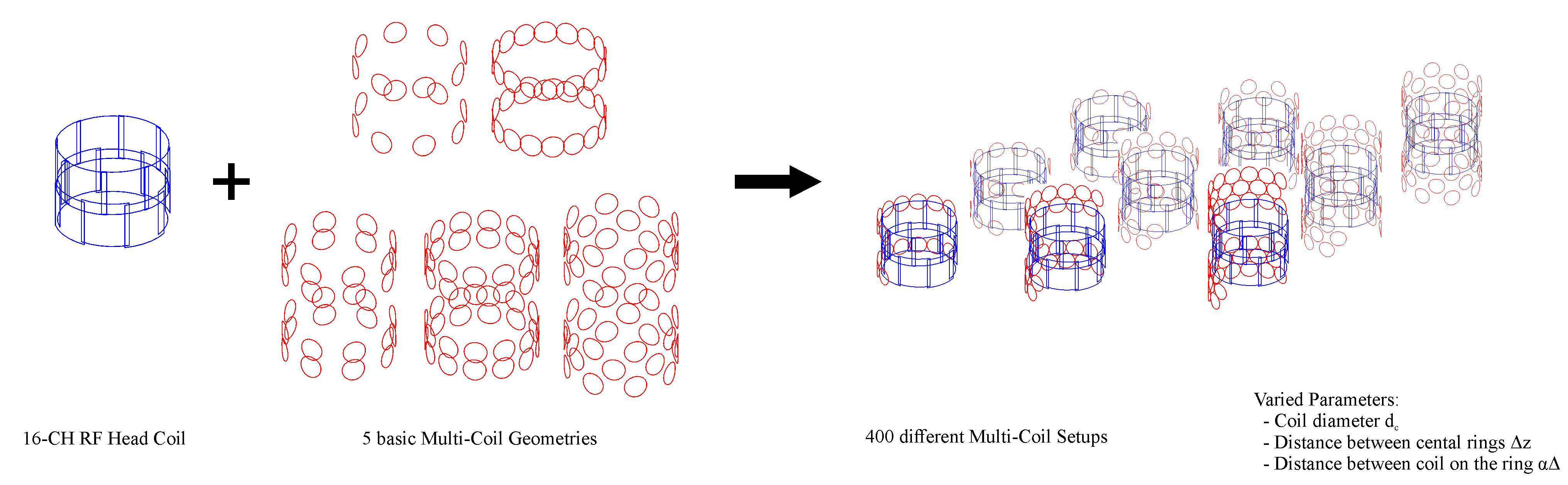
Fig 1: Illustration of the multi-coil geometry generation. Variations of five different geometries with 16-48 coils on 2-6 rings were created and added to the 16 elements of an RF head coil. Varied parameters include the location of the coil rings in z-direction, the coil diameter, and the arrangement of the coil on the rings.
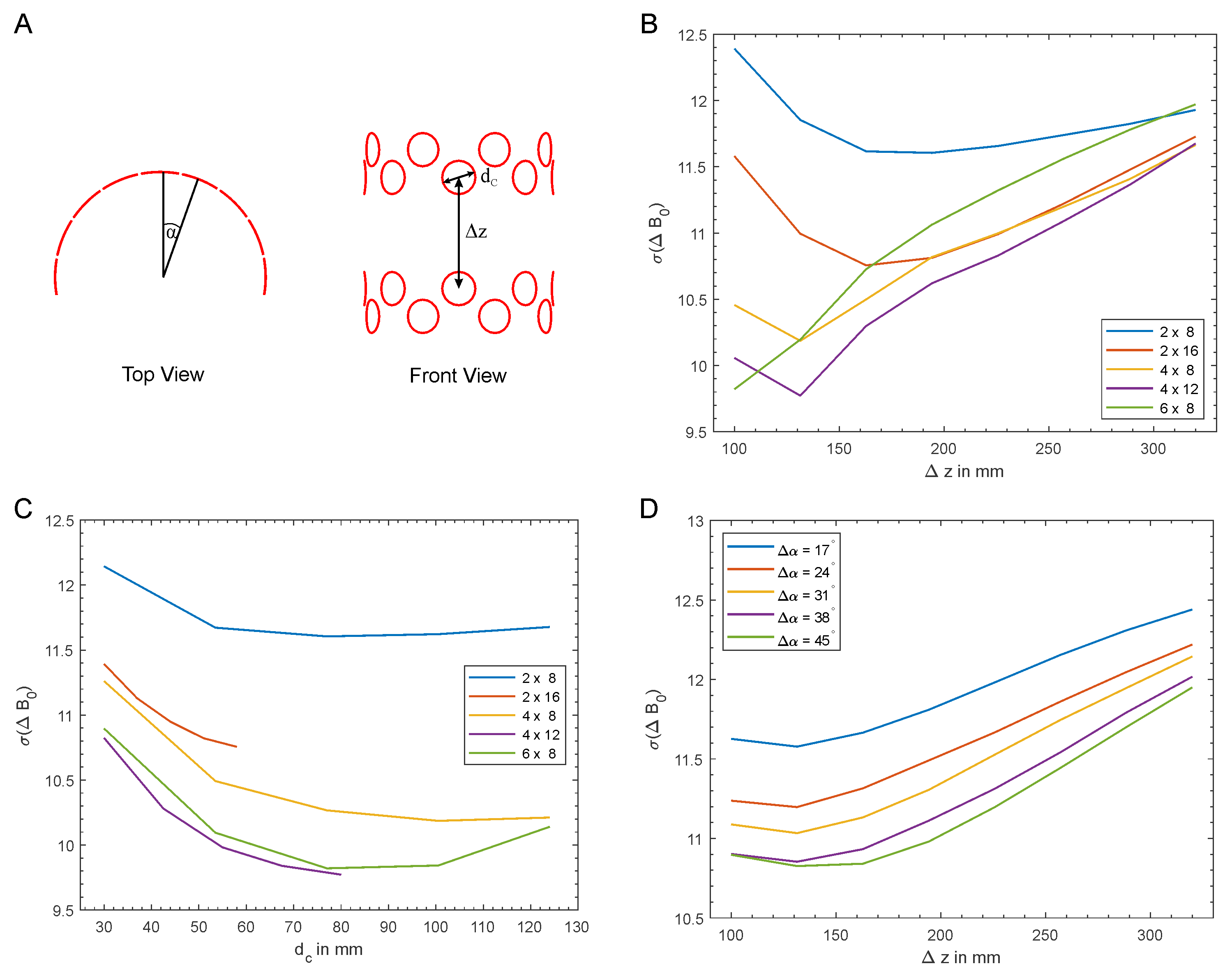
Fig 2: A) Parameter definition: Δα angle between coils on a ring, Δz distance between the inner most rings, dC coil diameter. B/C) Shim performance for different setups (rings x coils/ring) with coils equally spaced around the rings at B) the best tested dC for each geometry, C) the best tested Δz for each geometry. More coils per ring and more rings led to better performance, and the optimal Δz is reduced with more rings. D) Shim performance for 4 rings with 8 coils each for various Δα with dC = 40 mm. Δα = 45° distributes coils evenly around the ring, smaller angles concentrate them at the front.
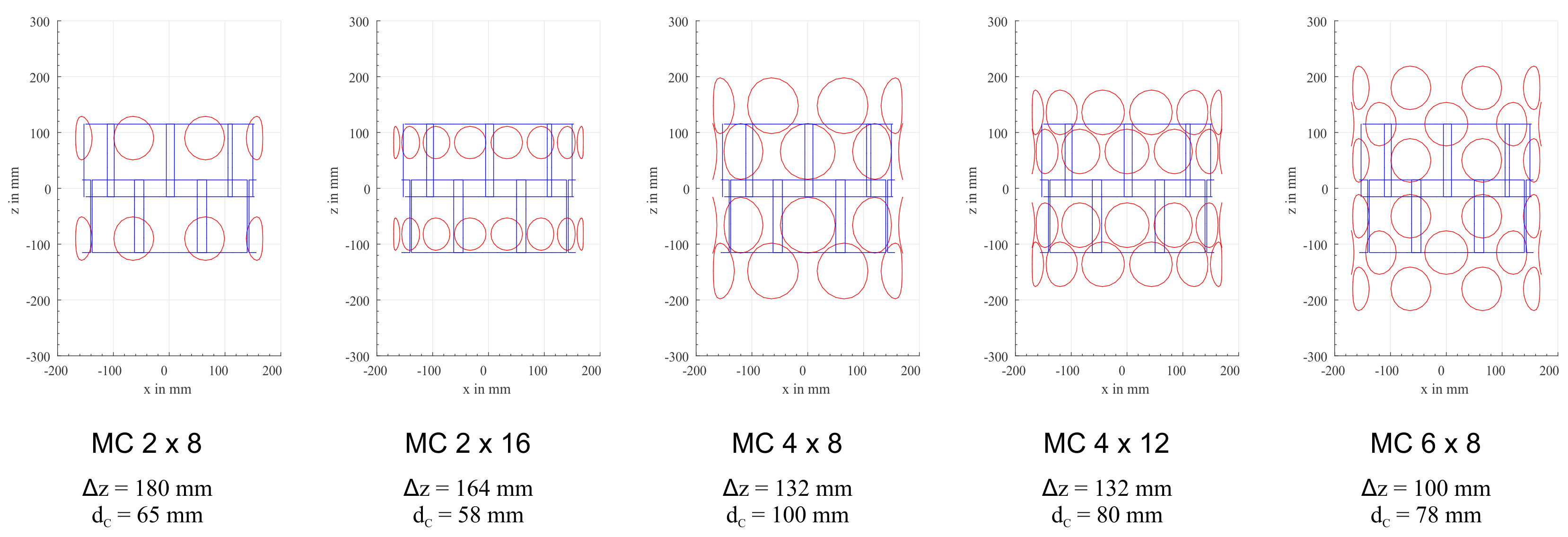
Fig 3: Illustration of the best performing simulated setup for each basic geometry and the respective distance Δz between the inner rings and coil diameter dC. The optimal Δz tends to grow smaller with an increasing number of rings.
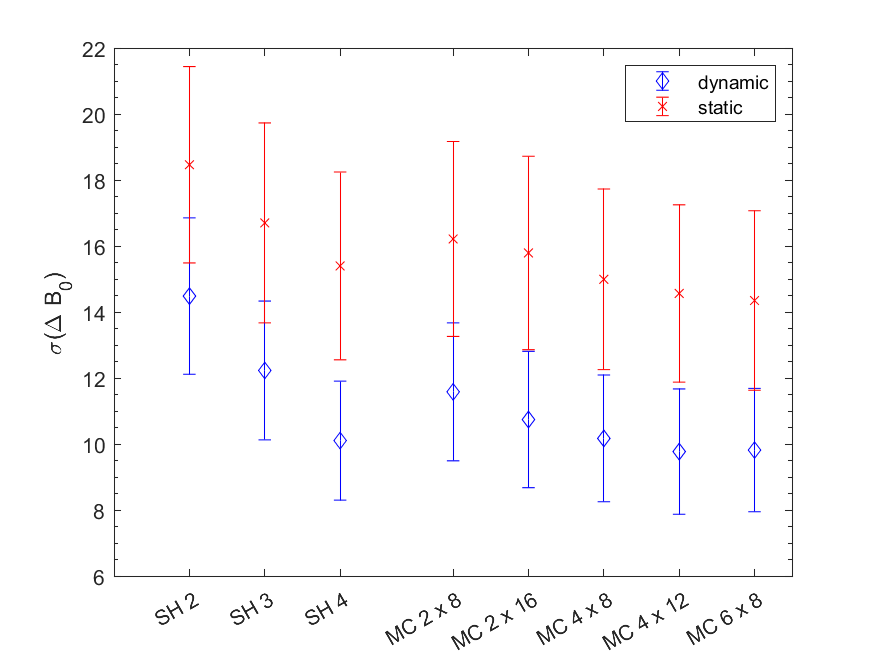
Fig 4: Shim performance of the optimal setups for each basic geometry compared to traditional spherical harmonics (SH) shimming, both in static global shimming of the full brain ROI, and in dynamic slice-by-slice shimming. Shown is the average shim performance σ(ΔB0) and its standard deviation across all 139 in vivo subjects. Note that dynamic shimming above 1st order is currently not available in clinical systems.
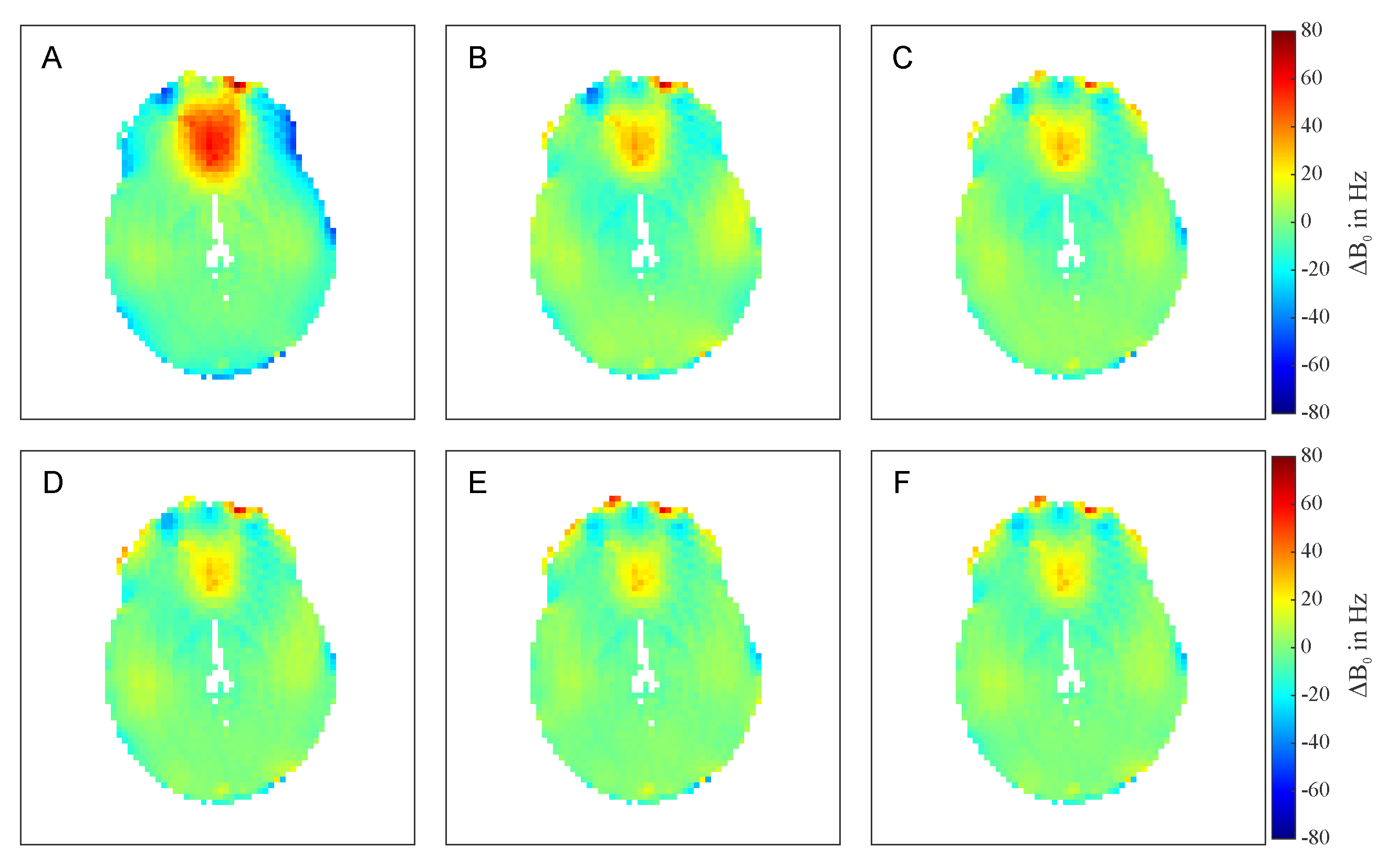
Fig 5: Exemplary shimmed B0 field distribution in one central axial slice of one subject. A) after 2nd order static SH shimming as is the clinical standard today. B-F) after dynamic multi-coil shimming using the best calculated setup with B) 2 x 8 coils, C) 2 x 16 coils, D) 4 x 8 coils, E) 4 x 12 coils, and F) 6 x 8 coils.
DOI: https://doi.org/10.58530/2023/4429