4403
Tailored cost functions for improved static pTX-based B1+ shimming in 7T cardiac MRI.1Chair of Molecular and Cellular Imaging, Comprehensive Heart Failure Center, University Hospital Würzburg, Wuerzburg, Germany, 2Physikalisch-Technische Bundesanstalt (PTB), Braunschweig and Berlin, Berlin, Germany
Synopsis
Keywords: Parallel Transmit & Multiband, Cardiovascular
Parallel transmit (pTX) technology is an emerging tool for improving of the B1+-field homogeneity in cardiac MRI (cMRI) at the ultra-high magnetic field. In this work, we propose a methodology to enhance the characteristics of the shaped B1+ field using a tailored cost function for the optimization procedure computing complex transmit vectors of magnitudes and phases for driving TX array. Using the cost functions (CF) based on the local B1 gradients with fine-tuning by weighting coefficients allows for considerable improvement of static pTX B1-shimming quality in compared to traditional CF using the coefficient-of-variation (CoV) of B1.Introduction
During the last decades parallel transmit (pTX) technology became an emerging tool for improving the B1+-field homogeneity in cardiac MRI (cMRI) at the ultra-high magnetic field. Manipulating the driving voltages of transmitting (Tx) array elements allows for shaping the spatial distribution of B1+ with desirable spatial properties within a region of interest (ROI). In this work, we propose a methodology to improve the characteristics of the shaped B1+ field using tailored cost functions (CF) for the optimization procedure by computing complex transmit voltage vectors for the TX array. Preliminary results[1] in phantoms using in-house developed arrays demonstrate that using a CF based on the B1 gradients allows taking into account the properties of the local surface Tx-arrays that by its geometry generates B1 with intrinsic heterogeneity in specific directions (most often anterior-posterior). As a result a considerable improvement of static pTX B1-shimming quality can be achieved in comparison to traditional CF using the coefficient-of-variation (CoV) of B1. In this work, the dataset of B1+ obtained by a commercial cardiac array (MRI Tools, Berlin, Germany) acquired from 36 subjects[2] has been used to explore further this hypothesis.Methods
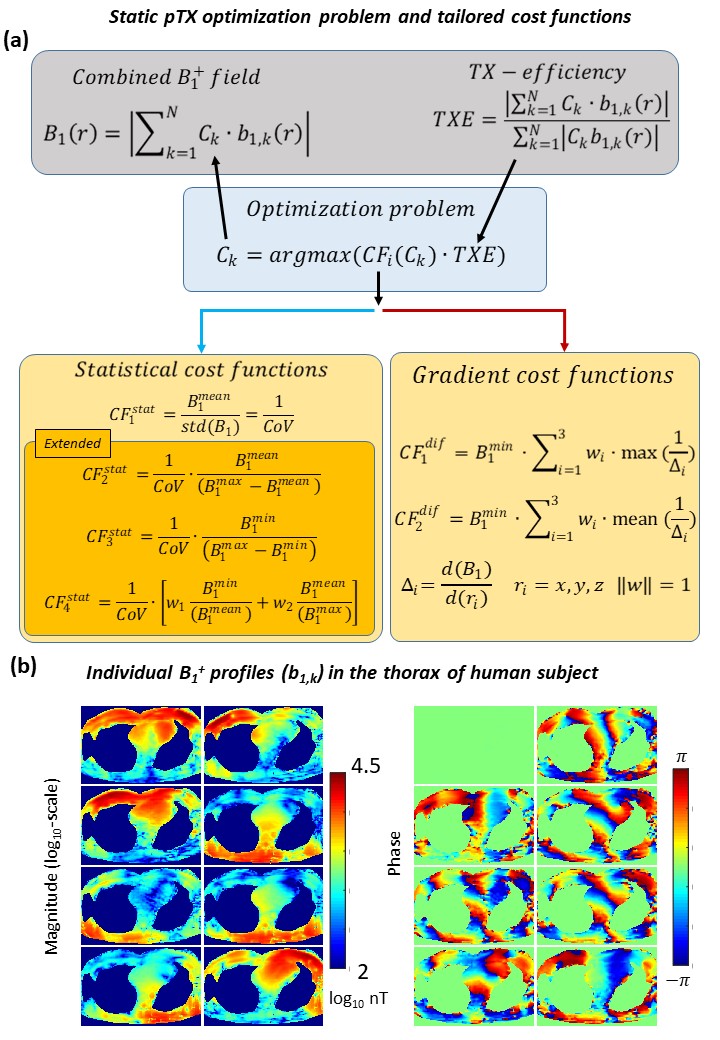
The combined magnetic field of the array is given $$$ B_1(r) = \sum_{k=1}^{N} C_k \cdot b_{1k}(r) $$$ where b1k(r) are complex absolute or relative B1-maps measured for each Tx-channel. The B1-shimming of an array is performed by control of the Tx-vector {C1..CN} to achieve the targeted spatial homogeneity of combined field B1(r). Finding out a vector is formulated as an optimization problem for the specific cost function (CF) including characteristics of the targeted B1 in the region-of-interest. The efficient usage of the RF-power with the specific Tx-vector is controlled via the “transmit efficiency factor”. The summary of the optimization problem and cost functions is shown in Fig 1a. In the first step, we explore the efficiency of B1 optimization using CF based on the coefficient-of-variation (CoV) of B1 (“statistical-based” CF, further SCF) with extension factors aimed improving homogeneity and managing destructive interference. In the second step, we probed the CFs based on the spatial gradients of targeted B1 with adjustable weighting coefficients (“gradient-driven” CF, further GCF). In order to ensure a fair comparison of results using different CF with regard to the used RF-power the equal boundary conditions for the real and imaginary part of the vector were used in the optimization solver (equivalent to the limitation of RF-power-per-channel). Additionally, all resulted vectors were normalized as before evaluating the statistical metrics of combined B1. As a data source of B1 maps, the dataset acquired in the context of [3] and [4] was used. This includes B1-maps acquired using RF-array with 8 dipole Tx-elements and 24 loops composing 8Tx/32Rx architecture for pTX application for cMRI at 7T. The dataset includes B1 maps of 8 individual channels and 3D masks of optimization ROIs. The computation was done using an in-house developed Matlab toolbox [5].Results
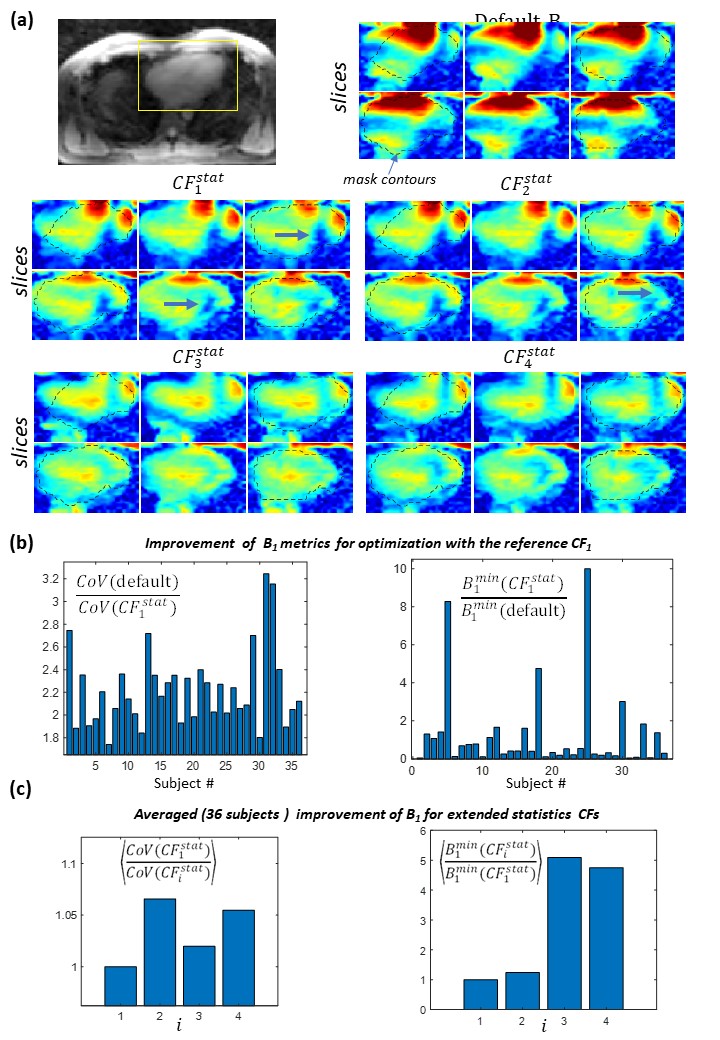
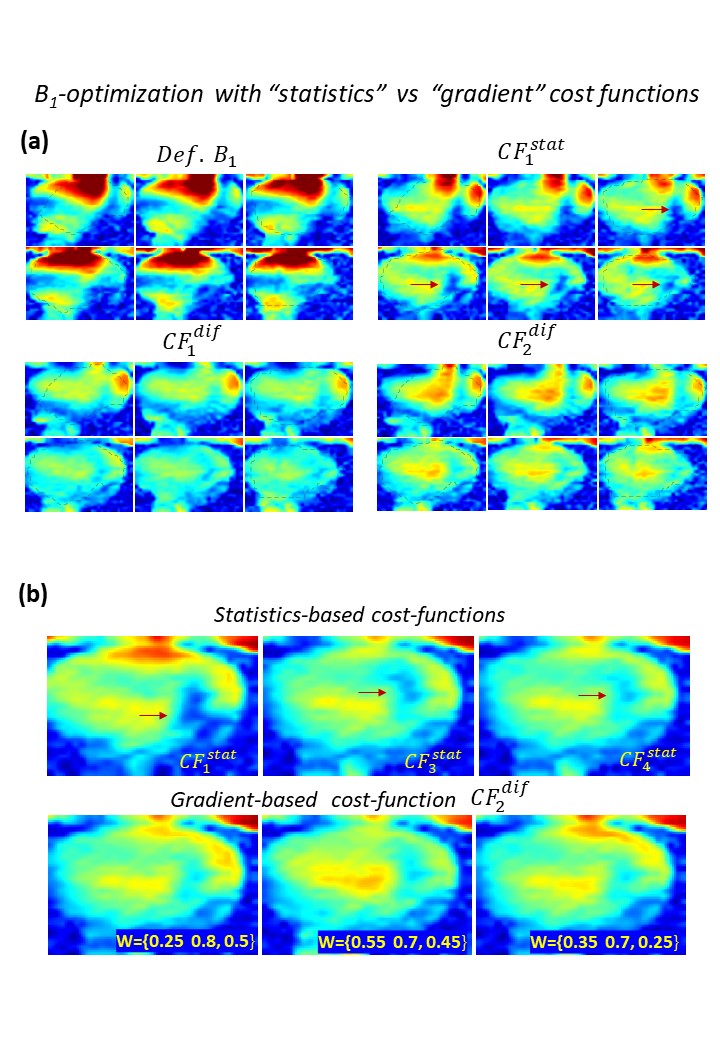
Figure 2 demonstrates the results of using SCF (CF1stat.. CF4stat) to optimize default B1 maps in the example subject (#4 in the dataset). For the reference CF1stat (including only CoV), the improvement of homogeneity (CoV decreased by factors 2 to 3) is observed (Figure 2b). Using the basic function CF1stat removes destructive interferences only partially. Using tailored SCF with extension factors allows for significantly better managing the destructive interferences which are manifested both visually (Figure 2a, arrows marks) and by an increase of the minimal B1 value up to factor 5 (Figure 2c).Figure 3 demonstrates the results of B1 optimization using SCF and GCF respectively in the example subject. Using fine-tuning of the weighting coefficient for GCF allows for achieving further improvement in managing destructive interference compared to both the reference and extended SCF.
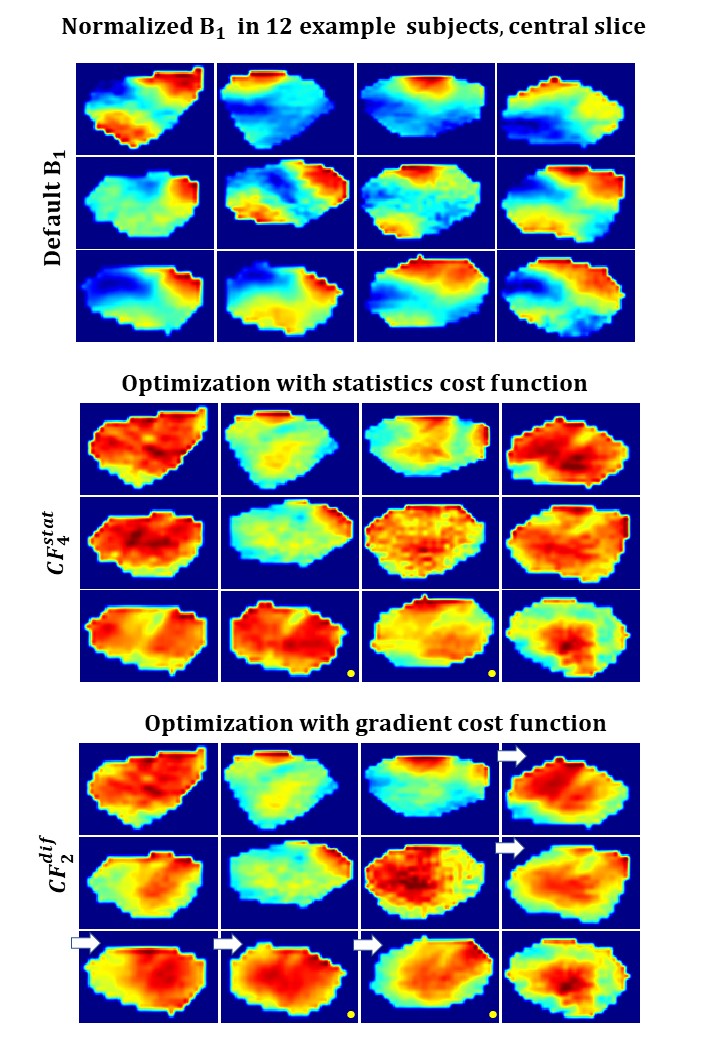
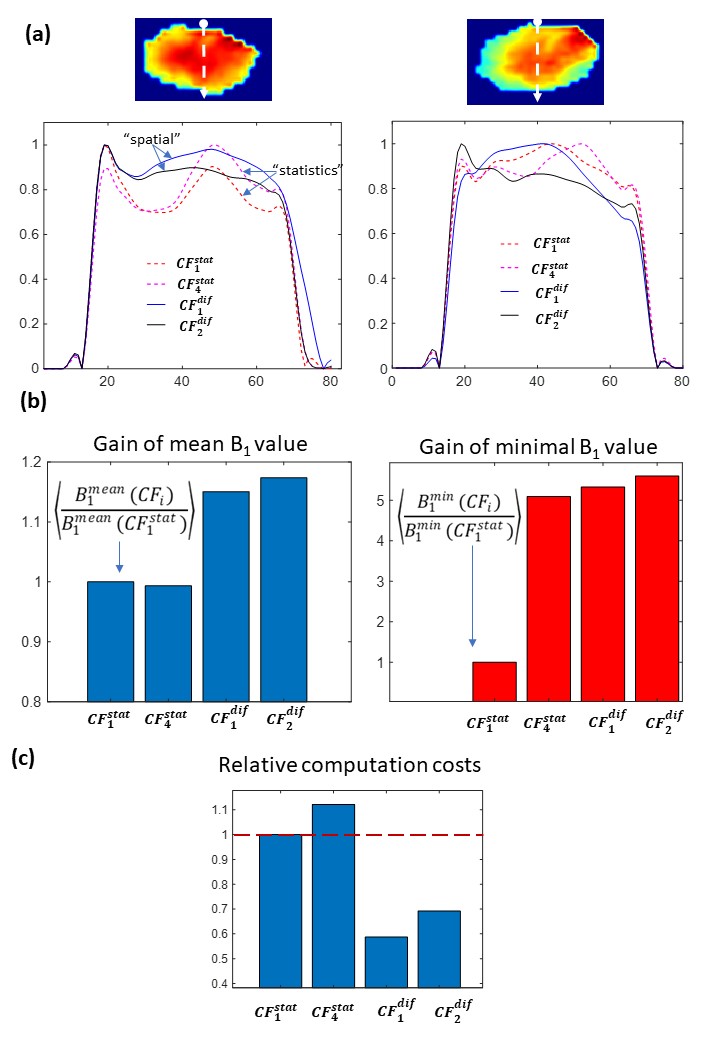
Figure 4 shows default and optimized B1 maps in 12 example subjects. The slice with the maximal area of the mask is demonstrated. One can observe that GCF-optimization provides additional smoothness of the B1-maps (examples are labeled) in comparison to SCF-optimization. This could be seen in the Figure 5a demonstrating examples of vertical profiles in the same slice. In addition to that, using GCF provides an additional gain of both minimal and mean value of B1 compared to SCF-optimization (Figure 5b). Finally, Figure 5c shows that using GCF is up to 40% less computationally expensive compared to CF based on CoV ( even without extension factors)
Discussion
Our results show that CFs extending the standard CoV-based function provide options for efficient suppression of destructive interferences of B1 using static pTX-shimming. This introduces, however, additional computational costs in the optimization. Using CF based on weighted spatial metrics allows taking into account the geometry of surface Tx-arrays for UHF cMRI which introduces intrinsic gradients in a shaped B1. Using fine-tuning of weighting coefficients allows us to better address both destructive interferences and intrinsic spatial inhomogeneities of B1 in the heart at UHF.Conclusion
It was demonstrated that using specifically tailored cost functions allows for better addressing the destructive interferences of B1 in the CMRI at 7T using static pTX shimming. The same approach can be transferred further for dynamic pTX optimization tasks using both tailored and universal RF pulses.Acknowledgements
L.M Schreiber receives research support by Siemens Healthineers. The position of D. Lohr is partially funded by this research support.References
1. Terekhov, M., Elabyad, I,, Schreiber, L. Optimal Cost Functions for the Static pTX B1+-Shimming in Ultra-High Magnetic Field cardiac MRI in ISMRM Workshop "Ultra-High Field MR". 2022. Lisbon, Portugal. 2. Aigner, C.S., et al., Calibration-free pTx of the human heart at 7T via 3D universal pulses. Magn Reson Med, 2022. 87(1): p. 70-84.
3. Aigner, C.S., S. Dietrich, and S. Schmitter, Respiration induced B 1 + changes and their impact on universal and tailored 3D kT-point parallel transmission pulses for 7T cardiac imaging. Magn Reson Med, 2022. 87(6): p. 2862-2871.
4. Dietrich, S., et al., 3D Free-breathing multichannel absolute B 1 + Mapping in the human body at 7T. Magn Reson Med, 2020.
5. Terekhov, M., I.A. Elabyad, and L.M. Schreiber, Global optimization of default phases for parallel transmit coils for ultra-high-field cardiac MRI. PLoS One, 2021. 16(8): p. e0255341.
Figures