4402
Comparison of the Optimization of a 60-channel Transmit Coil in pTx and sTx mode at 7T
Andrea N Sajewski1, Tales Santini1, Tiago Martins1, Jacob Berardinelli1, and Tamer Ibrahim1
1University of Pittsburgh, Pittsburgh, PA, United States
1University of Pittsburgh, Pittsburgh, PA, United States
Synopsis
Keywords: In Silico, RF Arrays & Systems
The recently developed 60-channel Tic-Tac-Toe transmit coil was analyzed for use in either single or parallel transmit systems at 7T. With the 60-channel TTT coil, excellent homogeneity can be achieved and safe levels of SAR can be provided regardless of which system (sTx or pTx) is used.Introduction
The Tic-Tac-Toe (TTT) family of transmit coils1-4 has shown effectiveness at producing homogeneous and load-insensitive B1+ for 7T MRI, a priority for single-channel transmit (sTx) systems. This study investigates the use of TTT coils for parallel transmit (pTx) systems; specifically, we are investigating B1+ and SAR of a 60-channel TTT head coil optimized separately for sTx and pTx systems.Methods
The 60-channel head coil has 15 TTT panels which each have 4 transmit channels. Simulations of the magnetic and electric fields were performed using in-house finite difference time domain (FDTD) software, which includes transmission line and capacitor models. Three anatomically detailed head models, shown positioned in the coil in Figure 1, were used from the IT’IS Virtual Family5: Duke (155lbs male), Ella (126lbs female), and Billie (75lbs female). RF shimming was performed in Matlab in order to optimize the phases and amplitudes of each channel. The ROI for SAR calculations was the whole head, and the ROI for B1+ was the whole head excluding nasal cavities and ears, from the bottom of the cerebellum to the top of the brain.For the single-channel mode (sTx), the coil was simultaneously optimized over the three head models in order to find a non-subject specific case. Amplitudes were constrained to implementable cases (a reasonable number of standard power splitters) and total power was constrained to 8kW as provided by the scanner in sTx mode. We aimed to raise the minimum B1+ in the cerebellum and temporal lobe while not sacrificing homogeneity by using an objective function of coefficient of variation (CV) over minimum B1+ (CV/min).
To simulate how the coil would perform in a pTx system, the fields were optimized independently for each head model and total power was constrained to 16kW output from the scanner. The cost functions utilized were coefficient of variation (CV) of B1+, maximum B1+ over minimum B1+ (max/min), and peak SAR. Different weights were applied to each of the terms in order to provide varied shim cases. An optimal shim case was chosen for each head model based on peak and average SAR, CV, and visual assessment of homogeneity and symmetry of the B1+ field distribution.
Results
Comparisons of B1+ and SAR in sTx and pTx mode for each of the head models are displayed in Figures 2, 3 and 4. Each is scaled to its maximum value. A summary of relevant statistics is shown in Table 1, including mean, CV, and maximum over minimum (max/min) of the B1+, peak/average SAR, and SAR efficiency (μT/√(W/kg) for each case. Using a 16kW pTx system, large improvements in CV and max/min of the B1+ are seen as compared to the 8kW sTx mode, while, for Duke and Ella, peak/average SAR is lower with 8kW sTx. For all head models, SAR efficiency is similar in both pTx and sTx modes.Discussion and Conclusion
The parallel transmit system improves the homogeneity of the B1+ provided by the 60-channel TTT array as it allows for a unique shim case for each head and supplies more power. However, B1+ efficiency (B1+ per unit power) is reduced in pTx, but without having to combine the 60 transmit channels into one, less losses due to cables and splitters are expected. Additionally, regardless of sTx or pTx mode, SAR efficiency remains nearly the same. In any case, with the 60-channel TTT coil, excellent homogeneity can be achieved (CV as low as 0.157) and safe levels of SAR can be provided (peak/avg less than 3.3).Acknowledgements
This work was supported by the National Institutes of Health under award numbers R01MH111265, R01AG063525, R56AG074467, and T32MH119168, and by the National Science Foundation Graduate Research Fellowship under Grant No. 1747452. This work was supported in part by the University of Pittsburgh Center for Research Computing through the resources provided.References
- Kim, J., et al. (2016). “Experimental and numerical analysis of B1+ field and SAR with a new transmit array design for 7T breast MRI.” J Magn Reson 269: 55-64.
- Krishnamurthy, N., et al. (2019). “Computational and experimental evaluation of the Tic-Tac-Toe RF coil for 7 Tesla MRI.” PLoS ONE 14(1): e0209663.
- Santini, T., et al. (2018). “In-vivo and numerical analysis of the eigenmodes produced by a multi-level Tic-Tac-Toe head transmit array for 7 Tesla MRI.” PLoS ONE 13(11): e0206127.
- Santini, T., et al. (2020). “Improved 7 Tesla Transmit Field Homogeneity with Reduced Electromagnetic Power Deposition Using Coupled Tic Tac Toe Antennas.” Sci Rep 11: 3370.
- Christ, A., et al. (2009). “The Virtual Family – development of surface-based anatomical models of two adults and two children for dosimetric simulations.” Phys Med Biol 55: 23.
Figures
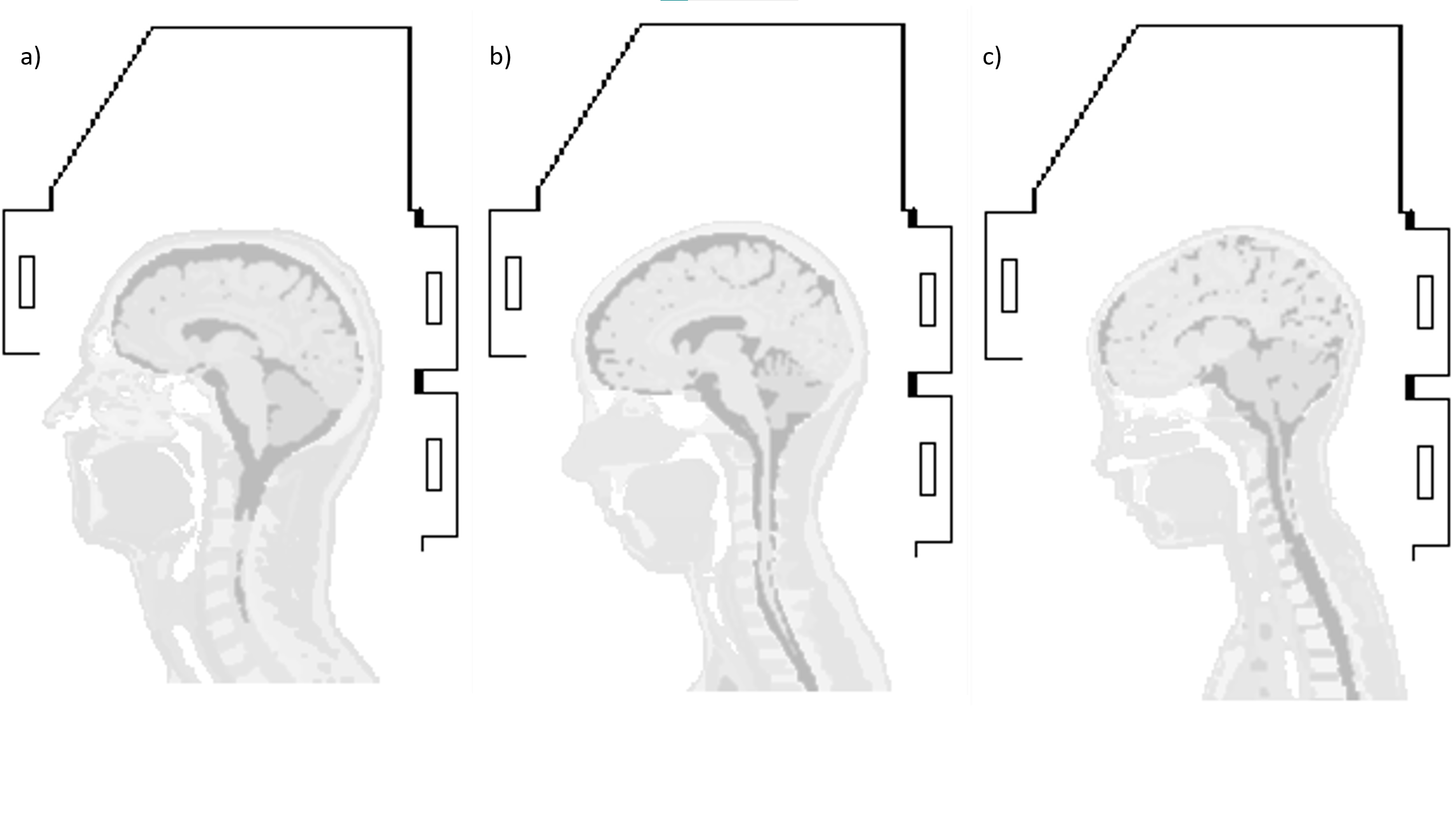
Figure 1: Three head models a) Duke, b) Ella, and c) Billie in the FDTD grid using the 60-channel TTT RF coil.
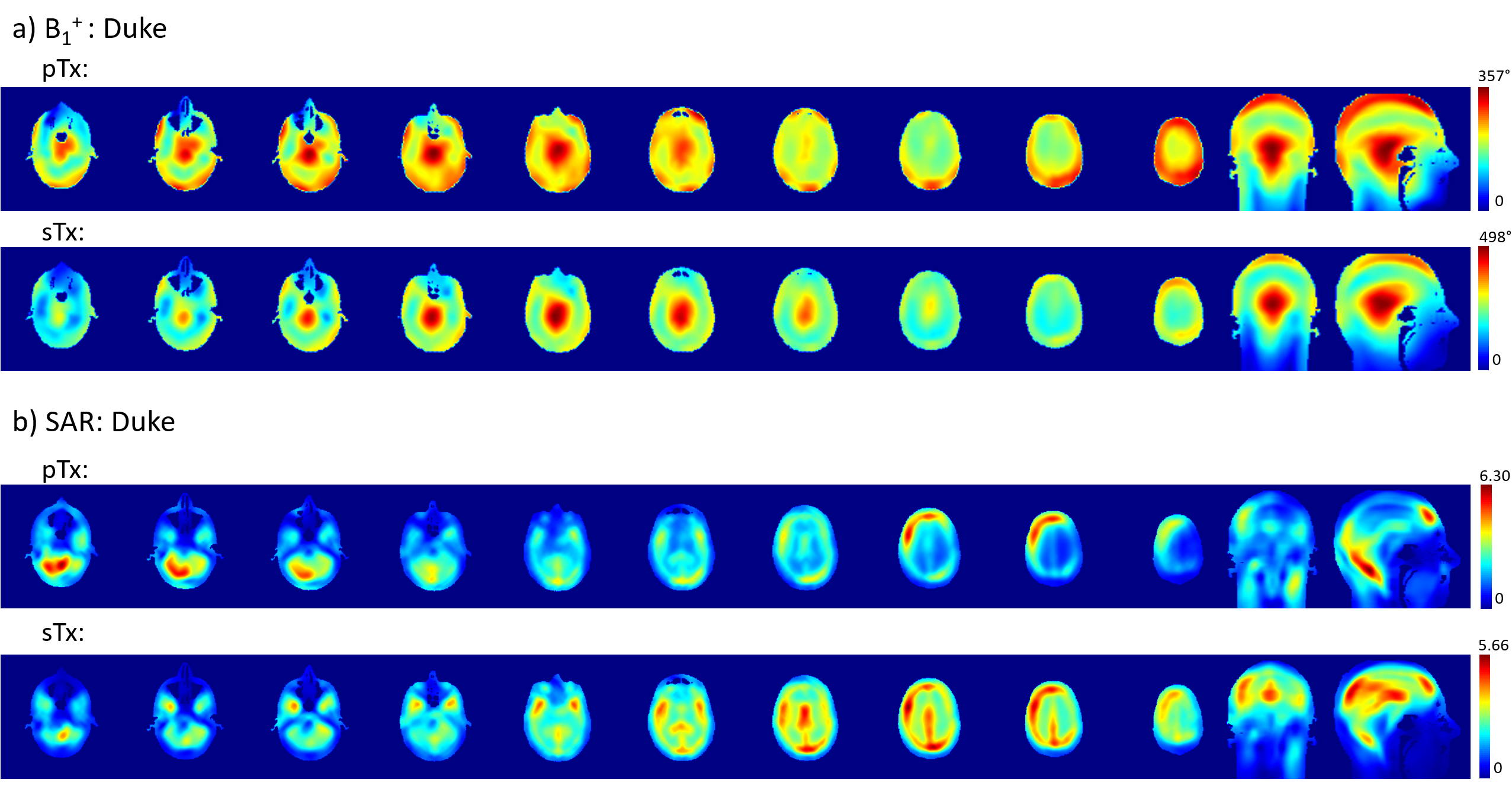
Figure 2: Simulation of a) B1+ and b) SAR in pTx (16kW) and sTx (8kW) modes on the Duke model, each scaled 0-max. No losses are considered. Units for B1+ are flip angle per 707V (16kW) and flip angle per 500V (8kW). Units for SAR are W/kg per 2µT.
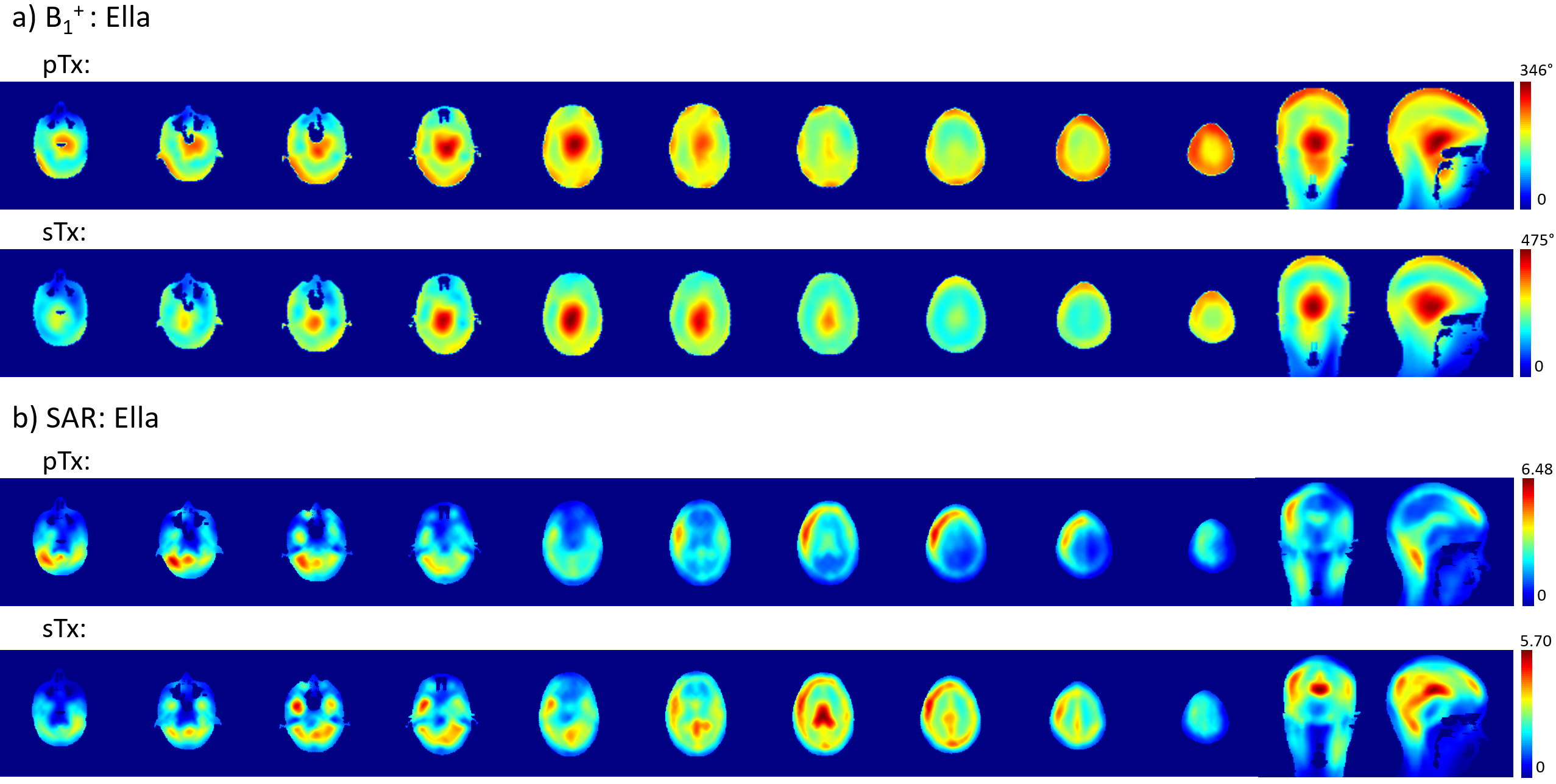
Figure 3: Simulation of a) B1+ and b) SAR in pTx (16kW) and sTx (8kW) modes on the Ella model, each scaled 0-max. No losses are considered. Units for B1+ are flip angle per 707V (16kW) and flip angle per 500V (8kW). Units for SAR are W/kg per 2µT.
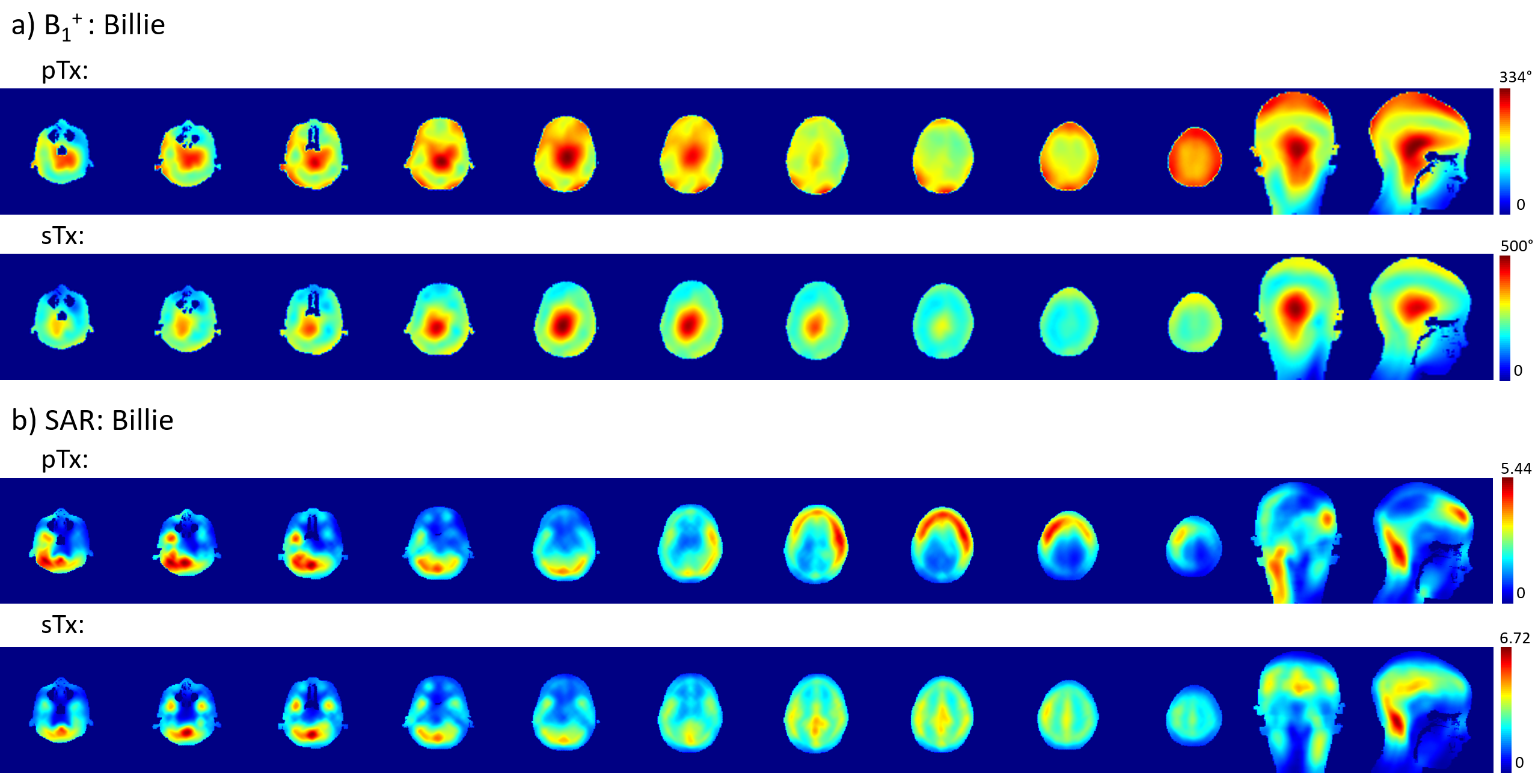
Figure 4: Simulation of a) B1+ and b) SAR in pTx (16kW) and sTx (8kW) modes on the Billie model, each scaled 0-max. No losses are considered. Units for B1+ are flip angle per 707V (16kW) and flip angle per 500V (8kW). Units for SAR are W/kg per 2µT.
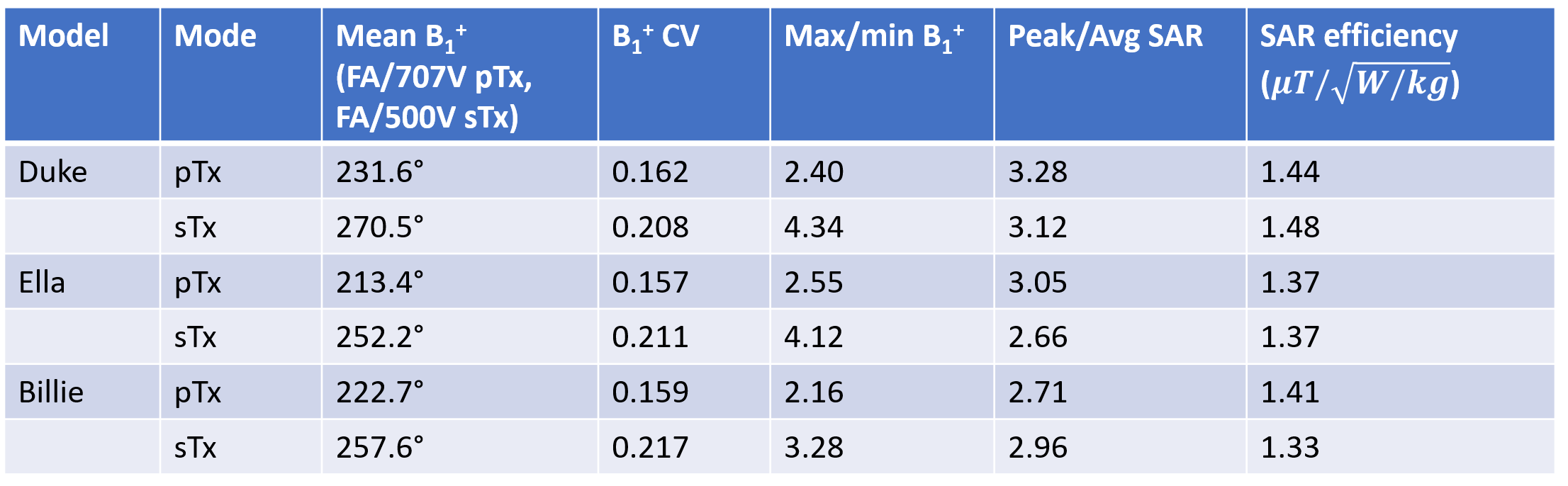
Table 1: Summary statistics for computed B1+ and SAR on three head models optimized for pTx and sTx mode.
DOI: https://doi.org/10.58530/2023/4402