4378
RADIOMICS FEATURES OF INFRAPATELLAR FAT PAD ASSOCIATED WITH POST-TRAUMATIC OSTEOARTHRITIS AT 10+ YEARS AFTER ACL RECONSTRUCTION
Sameed Khan1,2,3, Richard Lartey1,2, Nancy Obuchowski1,4, Sibaji Gaj1,2, Jee Hun Kim1,2, Mei Li1,2, Brendan Eck1,3, Carl S. Winalski1,2,3, Faysal Altahawi1,3, Morgan H Jones5, Laura J Huston6, Kevin D Harkins7, Michael V Knopp8, Christopher C Kaeding9, Kurt Spindler1,10, and Xiaojuan Li1,2,3
1Program of Advanced Musculoskeletal Imaging, Lerner Research Institute, Cleveland, OH, United States, 2Department of Biomedical Engineering, Lerner Research Institute, Cleveland, OH, United States, 3Department of Diagnostic Radiology, Imaging Institute, Cleveland, OH, United States, 4Department of Quantitative Health Sciences, Lerner Research Institute, Cleveland, OH, United States, 5Department of Orthopedic Surgery, Brigham and Women's Hospital, Boston, MA, United States, 6Department of Orthopedics and Rehabilitation, Vanderbilt University, Nashville, TN, United States, 7Department of Biomedical Engineering, Vanderbilt University, Nashville, TN, United States, 8Wright Center of Innovation in Biomedical Imaging, Ohio State University, Columbus, OH, United States, 9Department of Orthopedic Surgery, The Ohio State University, Columbus, OH, United States, 10Department of Orthopedic Surgery, Cleveland Clinic, Cleveland, OH, United States
1Program of Advanced Musculoskeletal Imaging, Lerner Research Institute, Cleveland, OH, United States, 2Department of Biomedical Engineering, Lerner Research Institute, Cleveland, OH, United States, 3Department of Diagnostic Radiology, Imaging Institute, Cleveland, OH, United States, 4Department of Quantitative Health Sciences, Lerner Research Institute, Cleveland, OH, United States, 5Department of Orthopedic Surgery, Brigham and Women's Hospital, Boston, MA, United States, 6Department of Orthopedics and Rehabilitation, Vanderbilt University, Nashville, TN, United States, 7Department of Biomedical Engineering, Vanderbilt University, Nashville, TN, United States, 8Wright Center of Innovation in Biomedical Imaging, Ohio State University, Columbus, OH, United States, 9Department of Orthopedic Surgery, The Ohio State University, Columbus, OH, United States, 10Department of Orthopedic Surgery, Cleveland Clinic, Cleveland, OH, United States
Synopsis
Keywords: Osteoarthritis, Fat
ACL injury is a major risk factor for post-traumatic osteoarthritis (PTOA), however mechanisms are not fully understood. In this work, we use radiomics from quantitative MRI imaging to associate subvisual changes in the infrapatellar fat pad (IPFP) to both symptomatic and radiographic PTOA. MRI was collected from 113 patients at least 10 years post-ACLR. 1690 radiomics and 11 clinical features were extracted and selected using a gradient-boosted decision tree classifier model. A subset of texture-associated features of IPFP and no clinical features were associated with symptomatic PTOA with an AUROC of 0.74 and radiographic PTOA with an AUROC of 0.84.
Introduction
Anterior cruciate ligament (ACL) injury is a significant risk factor for subsequent post-traumatic osteoarthritis (PTOA), despite ACL reconstruction (ACLR)1. Both inflammatory and biomechanical factors are thought to contribute to PTOA development after ACLR, however, their mechanisms are not fully understood. Recent evidence has suggested that the infrapatellar fat pad (IPFP) may contribute to OA development beyond its biomechanical properties, namely through secretion of pro-inflammatory and catabolic molecules2. Studies investigating the association of the IPFP with PTOA development after ACLR are limited. Furthermore, radiomics have been used effectively in the neuro-oncological literature to link subvisual changes on MRI to cancer progression3–5. In this study, we aimed to evaluate potential associations between radiomic features of the IPFP with symptomatic and radiographic PTOA at 10 years after ACLR.Methods
Quantitative MRI was collected from a nested onsite cohort within the Multicenter Orthopedic Outcomes Network (MOON) at least 10 years following ACLR in an ongoing multi-site, multi-vendor (three sites with two MR vendors) prospective cohort study. The MOON onsite cohort consists of patients who suffered an ACL tear while playing a sport with no previous knee injuries (baseline age 13-33 years). In this report, the first 113 patients (mean age at 10-year follow-up: 33.7 years; 57 females) were analyzed. At the 10-year follow up, patients were classified as exhibiting symptomatic PTOA using the OARSI/OMERACT criteria based on Knee Injury and Osteoarthritis Outcome (KOOS) scores: KOOS quality of life < 87.5 and at least 2 of the following: KOOS pain < 86.1, KOOS symptoms < 85.7, KOOS Function in daily living (ADL) < 86.8, KOOS Function in Sport and Recreation < 85.0. Kellgren-Lawrence (KL) grading was performed in a subset of 102 patients, and knees with a KL grade of two or higher were considered to have radiographic PTOA. Dual-echo steady spin state (DESS) sequence fat-suppressed images were used for IPFP segmentation and radiomic feature extraction. Each sagittal slice of the IPFP was automatically segmented by a 2D Bayesian U-Net with dropout, then manually corrected. A total of 1690 radiomics features were extracted including first-order intensity, texture, and shape. Features were selected by fitting a LightGBM classifier model6 and choosing a subset with the highest feature importance values. Three LightGBM decision tree classifier models were built across three feature sets: clinical features only (race, sex, age at follow-up, Marx activity score at follow-up, BMI at follow-up, and baseline KOOS scores), radiomics features only, and combined clinical and radiomics features. Models predicted symptomatic and radiographic PTOA for each feature set. Data were divided 80:20 for training and testing in each fold of a six-fold cross-validation scheme. To correct for class imbalance, the minority class in the training data was randomly oversampled to achieve a 50/50 split between positive and negative cases for each fold. Oversampling and cross-validation were repeated 100 times with different random seeds. Performance is reported as the mean and standard error across a total of 600 different train-test split and oversampling permutations.Results
Twenty out of 113 patients (17.6%) had symptomatic PTOA while 24 out of 102 patients (23.5%) had radiographic PTOA. Radiomic classification results are reported as mean +/- standard deviation. Using only radiomics features for symptomatic PTOA prediction yielded an AUROC of 0.736 +/- 0.158 (Figure 1, Figure 2). For radiographic PTOA prediction, only using radiomics features yielded an AUROC of 0.841 +/- 0.104 (Figure 3, Figure 4). The most predictive features after feature selection were related to infrapatellar fat pad texture and intensity. Of note, the feature selection process selected no clinical features for predicting either symptomatic or radiographic PTOA.Discussion
Our results demonstrate that changes in the appearance of the IPFP on MRI, specifically less uniform texture and higher intensities, are associated with PTOA 10 years after ACLR — by both symptomatic and radiographic criteria. It is notable that adding clinical features to the model did not significantly increase or decrease performance. The current dataset is limited and highly class-imbalanced, so additional study is required to confirm these results. Furthermore, the IPFP is often affected during ACLR, which may produce confounding factors to texture analysis of IPFP. Immediate future directions include segmenting and extracting three-dimensional radiomics from the quadriceps fat pad and prefemoral fat pad, which are normally intact during ACLR and may provide additional insights into the role fat pads that may play in PTOA after ACLR.Conclusion
Our work suggests that IPFP may contribute to symptomatic and radiographic PTOA development after ACLR. Radiomics is a powerful tool to identify novel imaging markers that may help to understand PTOA development mechanism after ACLR, and to improve diagnosis and prognosis of PTOA.Acknowledgements
The work was supported by NIH/NIAMS R01AR075422 and by the Arthritis Foundation.References
1. Lohmander LS, Englund PM, Dahl LL, Roos EM. The long-term consequence of anterior cruciate ligament and meniscus injuries: osteoarthritis. Am J Sports Med 2007;35(10):1756–69.2. Heilmeier U, Mamoto K, Amano K, et al. Infrapatellar fat pad abnormalities are associated with a higher inflammatory synovial fluid cytokine profile in young adults following ACL tear. Osteoarthritis Cartilage 2020;28(1):82–91.
3. Lambin P, Leijenaar RTH, Deist TM, et al. Radiomics: the bridge between medical imaging and personalized medicine. Nat Rev Clin Oncol 2017;14(12):749–62.
4. Sasaki T, Kinoshita M, Fujita K, et al. Radiomics and MGMT promoter methylation for prognostication of newly diagnosed glioblastoma. Sci Rep 2019;9(1):14435.
5. Reginelli A, Nardone V, Giacobbe G, et al. Radiomics as a New Frontier of Imaging for Cancer Prognosis: A Narrative Review. Diagnostics (Basel) 2021;11(10):1796.
6. Ke G, Meng Q, Finley T, et al. LightGBM: A Highly Efficient Gradient Boosting Decision Tree [Internet]. In: Advances in Neural Information Processing Systems. Curran Associates, Inc.; 2017 [cited 2022 Nov 8]. Available from: https://papers.nips.cc/paper/2017/hash/6449f44a102fde848669bdd9eb6b76fa-Abstract.html
Figures
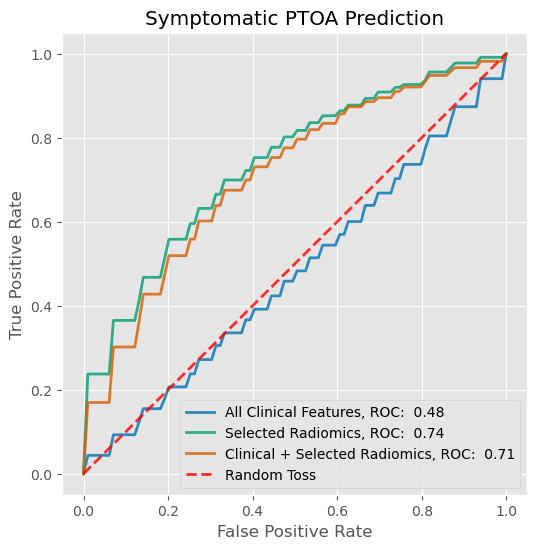
Receiver-operating (ROC) curves for prediction
of symptomatic PTOA at 10+ years after ACLR. Each curve corresponds to a
different feature set used as input. ROC curves are averaged across a total of
600 different train-test split and oversampling permutations.
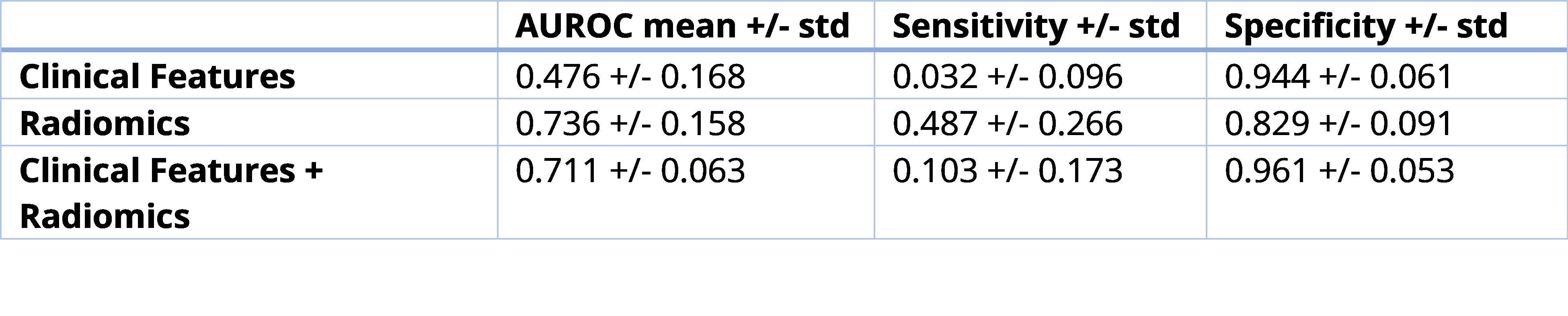
Results of 600-permutation train-test scheme
predicting symptomatic PTOA in patients
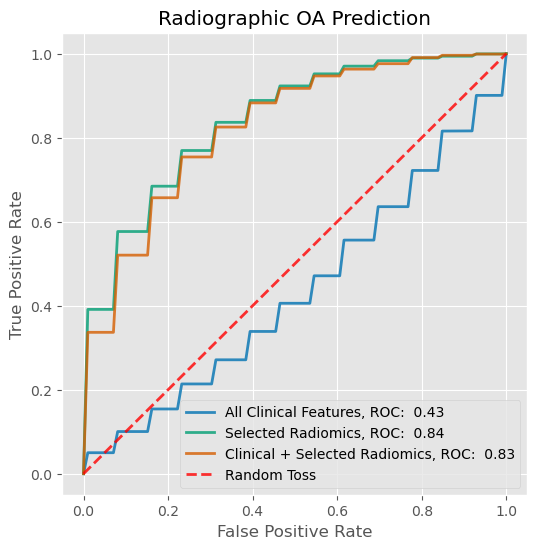
Receiver-operating (ROC) curves for prediction
of radiographic PTOA at 10+ years after ACLR. Each curve corresponds to a
different feature set used as input. ROC curves are averaged across a total of
600 different train-test split and oversampling permutations.
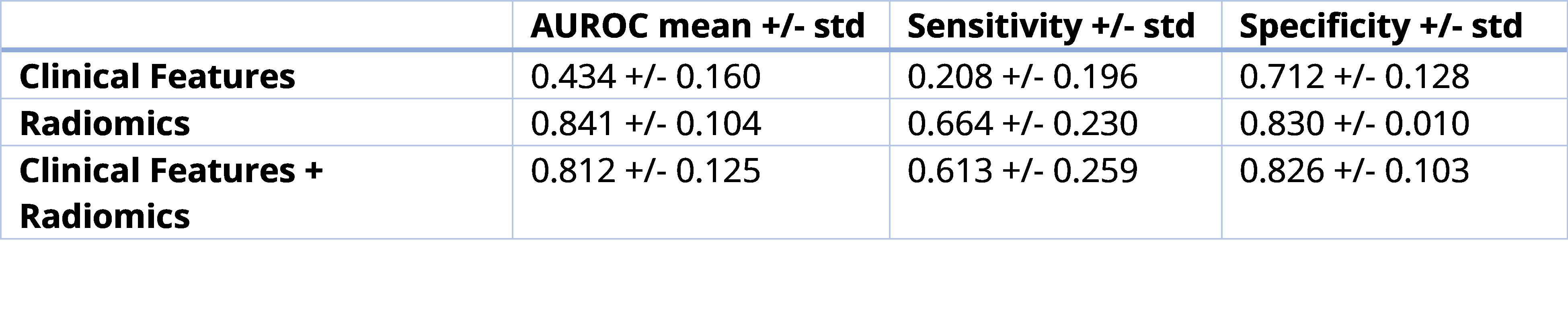
Results of 600-permutation train-test scheme
predicting radiographic PTOA in patients
DOI: https://doi.org/10.58530/2023/4378