4260
RF Interference Removal in Multi-Channel Receive coil
Harsh Kumar Agarwal1 and Ramesh Venkateshan1
1GE Healthcare, Bangalore, India
1GE Healthcare, Bangalore, India
Synopsis
Keywords: System Imperfections: Measurement & Correction, Artifacts
RF Interference can severely degrade the performance of an MR system. Several solutions such as RF shielding, waveguides and special filters are used to send and receive data to the MRI scanner. These solutions constitute significant part of MR installation and maintenance cost. RF interference in multi-channel receive MR system is strongly correlated across multiple receive channels. This correlation is exploited in this manuscript to remove/suppress the artifacts in the MR images arising due to RF interference. Initials results are demonstrated on 1.5T commercial MRI scanner with data acquired with open RF cage door.PURPOSE
To suppress the RF interference in the MRI system using the data from the imaging receive coil.INTRODUCTION
External RF interference leads to an increase noise and zipper artifact in the MRI images. While noise can decrease the image quality, zipper can occlude the anatomy/pathology of interest and limit the clinical usability of the MR Image. Several solutions such as Faraday cage with RF shielded doors and wave guides and band stop filters are used to send/receive signals for the MR scanner kept inside the Faraday cage. These solutions limits the ease of use of MR system and also constitute significant installation and operating cost.Recently methods are proposed for low-cost low-field MR systems equipped with auxiliary RF sensors knows as external coils or sniffer coils were developed to predict and correct the RF interference received at the imaging coils are proposed1,2. In this manuscript, we have proposed a self-calibrated method that use the imaging coil data itself to suppress the RF interference without using the auxiliary RF sensors.
METHODS
The MR signal $$$c_i(k_{xy})$$$ received at the ith receive coil during the readout is combination of desired signal $$$s_i(k_{xy})$$$, noise $$$n_i(k_{xy})$$$ and RF interference $$$r_i(k_{xy})$$$,$$c_i(k_{xy}) = s_i(k_{xy}) + n_i(k_{xy}) + r_i(k_{xy})$$
In this manuscript we assume that the RF interference across coils are linearly related to reach other and can be estimated from linear combination of RF interference received at other coils,
$$r_i(k_{xy}) = \sum_{j, j\neq i} a_{i,j} r_j(k_{xy})$$
Interference across all the coils can be modelled as,
$$\mathbf{R} = A \mathbf{R} $$
where $$$\mathbf{R}$$$ is a column vector of RF interference from multiple coils and $$$\mathbf{A}$$$ is square matrix with zero diagonal entries.
As per the above Eq(1) formulation,
$$\mathbf{C} = \mathbf{S} + \mathbf{N} + \mathbf{R} $$
where $$$\mathbf{R}$$$, $$$\mathbf{S}$$$ and $$$\mathbf{N}$$$ are corresponding column vectors across coils. Multiplying $$$\mathbf{I}-\mathbf{A}$$$ to both sides,
$$\begin{matrix}
(\mathbf{I}-\mathbf{A}) \mathbf{C} & = & (\mathbf{I}-\mathbf{A})\mathbf{S} + (\mathbf{I}-\mathbf{A})\mathbf{N} + (\mathbf{I}-\mathbf{A})\mathbf{R} \\
& = & (\mathbf{I}-\mathbf{A})\mathbf{S} + (\mathbf{I}-\mathbf{A})\mathbf{N} \end{matrix}$$
Multiplying psuedo-inverse of $$$\mathbf{I}-\mathbf{A}$$$ , $$$(\mathbf{I}-\mathbf{A})^{-p}$$$ to both sides,
$$(\mathbf{I}-\mathbf{A})^{-p}(\mathbf{I}-\mathbf{A}) \mathbf{C} = (\mathbf{I}-\mathbf{A})\mathbf{S} + (\mathbf{I}-\mathbf{A})\mathbf{N} $$
As seen from above equation, the virtual coils $$$ (\mathbf{I}-\mathbf{A})^{-p}(\mathbf{I}-\mathbf{A}) \mathbf{C} $$$ are generated from original coils $$$\mathbf{C}$$$ in this manuscript.
A volunteer scan with spine imaging was done at the commercial 1.5T Signa Artist MRI scanner (GE Healthcare, Milwaukee, USA) using 13 channel posterior coil. RF interference was simulated by repeating a clinical T2w Sagittal MRI scan with door of RF cage kept open.
RESULTS
The sum-of-squares (SOS) MR image acquired with door closed, Figure 1a) showed no RF interference. However, when the scan was acquired with open RF cage door, increase in noise and zipper artifact is observed as seen in Figure 1b). The proposed method generated virtual channel suppressed the zipper and noise arising due to RF interference as shown in Figure 1c).DISCUSSION and CONCLUSION
RF Interference isolation mechanism such as Faraday cage, door of the RF cage, Waveguides and special filters impacts the installation cost, maintenance cost and ease-of-use of the MR system. Recently auxiliary coil-based RF interference suppression methods are proposed for low-cost low-field MR systems which can estimate and suppress the RF interference from the partially/weakly shielded MR systems. The application of these methods are however limited by the availability of auxiliary coil at an MR system. Once a zipper artifact arising due to RF interference is detected at an MR system, significant amount of time is spent in identifying the source of RF interference and its mitigation with multiple repeat scans.In this work we have proposed a method to suppress RF interference using only the receive coils thereby enabling RF interference suppression for any MR system acquiring images using multi-channel receive coils. The proposed method is demonstrated in a commercial 1.5T MR system when 2D T2w scans is acquired with Faraday cage RF door kept open. However, further studies are warranted to understand the use and limitation of the proposed method.
Acknowledgements
No acknowledgement found.References
- Dyvorne, H., Rearick, T., Poole, M., Lazarus, C., Weiss, P., Sacolick, L., Jordan, J., Hugon, C., Mileski, W., Chen, G. and O'Halloran, R., 2021. Freeing MRI from its Faraday cage with Interference Rejection. In Proceedings of the 29th Annual Meeting of ISMRM (Vol. 749).
- Srinivas, S.A., Cauley, S.F., Stockmann, J.P., Sappo, C.R., Vaughn, C.E., Wald, L.L., Grissom, W.A. and Cooley, C.Z., 2022. External Dynamic InTerference Estimation and Removal (EDITER) for low field MRI. Magnetic Resonance in Medicine, 87(2), pp.614-628.
Figures
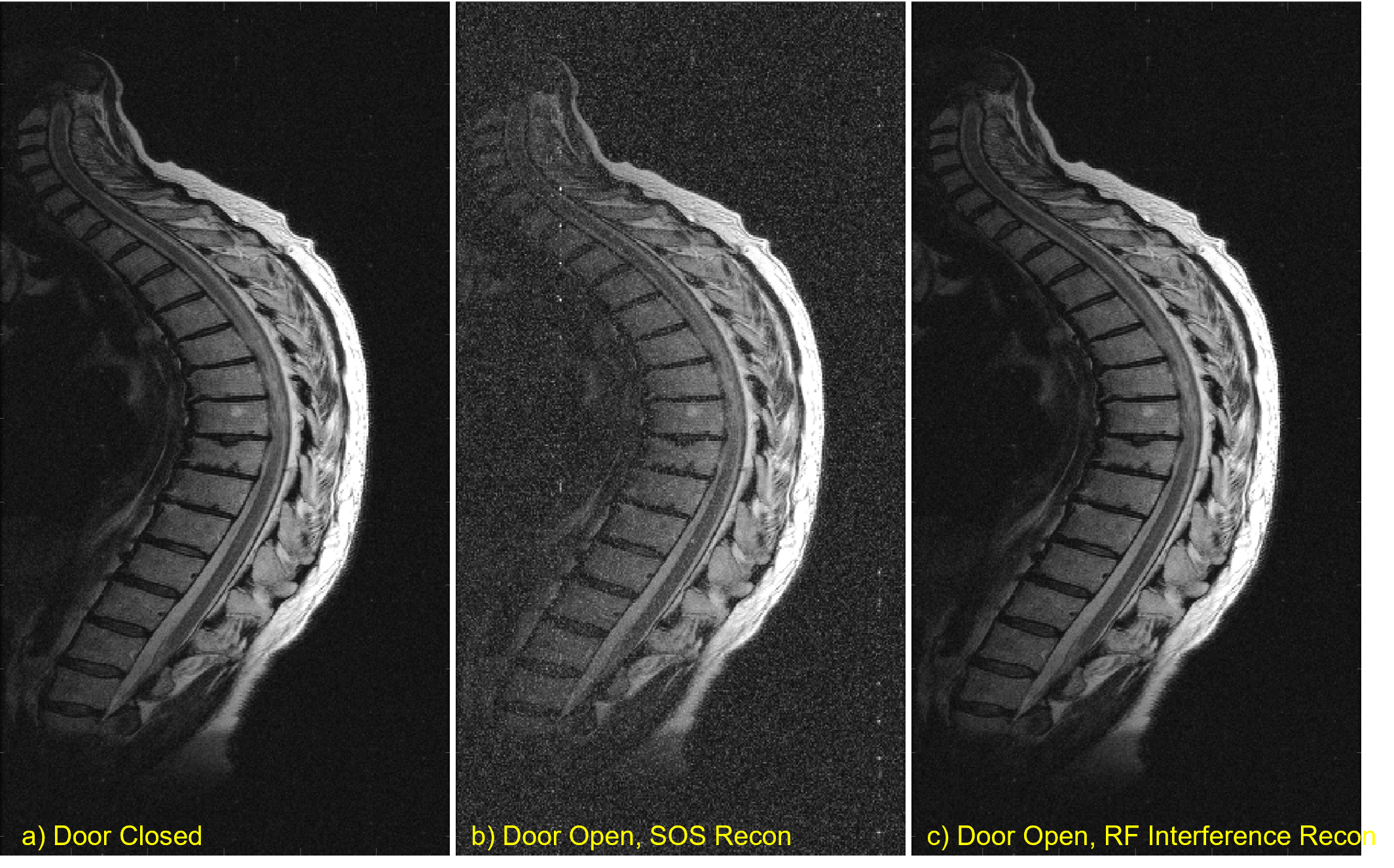
Figure 1 : 2D T2w Sagittal MRI scan was with door
of the MR scanner kept a) open and b) closed. c) Multiple receive channels of
the data acquired while door is open is combined to generate virtual channels
is reconstructed. All the channels were combined using sun-of-squares (SOS) and
none of the postprocessing IQ enhancement filters were applied.
DOI: https://doi.org/10.58530/2023/4260