4240

Uniformity Improvement of the 7T Body MR Images
Bu S Park1 and Sunder Rajan2
1FDA, Silver Spring, MD, United States, 2Division of Biomedical Physics (DBP), FDA, Silver Spring, MD, United States

Synopsis

Keywords: High-Field MRI, Electromagnetic Tissue Properties

To optimize MR image quality of 7T Body, the image region is divided into multiple ROIs, which can be independently optimized using transmit array optimization techniques to improve image intensity. Compared to the results of quadrature driving method, mean and SD of |Mt| in the full image (inner diameter of 500 mm) were improved 47% (Mean) and 48% (SD), whereas 94% (Max) and 97% (Mean) improved in the unaveraged SAR using the proposed method. The proposed method using multiple independently optimized ROIs and numerical simulations significantly improved uniformity of |Mt| body images at 7T.

Keywords: 7T Body, Uniformity, SAR

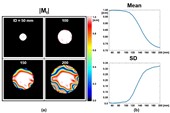
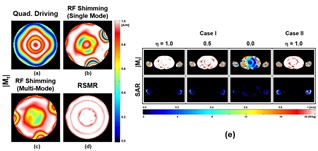
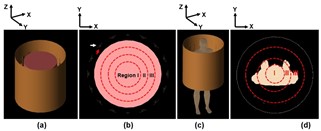
INTRODUCTION: To acquire magnetic resonance (MR) images of high resolution and increased signal-to-noise ratio (SNR), a higher static magnetic field (|B0|) is needed [1]. However, as |B0| is increased, the absorbed power in the tissue increases significantly and magnetic field inhomogeneity caused by a wavelength effect results in decreased image intensity uniformity [2]. Many different methods have been studied to solve the issues of image uniformity and absorbed power of high-field MRIs [3]. Based on the previous research, a new method is presented using RF shimming with multiple ROIs (RSMR) to improve uniformity of the RF magnetic field and corresponding MR image intensity at 7T. The RSMR method was implemented using the finite difference time domain (FDTD) numerical simulations, and the Bloch equation-based MRI simulator [4]. METHODS: Numerical simulations and optimization were performed using 16-channel transmit array, cylindrical body phantom, whole body human female model named Ella from the Virtual Family [5], and the MRI system simulator for body imaging (Fig. 1). The 16-channel transmit array has an inner diameter (ID) of 620 mm (Fig. 1 (b) red and white arrows), and length of 620 mm (Fig. 1 (a) and (c)). The RF shield having ID of 827 mm and length of 845 mm was used with a cell size of 3´3´3 mm3 (Fig. 1 (a) and (c)). A cylindrical uniform phantom had an ID of 540 mm and length of 620 mm with electrical properties of s = 0.79 S/m, and er = 59.0. The optimized size of each ROI using the phantom was calculated by checking |Mt| uniformity using the RF shimming method (Fig. 2), and the results of four different optimization methods using the phantom were shown in Fig. 3 (a-d). During optimization using Ella, a simple cost function considering |Mt| uniformity and maximum SAR was used to balance the uniformity of |Mt| and SAR as follows: (Fig. 3 (e)). RESULTS: Fig. 2 shows calculated |Mt|-2D and corresponding mean and SD of |Mt| within the cylindrical phantom using different inner diameters (IDs). Fig. 3 (a-d) shows numerical simulation results of 2D-|Mt| acquired using the cylindrical phantom and four different optimization methods, i.e., quadrature driving, RF shimming using the single mode, RF shimming using the multi-mode, and RSMR method at 7.0T. Compared to the results of quadrature driving method, mean and SD of |Mt| were improved 39% (Mean) and 35% (SD) using RF shimming with single mode without multiple ROIs, whereas 61% (Mean) and 94% (SD) using the RSMR method. The uniformity of |Mt| acquired using the RSMR method was improved especially in the peripheral region of the selected phantom image compared to that of other methods. Fig. 3 (e) shows numerical simulation results of |Mt| (first row) and corresponding unaveraged SAR (second row) acquired with RSMR method using the Ella model. DISCUSSION: The principle of RSMR is based on the premise that it is difficult to achieve adequate image homogeneity in regions larger than one wavelength in tissue, the SD of |Mt| was significantly increased with the RF shimming optimization method (Fig. 2). Therefore, it is necessary to make multiple ROIs considering wavelength and electromagnetic properties of the tissue loading the coil. Then, the imaging parameters including RF coil design should be optimized. Compared to previous research, the novelty of our designed method is using the independent multiple ROIs to optimize a big imaging region. Some previous research used similar methods, however, they used one big ROI to cover the whole imaging region making a limitation to produce uniform |Mt| and lower SAR distributions within the ROI having a size of bigger than or close to one wavelength (Fig. 3). CONCLUSION: This study shows that the designed RSMR method improved uniformity of |Mt| and SAR within the cylindrical phantom and the human model compared to the results of quadrature driving and RF shimming with single mode and multi-mode using numerical simulations at 7.0T.

Acknowledgements

No acknowledgement found.

References

1. Hoult, CMR 12(4), 173–187, 2000

2. Webb and Collins, IJIST, 20(1), 2-13, 2010

3. Taracila et al., CMR Part B, MRE, 29B(3), 153–160, 2006

4. Mao et al., MRM 56, 918–922, 2006

5. Gosselin et al., PMB, 59(18):5287-303, 2014
Figures

Figure 1 Geometrical models and multiple ROIs used in this study. (a) 16-channel transmit array (ID = 620 mm, Length = 620 mm), RF shield (ID = 827 mm, Length = 845 mm), and cylindrical uniform phantom (ID = 540 mm, Length = 620 mm, s = 0.79 S/m, er = 59.0 (Ave. Muscle at 300 MHz)) at 7.0T MRI. (b) Multiple ROIs considering wavelength and electromagnetic properties of sample (inner rod (red arrow) width of 30 mm, outer rod (white arrow) width of 60 mm). (c) and (d) with human body model of Ella.

Figure 2 Numerical simulation results of transverse magnetization (|Mt|) with different inner diameters (IDs) of region of interest (ROI) and designed RF shimming method (a). Mean and standard deviation (SD) of |Mt| with different IDs were shown in (b).

Figure 3 Numerical simulation results of |Mt| and unaveraged SAR using the cylindrical phantom (a-d) and the Ella model (e) with three different methods of transmit array optimization, i.e., Quadrature driving (a), RF shimming with single mode (b) and combination of multi-mode optimizations (c) and RF Shimming with Multiple ROIs (RSMR)(d-e).

Proc. Intl. Soc. Mag. Reson. Med. 31 (2023)
4240
DOI: https://doi.org/10.58530/2023/4240