4131
SSc primary heart involvement assessed by cardiovascular magnetic resonance imaging and explore its relationship with the skin involvement1Department of Radiology, The First Medical Center of PLA General Hospital, Beijing, China, 2Philips Healthcare(Beijing), Beijing, China
Synopsis
Keywords: Heart, Heart, SSc primary heart involvement, cardiovascular magnetic resonance,extracellular-volume fraction, modified Rodnan skin score
Cardiac involvement is a significant cause of morbidity and mortality in subclinical systemic sclerosis (SSc). There are, however, no effective methods for detecting cardiac involvement in a general, asymptomatic SSc cohort. We aim to characterize SSc-primary heart involvement (SSc-pHI) through cardiovascular magnetic resonance (CMR), exploring the relationship between SSc-pHI and skin involvement by modified Rodnan skin score (mRSS). We found that 71% of SSC patients had Late gadolinium enhancement (LGE) fibrosis, and 75% and 46% had anomalous native T1 and extracellular-volume fraction (ECV). In addition, SSc-pHI is related to the severity of skin involvement.Introduction
Subclinical systemic sclerosis (SSc) is a heterogeneous immune-mediated rheumatic disease characterized by progressive fibrosis of the skin and visceral organs and excessive extracellular matrix deposition1. The previous research has been demonstrated that the prevalence of SSc-primary heart involvement (SSc-pHI) between 15% and 35%2, which is associated with poor prognostic. However, effective means of early detection of cardiac involvement in a general, asymptomatic SSc cohort are lacking. Currently, T1 mapping based on cardiovascular magnetic resonance (CMR) is a novel technique, which can calculate extracellular-volume fraction (ECV) by measuring the T1 of myocardium before and after contrast quantifying early, slight. and invisible myocardial fibrosis in SSc patients. In addition, CMR T2 mapping also could quantify diffuse myocardial edema by measuring the T2 of the myocardium. We aim to characterize SSc-pHI through multi-parameters CMR and explore the relationship between SSc-pHI and skin involvement by modified Rodnan skin score (mRSS).Methods
25 Patients were recruited to this study fulfilled the 2013 ACR/ EULAR criteria for SSc3 and were classified as local SSc (lcSSc) or diffuse SSc (dcSSc) according to LeRoy classification 4. Patients were excluded if they had any prior diagnosis of ischaemic heart disease (IHD) (or clinically overt SSc-pHI), diabetes, or more than two traditional CV risk factors. A rheumatologist with more than ten years of work experience blinded to CMR data scored the patient's skin involvement by mRSS. Patients underwent CMR on a 3 Tesla CMR (Ingenia, Philips Healthcare, best, the Netherlands), including cine imaging for left ventricle (LV) function estimation, Late gadolinium enhancement (LGE), T2 mapping, and native and post-contrast T1 mapping for ECV quantification, which enabled quantitative assessment of myocardial fibrosis. 24 patients with complete CMR function assessment, LGE, T1, ECV, and T2 mapping available were recruited finally. The LGE (presence or absence) was identified by a consensus agreement among 2 radiologists who were experienced in CMR and blinded to clinical outcome. According to the departmental reference ranges, an ECV >29% and native T1 > 1240 (ms) were classed as abnormal5,6.Results
In total, 24 consecutive patients were recruited and 25% had diffuse SSc. And patients with dsSSc had significantly higher mRSS compared with lcSSc [median (IQR) 14 (9–20) vs. 4 (3–19), P = 0.006]. A total of 18 (75%) and 11 (46%) SSc patients, respectively, had native T1 and ECV above normal values. ECV, a marker of diffuse fibrosis, was higher in patients with dcSSc than lcSSc (32.25±0.96 vs. 29.93±3.04; P =0.03). For LGE, a total of 17 (71%) SSc patients had focal LGE fibrosis in a non-ischaemic pattern. SSc patients were divided into the group with mRSS≤6 or the group with mRSS>6 according to the median of mRSS. The LVEDVI of the group with mRSS >6 was significantly higher than that of the groups with mRSS≤6 (73.03±8.94 vs. 64.19±9.39; P =0.03). Native T1, ECV, and T2 value of the group with mRSS > 6 were also higher than that of the group with mRSS≤6 but did not reach statistical significance. Univariable Logistic regression confirmed an association between mRSS and LV EDVI [OR 1.13 (CI 1.01-1.28)] and BMI [OR 0.70 (CI 0.50-0.98)].Discussion
Cardiac involvement is a significant cause of morbidity and mortality in SSc, but we have a limited understanding of sub-clinical SSc-pHI. The study demonstrated that the ECV of groups with diffuse SSc had significantly higher than that of groups with lcSSc, indicating interstitial fibrosis is more serious in diffuse SSc. Our study showed that patients with mRSS > 6 also had higher ECV than those in other groups. And LV EDVI of the group with mRSS was correlated with mRSS in a predictive model. Collectively, these findings support the association of SSc-pHI with the severity of the skin involvement.Conclusion
Cardiac magnetic resonance imaging provides a reliable method for detecting sub-clinical cardiac involvement in SSC patients. The severity of the skin involvement in SSc is related to SSc-pHI.Acknowledgements
No acknowledgement found.References
1.Ferri C, Valentini G, Cozzi F et al. Systemic sclerosis: demographic, clinical, and serologic features and survival in 1,012 Italian patients. Medicine 2002;81: 139–53
2.Tyndall AJ, Bannert B, Vonk M et al. Causes and risk factors for death in systemic sclerosis: a study from the EULAR Scleroderma Trials and Research (EUSTAR) database. Ann Rheum Dis 2010;69:1809–15.
3.van den Hoogen F, Khanna D, Fransen J et al. classifification criteria for systemic sclerosis: an American College of Rheumatology/European League Against Rheumatism collaborative initiative. Ann Rheum Dis 2013;72:1747–55.
4.LeRoy EC, Black C, Fleischmajer R et al. Scleroderma (systemic sclerosis): classifification, subsets and pathogenesis. J Rheumatol 1988;15:202–5.
5. Dabir D, Child N, Kalra A et al. Reference values for healthy human myocardium using a T1 mapping methodology: results from the International T1 Multicenter cardiovascular magnetic resonance study. J Cardiovasc Magn Reson 2014;16:69.
6. McDiarmid AK, Swoboda PP, Erhayiem B et al. Athletic cardiac adaptation in males is a consequence of elevated myocyte mass. Circ Cardiovasc Imaging 2016; 9:e003579.
Figures
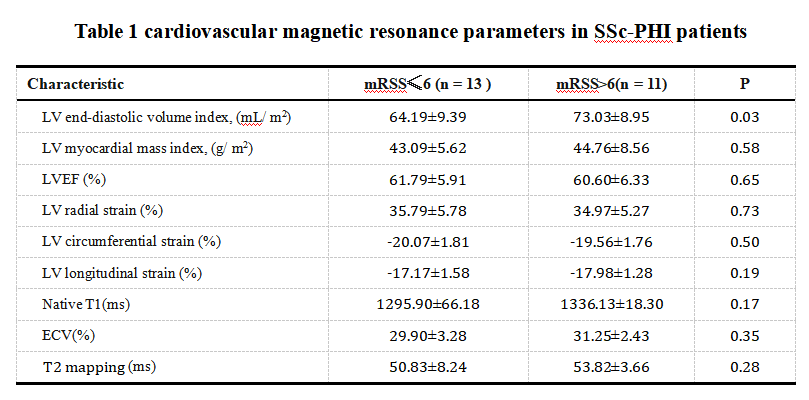
Table 1 cardiovascular magnetic resonance parameters in SSc-PHI patients
LV: left ventricular; EF: ejection fraction; ECV: extracellular-volume fraction