4083
Significant Signal-to-Noise Ratio (SNR) Enhancement with Ultrahigh Dielectric Constant (uHDC) Ceramic Disks for 2H MRSI Application at 7T1Center of Magnetic Resonance Research (CMRR), Department of Radiology, University of Minnesota, Minneapolis, MN, United States, 2Department of Biomedical Engineering, University of Minnesota, Minneapolis, MN, United States, 3Department of Engineering Science and Mechanics, Pennsylvania State University, University Park, PA, United States, 4Center for NMR Research, Department of Neurosurgery and Radiology, College of Medicine, Pennsylvania State University, Hershey, PA, United States
Synopsis
Keywords: High-Field MRI, New Devices, Ultrahigh dielectric constant material (uHDC)
Ultrahigh-field (UHF) deuterium (2H) magnetic resonance spectroscopy imaging (DMRSI) is valuable to study neuroenergetics by quantitatively measuring the energy metabolic rates in the human brain. However, the low intrinsic signal-to-noise ratio (SNR) of deuterium signal due to its low gyromagnetic ratio and low metabolites concentration has been a technical challenge to achieving high imaging resolution. In this study, we have integrated ultrahigh dielectric constant (uHDC) ceramic disks with an 8-channel 2H-1H human head array coil to largely improve the receive sensitivity and DMRSI SNR (>60%) at 7T, aiming for human brain metabolic imaging application.Introduction
Ultrahigh field (UHF) magnetic resonance imaging (MRI) and spectroscopy imaging (MRSI) have been effective imaging technologies to study brain functionality and energetics. X-nuclei MRSI, which focuses on metabolic pathways of various nuclei, is a useful method to detect human brain diseases by quantitatively measuring brain metabolic rates such as deuterium MRSI (DMRSI) to measure brain glucose metabolism and TCA cycle activity in normal and diseased brain1-4. However, the low natural abundance of deuterium and the low 2H gyromagnetic ratio result in a low intrinsic signal-to-noise ratio (SNR), which poses a challenge to achieving high imaging resolution. There have been shown various methods to improve the SNR of the MRSI. One interesting approach to enhance the X-nuclear MRSI SNR is to apply ultrahigh dielectric constant (uHDC) materials integrated with RF coil(s), for instance, it has been applied to 31P and 17O X-nuclear MRSI at UHF5,6. In this study, we introduce an efficient method to improve 2H head coil receive sensitivity using 8 low-loss uHDC ceramic disks with a 2H-1H dual-frequency array coil to largely improve the DMRSI performance at 7T.Methods
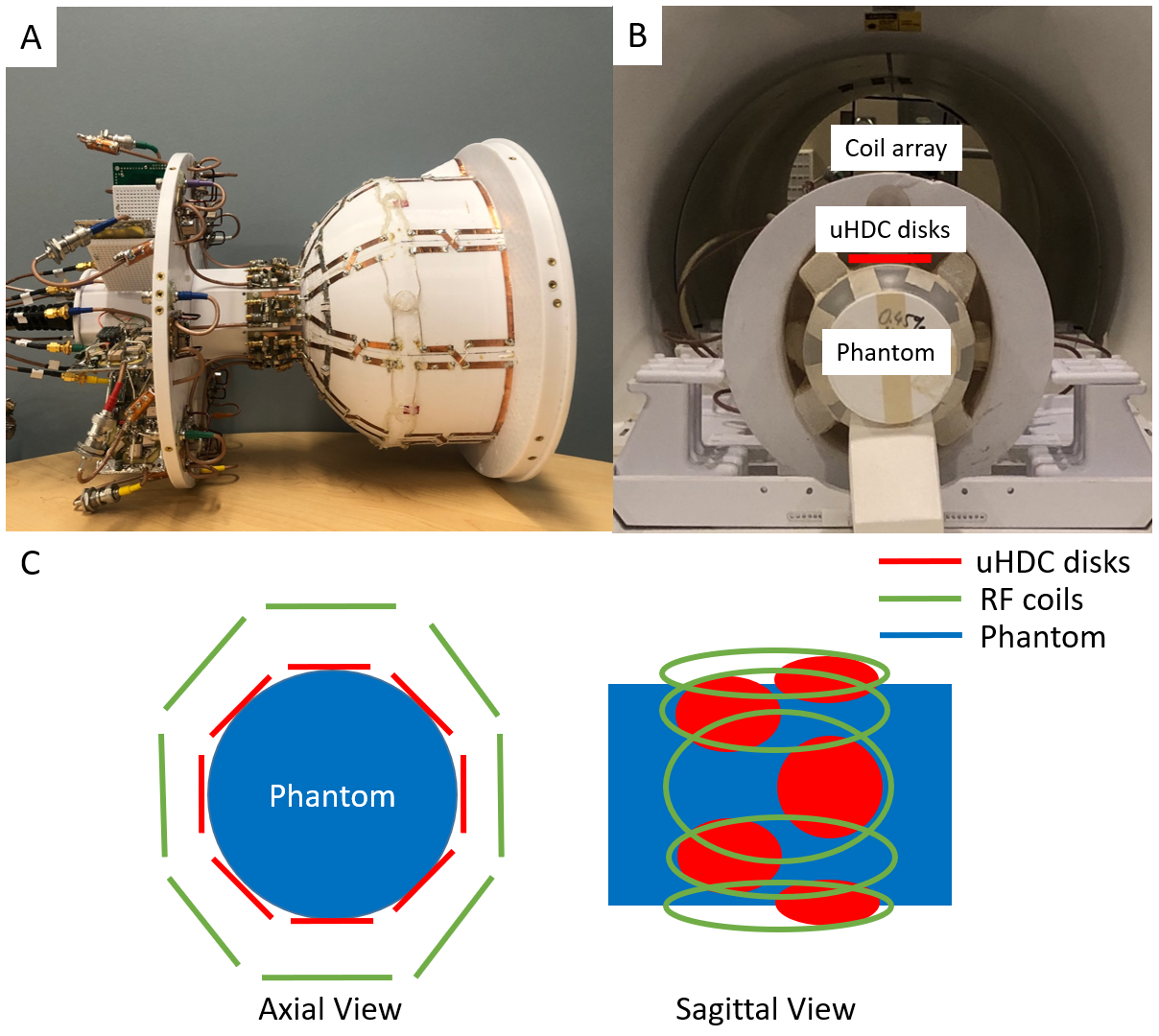
We have designed and constructed an 8-channel 2H-1H dual-frequency radiofrequency (RF) array coil, which can be tuned to 297MHz and 45.6MHz for proton and deuterium resonant frequencies at 7T, respectively7. Eight (circular) low-loss uHDC disks (8cm diameter, 0.5-0.9cm thickness) were made from mixed composite materials (Ba0.6Sr0.4TiO3 + 10% w/t BaTiO3), having an extremely high permittivity (er≈6000) at the room temperature (20°C). Figure 1 shows the setup of the RF head coil with the eight uHDC disks surrounding a cylindrical water bottle phantom with 50mM sodium concentration for the uHDC condition for the performance compared to the control in the absence of the disks. The 2H chemical shift images (CSI) of natural abundance 2H water (HDO) in axial orientation with various voltages were collected to estimate the RF magnetic reception field (B1-) maps using the sinusoidal curve fitting method5,6. B0-shimming was performed before the acquisition of CSI. To consider the resonance linewidth variation between different scans, we applied the resonance integral to determine B1-. Estimated B1- maps were divided by the noise level to calculate the ultimate SNR of CSI voxels and generate maps. Noise levels were calculated using the standard deviation of the spectral baseline of noise CSI acquired with zero pulse voltage. The ratios of SNR maps were calculated by voxel-wise division of SNR acquired under the uHDC condition over that under the control condition. Average SNR ratios were calculated for selected DMRSI slices.Results
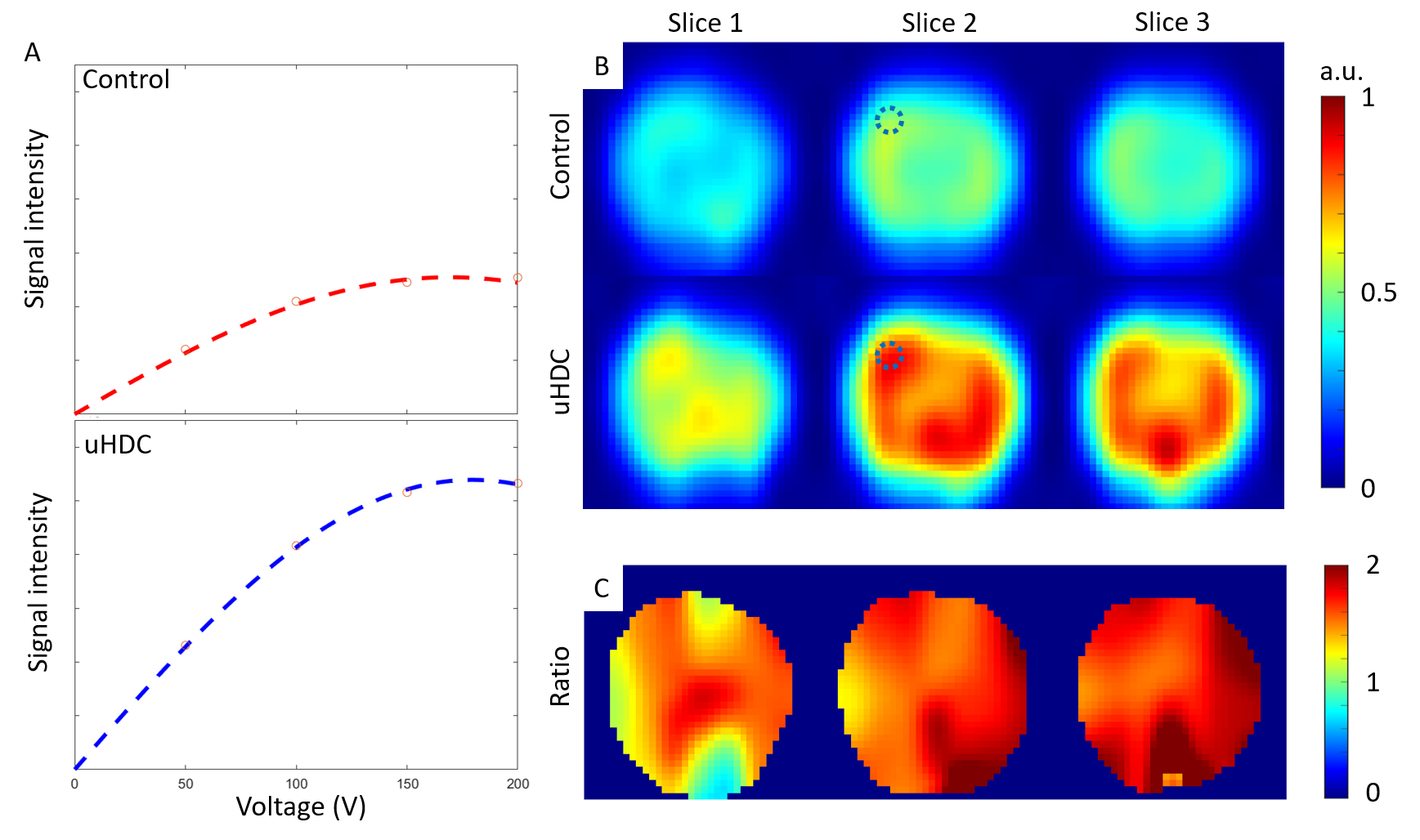
Figure 2A illustrates the sinusoidal curve fitting of a representative CSI voxel 2H spectrum of HDO signal for determining the B1- and SNR values for the voxel, which were used to generate the multiple slice SNR maps for the uHDC and control conditions (Figure 2B). Figure 2C shows the SNR ratio maps acquired under the uHDC and control conditions for three representative slices (axial orientation). The average SNR improvement with the uHDC ceramic disks was 62%. The average noise levels for the uHDC condition and the control condition were 0.462 and 0.481, respectively, thus, indicating a small (4%) de-noising effect.Discussion
The application of the uHDC ceramic disks around the water phantom provides significant SNR improvement by 62%. From the SNR ratio maps, the peripheral region in the phantom had a higher SNR ratio than the central region in the superior slices (Slice 2 and Slice 3). Nevertheless, the uHDC condition consistently shows large SNR improvement in the entire field of view. The average noise level was 4% lower with the uHDC condition than the control condition and it slightly boosts the overall SNR. The optimal permittivity value for the DMRSI application at 7T should be > 100005, the uHDC ceramic disks had a permittivity value of 6000, thus, meaning this sub-optimal condition has a great potential to be easily further improved by cooling as shown by our early work or developing higher permittivity dielectrics at room temperature5.Conclusion
The integration of the uHDC ceramic disks and 2H head coil with a head-size phantom results in the enhancement of receive sensitivity and de-noising effect, thus, large SNR gain for 7T DMRSI application, even under the sub-optimal condition of the uHDC material. The advancement to fabricate the uHDC ceramics with extremely high permittivity and low dielectric loss will further improve the DMRSI at 7T aiming for human brain imaging studies1,4.Acknowledgements
This work was supported in part by NIH grants of U01 EB026978 and P41 EB027061.References
1. De Feyter, H. M., Behar, K. L., Corbin, Z. A., Fulbright, R. K., Brown, P. B., McIntyre, S., Nixon, T. W., Rothman, D. L. & De Graaf, R. A. Deuterium metabolic imaging (DMI) for MRI-based 3D mapping of metabolism in vivo. Science Advances 4, eaat7314, doi:10.1126/sciadv.aat7314 (2018).
2. Li, Y., Zhao, Y., Guo, R., Wang, T., Zhang, Y., Chrostek, M., Low, W. C., Zhu, X. H., Liang, Z. P. & Chen, W. Machine Learning-Enabled High-Resolution Dynamic Deuterium MR Spectroscopic Imaging. IEEE Trans Med Imaging 40, 3879-3890, doi:10.1109/TMI.2021.3101149 (2021).
3. Lu, M., Zhu, X. H., Zhang, Y., Mateescu, G. & Chen, W. Quantitative assessment of brain glucose metabolic rates using in vivo deuterium magnetic resonance spectroscopy. J Cereb Blood Flow Metab 37, 3518-3530, doi:10.1177/0271678x17706444 (2017).
4. Zhu, X. H., Lu, M. & Chen, W. Quantitative imaging of brain energy metabolisms and neuroenergetics using in vivo X-nuclear 2H, 17O and 31P MRS at ultra-high field. J Magn Reson 292, 155-170, doi:10.1016/j.jmr.2018.05.005 (2018).
5. Chen, W., Lee, B. Y., Zhu, X. H., Wiesner, H. M., Sarkarat, M., Gandji, N. P., Rupprecht, S., Yang, Q. X. & Lanagan, M. T. Tunable Ultrahigh Dielectric Constant (tuHDC) Ceramic Technique to Largely Improve RF Coil Efficiency and MR Imaging Performance. IEEE Trans Med Imaging 39, 3187-3197, doi:10.1109/TMI.2020.2988834 (2020).
6. Lee, B. Y., Zhu, X. H., Rupprecht, S., Lanagan, M. T., Yang, Q. X. & Chen, W. Large improvement of RF transmission efficiency and reception sensitivity for human in vivo 31P MRS imaging using ultrahigh dielectric constant materials at 7T. Magn Reson Imaging 42, 158-163, doi:10.1016/j.mri.2017.07.019 (2017).
7. Soon, S. H., Waks, M., Wiesner, H. M., Li, X., Zhu, X. H. & Chen, W. Development of 8-Channel 1H-2H Dual-Frequency loop coil array with LC tanks for 1H MRI and 2H MRS imaging of human brain at 7 Tesla. in Proc. Intl. Soc. Mag. Reson. Med.. 30, p. 1542 (2022).
Figures