4072
Design of calibration-free RF pulses for T2-weighted single-slab 3D turbo-spin-echo sequences at 7T utilizing parallel transmission
Daniel Löwen1, Eberhard Daniel Pracht1, Vincent Gras2, Aurelien Massire3, Franck Mauconduit2, Nicolas Boulant2, and Tony Stöcker1,4
1German Center for Neurodegenerative Diseases (DZNE), Bonn, Germany, 2Université Paris-Saclay, Commissariat à l’Energie Atomique, CNRS, NeuroSpin, BAOBAB, Gif sur Yvette, France, 3Siemens Healthineers, Saint-Denis, France, 4Department of Physics and Astronomy, University of Bonn, Bonn, Germany
1German Center for Neurodegenerative Diseases (DZNE), Bonn, Germany, 2Université Paris-Saclay, Commissariat à l’Energie Atomique, CNRS, NeuroSpin, BAOBAB, Gif sur Yvette, France, 3Siemens Healthineers, Saint-Denis, France, 4Department of Physics and Astronomy, University of Bonn, Bonn, Germany
Synopsis
Keywords: High-Field MRI, RF Pulse Design & Fields, Brain, Parallel Transmit & Multiband
Multi-Slice T2-weighted MR imaging is a fundamental technique in brain imaging but suffers from field inhomogeneities at ultra-high field systems. In this work we present a pulse design method which provides slab-selective universal pulses with phase-coherent excitation profiles over selected brain regions. Applied in a 3D variable flip angle turbo-spin-echo (TSE) sequence, the pulses achieve superior SNR compared to multi-slice TSE imaging and B1+ field inhomogeneity mitigation.Introduction
Turbo-spin-echo (TSE) sequences are widely used in clinical MRI since they provide a variety of useful image contrasts for diagnosis of brain diseases such as detecting gray matter and white matter lesions in multiple sclerosis. However, at ultra-high field strengths (≥7T) RF field inhomogeneities lead to inhomogeneous signal and contrast. Various methods have been proposed to improve the quality in whole brain T2-weighted (T2w) TSE-based sequences at high fields1,2, but were limited so far to the non-selective case.In this work, we present the design of universal slab-selective pulses for usage in T2w-TSE imaging of the brain.
Methods
Three different RF pulse types are necessary for the slab-selective SPACE sequence3: A slab-selective excitation, a non-selective 180deg refocusing pulse and a (preferably) scalable non-selective refocusing pulse for the echo train (Figure 1).Excitation:
As the actual slab position is determined during the imaging session, a non-selective kT-points pulse4 is first optimized for whole brain uniform excitation. The orientation of the transverse component of the axis of rotation was extracted for each voxel after Bloch simulation and was saved as target axis of rotation for the refocusing pulses.
The resulting RF and k-space coefficients are used to construct slab-selective kT-spokes pulses (i.e. square pulses are replaced by sinc pulses) with respective RF and k-space coefficients (Figure 2a))5 with slab-selection gradients adapted to the slab orientation.
Refocusing:
Both 180° refocusing and variable flip angle refocusing pulses must be phase coherent with the excitation pulse in order to fulfill the CPMG condition. To limit the pulse design effort while meeting the CPMG condition, hence the 180° refocusing pulse was obtained by concatenating two 90° pulses (Figure 2b)) from the SPACE-refocusing train6 while targeting the spatial phase distribution of the excitation pulse (least-squares approach). The pulses of the train themselves have symmetric RF shapes and k-space trajectories7. That way a single optimized pulse could be used for all pulses after the excitation. The pulse was optimized utilizing a Gradient Ascent Pulse Engineering (GRAPE) algorithm8,9 to provide enough degrees of freedom to tackle the RF field inhomogeneity problem while meeting the phase constraints.
All pulses were designed under explicit RF power constraints and with simultaneous optimization of the k‐space trajectory under slew rate constraints. A database of B0 and B1+-maps from 10 healthy adults was used to generate universal pulses (UP)10.
The slab-selective SPACE sequence was tested with and without UPs in vivo with oblique slab orientation (Figure 3) and compared to a 2D T2w TSE covering the same volume in CP mode.
Additionally, the signal-to-noise ratio (SNR) was evaluated utilizing the so-called "difference method"11. It was compared over the entire slab, in the anterior half and the posterior half of the excited slab covering white and gray matter, but excluding CSF.
Experiments were conducted on a MAGNETOM 7T Plus scanner (Siemens Healthcare, Erlangen, Germany) using a head array coil with 32 receive and 8 transmit channels (Nova Medical, Wilmington, USA). In vivo experiments were performed in accordance with guidelines set by the institutional review board.
Sequence parameters for the slab-selective SPACE were: TR/TE (TEeffective)=4000/168 (76)ms, Echo spacing=4.8ms, 1.4 averages, 56 slices per slab, iPAT factor=3 (CAIPIRINHA, 27 reference lines), readout pixel bandwidth=488Hz, turbo factor=96, resulting voxel size=0.4x0.4x1.0mm³, TA=8:58min. A multi-slice 2D T2w TSE was acquired in CP mode for comparison using the following parameters: TR/TE=8090/76ms, Echo spacing=15.3ms, 1 average, 55 slices, iPAT factor=3 (GRAPPA, 27 reference lines), readout pixel bandwidth=155Hz, resulting voxel size=0.4x0.4x1.0mm³, TA=2:59min. The same protocol was repeated three times with reference voltages of 200V, 240V and 280V. The images were averaged to mitigate signal loss induced by B1+-inhomogeneities12 resulting in 8:57min total scan time.
Results
In vivo results of the 2D T2w TSE and the slab-SPACE with and without UPs are shown in Figure 4. Improved image homogeneity achieved with UPs can be clearly seen in the images. Additionally, SNR increases by approximately 100% when using UPs compared to CP pulses (Table 1).Even compared to multi-slice TSE (averaged over three different reference voltages), the slab-selective SPACE sequence achieves higher SNR at equal acquisition times and provides more homogeneous excitation, especially in the cerebellum and in the temporal lobes. On the other hand, a slightly decreased in-plane resolution due to blurring is observed in the SPACE sequence due to the point spread function induced by the refocusing train.
Discussion/Conclusion
This work shows that UPs can be designed to greatly enhance the performance of slab-selective SPACE at ultra-high fields.The slab-selective SPACE achieves improved excitation homogeneity throughout the imaging volume and improves SNR compared to multi-slice TSE. The simplicity of the approach makes it versatile: 1) UPs spare the user a cumbersome calibration procedure (especially when using GRAPE), 2) the 3D-optimization initially performed with kT-points and GRAPE allows the user to select slab positions and orientations arbitrarily without having to recompute RF pulses.
Compared to non-selective acquisitions, slab-selective imaging provides the ability to measure axial orientations without time penalty. That is particularly interesting for non-isotropic acquisitions with high in-plane resolution. For clinical applications 3D slab-selective FLAIR will be investigated.
In conclusion, the slab-SPACE sequence with UPs provides a viable easy-to-use alternative to multi-slice TSE at 7T.
Acknowledgements
This work received financial support from the European Union Horizon 2020 Research and Innovation program under grant agreement 885876 (AROMA).References
[1] Eggenschwiler F. et al.: Magn. Reson. Med. 2014; 71:1478-1488[2] Massire A. et al.: Magn. Reson. Med. 2015; 73:2195-2203
[3] Mugler J. et al.: Radiology 2000; 216:891-899
[4] Cloos M. A. et al.: Magn. Reson. Med. 2012; 67:72–80
[5] Gaël S. et al.: Joint Annual Meeting ISMRM-ESMRMB 2018
[6] Gras V. et al.: Magn. Reson. Med. 2019; 81:3202-3208
[7] Gras V. et al.: Magn. Reson. Med. 2018; 80:53-65
[8] Khaneja N. et al.: J. Magn. Reson. 2005; 172:296-305
[9] Van Damme L.et al.: Magn. Reson. Med. 2021; 85:678-693
[10] Gras V. et al.: Magn. Reson. Med. 2017; 77,635-643
[11] Dietrich O. et al.: J. Magn. Reson. 2007; 26:375-385
[12] Lee H. et al.: Current Biology 2020; 30:4201-4212
Figures
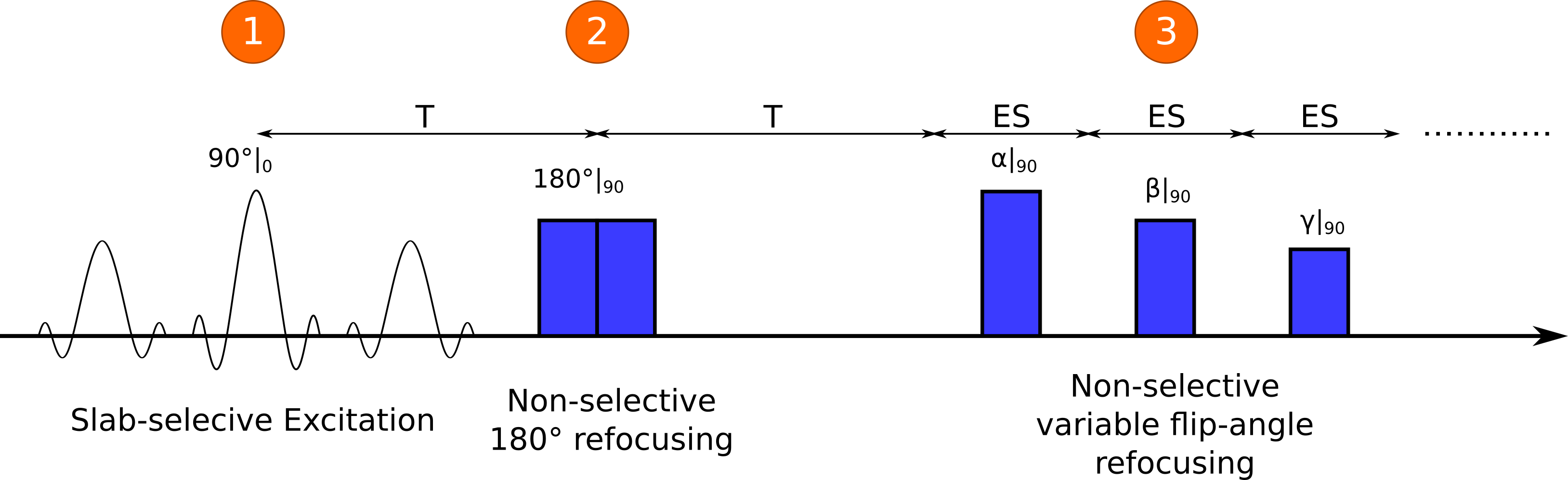
Sequence diagram of the SPACE sequence and pulse design approach. A slab-selective kT-spokes pulse with a target flip angle of 90deg (1) is followed by a non-selective 180deg refocusing pulse (2) in order to keep the echo spacing (ES) of the readout train (3) short. The 180deg refocusing pulse is the concatenation of two symmetric 90deg pulses from the pulse train, whose design targets the phase of the first, excitation, pulse.
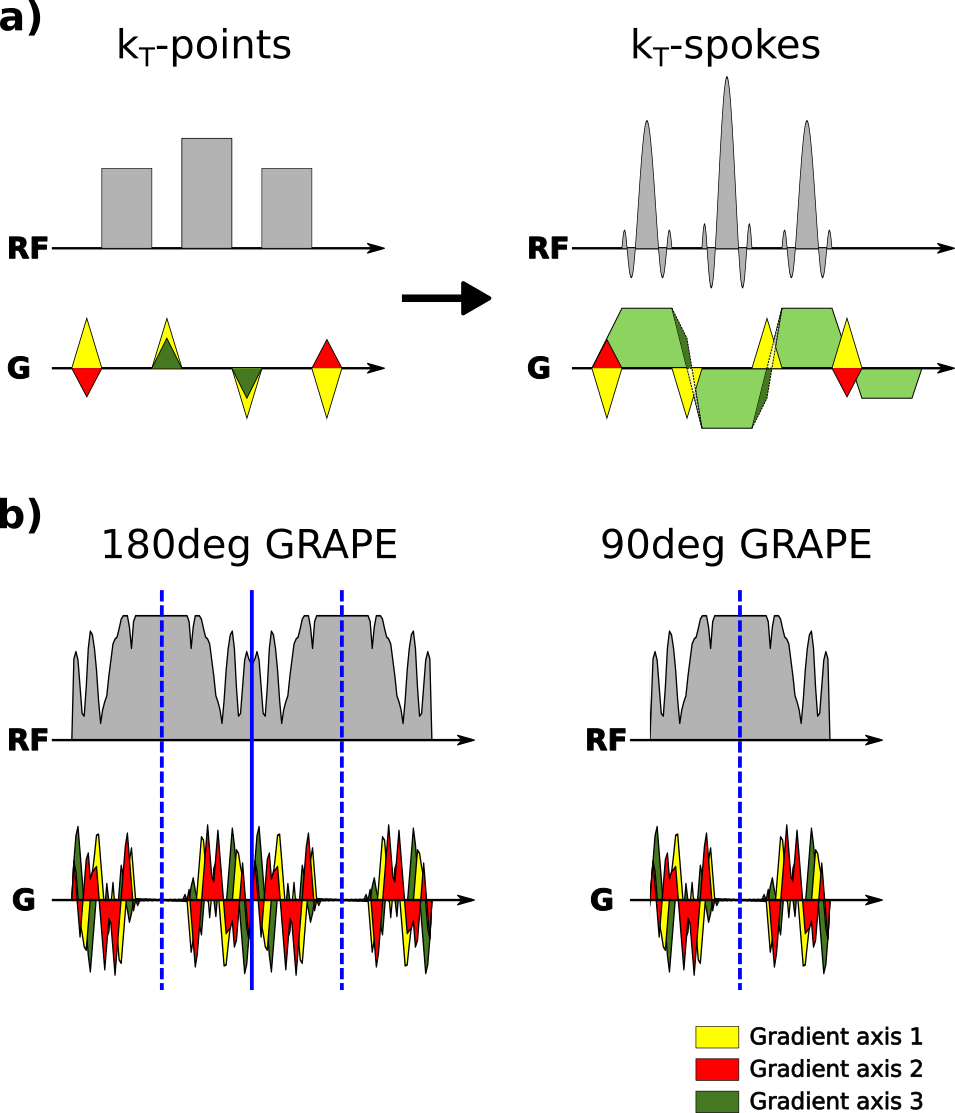
a) From a kT-points pulse, a kT-spokes pulse is created by replacing the rectangular RF-shapes by sinc-shapes. Additionally “spokes gradients” are applied to achieve the desired slab selection. 9 sub-pulses were used in the actual study, but 3 are depicted for more clarity.
b) A 180deg refocusing pulse consists of two concatenated 90deg pulses. The latter pulse (RF pulse and k-space trajectory) itself has mirror symmetry with respect to the middle.
b) A 180deg refocusing pulse consists of two concatenated 90deg pulses. The latter pulse (RF pulse and k-space trajectory) itself has mirror symmetry with respect to the middle.
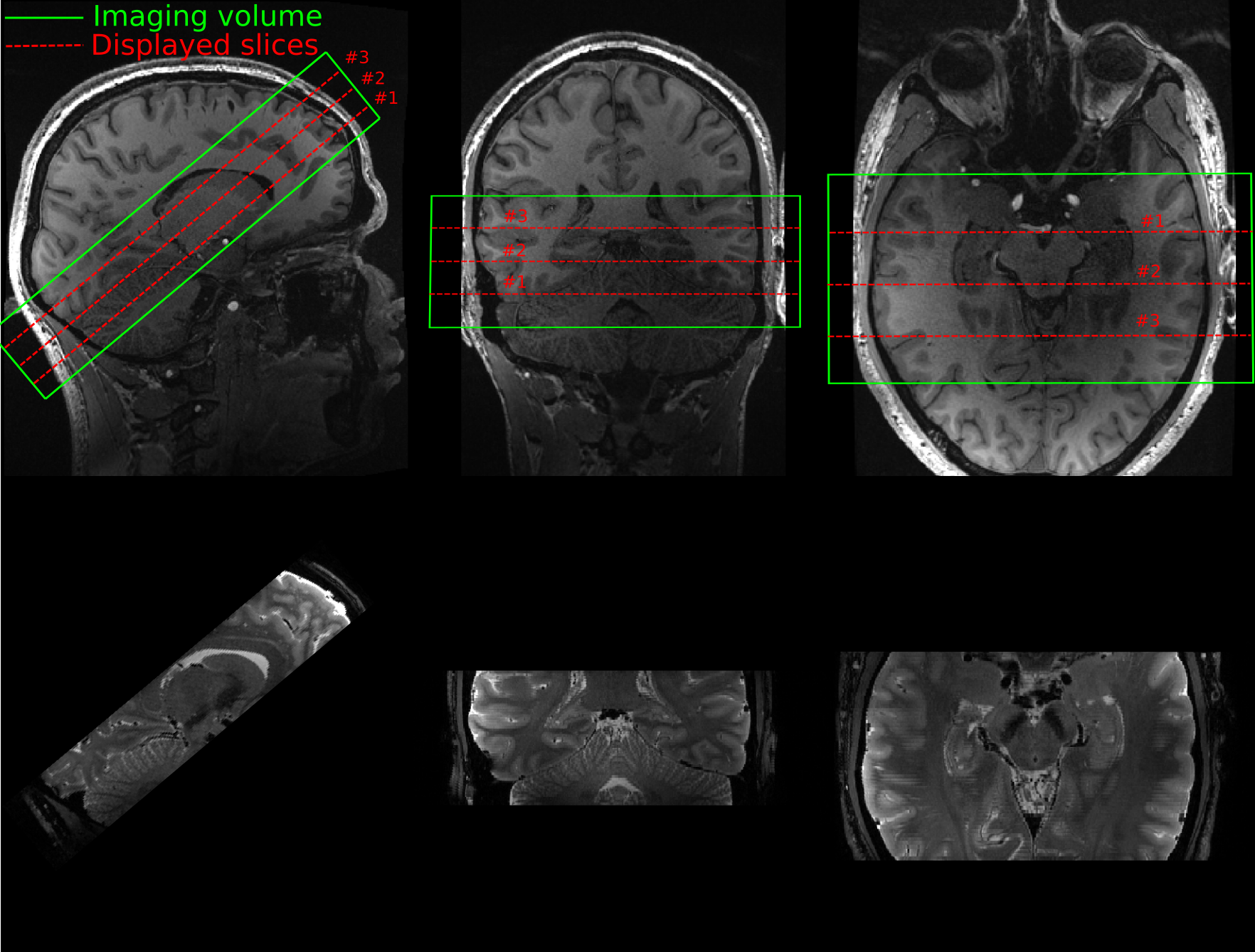
At the top a T1-weighted image is displayed showing the imaging volume of the slab-selective SPACE and 2D multi-slice TSE (green), as well as the slice positions (red) shown in Figure 4.
At the bottom the imaged slab acquired with slab-selective SPACE is shown.
At the bottom the imaged slab acquired with slab-selective SPACE is shown.
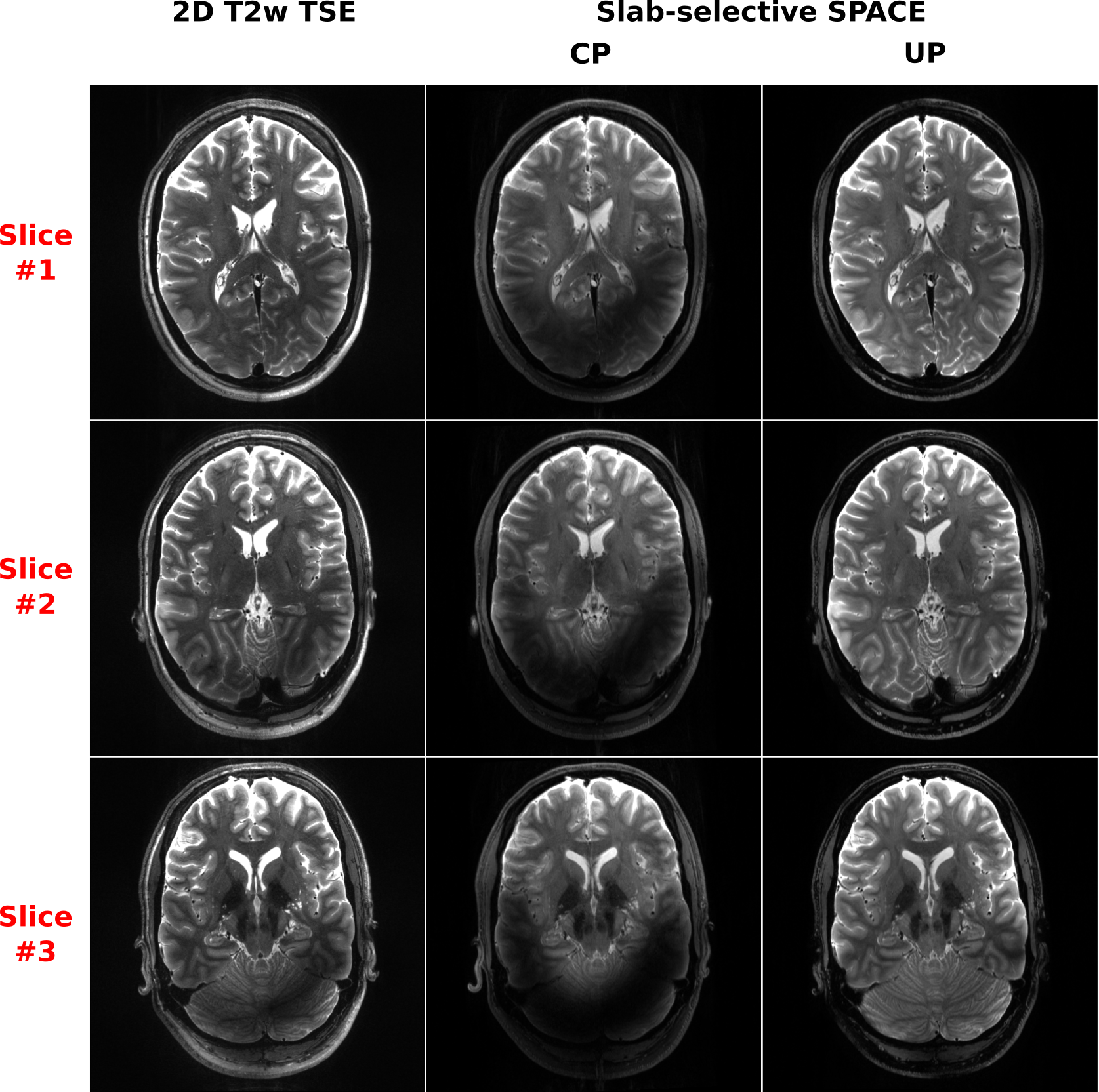
In vivo images of a 2D T2-weighted TSE (average of three images
acquired with different reference voltages to mitigate signal loss)
(left column), a slab-selective SPACE with circularly polarized (CP)
excitation (center column) and universal pulses (UP) (right column) in
oblique orientation.
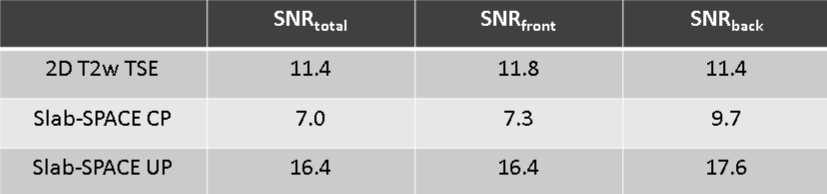
SNR comparison of a 2D T2-weighted TSE, a slab-SPACE with circularly
polarized (CP) excitation and universal pulses (UP) measured in vivo at
equal acquisitions times. SNRtotal is the SNR over the whole slab/ all
slices. SNRfront and SNRback is the SNR in the anterior or posterior
half of the imaged volume. The SNR was calculated in white and gray
matter only.
DOI: https://doi.org/10.58530/2023/4072