4037
Improving JSENSE Using an Initial Reconstruction with an Unrolled Deep Network Prior
Gulfam Ahmed Saju1, Zhiqiang Li2, Reza Abiri3, Tianming Liu4, and Yuchou Chang1
1Computer and Information Science, University of Massachusetts Dartmouth, North Dartmouth, MA, United States, 2Neuroradiology, Barrow Neurological Institute, Phoenix, AZ, United States, 3Electrical, Computer and Biomedical Engineering, University of Rhode Island, Kingston, RI, United States, 4Computer Science, University of Georgia, Athens, GA, United States
1Computer and Information Science, University of Massachusetts Dartmouth, North Dartmouth, MA, United States, 2Neuroradiology, Barrow Neurological Institute, Phoenix, AZ, United States, 3Electrical, Computer and Biomedical Engineering, University of Rhode Island, Kingston, RI, United States, 4Computer Science, University of Georgia, Athens, GA, United States
Synopsis
Keywords: Machine Learning/Artificial Intelligence, Parallel Imaging
JSENSE iteratively optimizes sensitivity maps and the image, so the sensitivity profile can be gradually improved during the reconstruction process. The initially reconstructed image in the first iteration is obtained by the initially estimated coil sensitivity maps. The initial coil sensitivity profiles may be inaccurate and therefore degrade the quality of the subsequent image quality and coil sensitivity map estimation in the iterative optimization process. We propose to use unrolled deep network prior to replace the initial reconstruction in the conventional JSENSE for improving the image reconstruction quality. Experimental results show that the proposed method outperforms CG-SENSE and JSENSE.Introduction
Sensitivity profile estimation is an open problem in MRI reconstruction. Accurate sensitivity estimation can enhance reconstructed image quality. JSENSE 1 iteratively optimizes sensitivity maps and the image, so the sensitivity profile can be gradually improved during the reconstruction process. The initially reconstructed image in the first iteration is obtained by the initially estimated coil sensitivity maps. The initial coil sensitivity profiles may be inaccurate. The quality of the firstly reconstructed image by the SENSE 2 may not be good enough, so the remaining iterations cannot significantly improve the quality of sensitivity maps and the reconstructed images. For this reason, if the initially reconstructed image quality is improved, the remaining images in the subsequent iterations and the final image can be improved in comparison to the reconstructions using the initial image with a low quality. To improve the first image quality, we use unrolled deep network prior for replacing the initial reconstruction in the conventional JSENSE.Methods
The flowchart of the proposed method is demonstrated in Figure 1. Instead of the reconstruction using the coil sensitivity maps initially estimated from the self-calibrated k-space data, the initial image is reconstructed using a pre-trained deep network model. For the conventional JSENSE 1, the imaging equation becomes $$$ E(a)f=d $$$ (1), where $$$a$$$ represents unknown actual coil sensitivities, $$$d$$$ is the acquired k-space data from all actual coils, the encoding matrix is $$$E$$$ containing the operations of Fourier encoding, undersampling of k-space, and coil sensitivities, and $$$f$$$ denotes the image to be reconstructed. An iterative optimization process alternatively optimizes the sensitivities and the image to be reconstructed.The initial image is reconstructed by the ADMM-CSNet 3, and then it is plugged into the JSENSE iterative reconstruction process. Note that external training data are needed for the ADMM-CSNet. We collected a group of 100 training images and trained the ADMM-CSNet. The pre-trained model is used to reconstruct the initial image. In the first iteration of JSENSE, the imaging equation is changed to be $$$ E(a) f_0=d $$$ (2), where $$$f_0$$$ represents the initial image reconstructed from the pre-trained model of ADMM-CSNet. After all iterations are completed, the final image is compared to CG-SENSE 4 and JSENSE for evaluating the reconstruction performance.
Results
Two brain datasets are used for evaluating the proposed approach. The second dataset was an axial brain image acquired using a 2D spin echo sequence (TE/TR = 11/700 ms, matrix size = 256 × 256, FOV=220 cm2). The second dataset of axial brain images was acquired on a 3T scanner with a 32-channel head coil using a 2D gradient echo sequence (TE/TR = 2.29/100 ms, flip angle = 25°, matrix size = 256 × 256, slice thickness = 3 mm, and FOV = 24 × 24 cm2). The reduction factor is 4 and ACS lines are 20 for undersampling k-space data. As shown in Figure 2 of the 8-channel brain data, the proposed JSENSE-ADMM can better suppress noise in compared to the conventional JSENSE reconstruction. In addition, JSENSE-ADMM outperforms CG-SENSE by removing aliasing artifacts. Figure 3 shows the 32-channel brain data reconstruction results. The proposed method can also suppress noise and aliasing artifacts compared to reconstruction results by CG-SENSE and JSENSE. Quantitative evaluations using the reduction factors of 2, 3, and 4 of the proposed approach are shown in Figure 4. Following the increased reduction factors, both PSNR and SSIM decrease.Discussion
JSENSE reconstruction is improved by enhancing the quality of the initial reconstruction of the image. The ADMM-CSNet, as an unrolled deep network method, reconstructs the initial reconstruction rather than the initial image reconstructed by the SENSE. Initial coil sensitivities are avoided for degrading the initial reconstruction. One issue is that external training data are required, and the distribution shift problem may degrade the initial image quality.Conclusion
The initial reconstruction of JSENSE determines the subsequent iterative optimization process. An unrolled deep network is used to improve the initial reconstruction quality of JSENSE and then the proposed approach outperforms CG-SENSE and JSENSE for brain image reconstructions.Acknowledgements
No acknowledgement found.References
1. Ying L, and Sheng J. Joint image reconstruction and sensitivity estimation in SENSE (JSENSE). Magn Reson Med. 2007;57(6):1196-1202.
2. Pruessmann, K, Weiger M, Scheidegger M, and Boesiger P. SENSE: sensitivity encoding for fast MRI. Magn Reson Med. 1999;42(5):952-962.
3. Yang Y, Sun J, Li H, and Xu Z. ADMM-CSNet: a deep learning approach for image compressive sensing. IEEE Trans Pattern Anal Mach Intell. 2020;42(3):521-538.
4. Maier O, et. al. CG-SENSE revisited: Results from the first ISMRM reproducibility challenge. Magn Reson Med. 2021;85(4):1821-1839.
Figures
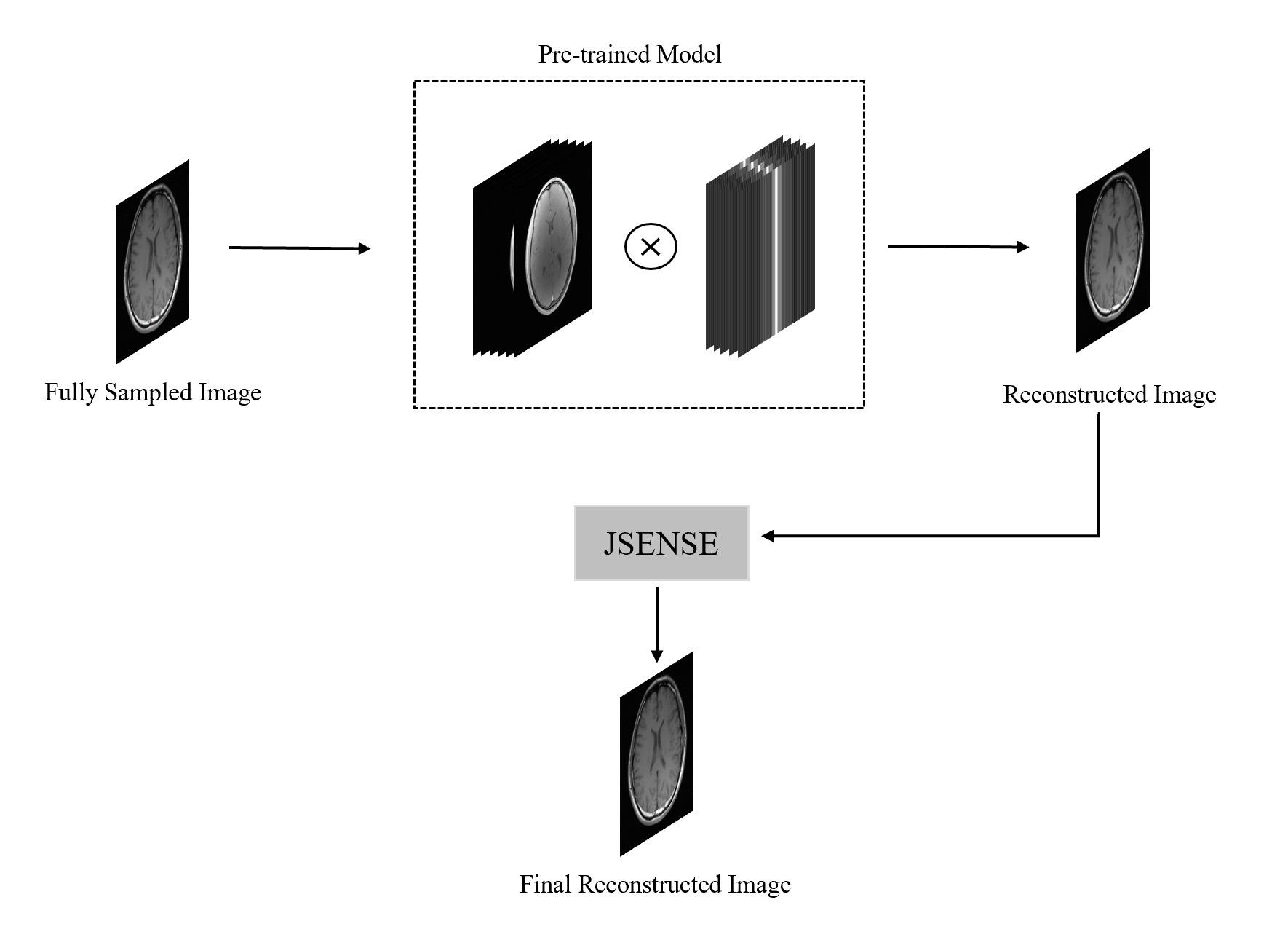
Figure 1: Flowchart of the proposed method. A pre-trained model generated by the ADMM-CSNet is used to initialize the first image and then fed to JSENSE reconstruction.
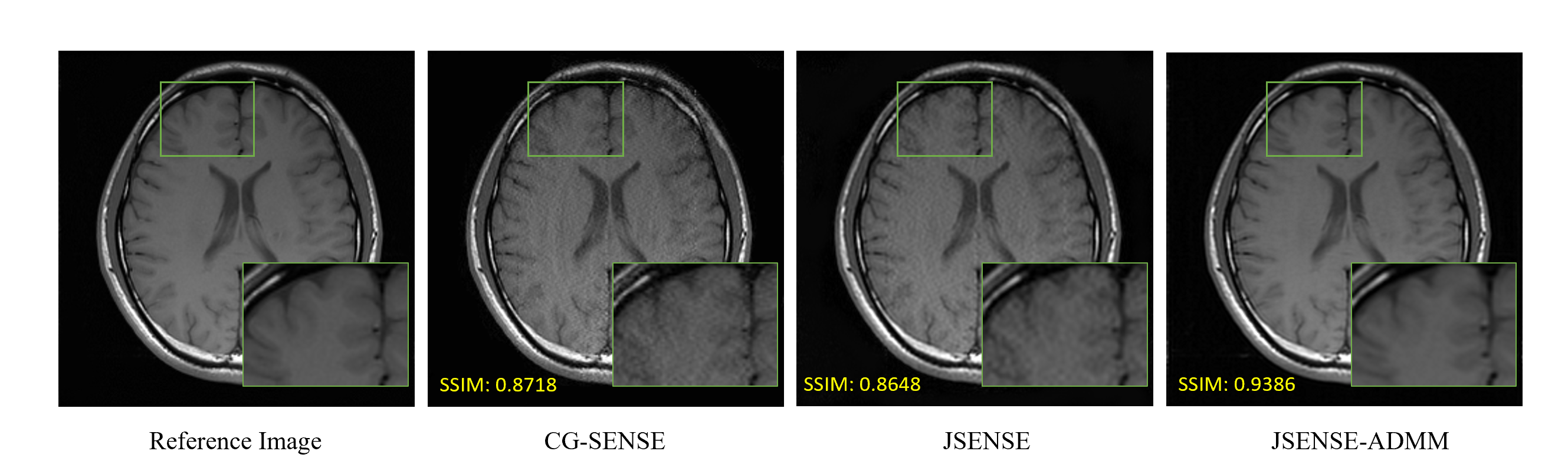
Figure 2: For
the 8-channel brain imaging, the proposed JSENSE -ADMM outperforms the CG-SENG
and JSENSE reconstructions with less noise and aliasing artifacts.
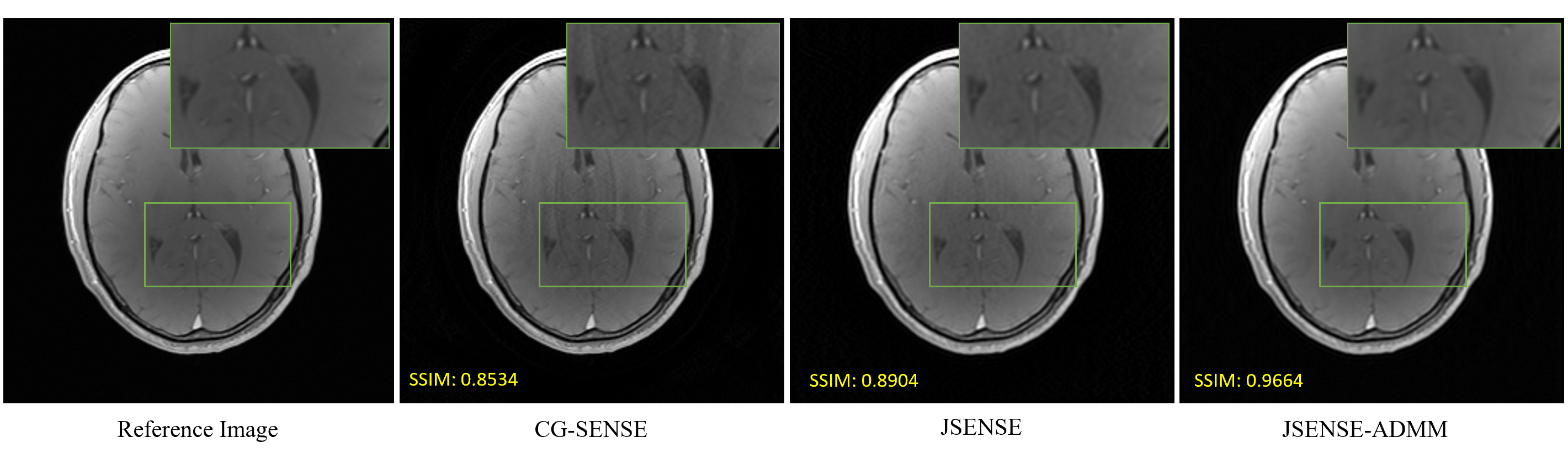
Figure 3: For the 32-channel brain imaging, the proposed JSENSE -ADMM outperforms the CG-SENG and JSENSE reconstructions with less noise and aliasing artifacts.
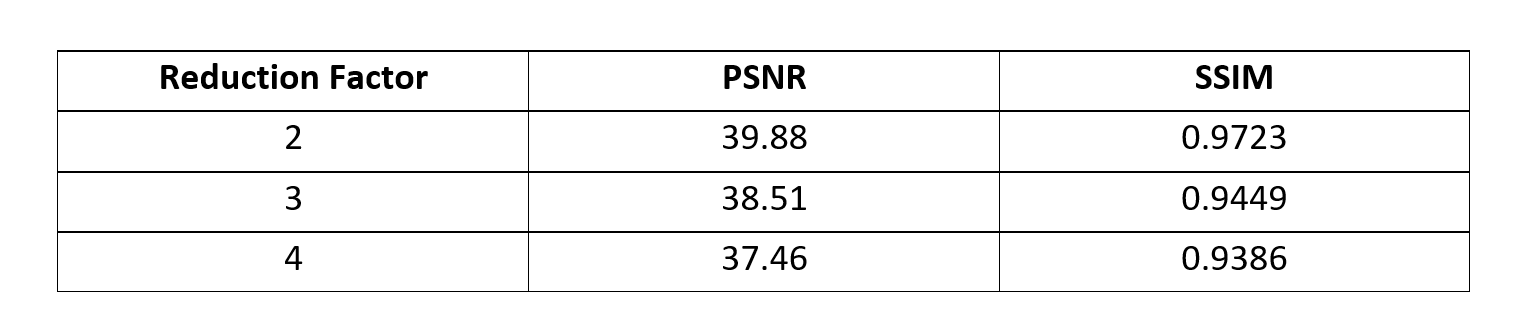
Figure 4: Quantitative
evaluation values by the proposed method show that the image quality is
degraded along the increased reduction factors.
DOI: https://doi.org/10.58530/2023/4037