4013
Cardiac MRI including myocardial T2 mapping for the differentiation of AL and ATTR amyloidosis1Diagnostic and interventional radiology, University Hospital Bonn, Bonn, Germany, 2Quantitative Imaging Laboratory Bonn, Bonn, Germany
Synopsis
Keywords: Myocardium, Cardiomyopathy
Cardiac amyloidosis can be visualized on CMR, but to date no reliable imaging parameters exist to distinguish the two most common forms of cardiac amyloidosis, AL and ATTR. Retrospective analysis of 37 cardiac amyloidosis patients shows that T2 times are markedly elevated in AL compared to ATTR, and in both compared to a control group of patients with other reasons for cardiac hypertrophy. Myocardial T2 mapping may be a useful CMR parameter for the differentiation of AL and ATTR cardiac amyloidosis.Keywords: amyloidosis, cardiac, MRI, CMR
Introduction
Cardiac amyloidosis (CA) is a progressive disease that leads to cardiac impairment and if untreated, death. There are two main types with significantly differing survival times: amyloid light-chain (AL) with around half a year and transthyretin amyloidosis (ATTR) with approximately 3 to 5 years (1). There are currently no reliable cardiac MR (CMR) markers for the differentiation of these two types of CA. The purpose of this study was to analyze quantitative CMR data to identify possible differentiators.Methods
In this retrospective study, patients who had a confirmed CA diagnosis (i.e., via myocardial biopsy, scintigraphy, or biopsy of other tissues in suspected cardiac involvement) und underwent CMR were analyzed. Consecutive control patients with non-amyloid myocardial hypertrophy (e.g., hypertrophic cardiomyopathy, hypertensive cardiomyopathy, cardiac sarcoidosis, or mixed connective tissue disease) were included as the control group. CMR protocol allowed for the determination of cardiac function, T1 and T2 relaxation times, extracellular volume (ECV), and late gadolinium enhancement (LGE). Receiver operating characteristic analysis, one way-ANOVA and χ2 test were used for statistical analysis.Results
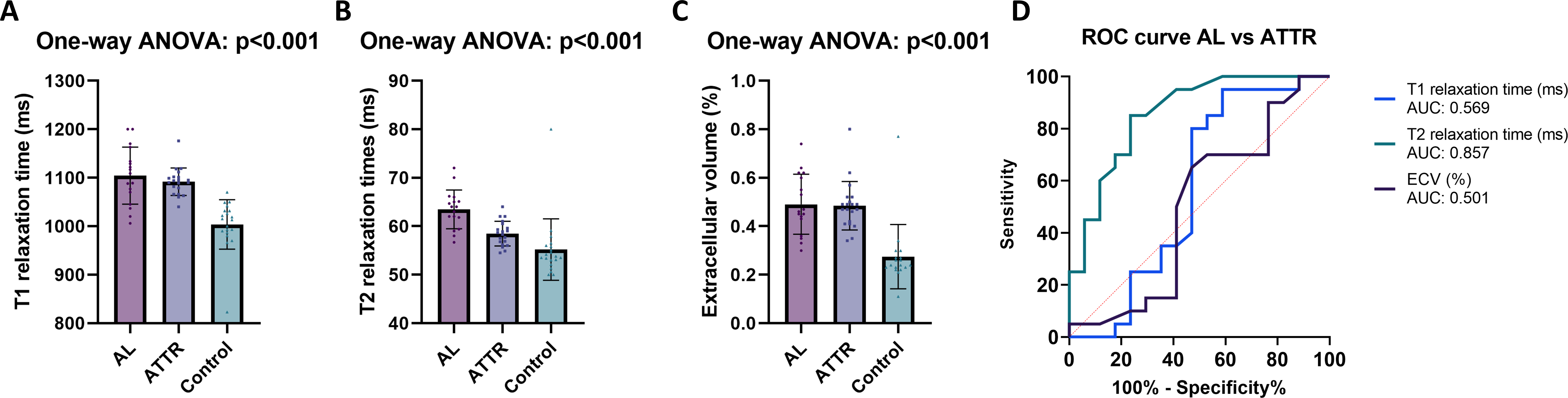
A total of 57 patients were included in this analysis (17 AL, 20 ATTR and 20 controls, 13 female, mean age [±SD] of 65±16 years). T1 relaxation times were lower in controls compared to AL and ATTR amyloidosis (1003±51 vs 1104±59 vs 1091±28ms; P<.001). ECV was lower in controls compared to AL and ATTR amyloidosis (27±13 vs 49±12 vs 49±10%; p<.001). T2 relaxation times were lower in controls compared to AL and ATTR amyloidosis (55±6 vs. 59±3 vs 64±4ms; p<.005). CA patients had extensive LGE abnormalities with different distribution patterns between AL (41% subendocardial and 29% subepicardial) and ATTR amyloidosis (predominantly transmural, nearly 70% of all cases). For the discrimination between AL and ATTR amyloidosis, myocardial T2 mapping displayed the highest diagnostic performance (area under the curve [AUC]: .857) compared to myocardial T1 times (AUC: .569; P=.007 vs T2) and ECV (AUC: .501; P=.005 vs T2).Discussion
Elevated T2 relaxation times may be due accompanying myocardial edema in AL patients as has been reported by one other study (2). Patients with ATTR did also demonstrate elevated T2 times compared to the control group, but these were comparatively lower than in the AL group, suggesting that both groups demonstrated edema, just to a differing extent. As has been previously described, T1 relaxation times and LGE also provide insight into the extent of the disease (3). While previous studies have suggested increased T1 signal in AL compared to ATTR, we could not find significant evidence for this in our study (3).Synopsis
Cardiac amyloidosis can be visualized on CMR, but to date no reliable imaging parameters exist to distinguish the two most common forms of cardiac amyloidosis, AL and ATTR. Retrospective analysis of 37 cardiac amyloidosis patients shows that T2 times are markedly elevated in AL compared to ATTR, and in both compared to a control group of patients with other reasons for cardiac hypertrophy. Myocardial T2 mapping may be a useful CMR parameter for the differentiation of AL and ATTR cardiac amyloidosis.Acknowledgements
No acknowledgement found.References
1. Korosoglou G, Giusca S, André F, dem Siepen F aus, Nunninger P, Kristen AV et al. Diagnostic Work-Up of Cardiac Amyloidosis Using Cardiovascular Imaging: Current Standards and Practical Algorithms. Vascular health and risk management 2021; 17:661–73. Available from: URL: https://pubmed.ncbi.nlm.nih.gov/34720583/.
2. Ridouani F, Damy T, Tacher V,
Derbel H, Legou F, Sifaoui I et al. Myocardial native T2 measurement to
differentiate light-chain and transthyretin cardiac amyloidosis and assess
prognosis. J Cardiovasc Magn Reson 2018; 20(1):58. Available from: URL:
https://jcmr-online.biomedcentral.com/articles/10.1186/s12968  018-0478-3.
3. Oda S, Kidoh M, Nagayama Y, Takashio S, Usuku H, Ueda M et al. Trends in Diagnostic Imaging of Cardiac Amyloidosis: Emerging Knowledge and Concepts. Radiographics 2020; 40(4):961–81.
Figures