3912
Design of a Highly Decoupled Compact Dual-tuned Transceiver RF Coil Arrays for 1H MRI and 31P MRSI at 7T1Department of Biomedical Engineering, University at Buffalo, Buffalo, NY, United States
Synopsis
Keywords: Parallel Imaging, Multimodal, Dual nuclear
In this work, we developed a decoupled multichannel double-tuned RF coil array for 1H/31P MR imaging and spectroscopy at the ultrahigh field of 7T. One of the difficulties in designing such high-frequency double-tuned coil arrays is to electromagnetically decouple the two frequency channels simultaneously. To address this issue, we designed a double-crossed magnetic wall (or ICE) decoupling which can independently and simultaneously decouple the 1H channels and 31P channels. With the improved performance, this developed 1H/31P transceiver array is expected to offer improved detection quality and imaging speed in 1H/31P metabolic imaging applications at 7T.
Introduction
31P MR spectroscopic imaging provides critical information in metabolic and physiological changes by detecting 31P signals in the biochemical process such as glycolysis and tricarboxylic acid (TCA) cycle 1-3. Heteronuclear 31P signals are weak due to their low natural abundance and nuclear spin polarization which limit the SNR and quantitative capability of this metabolic imaging technique. It’s demonstrated that heteronuclear SNR can be enhanced by using ultrahigh field MR and multichannel double-tuned RF array 4,5. Common-mode differential-mode (CMDM) resonators possess two resonant frequencies and have been used to design double-tuned volume coils through coupled elements 5. CMDM’s can be possibly used to design double-tuned RF arrays for sensitivity enhancement and acquisition acceleration by parallel imaging if an appropriate decoupling method is applied. In this study, we design a distributed filter trap decoupling for the dual-tuned (1H/31P) transceiver RF array at 7T. The proposed filter trap composes two orthogonal magnetic wall (or ICE) decoupling elements 6 which can decouple the 1H mode and 31P mode independently. To verify the proposed approach, a pair of double-tuned CMDM resonators are designed and manufactured with and without the distributed filter trap and their decoupling performance is assessed using full wave electromagnetic analysis of High-Frequency Structure Simulator (HFSS) and standard RF testing on the fabricated prototype on a bench. The simulations are supported with bench test results.Method
A dual-tuned (1H/31P) CMDM resonator is designed at 7T where the Larmor frequencies of the proton 1H and the X-nucleus 31P are 298MHz and 120MHz, respectively. In this situation, the common mode (CM) is used for the 1H anatomical acquisition while the differential mode (DM) is for the 31P spectroscopic data. The CMDM resonator, a rectangular (width=3cm, length=6cm) split microstrip transmission line made of 4 mm copper width on a grounded dielectric substrate incorporated two orthogonal fields, the CM and the DM. The design is placed 1 cm above a water phantom. The model of the double-tuned CMDM, the electric parameters, and the simulated scattering parameters of the design are illustrated in Fig. 1. Then an array of two dual-tuned CMDM resonators separated by a 1-cm gap is designed and constructed. A distributed trap filter is symmetrically inserted between the two resonators to provide sufficient decoupling between elements in the array (Fig.3). The proposed distributed trap filter is based on the induced current elimination (ICE) technique 6. It’s composed of two orthogonal ICE tunable loops. The trap filter #1 is transparent to the differential mode fields of the CMDM resonators and is independently tuned to suppress the induced current of the common mode coupling. Likewise, the trap filter #2 filter is transparent to the common mode fields and is solely used to reduce the induced current of the differential mode coupling.Results
The scattering parameters of the dual-tuned CMDM resonator in Fig. 1(b) show that the design operates for both the 1H and the 31P nucleus. At the low frequency (fP =120MHz), excellent input impedance matching is obtained about -27 dB and at the higher frequency (fH =298MHz) the reflection coefficient is about -25dB. Due to the orthogonality between the CM and the DM fields, a good isolation is obtained between the two frequencies on an average of -75dB. The pair of dual-tuned CMDM’s is also evaluated. The scattering parameter of the array without the distributed trap filters in Fig.2 (b) reveals strong coupling between the DM currents and also between the DM currents which can lead to noise amplification. To circumvent this limitation, a distributed trap filter is inserted between the pair of dual-tuned resonators. The impedance of the trap filter is adjusted by tuning the value of capacitors CT1 and CT2 [see Fig. 2(a)] to provide sufficient multi-mode decoupling between both dual-tuned closely placed resonators. As can be seen in Fig. 2(c), the scattering parameter of the array with the distributed trap filters (CT1 =3pF and CT2 =15pF) shows excellent isolation of 45 dB between DM1 & DM2 ports (the 31P channels) and about 23 dB between CM1& CM2 ports (1H channels). The pair of the double-tuned CMDM along with distributed trap filters are fabricated using PCB with low-loss substrates as shown in Fig. 3(a). The prototypes are tuned and matched at the desired frequencies using trimmer variable capacitors which are close to the simulated value. Bench test measurements of the pair of CMDM closely placed without the distributed trap filters show strong multimode coupling [see Fig. 3(b)]. The integration of the trap filters has introduced transmission zeros and significantly reduced the coupling between the pair of the CMDM resonators as shown in Fig. 3(c).Conclusion
A dual-tuned RF array is designed for 1H/31P MRI and MRSI at 7T using CMDM technique and evaluated for its decoupling performance. A distributed trap filter decoupling is successfully designed to provide simultaneous decoupling of two nuclear channels in the array. Numerical results and bench test show a significant reduction of the multi-mode coupling between resonators which demonstrates the feasibility of the proposed design for dual-tuned 1H/31P RF array at 7T.Acknowledgements
This work is supported in part by the NIH under a BRP grant U01 EB023829 and by the State University of New York (SUNY) under SUNY Empire Innovation Professorship Award.
References
1. J. C. Chatham and S. J. Blackband, "31P chemical shift imaging of the regionally ischemic perfused heart," NMR Biomed, vol. 3, no. 4, pp. 190-3, Aug 1990, doi: 10.1002/nbm.1940030408.
2. C. T. Moonen, P. C. van Zijl, D. Le Bihan, and D. DesPres, "In vivo NMR diffusion spectroscopy: 31P application to phosphorus metabolites in muscle," Magn Reson Med, vol. 13, no. 3, pp. 467-77, Mar 1990, doi: 10.1002/mrm.1910130314.
3. H Lei, et al. In vivo 31P magnetic resonance spectroscopy of human brain at 7 T: an initial experience. Magn Reson Med, vol. 49, no. 2, pp. 199-205, Feb 2003, doi: 10.1002/mrm.10379
4. O. Rutledge, T. Kwak, P. Cao, and X. Zhang, "Design and test of a double-nuclear RF coil for (1)H MRI and (13)C MRSI at 7T," J Magn Reson, vol. 267, pp. 15-21, Jun 2016, doi: 10.1016/j.jmr.2016.04.001.
5. Y. Pang, X. Zhang, Z. Xie, C. Wang, and D. B. Vigneron, "Common-mode differential-mode (CMDM) method for double-nuclear MR signal excitation and reception at ultrahigh fields," IEEE Trans Med Imaging, vol. 30, no. 11, pp. 1965-73, Nov 2011, doi: 10.1109/TMI.2011.2160192
6. Y. Li, Z. Xie, Y. Pang, D. Vigneron, and X. Zhang, “ICE decoupling technique for RF coil array designs”, Medical Physics, vol. 38, no. 7, pp. 4086–4093, 2011.
Figures
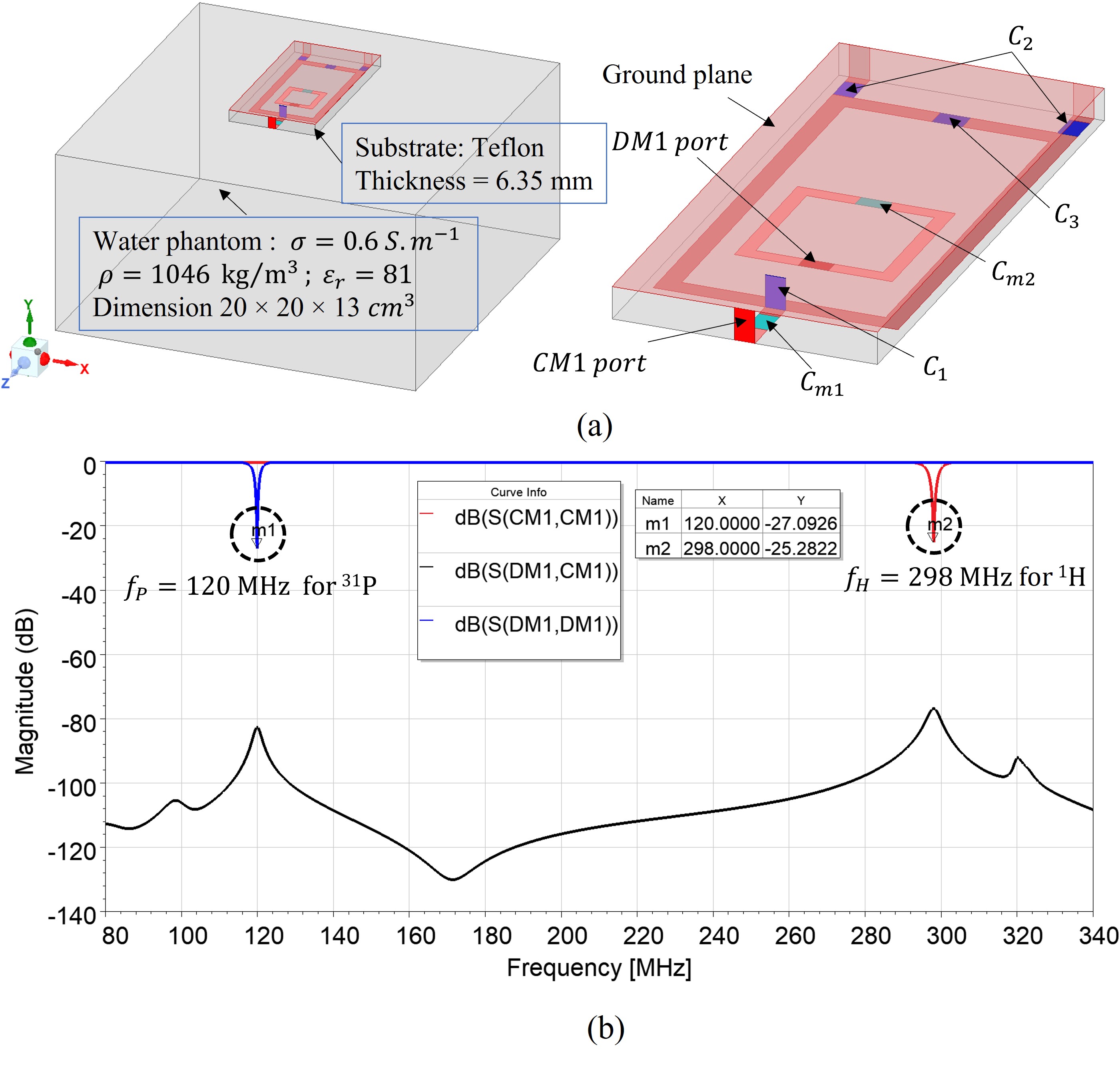
Fig. 1. (a) Numerical CAD model of the dual nuclear CMDM for 1H/31P imaging along with detailed electrical parameters (C1= 53 pF, C2 = 6 pF, C3 = 17.2 pF, Cm1= 6 pF, Cm2= 50 pF) and simulated scattering parameters. (b) The simulated results show a dual band resonance frequency at 7 T with good input impedance matching and excellent isolation between both bands.
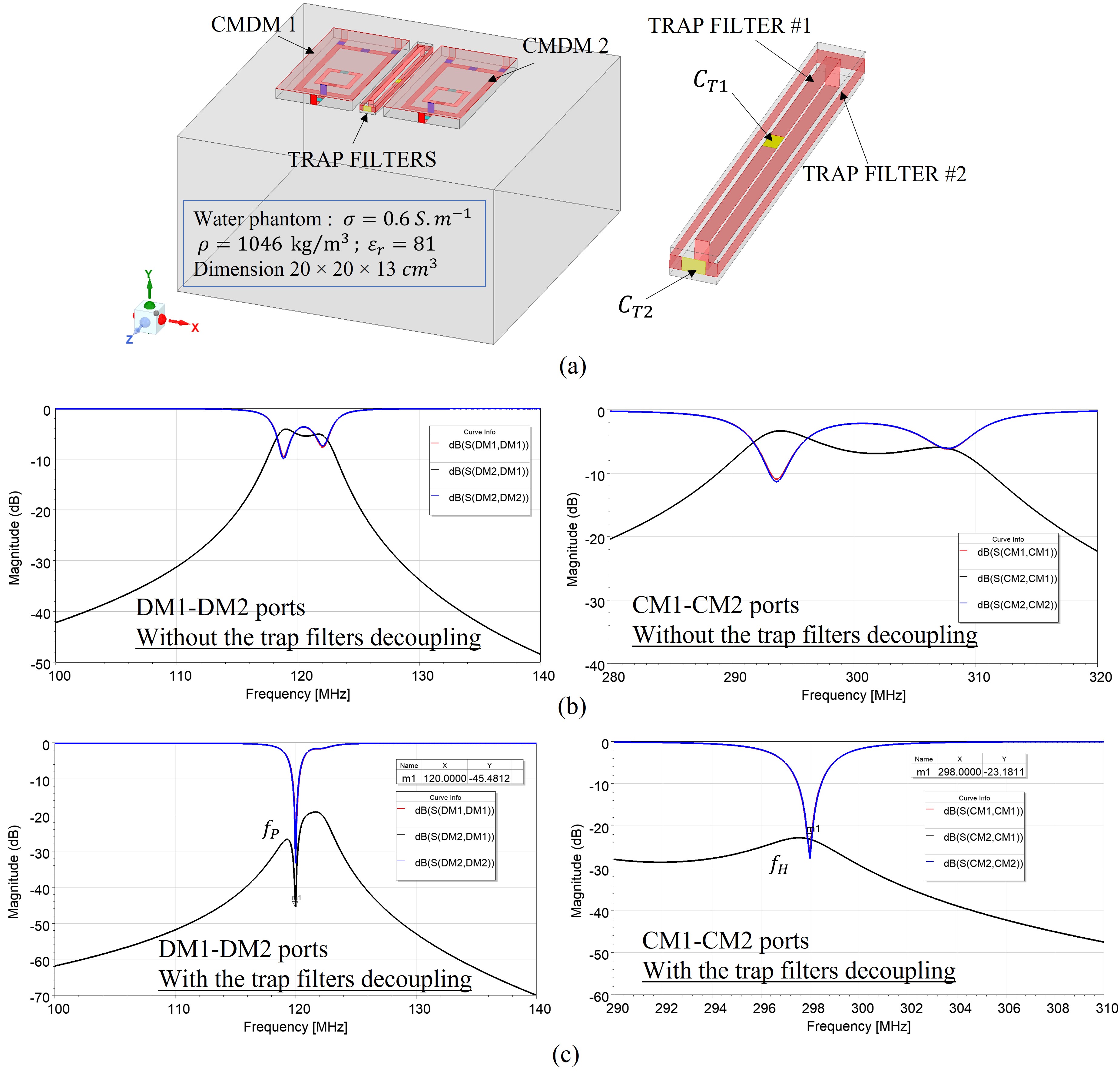
Fig. 2. (a) Pair of dual-tuned CMDM resonators with the distributed trap filters network placed 1 cm on top of the water phantom. (b) Simulated frequency response of the design without the trap filters showing strong electromagnetic coupling between both resonators. (c) Simulated frequency response of the design with the presence of the trap filters (CT1 = 3.4 pF and CT2 = 15.2 pF) showing excellent decoupling between the multimode resonators.
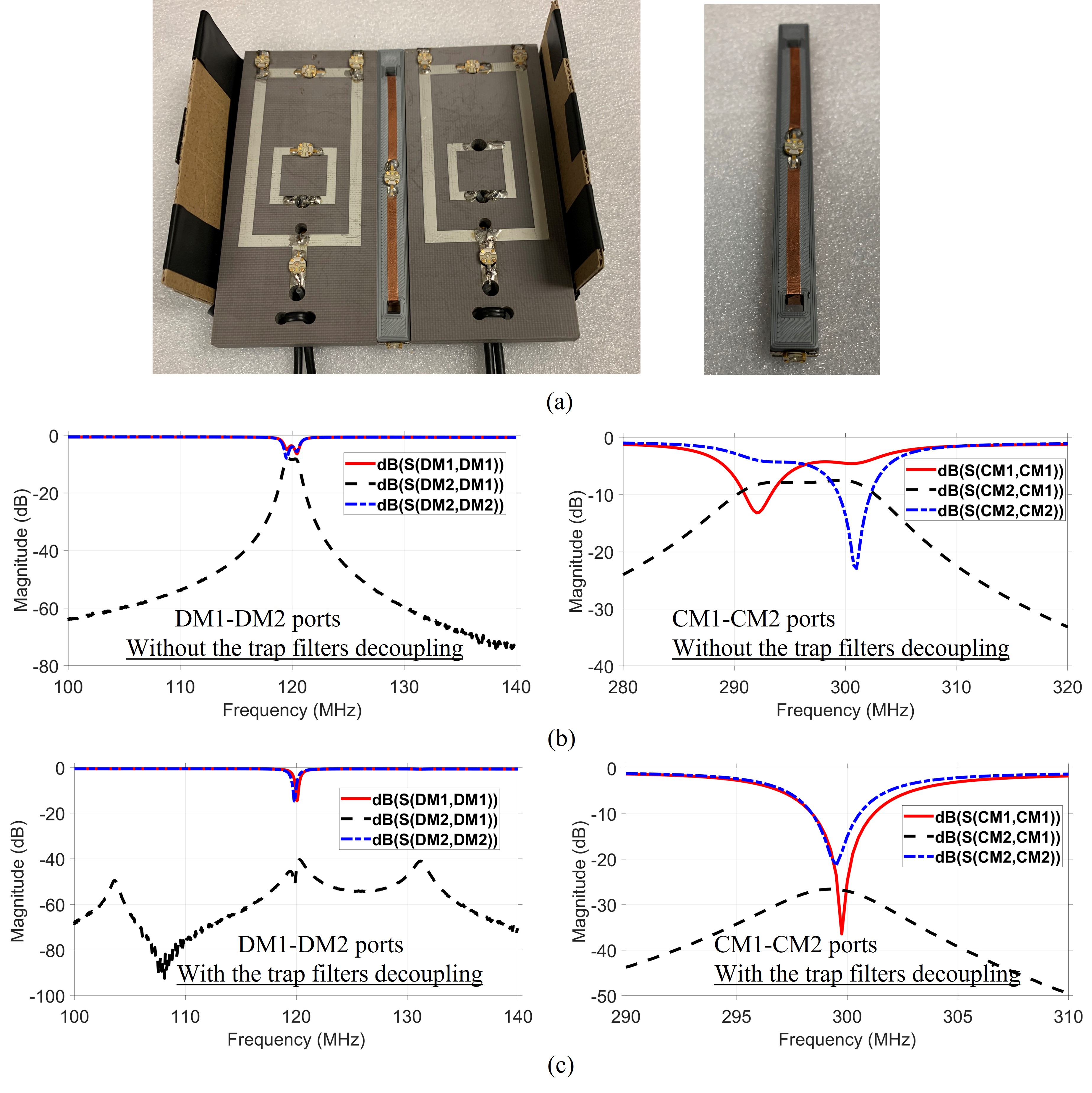
Fig. 3. (a) Photograph of the fabricated prototype along with the distributed filters trap. (b) Measured frequency response of the design without the trap filters showing strong electromagnetic coupling between both resonators. (c) Measure frequency response of the design with the presence of the trap filters (CT1 = 2.8 pF and CT2 = 15.5 pF) showing excellent decoupling between the multimode resonators.