3907
Quantitative evaluation of two-dimensional flexible metasurfaces at 3.0 T1Bernard and Irene Schwartz Center for Biomedical Imaging, Department of Radiology, NYU Grossman School of Medicine, New york, NY, United States, 2Center for Advanced Imaging Innovation and Research (CAI2R), Department of Radiology, NYU Grossman School of Medicine, New york, NY, United States, 3ITMO University, St. Petersburg, Russian Federation
Synopsis
Keywords: Non-Array RF Coils, Antennas & Waveguides, RF Arrays & Systems
Quantitative evaluation of transmit efficiency and receive-specific SNR were performed for two different metasurfaces in a body-sized phantom for cases with 1) excitation and reception using the system body coil and 2) excitation with the system body coil and reception with a commercial 12-element array. Similar evaluations were performed for one of the metasurfaces in vivo with the receive array present, and for comparisons all measurements were also made with no metasurface present. Both metasurfaces were seen to significantly improve transmit efficiency in all cases, and to improve SNR when the body coil was used for reception, with effects being strong near the metasurface and extending toward the center of the phantom. The metasurfaces had minimal effects on receive SNR of the commercial Rx array.
Introduction
To address the local transmit field inhomogeneities caused by wave tissue interactions at high and ultrahigh field strengths high permittivity materials (HPM) have been used strategically 1-8. These have included relatively bulky bags of water or gel (1-3), slurries of ceramic powder in water which can both raise permittivity and reduce bulk compared to pure water (4-6), and pure ceramic materials which can increase permittivity even further with relatively little volume and increasing stability through time (7, 8). While many of these application have been focused on the imaging of the human head (1, 2, 4, 7, 8), some have been focused on imaging of the torso (3, 6). Recently, a thin flexible metasurface (MS) was designed to mimic the electrical properties of an HPM pad for improving RF field performance in imaging of the human abdomen9. In this work we quantitatively evaluated the performance of two ultra-thin flexible metasurface structures at 3T.Methods
Metasurface Design & Construction: Two different metasurfaces were evaluates in this work. The first was a slightly smaller version of one published previously8 and produced with the same methods but without the alterations removing portions on each side to avoid resonance of the structure. The second was designed to have equivalent performance as the previously published version8, but with a slightly thicker substrate (50 micron compared to 25 micron) requiring larger capacitive overlaps between the two sides. The first (smaller) metasurface had strip width 0.1cm and periodicity of 1.4 cm machined on a DuPont Pyralux 8515R substrate (εr -3.3) with polyimide thickness of 25um and copper thickness of 18 um, and the second (larger) metasurface had strip width 0.1cm and periodicity of 2 cm manufactured on a DuPont Pyralux 9121R substrate (εr -3.3) with polyimide thickness of 50 um and copper thickness of 35 um.Imaging: To quantify the performane of the metasurface structures, imaging experiments were performed on a tissue equivalent body phantom with and without the two metasurfaces. Measurements were performed using a whole-body 3 T scanner (MAGNETOM, Siemens, Healthineers, Germany). Spin excitation and signal reception were evaluated in two configurations 1) System body coil in Tx/Rx mode 2) System body coil Tx and 12 channel general purpose flexible array for Rx. B1+ and SNR maps were respectively acquired using TurboFLASH (TE-1.9ms, TR-10000ms) and GRE sequences (with and without RF). To evaluate in vivo performance abdomen scans were performed on a healthy subject in configuration 2 with and without the large metasurface.
Results
In for both Tx/Rx body coil and Tx body coil, Rx receive array, both the small and large metasurfaces provided approximately a 25% improvement in transmit efficiency at the phantom center over the setup with no metasurface (Fig.2).Three-axis SNR maps (normalized to excitation flip angle) for the two imaging configurations are presented in Figure 3A, 3B. For Tx and Rx with the body coil, SNR maps with both the small and large metasurface show significant increase in SNR near the periphery and extending toward the coil center. The effects of the metasurfaces on SNR when receiving with the array are relatively small and are limited towards the phantom periphery.
As with the phantoms, in vivo B1+ maps show that the transmit field is stronger, especially near the metasurface, when the metasurface is present (Fig.4).
Discussion and Conclusions
Here we present quantitative evaluations of how two different metasurfaces affect transmit efficiency and SNR for a Tx/Rx body coil and for excitation with the body coil and reception with a commercial surface array. In all cases, the metasurfaces improved transmit efficiency in the imaging region adjacent the coil, and when the body coil was used for reception, similar increases in SNR were found. The metasurfaces had relatively little affect on SNR of a 12-element commercial receive array. These results indicate that thin, flexible metasurfaces could likely be used to replace bulkier high-permittivity pads used to improve regional image SNR in imaging of the torso.Acknowledgements
Ryan BrownReferences
1. Alsop et al., MRM 1998; 40:49-54.
2. Yang et al., JMRI 2006; 24:197-202.
3. Franklin et al., JMRI 2008;27:1443-7
4. Haines at al., JMRI 2010; 203:323-327.
5. Webb, Concepts Magn Reson Part A 2011;38(4):148-84.
6. De Heer et al., MRM 2012;68:1317-24
7. Sica C et al., MRM. 2020 83(3):1123-34.
8. Lakshmanan et al., MRM. 2021;86:1167-74.
9. Vorobyev et al., MRM. 2022;87:496-508
Figures
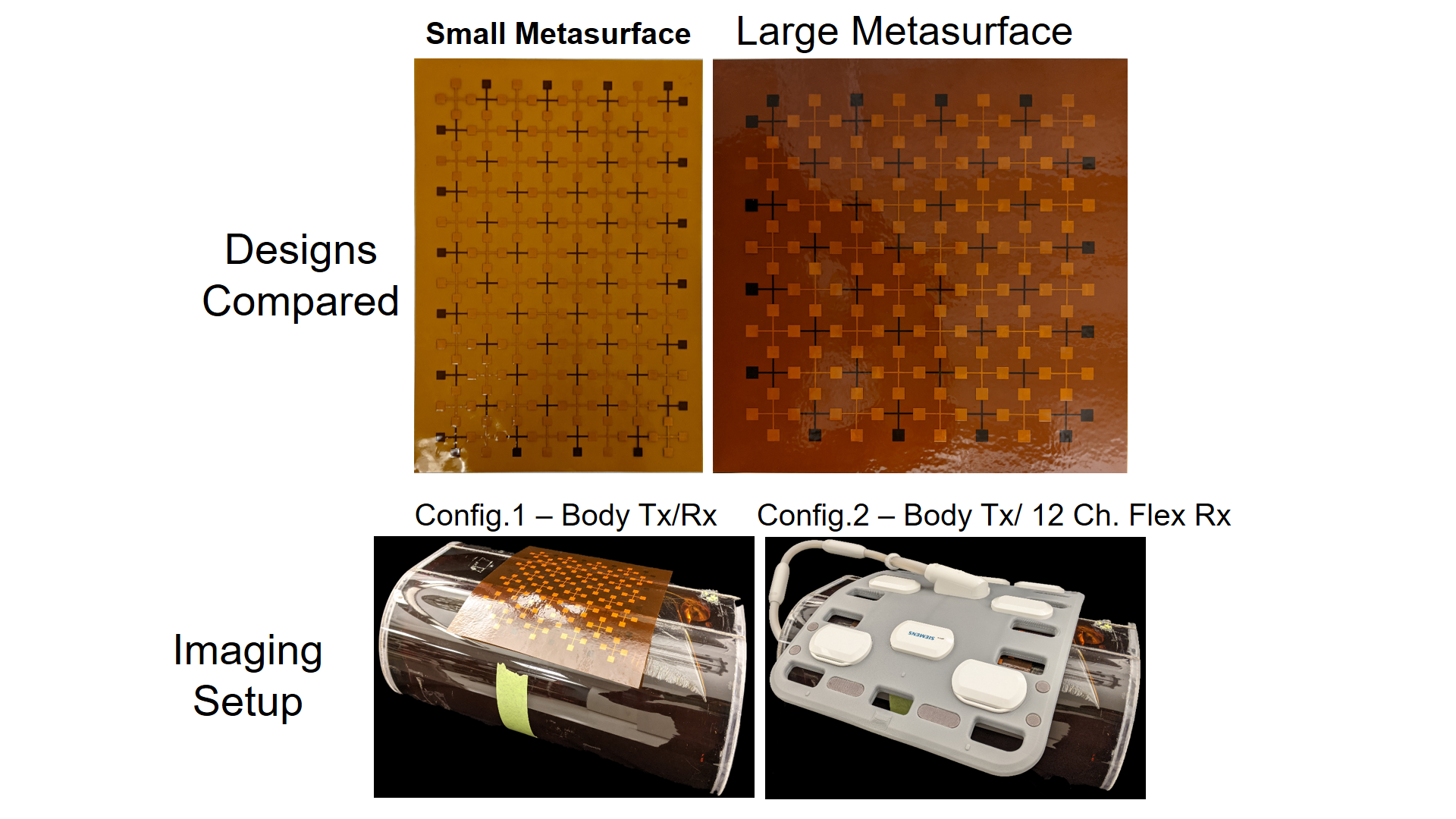
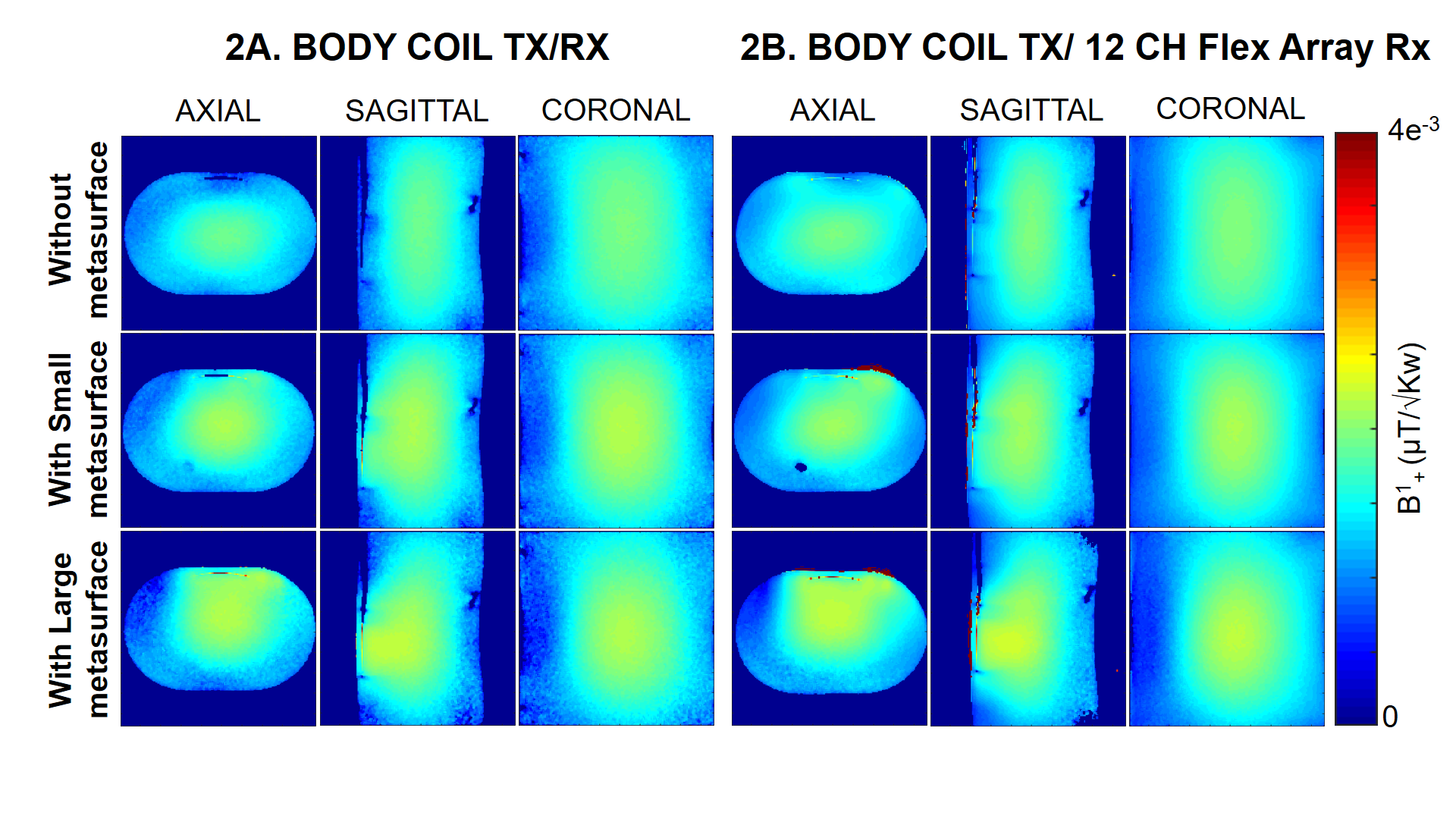
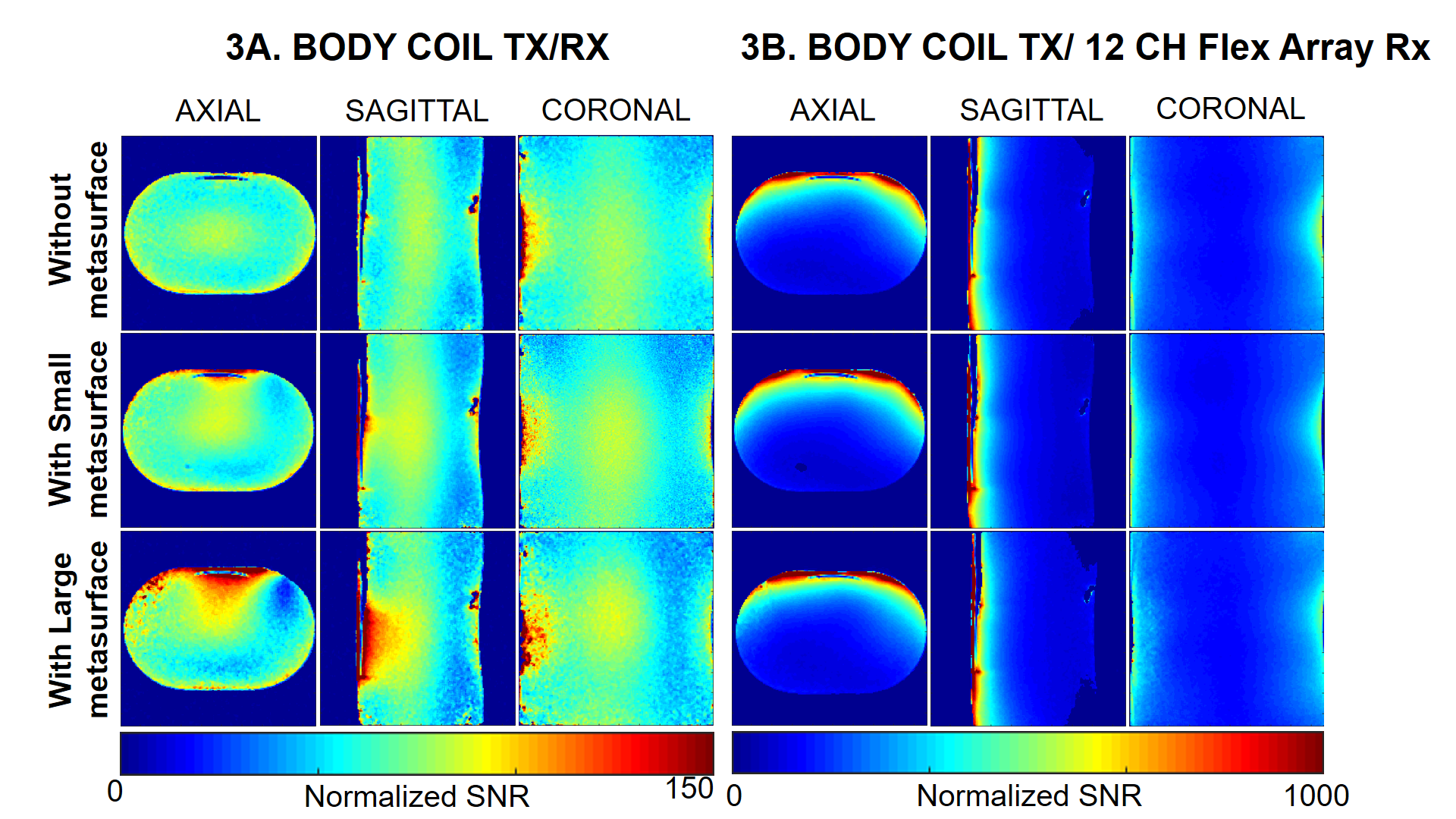
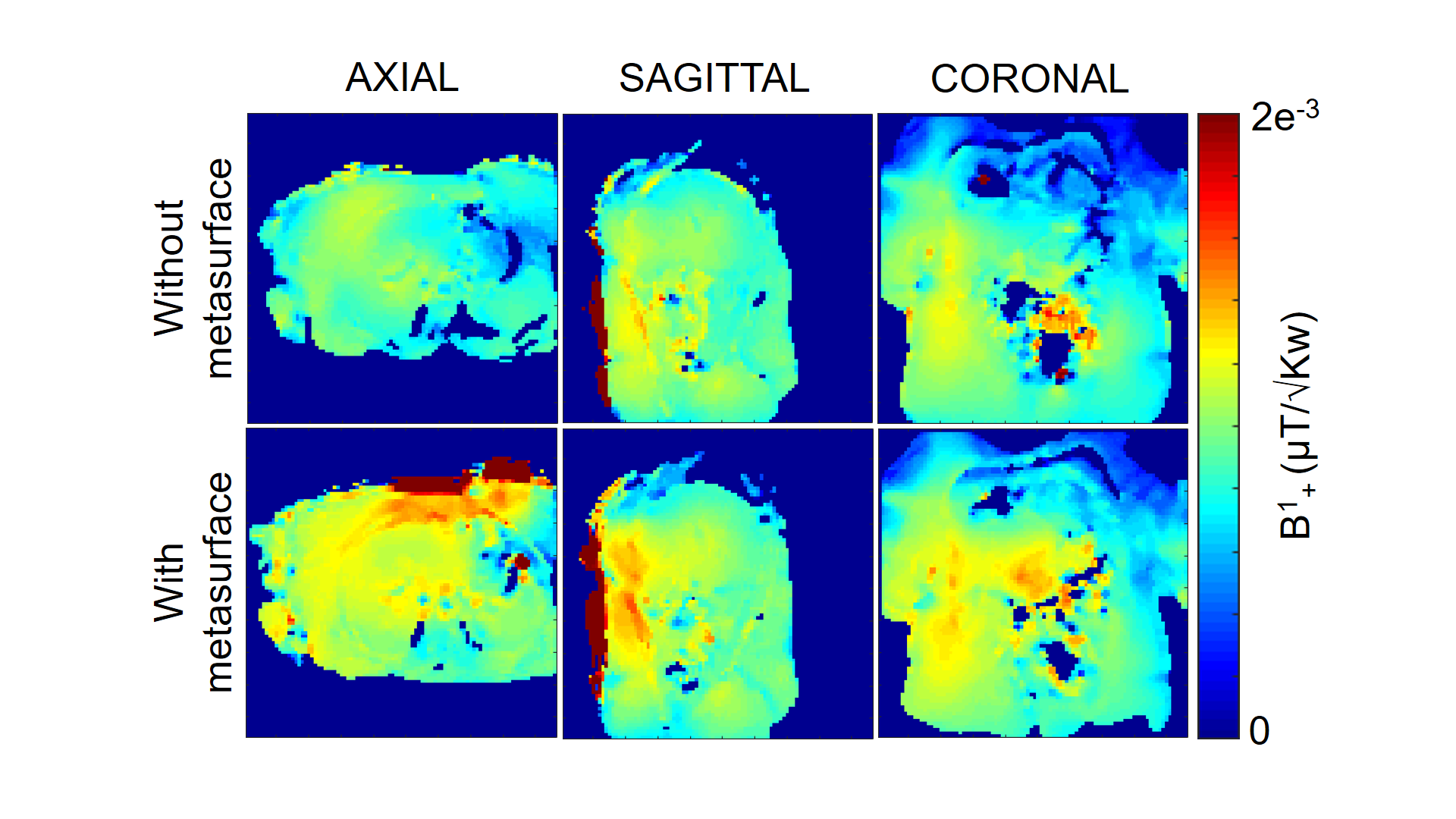
Figure 4. Three-plane in vivo B1+ maps generated by the body coil in Configuration 2 used with and without the larger metasurface. The use of the metasurface provides as 25% improvement in transmit efficiency in the whole volume. Metasurface and coil are positioned symmetrically on the subject at a longitudinal location roughly corresponding to the middle of the liver.