3904
A Wrap-on Decoupled Coaxial Transmission Line (CTL) Transceive Array for Head MR Imaging at 10.5T1Biomedical Engineering, State University of New York at Buffalo, Buffalo, NY, United States, 2Radiology, University of Minnesota, Minneapolis, MN, United States
Synopsis
Keywords: RF Arrays & Systems, RF Arrays & Systems
In this work, a wrap-on 447MHz transceiver array using the 2nd mode of coaxial transmission line resonator is designed, constructed and tested for human head imaging at the ultrahigh field of 10.5T. Results demonstrate the unique decoupling performance among the resonant elements achievable even for non-overlapped array layouts. The 10.5T images of a human head phantom acquired from the proposed array along with numerical simulations are shown.
Introduction
One of technical challenges encountered in the ultrahigh field 10.5T MR imaging is the design of efficient RF coils and coil arrays where pronounced issues related to achieving required high frequency and sufficient electromagnetic decoupling need to be addressed. Due to their unique features in high frequency operation and low loss, coaxial transmission lines were proposed for designing UHF RF coils used in high field MR applications. In the past two years, the usefulness of this approach has been explored at 7 Tesla (300MHz) and demonstrated their high impedance behavior [1,2]. In this work, we designed and tested an 8-channel flexible wrap-on transceive array using the coaxial transmission line (CTL) targeting head imaging at the ultrahigh magnetic field of 10.5T which operates at a much higher frequency (447MHz). With the increased frequency, radiation and electromagnetic coupling of the coil array are augmented. To achieve the proton Larmor frequency of 447MHz and gain sufficient electromagnetic decoupling among resonant elements, the 2nd resonant mode of the CTL resonator is used. This study shows that the circuit supporting the 2nd mode has a high impedance. The high impedance dramatically limits the currents, consequently suppressing inter-element coupling without using a decoupling network [3-5]. The design was validated through numerical simulations and imaging experiments at 10.5T with a human head phantom.Method
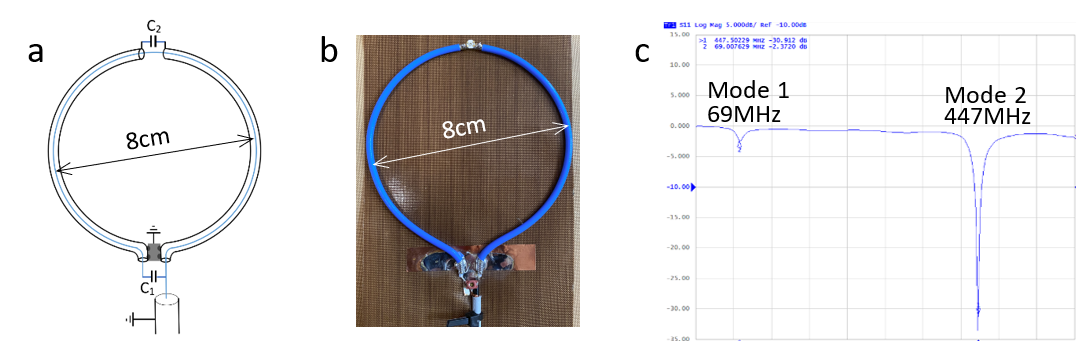
The resonant elements of the proposed 10.5T 8-channel transceive array are built using the 50-Ohm semi-rigid coaxial transmission line RG405 with a diameter of 0.08 inch. In the CTL resonator, the outer conductor is cut in the middle. This cut creates a small capacitance, next to which a tunable capacitor (C1) is connected in parallel to adjust the resonant frequency as shown in Fig 1. At the two ends of the CTL, the inner conductors are connected by a capacitor (C2) while the outer conductors are shorted, where a virtual ground is generated in this symmetric circuit topology. Before the coil construction, the individual CTL resonator and 8-channel CTL array were modeled and analyzed numerically using full wave electromagnetic analysis provided in commercial software (Ansys/HFSS, Canonsburg, PA). The resonant elements are fabricated based on the simulation results and mounted on thin Teflon sheets. Finally, the prototype array is wrapped on a 3D-printed human head phantom with a permittivity of ~55 and conductivity of ~0.6 S/m. In contrast to conventional rigid coils, this flexible wrap-on design could provide a better filling factor and thus better performance for signal detection and excitation. Coil element tuning, impedance matching, and decoupling among the array elements were evaluated by measuring the scattering parameters (S-parameters) on a network analyzer. All the imaging experiments were performed on a 10.5T whole body MR system interfaced to a Siemens console capable to support 16 pTx transmitters and up to 128 receivers. The excitation power for each channel was set with appropriate phase difference to avoid any possible signal cancellation in the area of interest.Results
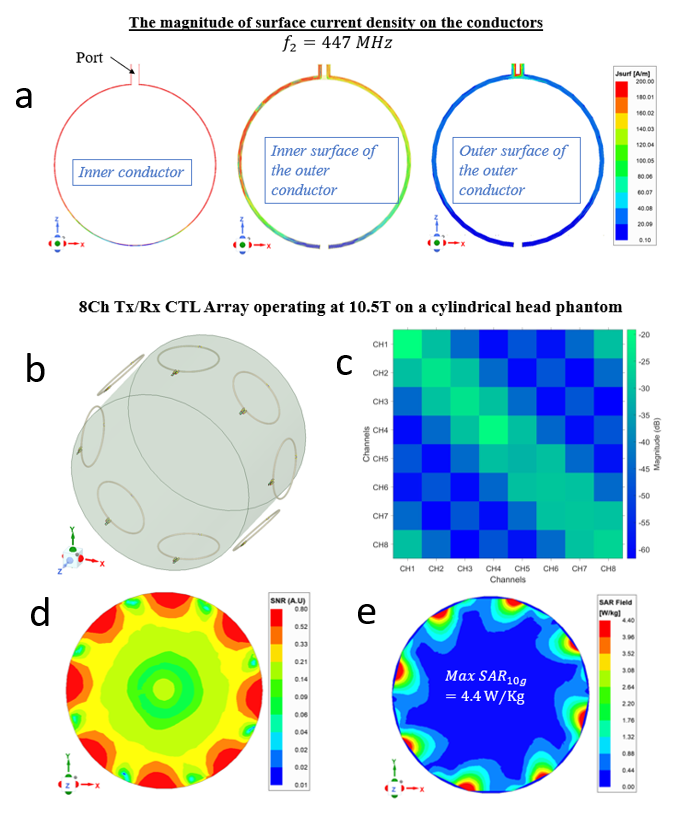
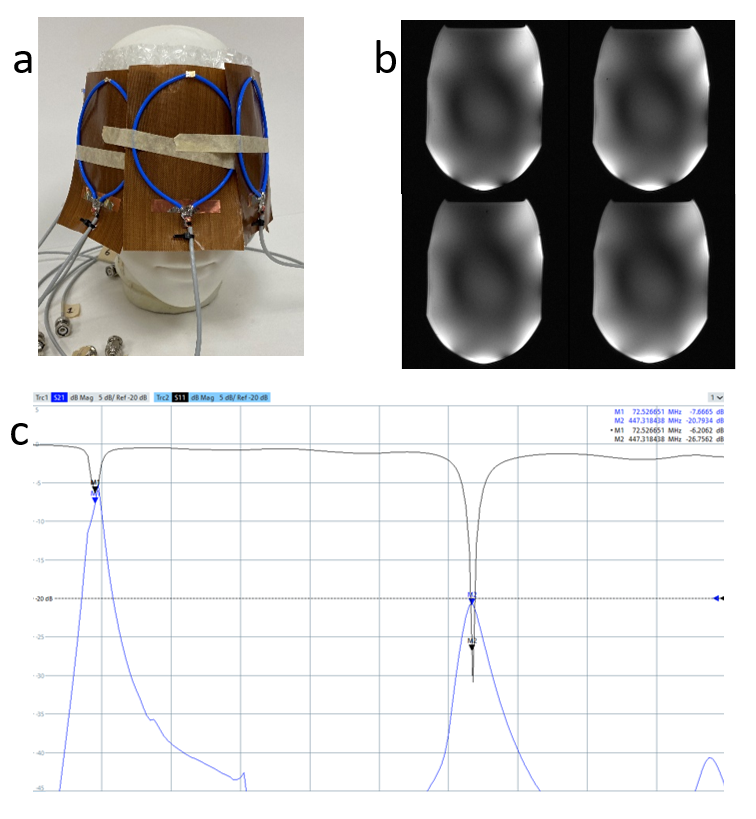
The numerical models of the single 8-cm CTL resonator and 8-channel transceiver array have been successfully established. Calculations show the current of Mode 2 on the outer surface of the outer conductor of the CTL resonator is much weaker than the current on the inner conductor (Fig 2(a)) which is expected to achieve low coupling among neighboring elements. This result is supported by the significantly reduced simulated transmission coefficients in the 8-channel CTL array (Fig 2(b)), indicating promising decoupling performance (Fig 2(c)). All transmission coefficients are in the range of -20 dB or better. Simulated SNR distributions (Fig 2(d)) and SAR maps (Fig 2(e)) also indicate the feasibility of the proposed 447MHz CTL coil array. These simulated results were consistent with the bench test on the prototype 8-channel array, as shown in Fig 3. In bench test, all elements are tuned to 447MHz and matched to 50 Ohm. Transmission coefficients were measured at -19dB or better between any pair of elements in the loaded case (Fig 3(a)). An example of reflection and transmission coefficient measurements between a pair of adjacent elements is shown in Fig 3(c). Loaded and unloaded Q-factors measured 28.6 and 49.3, respectively, resulting in a Q-ratio of 1.7:1. In MR imaging experiments, multi-slice imaging was successfully acquired in a phantom. The preliminary images shown in Fig 3(c) indicate the feasibility of the proposed CTL array design for 10.5T MR imaging applications. It’s worth noting that the low frequency mode (Mode 1) of the CTL resonator does not possess the high decoupling feature demonstrated by the high frequency mode (Mode 2) (Fig 3(c)).Conclusions
A flexible wrap-on transceiver array using the high frequency mode of a coaxial transmission line resonator was successfully designed, fabricated and evaluated for human head MR imaging at 10.5T. Due to the unique decoupling performance, the proposed transceiver array does not need any extra decoupling treatment between neighboring coil elements. The results also suggest that the excellent performance in decoupling of the CTL coils operating at the high frequency mode is not sensitive to the inter-coil distance. The proposed method may provide a robust design approach to high frequency multichannel transceive arrays at the ultrahigh field of 10.5 Tesla.Acknowledgements
This work is supported in part by the NIH under a BRP grant U01 EB023829, and U01 EB025144, BTRC P41 EB027061, P30 NS076408, NIH S10 RR029672, and by State University of New York (SUNY) under SUNY Empire Innovation Professorship Award.References
1. T. Ruytenberg, et al., “Shielded‐coaxial‐cable coils as receiver and transceiver array elements for 7T human MRI”, Magnetic Resonance in Medicine, vol. 83, no. 3, pp. 1135–1146, 2020.
2. L. Nohava, et al., "Flexible Multi-Turn Multi-Gap Coaxial RF Coils: Design Concept and Implementation for Magnetic Resonance Imaging at 3 and 7 Tesla", IEEE Transactions on Medical Imaging, vol. 40, no. 4, pp. 1267-1278, April 2021, doi: 10.1109/TMI.2021.3051390.
3. S. Gaddipati, et al., “High Impedance Loop coil Design for improved EM Decoupling in Multichannel Coil arrays”, Proc. Intl. Soc. Mag. Reson. Med. 29 (2021), 1394
4. K. Payne, et al., “Hairpin RF resonators for MR imaging transceiver arrays with high inter-channel isolation and B1 efficiency at ultrahigh field 7 T”, Journal of Magnetic Resonance, Vol. 345, 2022, https://doi.org/10.1016/j.jmr.2022.107321
5. T Gao, et al., Development of high impedance microstrip resonators for ultrahigh field MR imaging. Proc. Intl. Soc. Mag. Reson. Med. 30 (2022), 4505
Figures