3722
Quadrature Transceiver RF Arrays Using Double Cross Magnetic Wall Decoupling for Ultrahigh field MR Imaging1Department of Biomedical Engineering, University at Buffalo, Buffalo, NY, United States
Synopsis
Keywords: Hybrid & Novel Systems Technology, RF Arrays & Systems
Circularly polarized or quadrature transceiver coils can significantly increase overall signal reception and reduce the excitation power over linearly polarized RF transceivers. Due to the wave propagation of two modes owing to their electromagnetic field properties, it is challenging to achieve sufficient decoupling in multichannel quadrature coil arrays. In this work, we proposed a double cross magnetic wall decoupling for quadrature transceiver RF arrays based on a common-mode differential-mode (CMDM) resonator at UHF 7T. The proposed method comprised of two orthogonal decoupling elements is able to reduce the mutual coupling between the multi-modes in a pair of CMDM resonators.
Introduction
Quadrature RF coils outperform linear-polarized coils by providing a higher signal-to-noise ratio and reduced excitation power 1. At UHF, hardware in MRI systems has made progress toward the use of RF coils based on the microstrip transmission line (MTL) theory 2 due to their inherent low radiation losses. An MTL-based on common-mode differential-mode (CMDM) resonator that incorporated two intrinsically decoupled modes, the common-mode (CM) and differential-mode (DM) has demonstrated its potentiality as quadrature 3 and double nuclei 4 RF coils. Such CMDM resonators is used to design a volume coil for double nuclei 1H/13C MR acquisitions 4 through the enhanced coupling between elements. It is also beneficial to develop a multichannel quadrature CMDM array offering improved efficacy for parallel imaging and parallel excitation. However, the implementation of quadrature transceiver arrays using CMDM resonators could be technically challenging due to the requirement of simultaneous decoupling between CMs and between DMs. Magnetic wall decoupling technique or induced current elimination (ICE) has previously been theoretically analyzed 5 and used to diminish electromagnetic coupling between linearly polarized resonators for parallel imaging applications 6. However, it is not feasible to use such a conventional magnetic wall decoupling technique to decouple quadrature CMDM resonators due to the nature of the coupling existing between the multi-mode current 7. In this work, we proposed a double cross magnetic wall decoupling technique which can reduce all the multi-mode coupling simultaneously in multichannel quadrature coil arrays. To validate the proposed decoupling technique, a pair of closely placed CMDM quadrature resonators is designed and fabricated with and without the double cross magnetic decoupling wall. Their decoupling performance is evaluated using full-wave electromagnetic analysis and bench test measurements.Method
The CMDM resonator designed for 7T is based on split MTL made of a 4-mm strip copper width and a ground plane separated by a dielectric substrate. The strip copper is a rectangular loop (width=3cm, length=6cm) shorted to the ground plane by 2 stubs. A coaxial feeding is used to drive the CM port while the DM port is driven inductively using a square loop (1.5cm x 1.5cm). The electric parameters of the CMDM are depicted in the caption of Fig. 1. A pair of the CMDM resonator separated by a 1-cm gap is investigated for parallel imaging. Due to the close-fitting array configuration, the electromagnetic coupling is generated between the CM1-CM2 and DM1-DM2 ports as shown in Fig 2. To mitigate the coupling, we introduce a double cross magnetic wall decoupling. Such a decoupling network is composed of two orthogonal loops with tuning capacitors as shown in Fig 3(a). The two ICE loops are intrinsically decoupled from each other and can be used to independently suppress all the existing multi-mode coupling currents. By doing so, ICE loop1 was tuned to mitigate the common mode coupling while ICE loop 2 was optimized to reduce the differential mode coupling. The value of the tuning capacitances (Cc1 and Cc2) can therefore be optimized to provide sufficient decoupling of all the multi-mode coupling currents.Results
The simulated scattering parameters of the single CMDM resonator (Fig.1) indicate intrinsic decoupling between both the CM and DM ports which can be used to generate a quadrature field when it’s driving with a 90-degree phase difference (phase of CM port = 90°, DM port = 0°). By placing a pair of the CMDM resonators very close to each other, we observe a strong coupling between the common mode currents which generate 2 split frequencies away from the Lamour frequency. Likely, a strong coupling is also observed at differential mode ports [Fig. 2(b)]. The double cross magnetic wall decoupling integrated between the pair of resonators provides isolation in terms of electromagnetic magnetic propagation. As seen in Fig. 2(c), the DM and CM coupling have been reduced by 24dB and 16dB, respectively.To confirm the numerical results, a prototype of a pair of CMDM that incorporates the double cross magnetic decoupling is fabricated and measured on a bench. The design pattern is printed on a low-loss 1/4-inch TLX-9 from Taconic PTFE substrates laminated with 1 oz. copper Trimmer capacitors are soldering in the coils design for matching and tuning of the CDMDs resonator as shown in Fig. 3(a). The bench test results without the decoupling magnetic wall show strong electromagnetic coupling between the CM ports as well as the DM ports [see Fig. 3 (b)]. By integrating the double cross ICE loop with optimized capacitance value (Cc1=3.2pF and Cc2=1.4pF), good isolation of about 20 dB is achieved between all the ports as shown in Fig. 3(c).
Conclusion
We proposed a double cross magnetic wall decoupling technique for quadrature transceiver RF arrays based on CMDM resonators for ultrahigh field MRI. The proposed decoupling network composed of two orthogonal loops is analyzed to concurrently suppress all the existing multi-mode coupling in a close-fitting pair of resonators. Results of bench tests and simulations have demonstrated the feasibility of this decoupling mechanism for the quadrature CMDM resonator array. The proposed decoupling technique is expected to provide a more efficient and flexible design in coupling control for other array types, including “microstrip+loop”, “dipole+loop”, or “microstrip loop+dipole”.Acknowledgements
This work is supported in part by the NIH under a BRP grant U01 EB023829 and by the State University of New York (SUNY) under SUNY Empire Innovation Professorship Award.
References
1. G. H. Glover et al., "Comparison of linear and circular polarization for magnetic resonance imaging," Journal of Magnetic Resonance, vol. 64, no. 2, pp. 255–270, 1985.
2. X. Zhang, K. Ugurbil, and W. Chen, "Microstrip RF surface coil design for extremely high-field MRI and spectroscopy," Magn Reson Med, vol. 46, no. 3, pp. 443-50, Sep 2001.
3. Y. Li, B. Yu, Y. Pang, D. B. Vigneron, and X. Zhang, "Planar quadrature RF transceiver design using common-mode differential-mode (CMDM) transmission line method for 7T MR imaging," PLoS One, vol. 8, no. 11, p. e80428, 2013, doi: 10.1371/journal.pone.0080428.
4. Pang Y, Zhang X, Xie Z, Wang C, Vigneron DB (2011) Common-mode differential-mode (CMDM) method for double-nuclear MR signal excitation and reception at ultrahigh fields. IEEE Trans Med Imaging 30: 1965-1973. doi:10.1109/TMI.2011.2160192. PubMed: 21693414.
5. Z. Xie and X. Zhang, "An eigenvalue/eigenvector analysis of decoupling methods and its application at 7T MR imaging," Proc Intl Soc Mag Reson Med, vol. 16, p. 2972, 2008
6. X. Yan, X. Zhang, B. Feng, C. Ma, L. Wei, and R. Xue, "7T transmit/receive arrays using ICE decoupling for human head MR imaging," IEEE Trans Med Imaging, vol. 33, no. 9, pp. 1781-7, Sep 2014, doi: 10.1109/TMI.2014.2313879.
7. K. Payne, S. I. Khan, and X. Zhang, "Investigation of Magnetic Wall Decoupling for planar Quadrature RF Array coils using Common-Mode Differential-mode Resonators," Proc Int Soc Magn Reson Med Sci Meet Exhib Int Soc Magn Reson Med Sci Meet Exhib, vol. 30, May 2022. [Online]. Available: https://www.ncbi.nlm.nih.gov/pubmed/36071707.
Figures
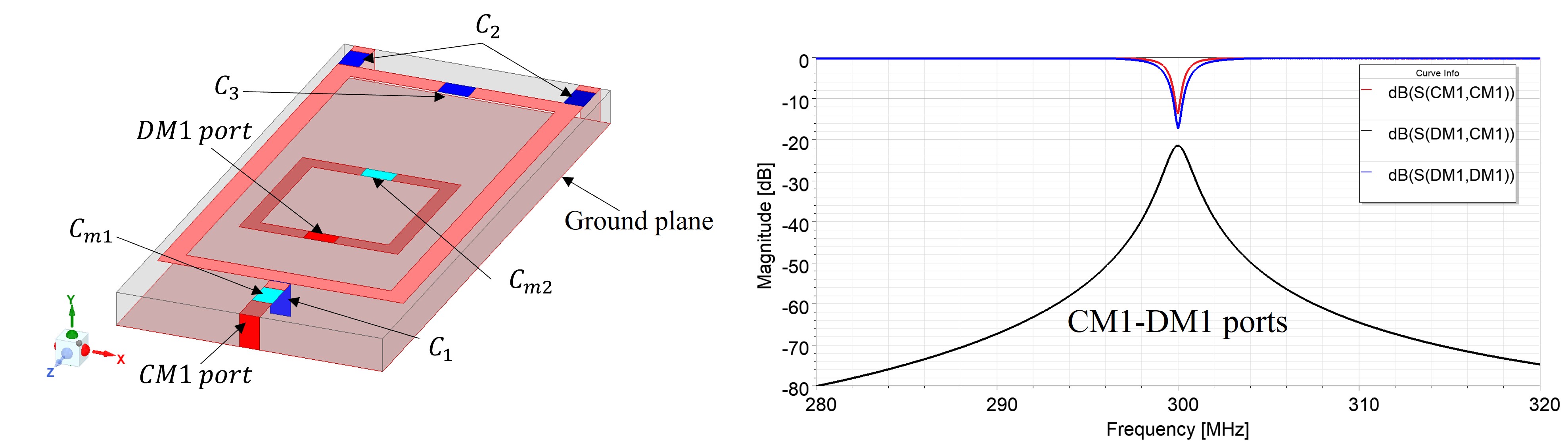
Fig. 1. Topology of the quadrature CMDM resonator with detailed electrical parameters. C1= 95 pF, C2 = 4.8 pF, C3 = 0.4 pF, Cm1= 20 pF, Cm2= 4 pF. Simulated scattering parameters of the CMDM show good input impedance and isolation between both common mode (CM1) and differential mode (DM1) ports at the Larmor frequency of 1H at 7 Tesla UHF.
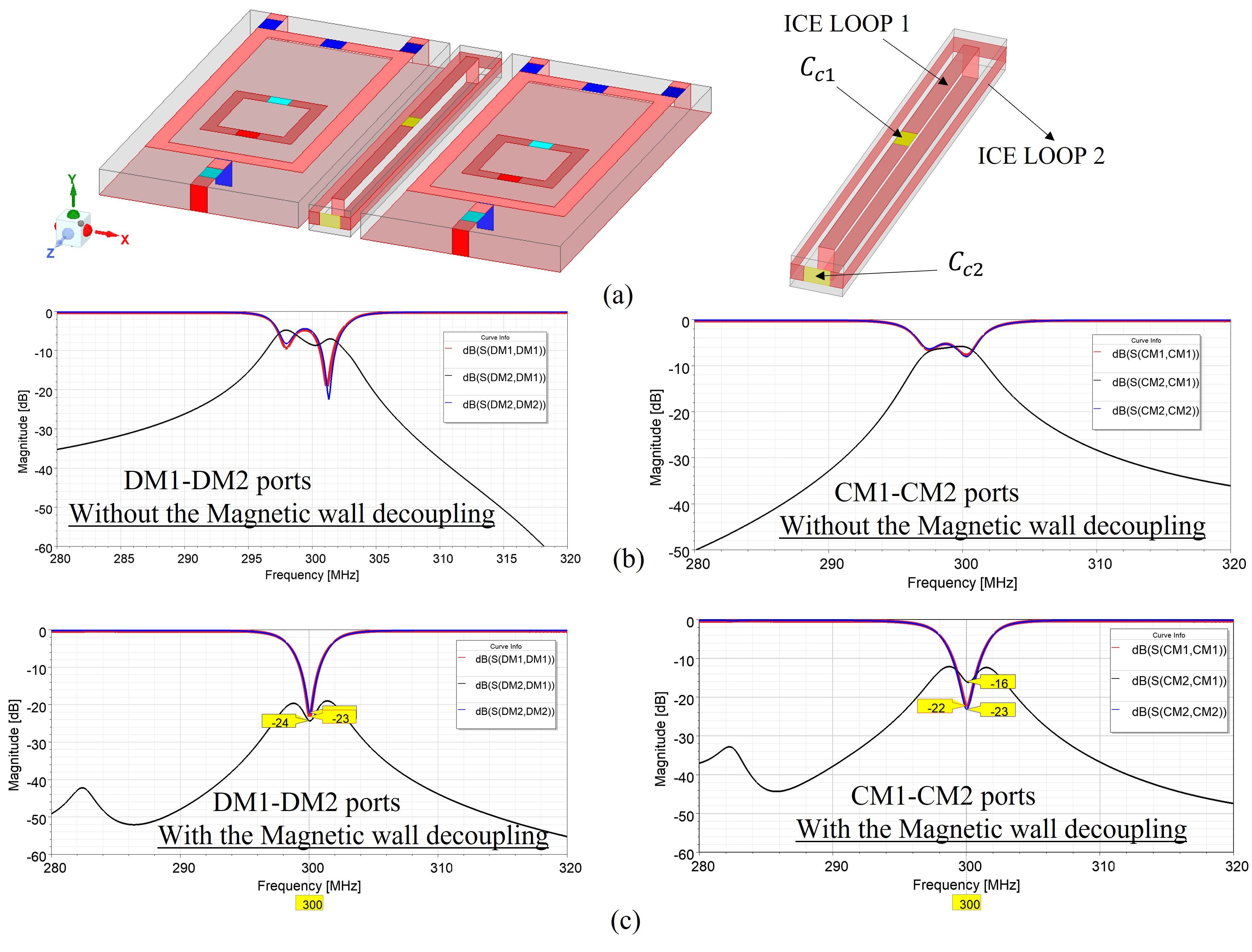
Fig. 2. (a) Schematic of the pair of quadrature CMDM resonators along with the double cross magnetic wall decoupling. (b) Simulated frequency response of this configuration without the ICE loops showing the electromagnetic multimode coupling between both resonators. (c) Excellent decoupling is obtained by integrating the ICE loops between the CMDM resonators. Good impedance matching is also observed at all the ports.
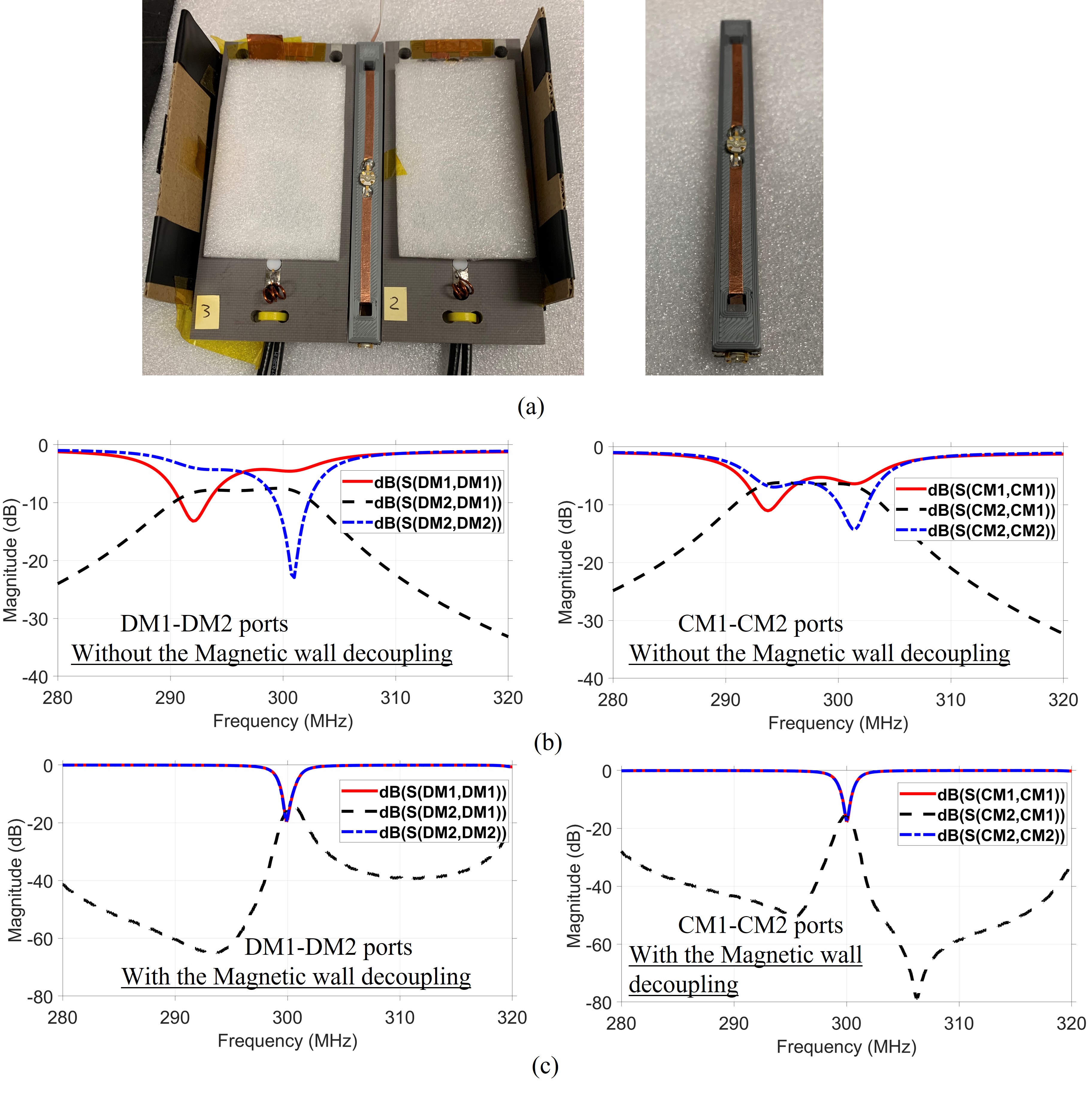
Fig. 3. (a) Photograph of the fabricated CMDM coils separated by 1 cm distance from each other along with the ICE loops. (b) Measured scattering parameters without the magnetic wall decoupling showing strong mutual coupling between both resonators. (c) Measured scattering parameters with the magnetic wall decoupling showing excellent matching (about -20 dB) and good isolation (about 18 dB) are achieved between DM1-DM2 ports as well as the CM1-CM2 ports.