3635
Renal Cell Carcinoma: Predicting Venous Tumor Thrombus Consistency via IVIM-Diffusion-weighted MR Imaging and Apparent Diffusion Coefficient1Department of Radiology, Chinese PLA General Hospital, Beijing, China
Synopsis
Keywords: Kidney, Diffusion/other diffusion imaging techniques
Problem: Evaluation of VTT consistency through preoperative images has not been reported yet.Methods: Intravoxel incoherent motion (IVIM)-derived parameters and apparent diffusion coefficient (ADC) were employed to predict VTT consistency of RCC.
Results: Dt of the primary tumor and VTT generated the area under the ROC curve (AUC) values of 0.758 (95%CI: 0.671, 0.832) and 0.712 (95%CI: 0.622, 0.792) for differentiating friable and solid VTT. The AUC value of the model combining Dp and Dt of VTT and Dt of the primary tumor reached 0.886 (95%CI: 0.814, 0.937).
Conclusions: IVIM parameters can effectively predict the VTT consistency of RCC.
Abstract
IntroductionRenal cell carcinoma (RCC) is prone to form venous tumor thrombus (VTT), and the prevalence of VTT accounts for about 10% of newly diagnosed RCC cases 1. Tumor thrombus may show different consistency (solid or friable), and the friable VTT has been found to increase the technical difficulties in RCC operation 2. However, as far as we know, there is no study to evaluate the VTT consistency of RCC using intravoxel incoherent motion (IVIM) parameters and apparent diffusion coefficient (ADC). So, the purpose of this study is to investigate the performance of IVIM parameters and ADC in differentiating friable VTT from solid VTT in RCC.
Materials and Methods
Our study enrolled consecutive patients with RCC and VTT who performed IVIM-DWI and underwent nephrectomy and thrombectomy from August 2016 to July 2021. Finally, one hundred and nineteen patients were enrolled in the study.
Images were obtained continuously in the supine position by a 3.0-T imager (Discovery MR750, GE Healthcare). The DW images were obtained with free-breathing, and the parameters were as follows: b values of 0, 20, 50, 100, 150, 200, 400, 600, 800 s/mm2 in three orthogonal gradient directions. Mono- and bi-exponential models were generated by calculating multiple-b-value DWI data on Matlab R2013a.
After calculating IVIM parameters and ADC maps, two independent board-certified radiologists manually drew region of interest (ROI) on the maximum section of the primary tumor (ROI 1) and tumor thrombus (ROI 2) on diffusion-weighted images (b = 0 s/mm2) in ITK-SNAP software, and then automatically copied ROIs to other parametric maps (Dt, Dp, f, and ADC). The values were averaged between the two readers and used for the final analysis.
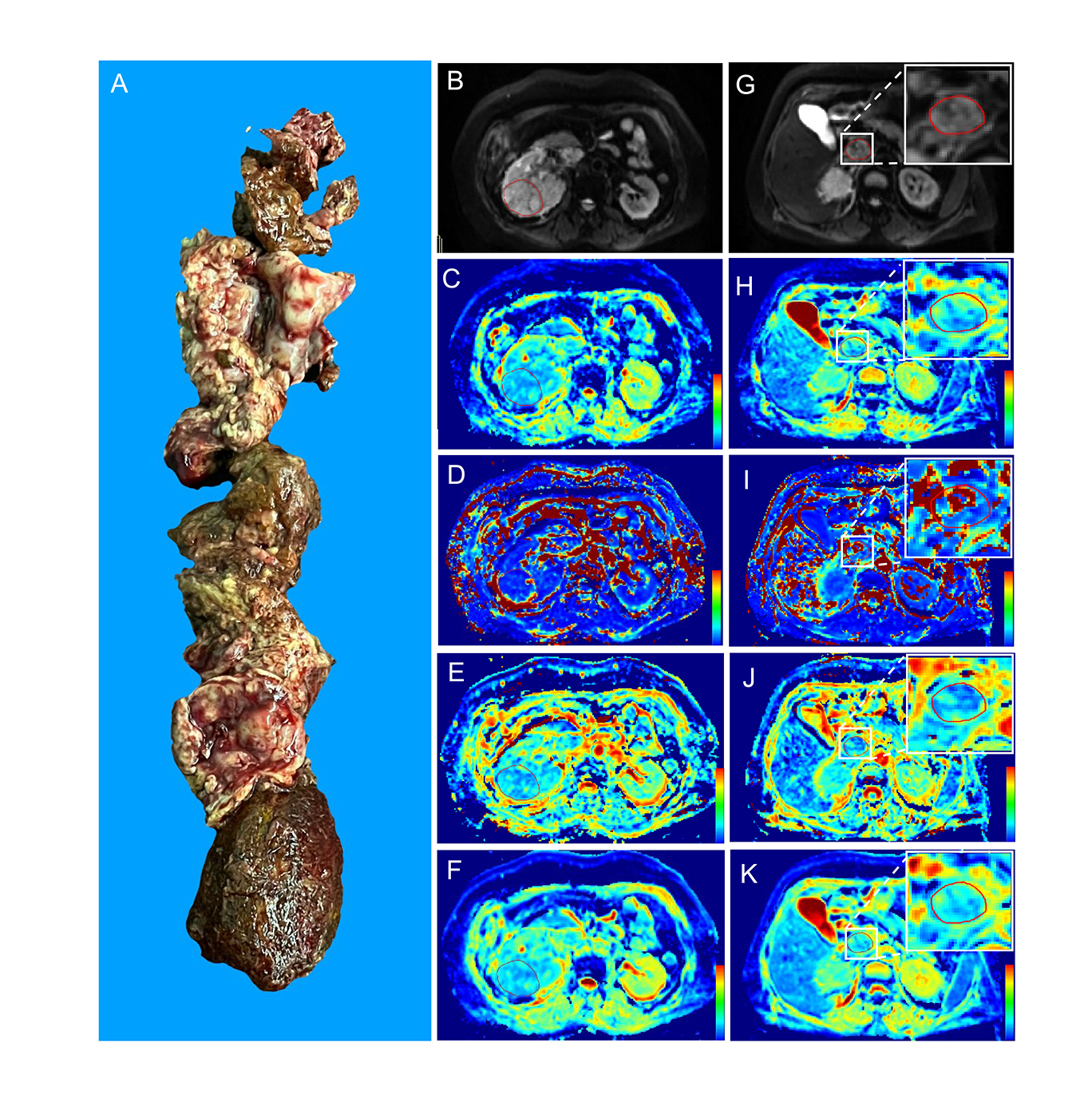
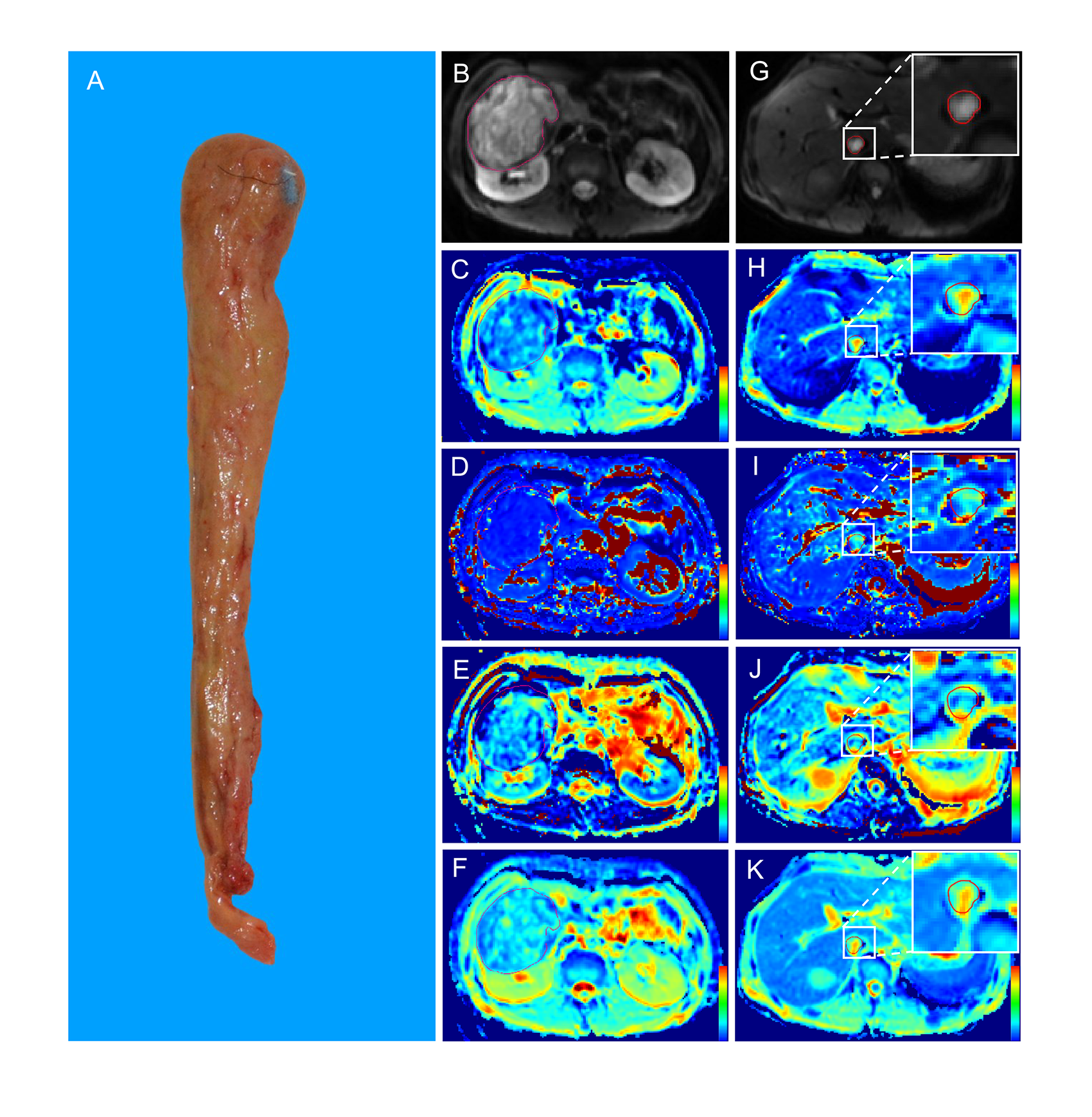
The determination of VTT consistency was made through intraoperative assessment including tactile perception and visual inspection by two senior urologists in consensus. VTT consistency was divided into friable tumor thrombus (fragile, soft, and unencapsulated) or solid tumor thrombus (hard and encapsulated). Typical friable VTT and solid VTT are shown in Figure 1 and Figure 2.
Clinical data, ADC, and IVIM parameters between friable and solid VTT were compared. IVIM parameters were combined to construct models using multivariate Logistic regression models. The IVIM parameters and the constructed model were evaluated by the ROC analysis to determine the diagnostic performances.
Results
Population Characteristics
Of the 119 patients (mean age, 55.8 years ± 11.5 [SD], 85 males) included in this study, eighty-six patients (72.3%) had solid VTT and 33 patients (27.7%) had friable VTT. Patients with friable VTT were more likely to experience open surgery (P = .005), more blood loss (P = .037) and longer operative duration (P = .011) than patients with solid VTT during operation.
Comparison of IVIM Parameters and ADC Values between Friable and Solid VTT
Compared with the solid VTT group, Dt and ADC values of the primary tumor were significantly lower (P < .001 and P = .006, respectively), and Dt, Dp and ADC values of tumor thrombus were also significantly lower (P < .001, P = .001 and P = .016, respectively) in the friable VTT group.
The Performance of IVIM Parameters and ADC Values in Predicting VTT Consistency
For differentiating friable VTT from solid VTT, AUC of ADC of the primary tumor and tumor thrombus were merely 0.653 (95%CI: 0.561-0.738) and 0.643 (95%CI: 0.550-0.729). Dt of the primary tumor generated the AUC of 0.758 (95%CI: 0.671, 0.832), with the sensitivity of 90.9%, specificity of 58.1%. Dt of tumor thrombus had the AUC of 0.712 (95%CI: 0.622, 0.792), with the sensitivity of 78.8%, specificity of 64.0%. The model combining the Dt of the primary tumor, the Dt of tumor thrombus, and Dp of tumor thrombus was demonstrated to have an excellent performance to distinguish friable VTT from solid VTT, with an AUC of 0.886 (95% CI: 0.814, 0.937), the sensitivity of 90.9%, specificity of 75.6%.
Discussion
Venous tumor thrombus consistency is a crucial factor influencing surgical strategies of RCC. Our results showed that IVIM parameters were of great potential in differentiating friable and solid VTT.
Both Dt of the primary tumor and tumor thrombus showed relatively satisfactory diagnostic performance, with an AUC of 0.758 and 0.712. AUC values of Dt in both primary tumor and tumor thrombus were higher than that of ADC value which was probably because Dt derived from bi-exponential IVIM can minimize the impact of perfusion, so it can reflect the true diffusion coefficient 3-5. On the other hand, our findings further indicate that VTT consistency could be predicted not only directly by delineating the ROIs in tumor thrombus, but also indirectly by delineating ROIs in the primary tumor. This finding suggests that VTT consistency is related to the characteristics of the primary tumor.
The AUC of Model 2 embracing the parameters from both primary tumor (ROI 1) and tumor thrombus (ROI 2) achieved 0.886, which was demonstrated to be better than individual parameters significantly. So, the combination of the parameters from both primary tumor and tumor thrombus is recommended.
Conclusions
Our results suggest that bi-exponential fit analysis of DWI is a feasible method for the noninvasive evaluation of VTT consistency of RCC preoperatively.
Acknowledgements
We thank all the urologists of the Chinese PLA General Hospital for their contributions to this study.References
1. WEISS VL, BRAUN M, PERNER S, et al. Prognostic significance of venous tumour thrombus consistency in patients with renal cell carcinoma (RCC) [J]. BJU Int, 2014, 113(2): 209-217.
2. BERTINI R, ROSCIGNO M, FRESCHI M, et al. Impact of venous tumour thrombus consistency (solid vs friable) on cancer-specific survival in patients with renal cell carcinoma [J]. Eur Urol, 2011, 60(2): 358-365.
3. LI H, LIANG L, LI A, et al. Monoexponential, biexponential, and stretched exponential diffusion-weighted imaging models: Quantitative biomarkers for differentiating renal clear cell carcinoma and minimal fat angiomyolipoma [J]. J Magn Reson Imaging, 2017, 46(1): 240-247.
4. LE BIHAN D, BRETON E, LALLEMAND D, et al. Separation of diffusion and perfusion in intravoxel incoherent motion MR imaging [J]. Radiology, 1988, 168(2): 497-505.
5. ZHANG H, WANG P, SHI D, et al. Capability of intravoxel incoherent motion and diffusion tensor imaging to detect early kidney injury in type 2 diabetes [J]. Eur Radiol, 2022, 32(5): 2988-2997.
Figures