3608
Pre-Excitation Gradients for Eddy Current-Nulled Convex Optimized Diffusion Encoding to Mitigate Distortion in 2D Diffusion Weighted Imaging
Matthew J. Middione1, Michael Loecher1, Xiaozhi Cao1, Kawin Setsompop1,2, and Daniel B. Ennis1,3
1Department of Radiology, Stanford University, Stanford, CA, United States, 2Department of Electrical Engineering, Stanford University, Stanford, CA, United States, 3Cardiovascular Institute, Stanford University, Stanford, CA, United States
1Department of Radiology, Stanford University, Stanford, CA, United States, 2Department of Electrical Engineering, Stanford University, Stanford, CA, United States, 3Cardiovascular Institute, Stanford University, Stanford, CA, United States
Synopsis
Keywords: Pulse Sequence Design, Diffusion/other diffusion imaging techniques, Eddy Currents
Diffusion encoding gradients produce eddy currents that cause image distortions in DWI. Twice refocused spin-echo (TRSE) and eddy current-nulled convex optimized diffusion encoding (ENCODE) mitigate eddy current-induced image distortions in DWI, but at the expense of extending the TE. Herein, we revise the original ENCODE method by playing additional pre-excitation gradient lobes (Pre-ENCODE). Using simulations, phantom experiments, and in vivo imaging we demonstrate that Pre-ENCODE mitigates eddy current-induced image distortions in DWI with a shorter TE than TRSE and ENCODE.Introduction
Diffusion weighted imaging (DWI) uses large amplitude gradient waveforms to encode the self-diffusion of water. These same diffusion encoding gradients induce unwanted eddy current fields that cause image distortions in echo planar imaging1,2. Twice refocused spin-echo (TRSE) pulse sequences3 were developed to reduce eddy current–induced image distortions by balancing the eddy currents produced by each diffusion-encoding gradient ramp using a bipolar gradient encoding design and an additional refocusing pulse. However, TRSE significantly increases the minimum achievable echo time (TE) compared to conventional (monopolar, MONO) Stejskal-Tanner4 diffusion encoding. Eddy current-nulled convex optimized diffusion encoding framework (ENCODE)5 is an alternative that mitigates eddy current distortion while minimizing the TE. ENCODE is effective at mitigating eddy current-induced image distortions while providing TEs that are significantly shorter than TRSE, but ~25% longer than MONO. The objective of this work was to revise the original ENCODE method by playing additional pre-excitation gradient lobes (Pre-ENCODE), thereby mitigating diffusion-induced eddy currents with a TE penalty less than both ENCODE and TRSE.Methods
The eddy current-induced fields, $$$\epsilon(\lambda_{i},t)$$$ from an arbitrary encoding gradient, G(t), can be modeled by using a resistive-inductive circuit6,7:$$\epsilon(\lambda_{i},t)\propto\frac{dG(t)}{dt}\circledast e^{-t/\lambda_{i}}$$
where $$$\circledast$$$ is the convolution operator and λi is the eddy current decay time constant. The ENCODE framework includes the constraint $$$\epsilon(\lambda_{null},T_{Diff})$$$=0, where λnull is the target eddy current decay constant to be nulled and $$$T_{Diff}$$$ defines the end of diffusion encoding. Therefore, eddy current-induced fields are zero at the end of diffusion encoding. To enable Pre-ENCODE, we modified this constraint to include the eddy current fields generated by additional gradients played before the excitation pulse (Figure 1). These new pre-excitation gradients generate off-setting eddy currents and do not contribute to diffusion encoding because they occur before excitation. We targeted λnull=100ms, which is an optimal value empirically determined for our system, as outlined by Reese et al.3, but our framework allows the use of any λnull.
Both MONO and TRSE 2D spin echo EPI was performed using a vendor provided DWI sequence. ENCODE and Pre-ENCODE were performed using a custom DWI sequence using the gradient optimization (GrOpt) framework8. All imaging was performed on a GE MR750 3T system (GE HealthCare, Waukesha, WI) using a maximum gradient amplitude of 50mT/m and a maximum slew rate of 67mT/m/ms. MRI imaging parameters are detailed in the Figure 1 caption. Eddy current fields and spectra were simulated using the gradient waveforms and Eqn. 1 (Figure 2). An ACR grid phantom was scanned with diffusion encoding independently applied along the x, y, and z-axes (Figure 3). To measure eddy current-induced image distortions, the voxel-wise coefficient of variation (CoV) was calculated across the three encoding directions, for each slice and average, within edge pixels masked from within the b0 image (Figure 4). Additionally, this analysis was demonstrated for all sequences by performing neuro DWI in a single healthy volunteer with IRB approval and consent.
Results
Figure 1 compares the pulse sequence diagrams for all diffusion encoding sequences. MONO provides no inherent eddy current nulling but offers the shortest TE. TRSE inherently nulls eddy currents with a 36% TE penalty compared to MONO. ENCODE and Pre-ENCODE are designed to null eddy currents from a time constant of λnull=100ms. ENCODE requires a 31% increase in TE compared to MONO, which limits the maximum achievable SNR, while Pre-ENCODE only requires a 12% increase in TE. Additionally, the Pre-ENCODE TE is about 18% shorter than TRSE. Simulated eddy current fields and eddy current spectra show that MONO generates the largest residual eddy currents while ENCODE and Pre-ENCODE null eddy currents for the prescribed λnull=100ms (Figure 2). Figure 3 shows qualitative phantom results, which highlights the ability of TRSE, ENCODE, and Pre-ENCODE to mitigate eddy current-induced image distortions compared to MONO. The reduction in image distortion can be seen in Figure 4, which show a high CoV for MONO that is reduced with TRSE and Pre-ENCODE for λnull=100ms. Pre-ENCODE for λnull=100ms mitigates eddy current-induced image distortions compared to MONO in a single volunteer.Discussion
Simulations, phantom experiments, and in vivo imaging all indicate that Pre-ENCODE largely eliminates eddy current-induced image distortions in 2D spin echo DWI with a substantially shorter TE than TRSE and ENCODE. The shorter TE provided by Pre-ENCODE provides increased SNR.Pre-ENCODE requires either a longer TR for the same number of slices compared to MONO or fewer slices for the same TR compared to MONO. This is due to the additional pre-excitation gradient for Pre-ENCODE and pulse sequence constraints associated with gradient heating. For most 2D spin echo DWI applications, it is acceptable to use a longer TR in favor of a shorter TE, to increase SNR.
Gradients played prior to excitation do not impact the b-value, gradient moments, and/or concomitant fields because the spins have not yet been excited. However, future work should be conducted to explore potential TE savings when combining Pre-ENCODE with additional constraints, such as gradient moment nulling9-11 and/or concomitant field corrections12,13.
Conclusion
Pre-ENCODE mitigates eddy current-induced image distortions in DWI with a substantially shorter TE than ENCODE and TRSE.Acknowledgements
This project was supported, in part, by U01-EB025162 and R01-MH116173 to KS.References
- Koch M, Norris DG. An assessment of eddy current sensitivity and correction in single-shot diffusion-weighted imaging. Phys Med Biol 2000;45:3821-3832.
- Rohde GK, Barnett AS, Basser PJ, Marenco S, Pierpaoli C. Comprehensive approach for correction of motion and distortion in diffusion-weighted MRI. Magn Reson Med 2004;51:103-114.
- Reese TG, Heid O, Weisskoff RM, Wedeen VJ. Reduction of eddy- current-induced distortion in diffusion MRI using a twice-refocused spin echo. Magn Reson Med 2003;49:177-182.
- Stejskal EO, Tanner JE. Spin diffusion measurements: spin echoes in the presence of a time-dependent field gradient. J Chem Phys. 1965;42(1):288-292.
- Aliotta E, Moulin K, Ennis DB. Eddy current–nulled convex optimized diffusion encoding (EN‐CODE) for distortion‐free diffusion tensor imaging with short echo times. Magnetic resonance in medicine. 2018 Feb;79(2):663-72.
- Jehenson P, Westphal M, Schuff N. Analytical method for the compensation of eddy-current effects induced by pulsed magnetic field gradients in NMR systems. J Magn Reson 1990;90(2):264-78.
- Van Vaals JJ, Bergman AH. Optimization of eddy-current compensation. J Magn Reson 1990;90(1):52-70.
- Loecher M, Middione MJ, Ennis DB. A gradient optimization toolbox for general purpose time‐optimal MRI gradient waveform design. Magn Reson Med 2020;84(6):3234-45.
- Aliotta E, Wu HH, Ennis DB. Convex optimized diffusion encoding (CODE) gradient waveforms for minimum echo time and bulk motion-compensated diffusion weighted MRI. Magn Reson Med. 2017;77(2):717–729.
- Zhang Y, Peña-Nogales Ó, Holmes JH, Hernando D. Motion-robust and blood suppressed M1-optimized diffusion MR imaging of the liver. Magn Reson Med. 2019;82(1):302–311
- Sjölund J, Szczepankiewicz F, Nilsson M, Topgaard D, Westin CF, Knutsson H. Constrained optimization of gradient waveforms for generalized diffusion encoding. J Magn Reson. 2015;261:157–168.
- Peña-Nogales Ó, Zhang Y, Wang X, et al. Optimized Diffusion-Weighting Gradient Waveform Design (ODGD) formulation for motion compensation and concomitant gradient nulling. Magn Reson Med. 2019;81(2):989–1003.
- Szczepankiewicz F, Westin CF, Nilsson M. Maxwell-compensated waveform design for asymmetric diffusion encoding. Magn Reson Med. 2019;82(4):1424–1437.
Figures
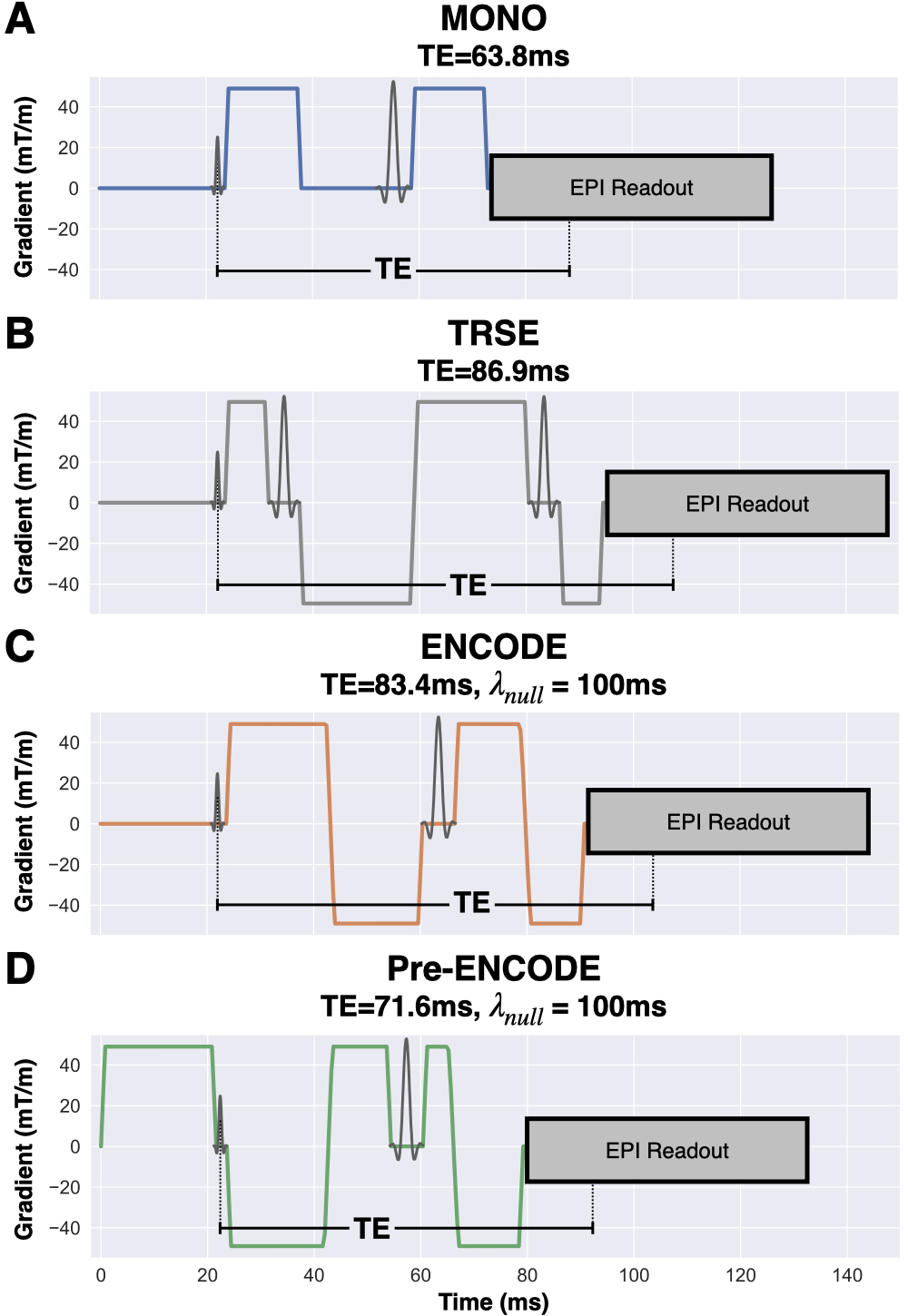
Figure 1. Pulse sequence diagrams for (A) MONO, (B) TRSE, (C) ENCODE, and (D) Pre-ENCODE using FOV=240x240mm2, resolution=1.5x1.5x5mm3, b=1000 s/mm2, slices=10, averages=5, TE=minimum with partial Fourier, TR=3000ms, and 2x parallel imaging. MONO provides no inherent eddy current nulling but offers the shortest TE. TRSE inherently nulls eddy currents with a 36% increase in TE. ENCODE and Pre-ENCODE are designed to null eddy currents using λnull=100ms and increase the TE by 31% and 12%, respectively, compared to MONO. Additionally, the Pre-ENCODE TE is ~18% shorter than TRSE.
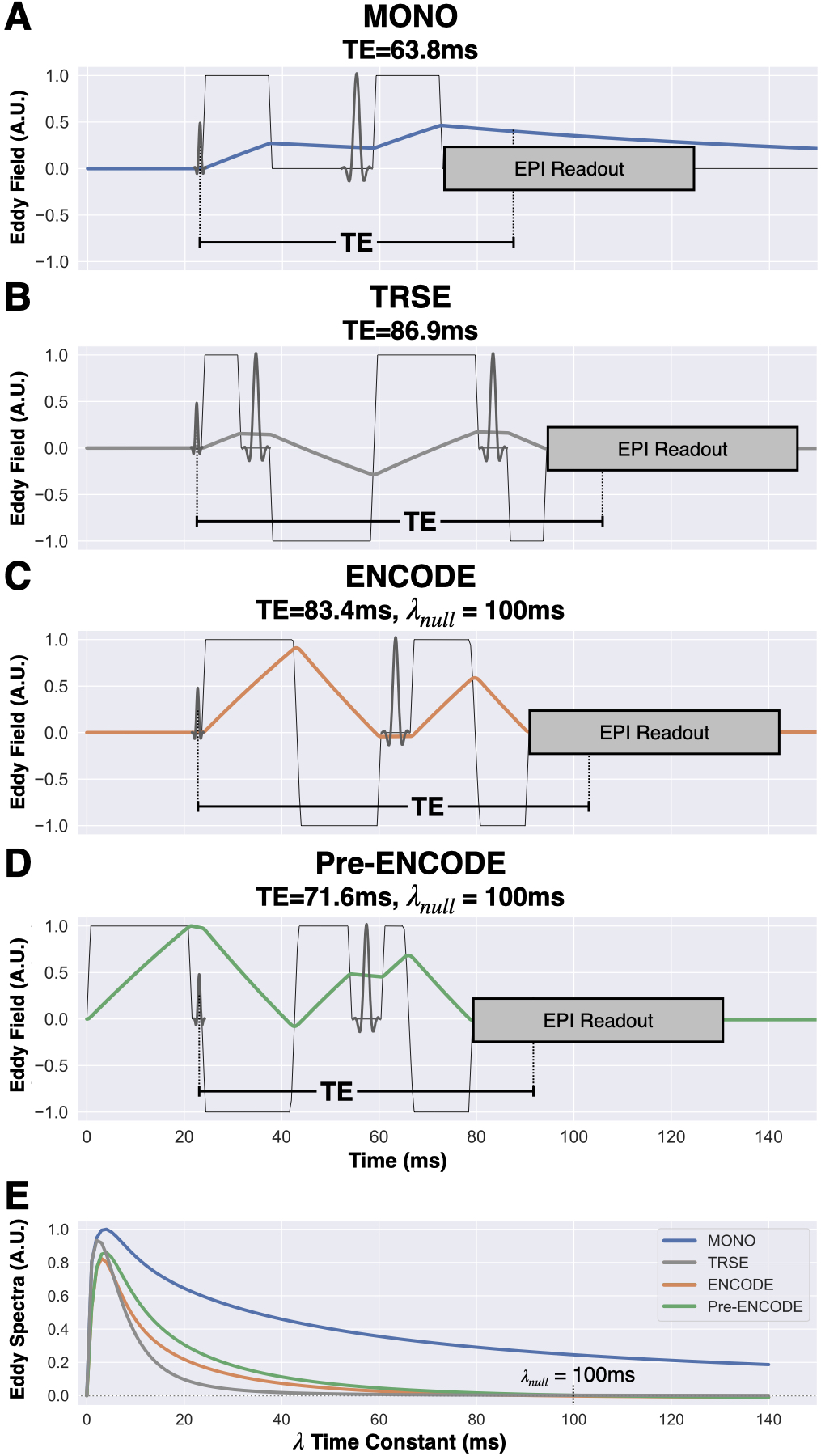
Figure 2. Simulated eddy current fields (A-D) and (E) spectra for MONO (blue), TRSE (gray), ENCODE (orange), and Pre-ENCODE (green). For MONO, non-zero eddy current fields persist during the EPI readout while TRSE, ENCODE, and Pre-ENCODE null eddy current fields. The eddy current spectra were generated by convolving the gradient slew rates in Figure 1 with Eqn. 1 for λ=0-140ms. MONO generates the largest residual eddy currents across all time constants while ENCODE and Pre-ENCODE show significant reductions, with nulled eddy currents at the prescribed λnull=100ms.
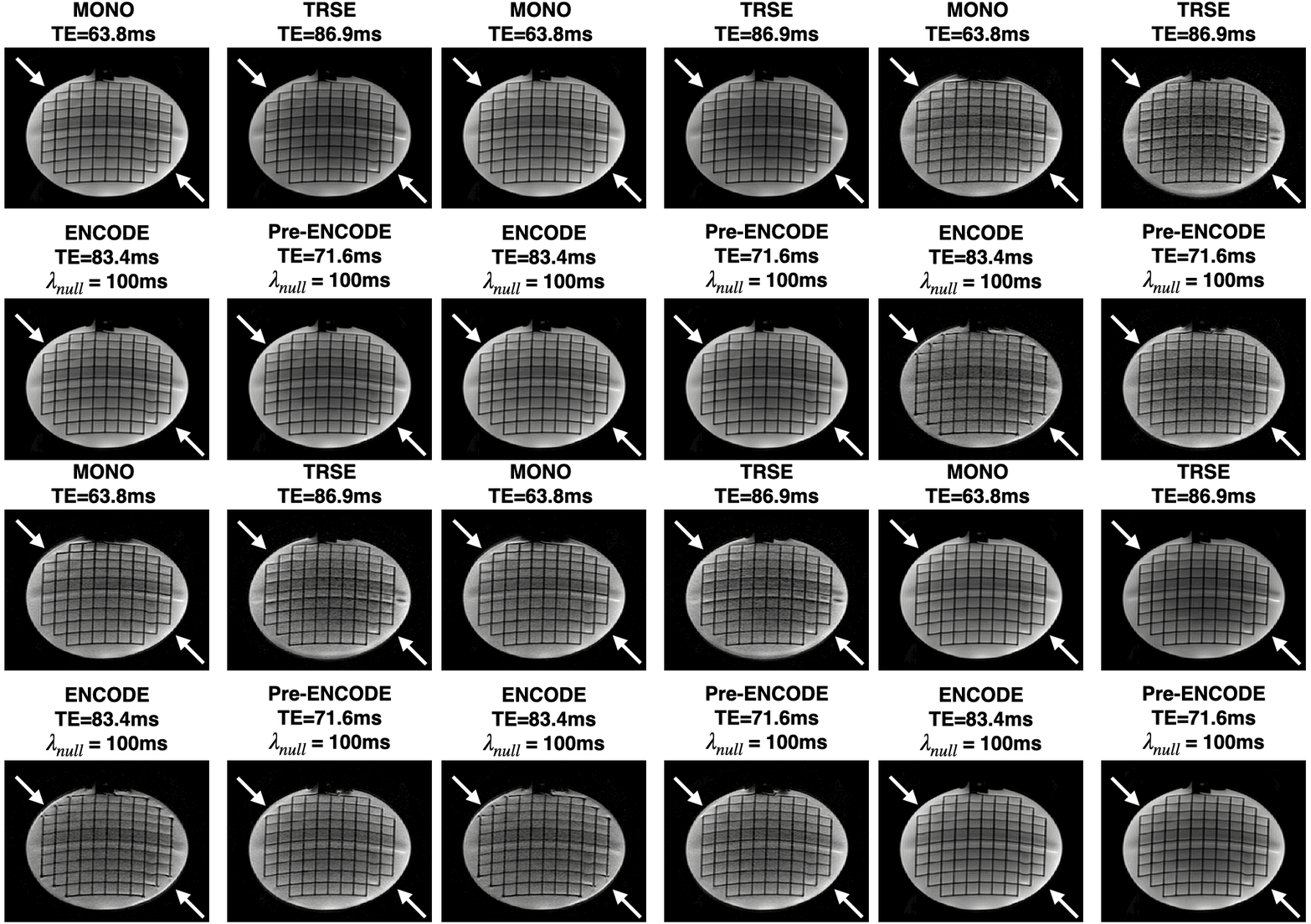
Figure 3 (Animated). Phantom results qualitatively comparing eddy current-induced image distortions between MONO, TRSE, and ENCODE and Pre-ENCODE for λnull=100ms. The animation was arranged by cycling through the T2 (b=0) and b=1000s/mm2 images along the x, y, and z axes. Eddy current-induced image distortions are visualized as deviations in the animation, especially at the phantom edges (arrows). MONO shows the most image distortion while TRSE and Pre-ENCODE with λnull=100ms mitigate these effects.
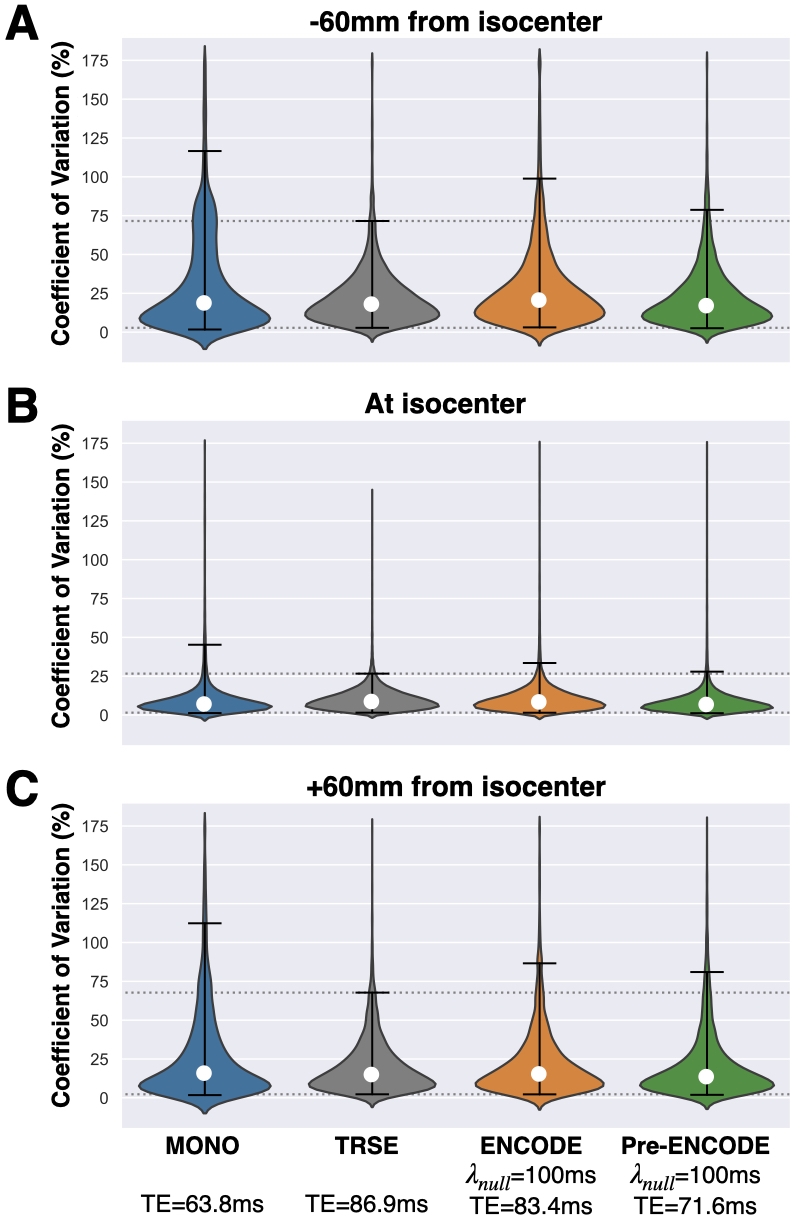
Figure 4. Phantom results comparing the coefficient of variation (CoV) between MONO, TRSE, ENCODE, and Pre-ENCODE for slices (A) -60mm from isocenter, (B) at isocenter, and (C) +60mm from isocenter. The CoV metric is expressed as a percent. ENCODE and Pre-ENCODE were designed using λnull=100ms. The median (white dot), upper and lower 95%-CIs (vertical black lines), and the TRSE 95%-CIs (dashed horizontal lines) are shown. The median CoV values are similar across all sequences, but the 95%-CIs are most similar between TRSE and Pre-ENCODE.
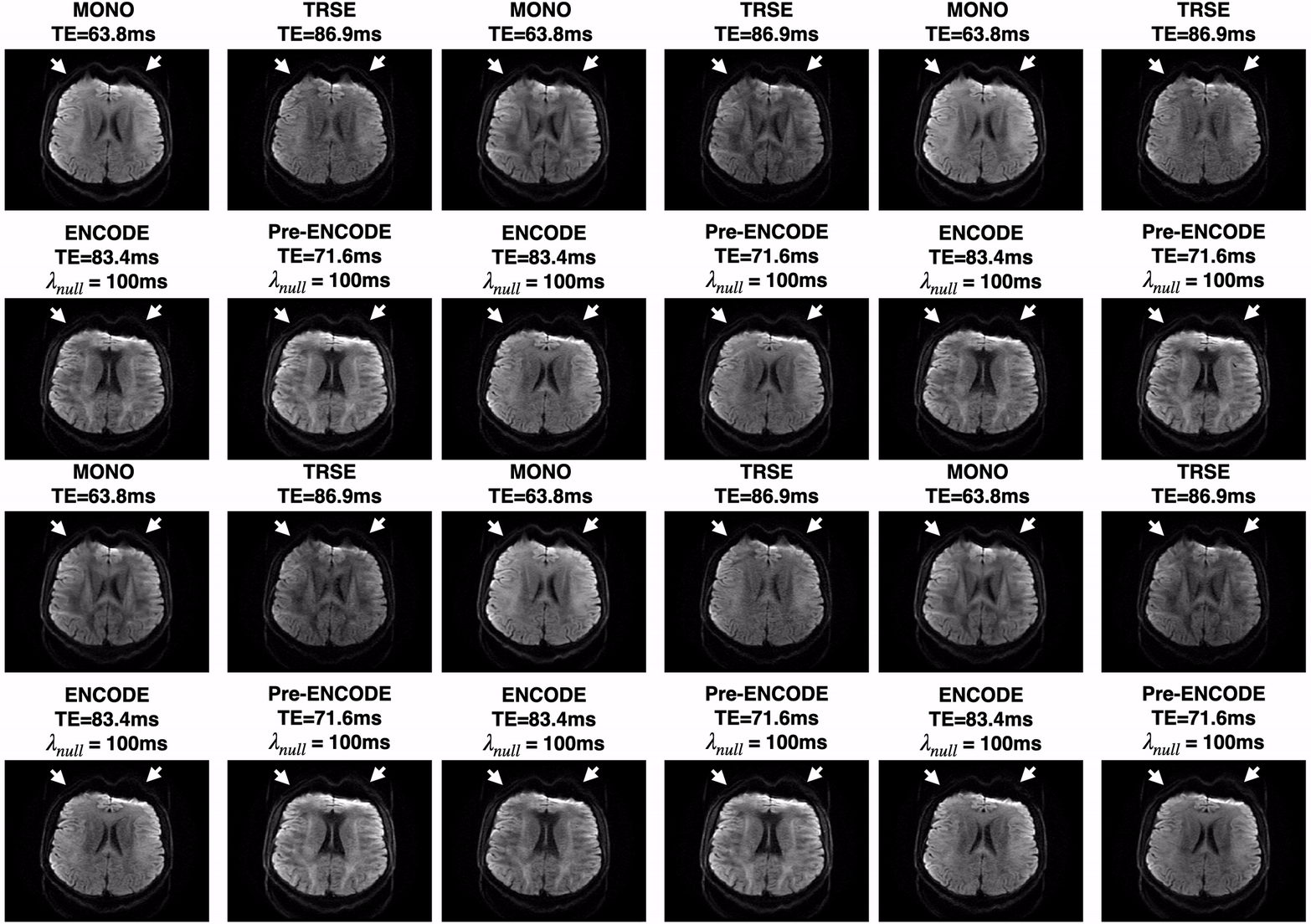
Figure 5 (Animated). An in vivo demonstration comparing eddy current-induced image distortions between MONO, TRSE, and ENCODE and Pre-ENCODE for λnull=100ms. The animation was arranged by cycling through the b=1000s/mm2 images along the x, y, and z axes. Eddy current-induced image distortions are visualized as deviations in the animation, especially near the anterior portion of the images (arrows). MONO shows the most image distortion while TRSE, ENCODE, and Pre-ENCODE with λnull=100ms mitigate these effects.
DOI: https://doi.org/10.58530/2023/3608