3605
Hybrid-space reconstruction with add-on distortion correction for simultaneous multi-slab DWI1Center for Biomedical Imaging Research, Department of Biomedical Engineering, School of Medicine, Tsinghua University, Beijing, China, 2Philips Healthcare, Beijing, China
Synopsis
Keywords: Image Reconstruction, Diffusion Tensor Imaging
3D simultaneous multi-slab imaging (SMSlab) can achieve high-resolution DWI with high SNR efficiency. Recently, we integrated SMSlab DWI with blipped-CAIPI gradients (blipped-SMSlab) and proposed a hybrid-space reconstruction algorithm, REACH. In this study, REACH is extended for distortion correction, which is called DC-REACH. It can correct the image distortions and the phase interferences introduced by the blipped-CAIPI gradients simultaneously. It also distinctly reduces the g-factor penalty via the joint reconstruction of the blip-up/down data.
Introduction
3D simultaneous multi-slab (SMSlab) 1-4 excites multiple 3D slabs simultaneously. It can achieve high-resolution whole-brain DWI with high SNR efficiency 5. Recently, we integrated SMSlab imaging with blipped-CAIPI 6, which is named blipped-SMSlab, to reduce the g-factor penalty. However, EPI-related image distortions induced by B0 field inhomogeneities and eddy currents remain a problem. Typically, the topup method is used to estimate the off-resonance maps and correct for distortions 7-10. It has been reported that a joint reconstruction of the blip-up/down data can correct the distortions and reduce the g-factors simultaneously 11,12. This study aims to propose such a joint reconstruction algorithm with distortion correction (DC) for blipped-SMSlab.Theory and Methods
Blipped-SMSlab and the combination with blip-up/down acquisitionThe blipped-SMSlab sequence with blip-up/down acquisition is shown in Figure 1. Multiple 3D slabs are simultaneously excited for acceleration. A table of kz gradients is used to encode the intra-slab slices. Blipped-CAIPI gradients are added between different EPI sub-echoes along the slice direction for multi-band encoding. Then a 4D k-space framework (kx-ky-kz-km) is formulated to model the signal encoding, with km representing multi-band encoding. For each image, two in-plane shots with blip-up/down acquisition are acquired for each kz. To reduce the inter-shot motion between the blip-up/down pairs, they are acquired inside the kz loop.
Because the km gradients and the kz gradients share the same physical gradient direction, the blipped-CAIPI gradients introduce kz deviations from the nominal k-space location 13, which are referred to as the ramp phase,
$$\varphi_{\text {ramp }}=2 \pi \cdot \Delta z / F O V_m \cdot n_{k m} \cdot n_z . (1)$$
Δz is slice thickness. FOVm=Rmb∙zgap is the defined FOV in the multi-band dimension. Rmb is the MB factor, and zgap is the gap between the centers of the simultaneously excited slabs. nkm is the index of km encoding in k-space, and nz is the intra-slab slice index in the image domain.
Reconstruction in a hybrid space with distortion correction
For b=0 s/mm2 images, φramp can be directly removed after 1D iFFT along kz. However, for diffusion-weighted images, it should be corrected during the reconstruction. An algorithm called REconstruction with phAse Correction in a Hybrid space (REACH) was proposed to solve this problem, which is reported in the other abstract. In this study, REACH is extended to jointly reconstruct the blip-up/down data of blipped-SMSlab, which is called DC-REACH.
In this study, the 4D representation of a distorted blipped-SMSlab diffusion-weighted image is formulated as
$$\mathrm{F}_{\mathrm{u}} \Psi \Theta \mathrm{SPI}=\mathrm{d} . (2) $$
The k-space signals are transformed into the hybrid space (x-ky-kz-km) and represented by d, which enables a separate reconstruction for each x index 14. Fu is an undersampled 3D FFT operator on y, z, and m dimensions. The ramp phase is represented by Ψ(nkm,nz)=φramp. The phase accrual (causing image distortions) along the ky dimension is formulated as Θ(∆f,nky)=exp(i∙∆f∙(ESP∙nky)), where Δf represents the off-resonance and/or eddy-current-induced field map. S represents coil sensitivities. P represents motion-induced inter-kz phase variations. I is the full-sampled image.
The flowchart of DC-REACH is shown in Figure 2. In step 0, the blip-up and blip-down data are separately reconstructed using REACH without distortion correction. Then, in step 1, the image amplitudes of the blip-up/down pairs are used to estimate the field maps Δf using topup 7 from the FSL 15. In step 2, to jointly reconstruct the blip-up and blip-down data, the background phase difference D caused by the reverse PE polarities should be corrected 12. The motion-induced phase P is extracted from the recovered SMS navigators. Both D and P are distortion corrected16 and smoothed to reduce the impact of geometric mismatch. In step 3, DC-REACH is done by minimizing the following cost function.
$$\mathrm{I}_{\mathrm{DC}}=\operatorname{argmin}\left\|\mathrm{d}-\mathrm{F}_{\mathrm{u}} \Psi \Theta \mathrm{SDPI}\right\|_2^2. (3)$$
Results & Discussion
The effect of correction for background phase difference between blip-up and blip-down data is shown in Figure 3. Without the correction, inter-slab aliasing artifacts arise in both the b=0 s/mm2 image and the b=1000 s/mm2 image of DC-REACH (yellow arrows).Figure 4 shows the reconstructed blipped-SMSlab images with 1.5-mm isotropic resolution. Results from both REACH and DC-REACH are shown. In DC-REACH, the distortions are corrected, and the geometry is close to the T2W image. The mean values of 1/g-factor of REACH and DC-REACH are 0.42 and 0.59, respectively. Compared with the separate REACH reconstruction, DC-REACH utilizes the acquired data more effectively and distinctly increases the 1/g-factor, which means that a higher SNR is maintained.
A DTI dataset acquired with the blipped-SMSlab and blip-up/down acquisition is shown in Figure 5. 1.3-mm isotropic resolution, 2 b=0 images and 32 diffusion directions with b=1000 s/mm2 were used. With TR=1.8 s and 10 kz steps for each slab, it took 36 s to acquire one direction, and 20.4 mins for a distortion-corrected whole-brain dataset.
Conclusion
This study integrated a hybrid-space reconstruction algorithm, REACH, with distortion correction (DC-REACH), for blipped-SMSlab DWI computation. It can correct image distortions and the phase interferences introduced by the blipped-CAIPI gradients simultaneously. It also reduces the g-factor penalty via the joint reconstruction of blip-up/down data.Acknowledgements
No acknowledgement found.References
1. Dai E, Wu Y, Wu W, et al. A 3D k-space Fourier encoding and reconstruction framework for simultaneous multi-slab acquisition. Magn Reson Med 2019;82(3):1012-1024.
2. Frost R, Jezzard P, Porter DA, Tijssen R, Miller K. Simultaneous multi-slab acquisition in 3D multi-slab diffusion-weighted readout-segmented echo-planar imaging. Proceedings of the 21st Annual Meeting of ISMRM. Salt Lake City, Utah, USA, 2013. p. 3176.
3. Dai E, Liu S, Guo H. High-resolution whole-brain diffusion MRI at 3T using simultaneous multi-slab (SMSlab) acquisition. NeuroImage 2021;237:118099.
4. Bruce IP, Chang H-C, Petty C, Chen N-K, Song AW. 3D-MB-MUSE: A robust 3D multi-slab, multi-band and multi-shot reconstruction approach for ultrahigh resolution diffusion MRI. NeuroImage 2017;159:46-56.
5. Moeller S, Ramanna S, Lenglet C, et al. Self‐navigation for 3D multishot EPI with data‐reference. Magnetic resonance in medicine 2020;84(4):1747-1762.
6. Setsompop K, Gagoski BA, Polimeni JR, Witzel T, Wedeen VJ, Wald LL. Blipped-controlled aliasing in parallel imaging for simultaneous multislice echo planar imaging with reduced g-factor penalty. Magn Reson Med 2012;67(5):1210-1224.
7. Andersson JL, Skare S, Ashburner J. How to correct susceptibility distortions in spin-echo echo-planar images: application to diffusion tensor imaging. NeuroImage 2003;20(2):870-888.
8. Chang H, Fitzpatrick JM. A technique for accurate magnetic resonance imaging in the presence of field inhomogeneities. IEEE transactions on medical imaging 1992;11(3):319-329.
9. Holland D, Kuperman JM, Dale AM. Efficient correction of inhomogeneous static magnetic field-induced distortion in Echo Planar Imaging. Neuroimage 2010;50(1):175-183.
10. Morgan PS, Bowtell RW, McIntyre DJ, Worthington BS. Correction of spatial distortion in EPI due to inhomogeneous static magnetic fields using the reversed gradient method. Journal of Magnetic Resonance Imaging 2004;19(4):499-507.
11. Liao C, Bilgic B, Tian Q, et al. Distortion‐free, high‐isotropic‐resolution diffusion MRI with gSlider BUDA‐EPI and multicoil dynamic B0 shimming. Magnetic Resonance in Medicine 2021;86(2):791-803.
12. Zahneisen B, Aksoy M, Maclaren J, Wuerslin C, Bammer R. Extended hybrid-space SENSE for EPI: Off-resonance and eddy current corrected joint interleaved blip-up/down reconstruction. NeuroImage 2017;153:97-108.
13. Zahneisen B, Aksoy M, Maclaren J, Wuerslin C, Bammer R. RF-Encoding for Simultaneous Multi Slab Imaging. Proc Int Soc Magn Reson Med. Singapore, 2016. p.
14. Zhu K, Dougherty RF, Wu H, et al. Hybrid-space SENSE reconstruction for simultaneous multi-slice MRI. IEEE transactions on medical imaging 2016;35(8):1824-1836.
15. Jenkinson M, Beckmann CF, Behrens TEJ, Woolrich MW, Smith SM. FSL. NeuroImage 2012;62(2):782-790.
16. Jezzard P, Balaban RS. Correction for geometric distortion in echo planar images from B0 field variations. Magnetic Resonance in Medicine 1995;34(1):65-73.
17. Robson PM, Grant AK, Madhuranthakam AJ, Lattanzi R, Sodickson DK, McKenzie CA. Comprehensive quantification of signal-to-noise ratio and g-factor for image-based and k-space-based parallel imaging reconstructions. Magnetic Resonance in Medicine 2008;60(4):895-907.
18. Zhang J, Liu S, Dai E, et al. Slab boundary artifact correction in multislab imaging using convolutional‐neural‐network–enabled inversion for slab profile encoding. Magnetic Resonance in Medicine 2022;87(3):1546-1560.
Figures
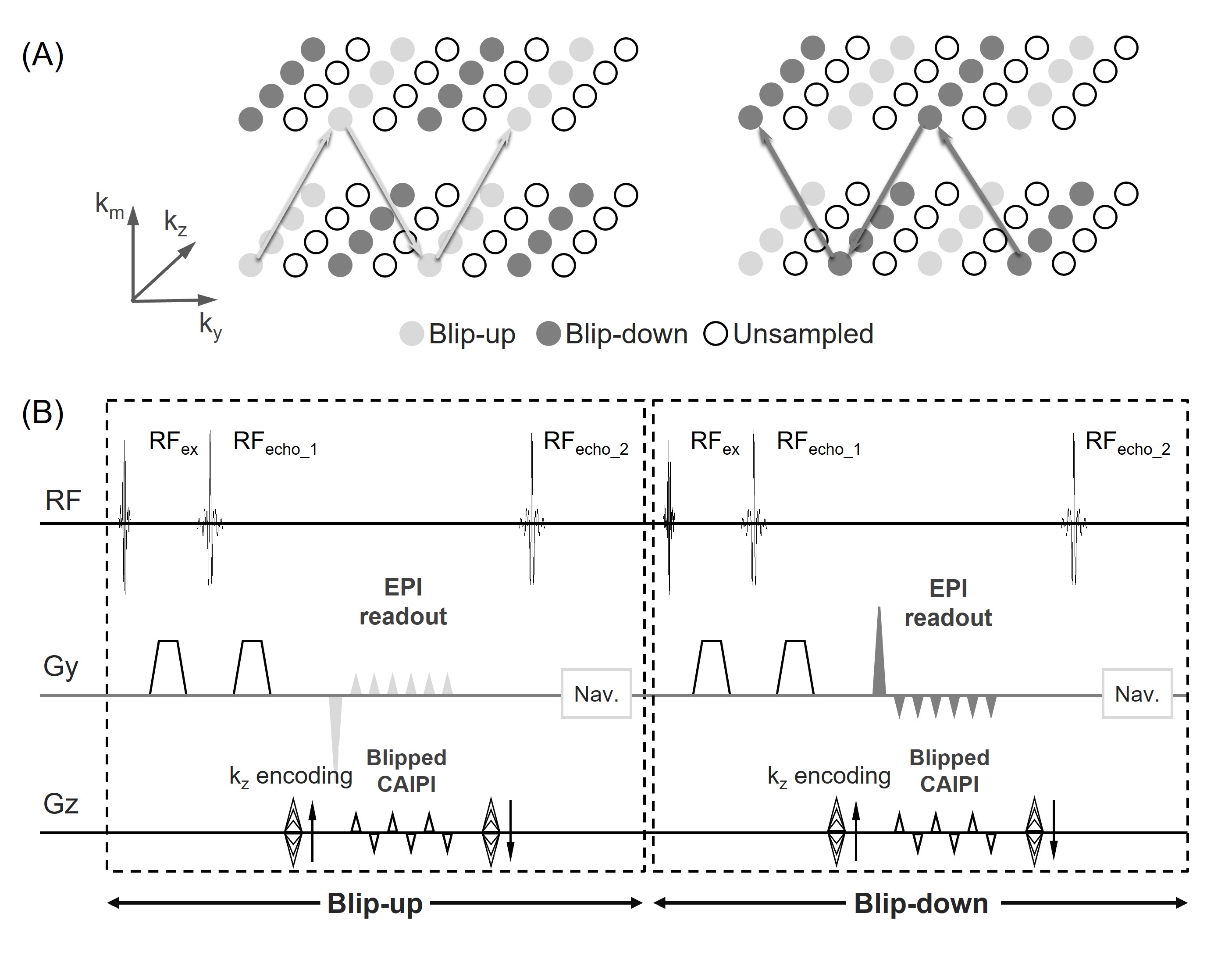
Figure 1. SMSlab EPI with blipped-CAIPI (blipped-SMSlab) combined with the blip-up/down acquisition. (A) and (B) show the sequence diagram and the trajectory in 4D k-space, respectively. Some gradients are omitted in (A) for simplification, including the slice-selection gradients, the Gx gradients, and so on.
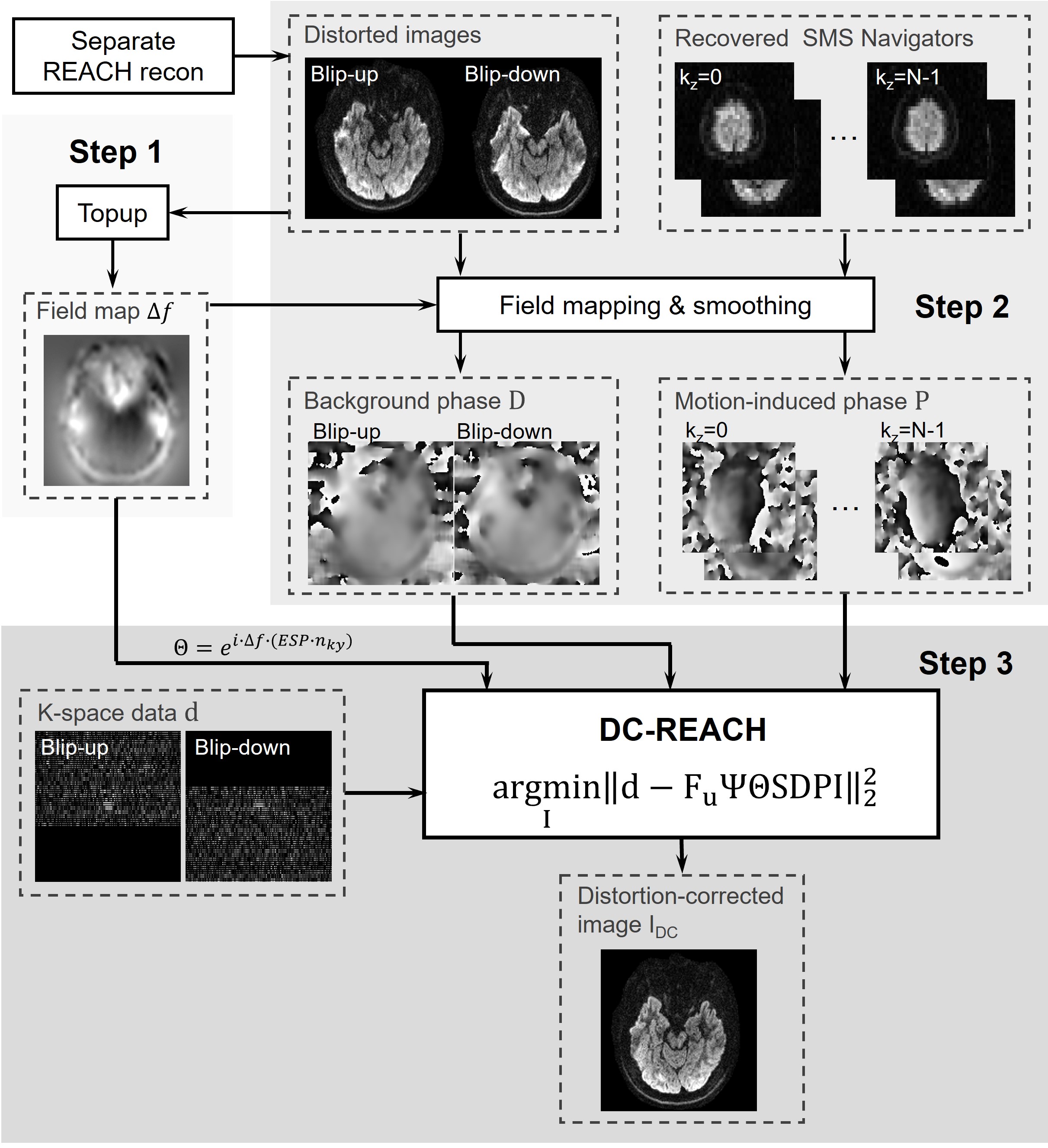
Figure 2. The flowchart of hybrid-space reconstruction with distortion correction (DC-REACH) for blip-up/down acquisitions.
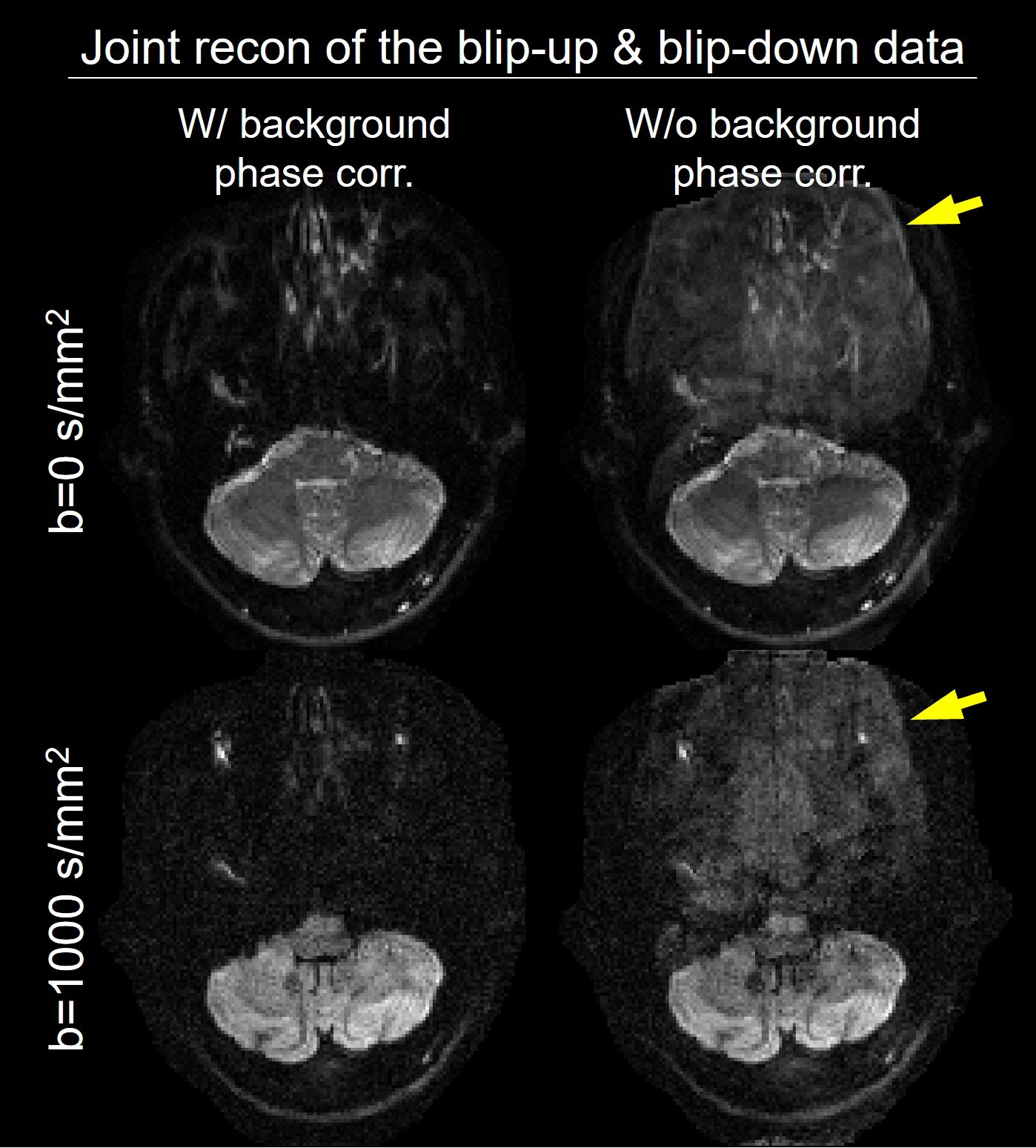
Figure 3. Comparison between results of joint reconstruction of the blip-up and blip-down data with (DC-REACH) and without background phase correction. The results without background phase correction were generated by removing D from the cost function of DC-REACH. Blipped-SMSlab images with the blip-up/down acquisition and 1.5-mm isotropic resolution are shown.
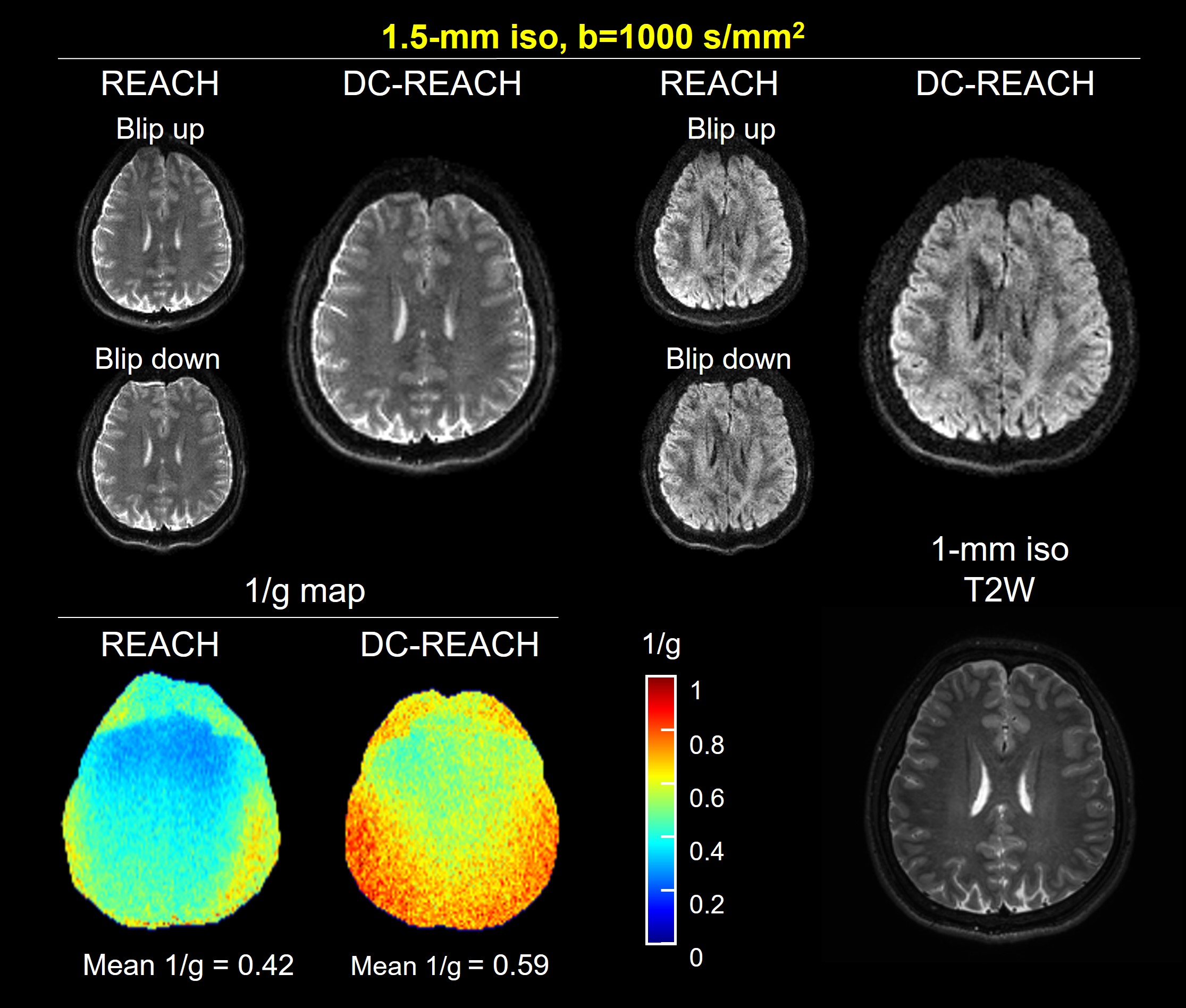
Figure 4. The images were acquired using blip-up/down blipped-SMSlab with TR=1.9 s, Ry × MB=2×2, and 1.5-mm isotropic resolution. T2W TSE images were acquired as the distortion-free reference. The g-factors of b=0 images were calculated via a Monte-Carlo-based method with 128 repetitions 17. For the REACH reconstruction, only the 1/g-factor maps of blip-up images are shown.
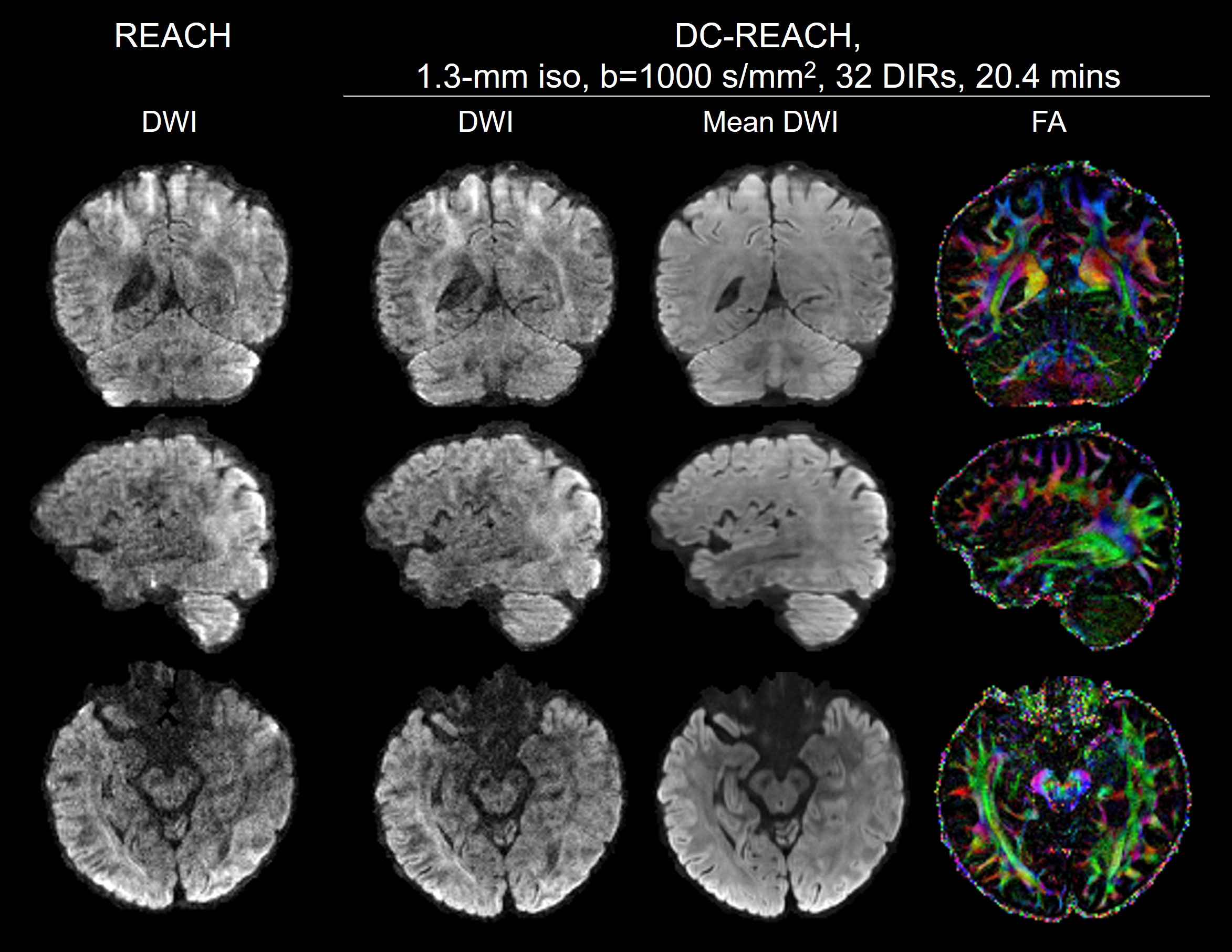
Figure 5. The reconstructed images via DC-REACH for the DTI dataset from blipped-SMSlab with blip-up/down acquisition. Ry × MB=2×3, 1.3-mm isotropic resolution, b=1000 s/mm2, and 32 directions were used. Slab boundary artifacts were corrected using a deep-learning-based algorithm 18. The first column shows the distorted b=1000 s/mm2 images reconstructed by REACH. The other columns show the b=1000 s/mm2 images and the colored fractional-anisotropy (FA) maps of DC-REACH.