3564
Maternal neural and behavioral sensitivity to baby emotional sounds1School of Psychology, Shandong Normal University, Ji’nan, Shandong, P. R. China, Jinan, China, 2The University of Melbourne, Victoria, Australia, 3Linyi University, Linyi, China, 4Shandong Provincial Hospital Affiliated to Shandong First Medical University, Jinan, China, 5Shanghai University of Sport, Shanghai, China
Synopsis
Keywords: Head & Neck/ENT, fMRI (task based)
After giving birth, women will experience a series of physiological and psychological changes. Exploring the changes in postpartum women's neurological function contributes to comprehending their cognitive and emotional processing mechanisms. Therefore, we recruited 43 new mothers and 26 nulliparous women to participate in the current fMRI study based on the baby sounds’ task. Results suggested that the brain function of new mothers showed dynamic plasticity in the temporal lobe. This study reflected the adaptive changes in new mothers' brain function toward nurturing the babies.Introduction
Babies at birth usually attract adults' attention and love through signals such as laughter, crying, and babbling. The remarkable changes in women after childbirth will help them better adapt to the role of mothers and enhance their sensitivity to baby cues. Previous studies have shown that the brain neural mechanism of postpartum women has dynamic plasticity1; specifically, the activity of new mothers' coordinated brain regions related to action, speech, hearing, and care was significantly enhanced2. This study would further investigate the differential activation in response to baby babbling (BB), baby cries (BC), baby laughter (BL), and noise control (NC) between new mothers and nulliparous women, and explore the relationship between the changes of new mothers' brain function and empathy.Materials and Methods
43 right-handed Chinese new mothers (mean age: 30.0±2.7 years) and 26 nulliparous women (mean age: 26.5±1.9 years) were selected for the study. The experimental materials included BB, BC, BL, and NC. Each type of sound had eight paragraphs, with a unified setting time of fifteen seconds, and the sounds were presented randomly. Each trial presented a 15s sound (stimulation state) and a 10s black screen (rest state). In the experimental process, all participants scored the baby's voice and completed the Interpersonal Reactivity Index (IRI). A two-sample t-test was used to examine differences in brain activation between new mothers and nulliparous women responding to BB, BC, BL, and NC. The significantly activated brain regions in the Two-sample t-test were scheduled for ROI to explore the relationship between brain function changes and empathy. All scans were performed on Siemens 3.0 T Trio Tim MR system. High-resolution 3D T1-weighted imaging parameters were collected (TR = 2350 ms, TE = 2.34 ms, 256 × 256matrix, slice = 192 slices, slice thickness = 1.0 mm). T2 - weighted gradient-echo plane imaging sequence was used to collect mission-state functional images. The parameters were as follows: TR = 2000 ms, TE = 30 ms, 64 × 64matrix, slice = 33 slices, slice thickness = 3.5 mm. The data was pretreated and analyzed by the Statistical Parametric Mapping software.Results
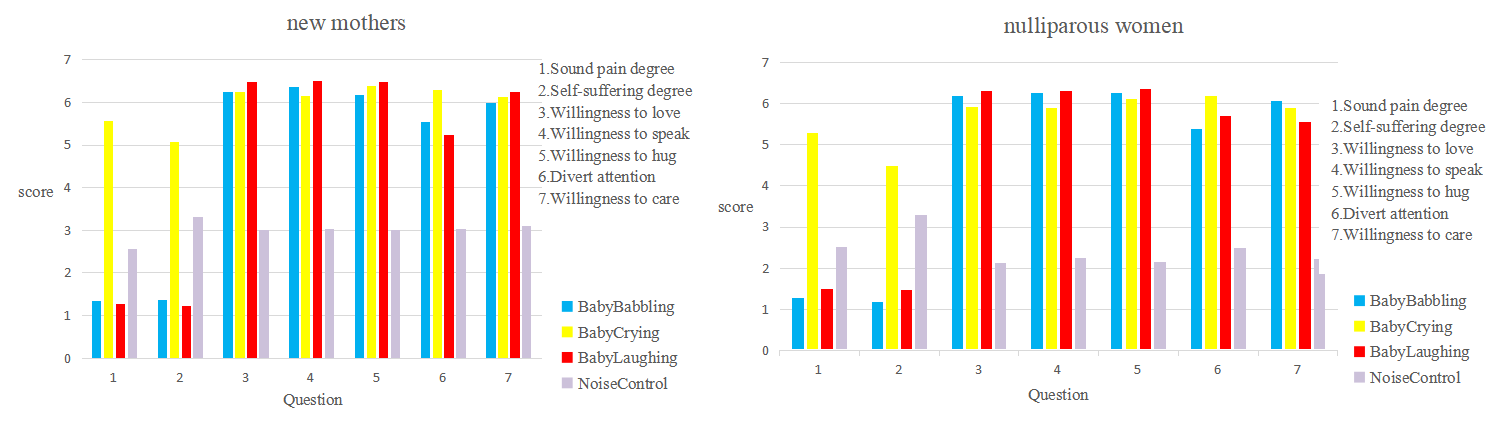
The two-sample t-test showed that the activation of brain regions related to language and auditory processing such as bilateral superior temporal gyrus and middle temporal gyrus decreased when responding to BB, BC, BL, and NC in new mothers (Figure 1). Moreover, when responding to BB, the activation of brain clusters extending to left paracentral lobules, precuneus, limbic lobe, and cingulate gyrus were decreased in new mothers. Behavioral results showed that the empathy concern score of new mothers was significantly higher than that of nulliparous women (p = 0.029). And the score of willingness to care of new mothers was significantly higher than that of nulliparous women (p = 0.009) while hearing BL, and the score of willingness to love, speak, hug and care in new mothers was significantly higher than that of nulliparous women while hearing NC (p < 0.05) (Figure 2). Correlation analysis showed that the brain function changes stimulated by BC of new mothers were positively significantly related to empathy abilities (p = 0.025).Discussion
This study found significant intergroup differences in the brain responses of new mothers and nulliparous women to baby sound stimuli. The differential brain regions are mainly in the superior temporal gyrus and middle temporal gyrus, which are closely related to language, hearing, and emotional processing. Behavioral results revealed that while hearing BL, new mothers express more positive emotional and behavioral feedback to babies, which may reveal that new mothers’ brain emotional processing function is more sensitive3. In addition, it was found that the empathy ability of new mothers was significantly higher than that of nulliparous women. And the correlation analysis showed that the activation of the right superior temporal gyrus and middle temporal gyrus of the new mother’s brain has a significant positive correlation with empathy while hearing BC. These findings reflected adaptive changes in brain function of the new mother's brain to cognitive and emotional processing, which might be related to raising babies.Conclusion
The current study suggested that the brain regions related to cognition and emotional processing of new mothers exhibited functional reorganization, which provided a basis for understanding the changes in the neurophysiological mechanism of postpartum women.Acknowledgements
We would like to acknowledge the dedication of all the participants involved in this research. This work was financially supported by the National Natural Science Foundation of China (Grant Nos. 32200915).References
1. Pilyoung Kim, Lane Strathearn, and James E. Swain. The maternal brain and its plasticity in humans. Horm Behav. 2016 January; 77: 113–123.
2. Marc H. Bornsteina, Diane L. Putnicka, Paola Rigo, et al. Neurobiology of culturally common maternal responses to infant cry. Proc Natl Acad Sci U S A. 2017 November 7; 114(45): E9465-E9473.
3. Erica D. Musser, Heidemarie Kaiser-Laurent, Jennifer C. Ablow. The neural correlates of maternal sensitivity: An fMRI study. Developmental Cognitive Neuroscience. 2012 April; 2: 428-436.
Figures
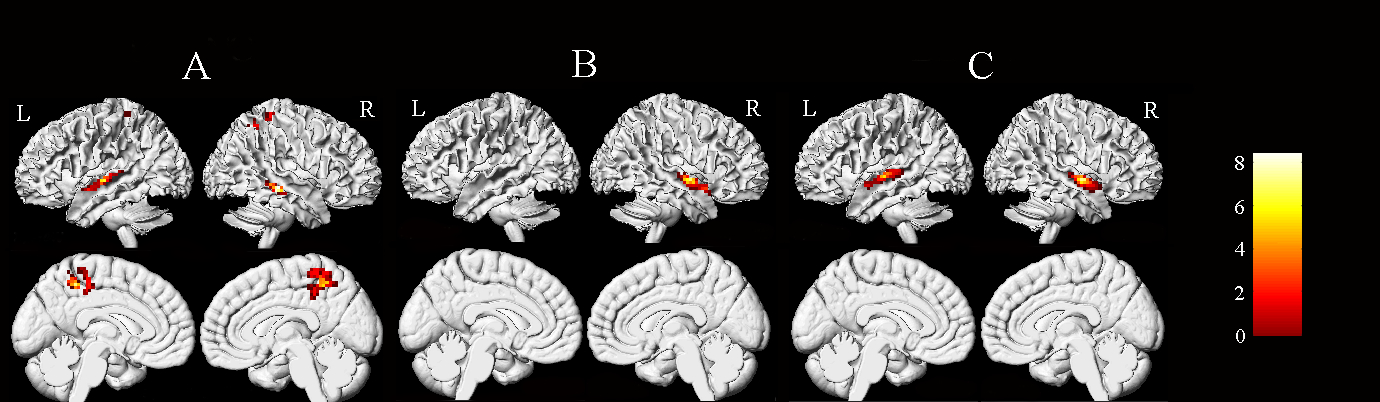
Figure 1. Brain regions with significant differences in brain activation between new mothers and nulliparous women in response to baby sounds (A, BB-NC; B, BC-NC; C, BL-NC). The results are reported with uncorrected p < 0.001 and a threshold of p < 0.05 with family-wise error correction (FWE) on the voxel level. R: right, L: left.