3557
OPTICS STUDY: INTRACRANIAL EFFECTS OF STATIC LOWER BODY NEGATIVE PRESSURE WITH HEAD DOWN TILT BED REST: COMPARISON TO UPRIGHT POSTURE1Diagnostic Imaging and Intervention, University of Texas Health Science Center at Houston, Houston, TX, United States, 2University of Texas Health Science Center at Houston, Houston, TX, United States, 3Clinical and Translational Sciences, University of Texas Health Science Center at Houston, Houston, TX, United States, 4Karina Marshall-Goebel, NASA, Houston, TX, United States, 5NASA, Houston, TX, United States, 6KBR, Houston, TX, United States, 7Acyonetx, Moscow, ID, United States, 8Chemical and Biological Engineering, University of Idaho, Moscow, ID, United States
Synopsis
Keywords: Blood vessels, Quantitative Imaging, Microgravity, Head down tilt, Spaceflight Associated Neuro-ocular Syndrome
Lower body negative pressure applied a total of 6 hours daily during 29 days of head down tilt bed rest shows promise as a countermeasure to spaceflight acquired neuro-ocular syndrome.INTRODUCTION
Spaceflight-associated neuro-ocular syndrome (SANS) affects a large majority of astronauts during long-duration spaceflight. SANS is hypothesized to result from an unrelenting headward fluid shift that occurs in the microgravity environment. Altered intracranial structure and physiology documented in spaceflight and head-down tilt (HDT) experiments(1, 2) are similarly theorized to be caused by chronic headward fluid shift and thereby provide an independent quantitative assessment related to this mechanism. As a potential countermeasure, lower body negative pressure (LBNP) applied in the supine posture has shown efficacy in reducing headward fluid shift(3). However, it remains unknown if daily use of LBNP simulating daily upright posture fluid redistribution can mitigate SANS and intracranial changes associated with long-duration spaceflight. The goal of this study was to quantify the effects of daily application of LBNP or daily exposure to the upright posture on intracranial structure and physiology during long-term HDT to evaluate the potential efficacy of LBNP as a countermeasure to SANS.METHODS
22 healthy volunteers (11 men; 11 women; mean age = 35 years (SD=9.2)(age range = 24 to 52 years); mean BMI = 24.0 kg/m2 (SD=2.8)) completed an MRI study performed at the German Aerospace Facility in Cologne, Germany. A strict six-degree head-down tilt (HDT) bed rest study was used as a spaceflight analog to induce a continuous headward fluid shift for 30 days. The subjects were divided equally into two groups of interventions: 1) LBNP for 3-hour sessions twice daily and 2) seated position for 3-hour sessions twice daily. Interventions were divided into morning and afternoon sessions for both groups. The LBNP intervention was maintained at 25 mmHg ± 2 mmHg. Pulse-gated MRI phase-contrast flow imaging was used to quantify cerebral artery stroke volume (CASV) and peak-to-peak cerebral spinal fluid (CSF) velocity (CSFVp-p) within the cerebral aqueduct. A 3D T1-MPRAGE sequence was used to quantify volumetric changes in the brain and intracranial CSF spaces using MRI Cloud software. MRI acquisitions were obtained at baseline before bedrest (BL, supine posture), 15 days into HDT (HDT15), 29 days into HDT (HDT29), and 12 days after recovery (R12, supine posture). The data were analyzed by the mixed model, which included intervention, time (four nominal levels BL, HDT15, HDT29, R12), and intervention-time interaction as the fixed effects and included the subject as a random effect. Results were considered significant for P values <.05.RESULTS
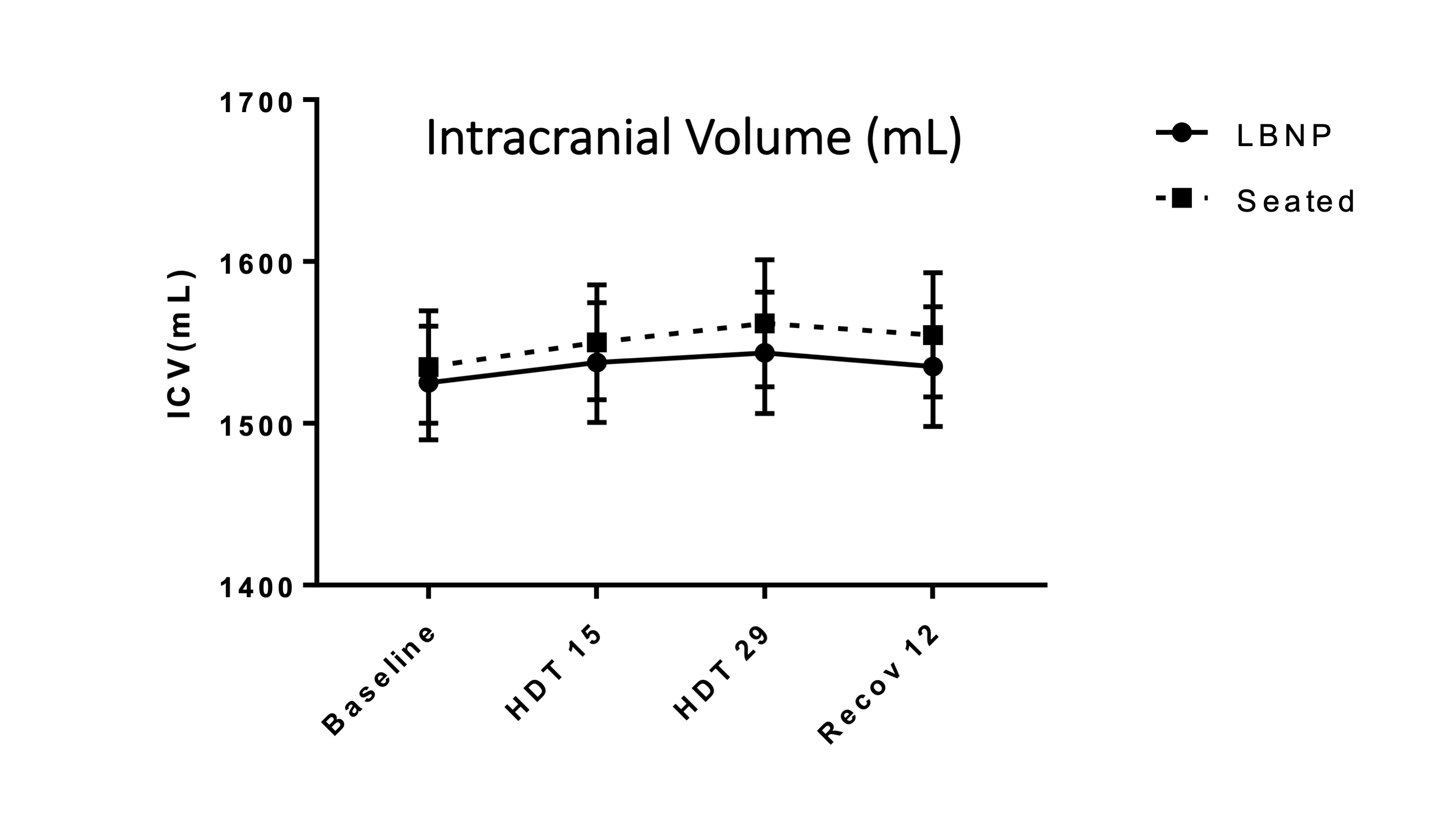
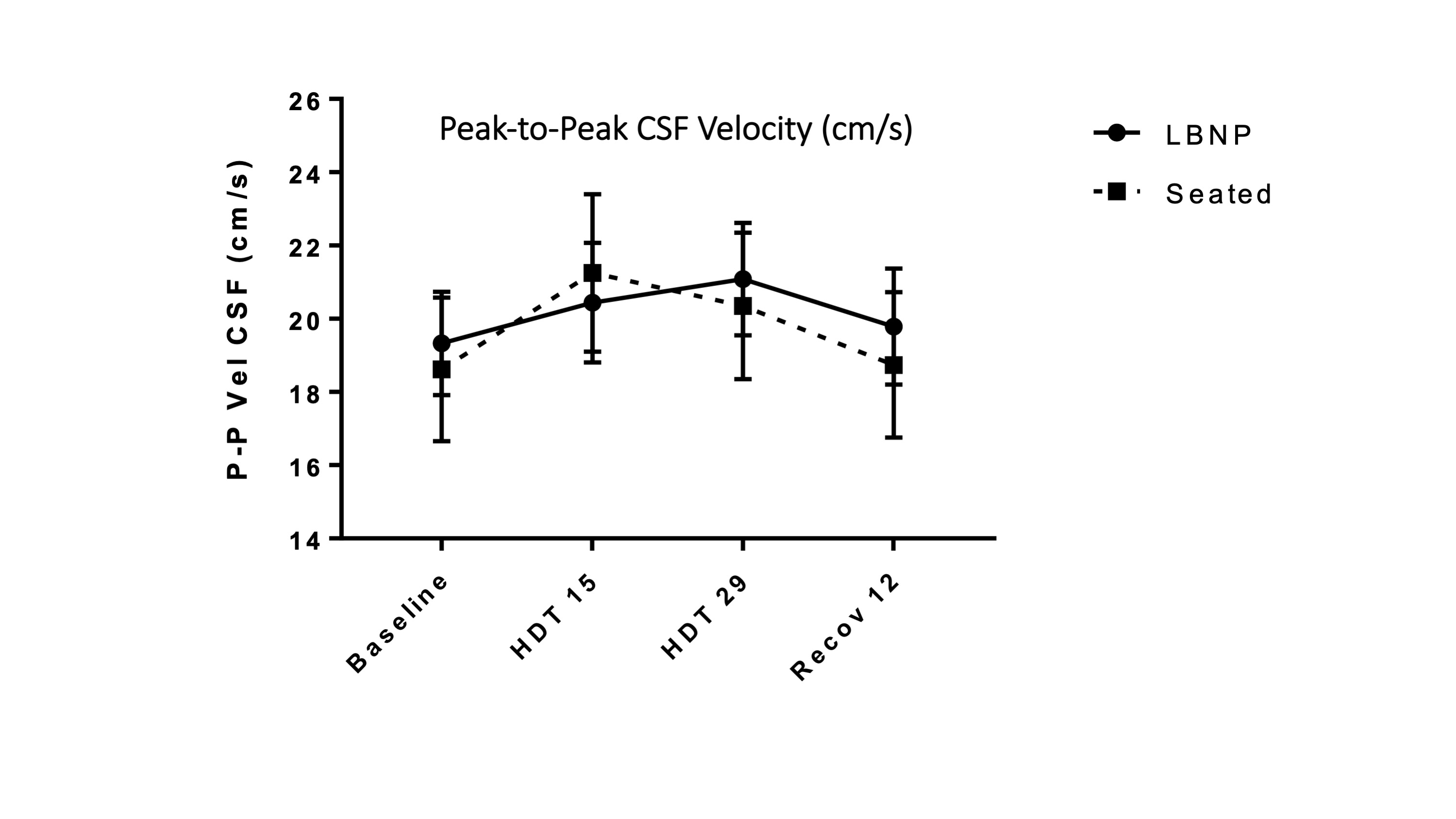
Compared to BL there was no statistically significant difference in CASV and CSFVp-p during HDT except for CASV at HDT29 (seated group) where there was a 1.7 mL (12%) decrease (P<.01). Compared to BL there was a statistically significant increase in intracranial volume (ICV; ICV = white matter + gray matter + CSF) for both interventions at HDT15 (Δ13 mL, 0.9 % (LBNP group)); (Δ15 mL, 1.0%, (seated group)) and HDT29 (Δ19 mL, 1.2%, (LBNP group)); (Δ23 mL, 1.5% (seated group)) (All Ps<.001). Compared to baseline, lateral ventricular volume increased at HDT15 (Δ0.9 mL, 5.5%) and HDT29 (Δ1.8 mL, 10%) for LBNP only (P=.001 for each). During HDT, white matter volume remained stable compared to baseline for both interventions. There were no significant intervention effects in the overall response to HDT (All Ps >.2)(Figures 1-2).CONCLUSION
Seated posture maximizes lower body fluid and venous blood distribution and is a natural component of circadian physiology. Our results show that LBNP has a similar quantitative MRI response relative to the seated posture during 29 days of HDT. Although there was an increase in ICV and lateral ventricular volume with HDT there was no significant change in intracranial physiological parameters with LBNP suggesting that volumetric changes were insufficient to affect cerebrovascular and CSF hydrodynamic homeostasis. Our preliminary results suggest that LBNP is a potential countermeasure to SANS.Acknowledgements
NASA GRANT 2018-2019 HERO 80JSC018N0001-SANSReferences
1. Kramer LA, Hasan KM, Stenger MB, Sargsyan A, Laurie SS, Otto C, Ploutz-Snyder RJ, Marshall-Goebel K, Riascos RF, Macias BR. Intracranial Effects of Microgravity: A Prospective Longitudinal MRI Study. Radiology 2020;295(3):640-648. doi: 10.1148/radiol.20201914132.
2. Kramer LA, Hasan KM, Sargsyan AE, Marshall-Goebel K, Rittweger J, Donoviel D, Higashi S, Mwangi B, Gerlach DA, Bershad EM, Group SI. Quantitative MRI volumetry, diffusivity, cerebrovascular flow, and cranial hydrodynamics during head-down tilt and hypercapnia: the SPACECOT study. J Appl Physiol (1985) 2017;122(5):1155-1166. doi: 10.1152/japplphysiol.00887.20163.
3. Kramer LA, Hasan KM, Gabr RE, Macias BR, Marshall-Goebel K, Laurie SS, Hargens AR. Cerebrovascular Effects of Lower Body Negative Pressure at 3T MRI: Implications for Long-Duration Space Travel. J Magn Reson Imaging 2022. doi: 10.1002/jmri.28102
Figures