3505
Associations between reading ability and white matter tract integrity in adolescents1Radiology & Biomedical Imaging, University of California, San Francisco, San Francisco, CA, United States
Synopsis
Keywords: Brain Connectivity, Adolescents
Across a demographically diverse sample of over 7000 US adolescents, the relationship between white matter tracts and reading skills was evaluated using automated tractometry. Fractional Anisotropy (FA) values within several white matter tracts demonstrated strong positive associations with reading ability. Higher FA values were associated with higher reading scores, as assessed by the NIH Toolbox Oral Reading Recognition Test (TORRT). These relationships persisted even after correction for several potential confounding variables.
Introduction
Like many cognitive functions, reading ability reflects complex interactions among multiple biological and experiential factors. Although the neural circuitry underlying reading has been studied1, structural differences in white matter tracts hypothesized as central to reading ability have not been examined in large population-based samples, which have recently been shown to be critical to measuring reliable and reproducible brain wide associations2.Methods
Diffusion MRI data from over 7000 participants aged 10-11 years enrolled in the Adolescent Brain Cognitive Development (ABCD) Study were processed using Automated Fiber Quantification3 to extract individual subject White Matter (WM) fiber bundles for major WM tracts, including tracts proposed to be related to reading abilities (left inferior longitudinal fasciculus (ILF), callosum forceps minor, left and right arcuate fasciculus (AF)) and others with no specific relation to reading(left corticospinal tract (CST) and left thalamic radiation) (figure 1). Fractional Anisotropy (FA) was computed within the core of each tract at each of 100 nodes along the tract’s length. For each subject, the NIH Toolbox Oral Reading Recognition Test (TORRT) score4, a measure of single-word reading ability, and a range of potential confounding variables (age, sex, parental education, income, and marital status, ethnicity, genetic ancestry, and MRI scanner ID) were extracted. Mean (±SE) FA at every node along the length of each tract was measured for participants in each of five groups spanning the range of TORRT scores, binned with standard deviations from the mean (figures 2, 3). To control for potential confounding variables, residual FA values were calculated at each node after removing the variance explained by the potential confounders in a linear mixed effects model.Results
FA values were measured in individual subjects along the length of each white matter tract. FA values within specific tracts, including the left and right AF and forceps minor, showed strong positive graded associations with single word reading ability (TORRT score) Higher FA values were associated with higher reading scores in a monotonic fashion (figure 3). These effects were greatest for the forceps minor and were non-uniform along the length of each tract, being much greater along certain tract segments (figure 3). Non-reading related tracts such as the left CST and thalamic radiation showed no orderly relationship between FA values and TORRT scores.Discussion
Across a demographically diverse sample of over 7000 US adolescents aged 10-11 years, single-word reading ability was positively associated with FA values in certain segments of specific WM tracts. These effects were strongest in the left and right arcuate fasciculi and callosum forceps minor, tracts that have been implicated in reading, and were not present in non-reading related tracts such as the left CST and thalamic radiation. The tract specificity of these effects suggests that they relate to reading as a particular behavioral skill rather than higher overall brain maturation. Ongoing work is evaluating the specificity of these effects to reading compared to other cognitive functions and exploring how these brain-behavior associations change over time as individual participant’s reading abilities evolve during early adolescence.Conclusion
In the largest imaging study of the adolescent human brain, involving a diverse sample of over 7,000 US children, quantitative measures of whiter matter integrity along specific segments of particular tracts showed monotonic associations with single-word reading ability.Acknowledgements
NoneReferences
(1) Wandell BA, Le RK. Diagnosing the Neural Circuitry of Reading. Neuron. 2017 Oct 11;96(2):298-311. doi: 10.1016/j.neuron.2017.08.007. PMID: 29024656
(2) Marek, S., Tervo-Clemmens, B., Calabro, F.J. et al. Reproducible brain-wide association studies require thousands of individuals. Nature 603, 654–660 (2022). https://doi.org/10.1038/s41586-022-04492-9
(3) Yeatman JD, Dougherty RF, Myall NJ, Wandell BA, Feldman HM (2012) Tract Profiles of White Matter Properties: Automating Fiber-Tract Quantification. PLOS ONE 7(11): e49790. https://doi.org/10.1371/journal.pone.0049790
(4) Gershon RC, Slotkin J, Manly JJ, Blitz DL, Beaumont JL, Schnipke D, Wallner-Allen K, Golinkoff RM, Gleason JB, Hirsh-Pasek K, Adams MJ, Weintraub S. IV. NIH Toolbox Cognition Battery (CB): measuring language (vocabulary comprehension and reading decoding). Monogr Soc Res Child Dev. 2013 Aug;78(4):49-69. doi: 10.1111/mono.12034. PMID: 23952202; PMCID: PMC7659464.
Figures
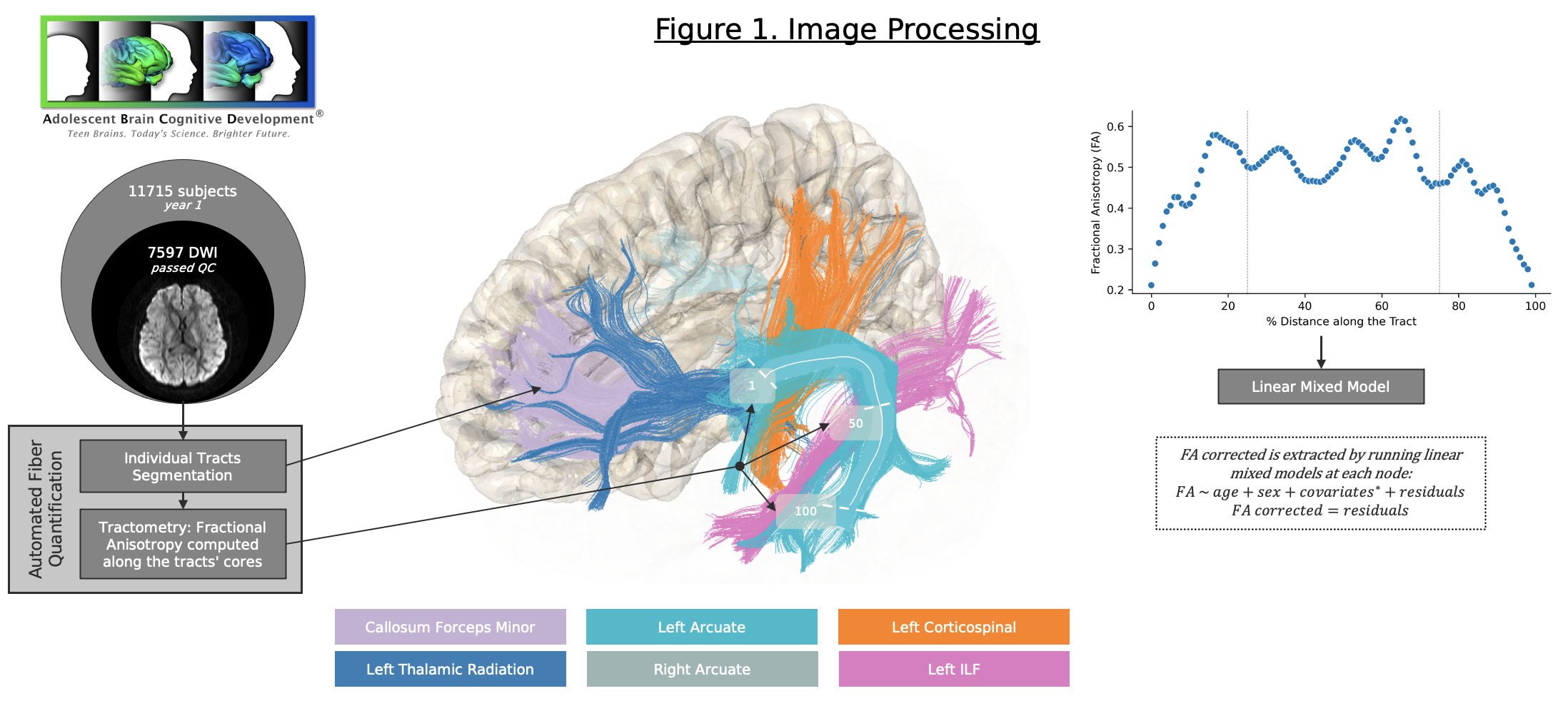
Image processing pipeline (see methods for details). In short, individual subject tractometry data was extracted from quality checked diffusion MRI data from the ABCD study, allowing to plot Fractional Anisotropy (FA) along each tract. Then, linear mixed models were run at each node to remove the variance explained by standard covariates.
*covariates = parental education, income, and marital status, ethnicity, genetic ancestry, and MRI scanner ID
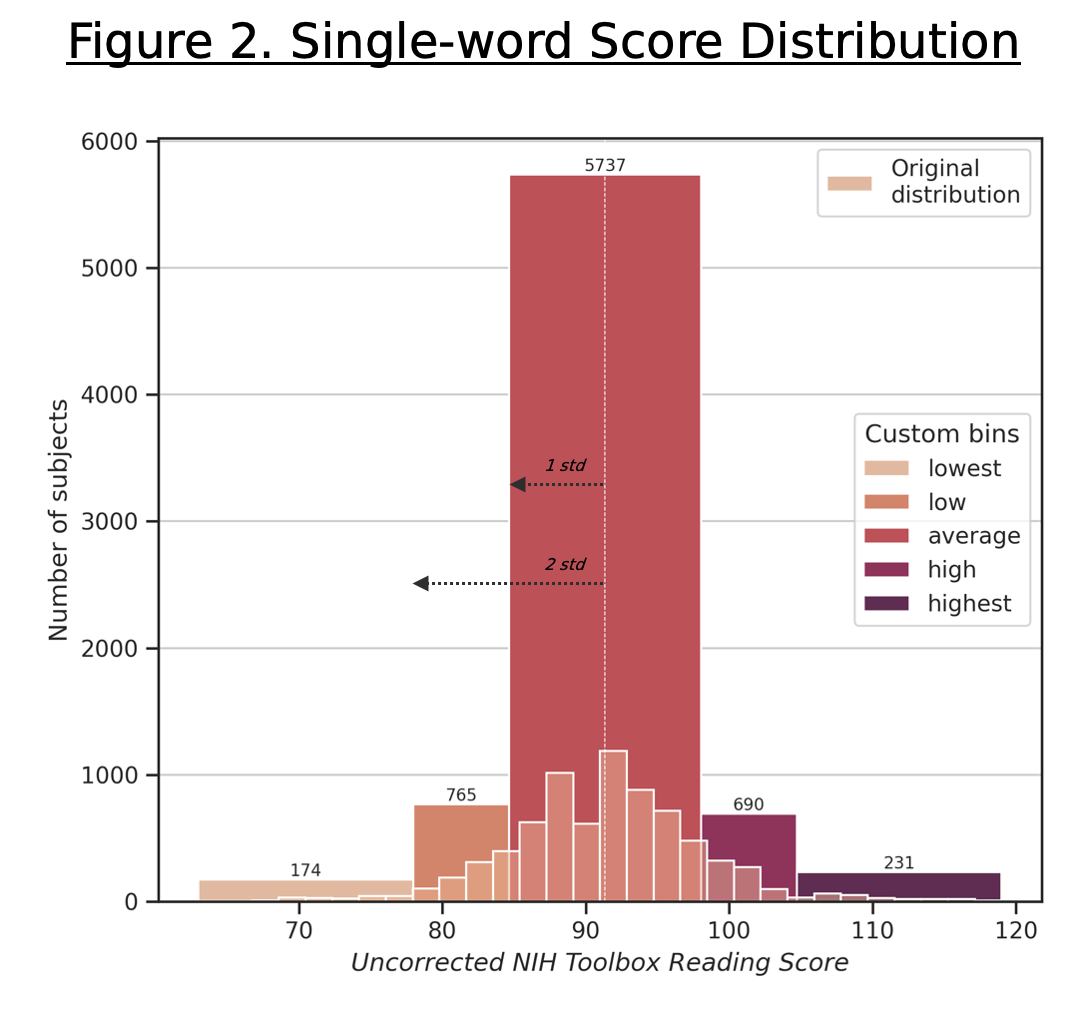
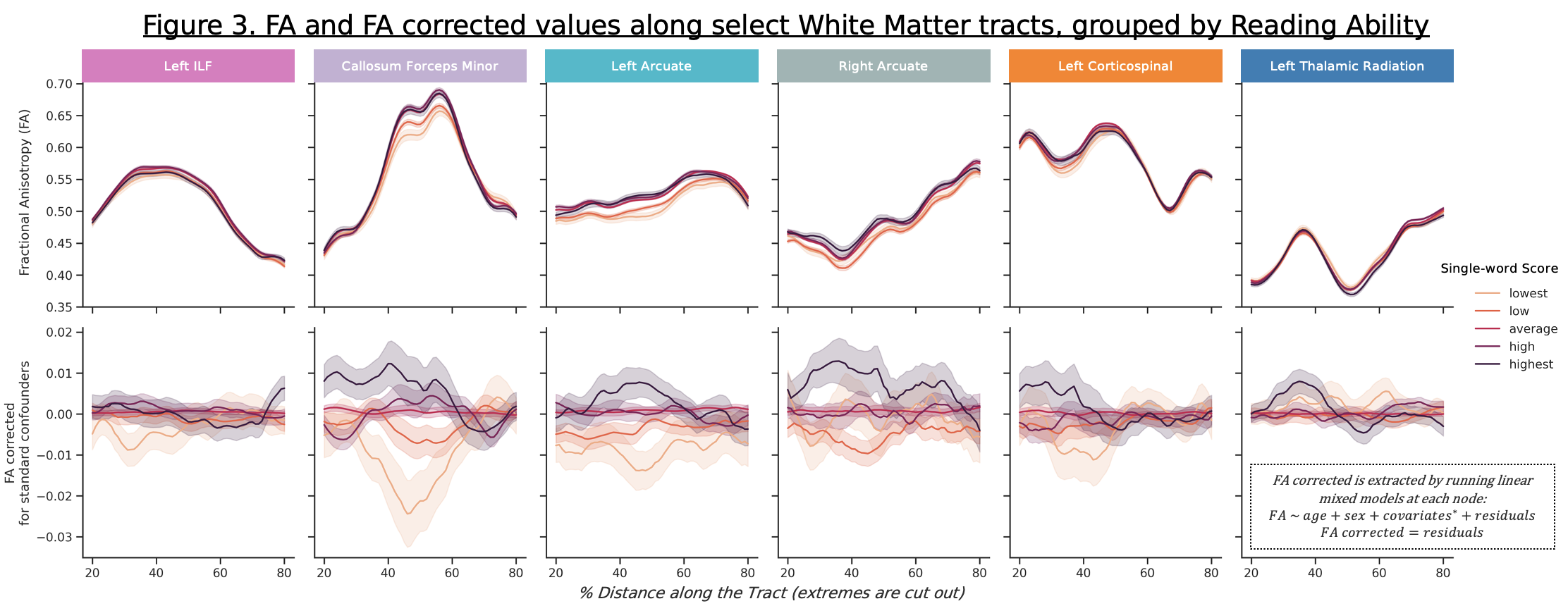
Fractional Anisotropy (FA) along individual tract profiles was averaged (solid lines) by reading group (Figure 2) and plotted for select tracts (Figure 1). Shaded areas show standard error. FA was also corrected for standard covariates (age, sex, parental education, income, and marital status, ethnicity, genetic ancestry, and MRI scanner ID) with linear mixed effects models.
*covariates = parental education, income, and marital status, ethnicity, genetic ancestry, and MRI scanner ID