3350
Effects on Granger causality Connectivity of Deaf Children during Working Memory Task after Aerobic Exercise Intervention1RADIOLOGY, Affiliated Hospital of Yangzhou University, Yangzhou, China, 2GE Healthcare, MR Research China, Beijing, China, 3Radiology, Affiliated Hospital of Yangzhou University, Yangzhou, China
Synopsis
Keywords: Brain Connectivity, fMRI (task based)
The cross-modal plasticity was truly involved in theWorking memory (WM) that related to decision-making and memory processing after exercise intervention. However, we know little about the functional connectivity changes after the exercise intervention. The purpose of this study was to examine the cross modal plasticity and Granger causality connectivity among the internetwork in deaf children when performing a WM task before and after exercise intervention. Our results show that aerobic exercise intervention could improve working memory performance in reaction time and mean accuracy rate accompanied with increased internetwork casual flow connectivity.Purpose
Abundant studies have elucidated that the loss of one sensory from early developmental stages drives the functional reorganization of the brain favoring the spared modalities [1], as is generally considered as cross-modal plasticity. Although the cross-model compensation is an enhancement of the perceptual skills in the remaining modalities [2], the improvement of visual and somatosensation perception cannot prevent the deficits in language, cognition as well as social and academic achievements in school-aged children [3]. Prior evidence indicated cross-modal plasticity in both healthy and deaf subjects after the exercise intervention, which also could rebuild the network structure of the brain [4]. As an essential physiological component of a wide range of complex cognitive activities, working memory (WM) is flexible and plastic, and can be improved through training and in essential correlation with children’s cognitive development [5].The purpose of this study was to examine the cross-modal plasticity and functional connectivity among the regions of interest (ROIs) in deaf children when performing a WM task before and after exercise intervention. Our first primary hypothesis was that aerobic exercise intervention could exhibit stronger improvement in working memory performance in reaction time and mean accuracy rate. The second primary hypothesis was that aerobic exercise intervention could exhibit increased or decreased functional connectivity among several ROIs using the Granger causality analysis (GCA).
Materials and Methods
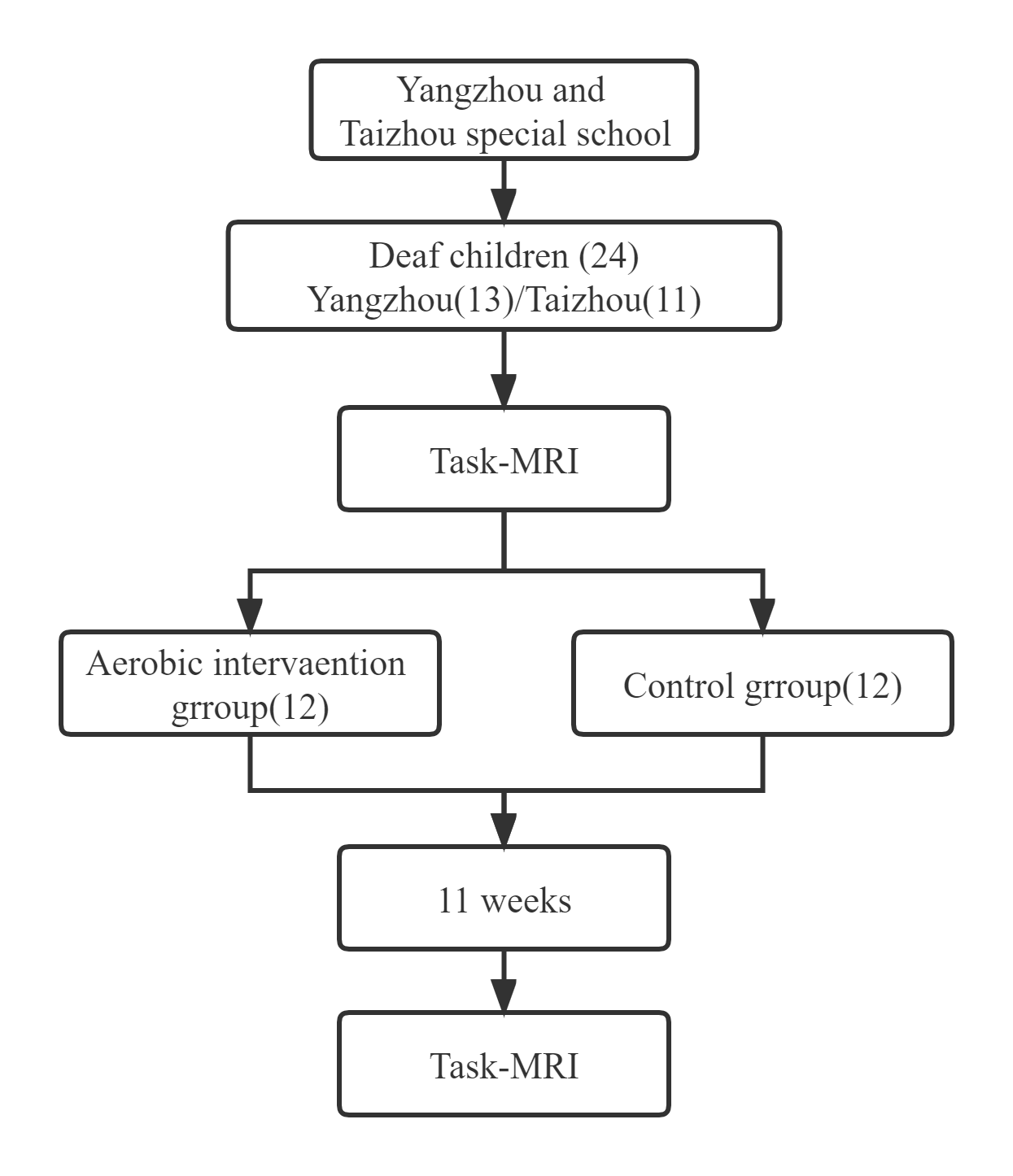
Deaf children were recruited from Yangzhou and Taizhou special education schools (As shown in flow chart Fig 1).2.1 Aerobic Exercise Intervention
In the aerobic exercise session, exercise group performed intermittent vigorous movements, including martial arts, jumping rope and running games. The moderate intensity was defined by the 60%-69% of maximum heart rate (220-age) based on the concept of American College of Sports Medicine.
2.2 Task fMRI design
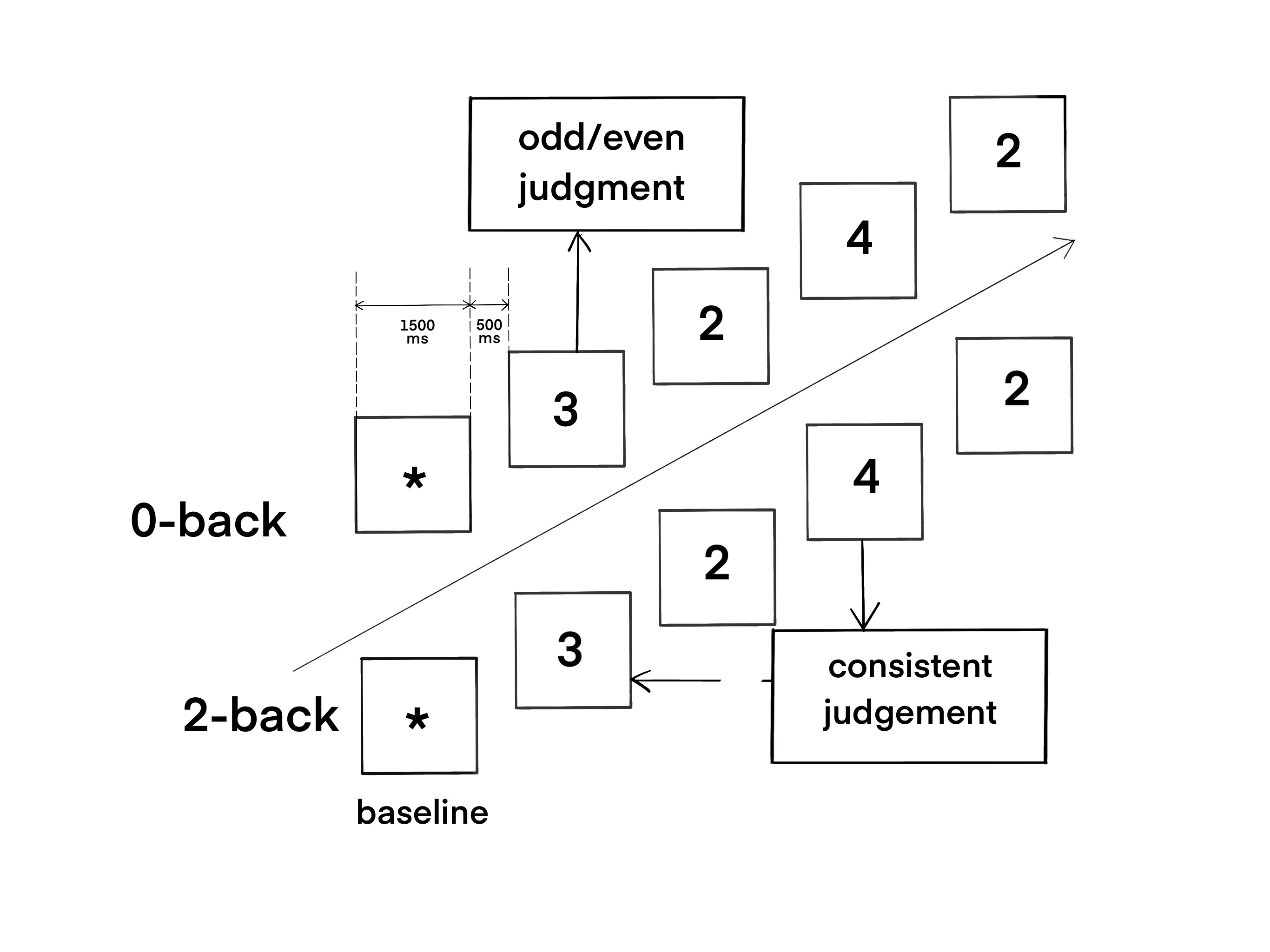
In the task-fMRI section, a modified visual n-back task was performed using E-Prime software 1.1 to assess WM. As shown in the Fig 2, the stimuli materials consisted of a series of Arabic numbers ranged from 1 to 4 that were displayed in the center of a monitor.
2.3. MRI Data Acquisition
All data were measured using a GE 750W 3.0 Tesla MRI scanner before and after 11 weeks aerobic exercise intervention. T1 weighted anatomical images were acquired with the scan parameters of TR/TE=1900/2.52ms, TI=900ms, slice thickness=1.0mm, flip angle=9 degrees, acquisition matrix=256*256, FOV=250*250mm. For task functional MRI (fMRI) measurement, the scan parameters were TR/TE=2000/30ms; thickness=3.0mm, spacing=1mm, flip angle =90 degrees, acquisition matrix =64*64 and FOV=200*200mm.
2.4 Granger causality analysis
Initial, the region of interests (ROIs) for functional connectivity were determined by general linear model analysis in SPM, which were defined according to the peak activation of 2-back image with a maximum size of 6 × 6 × 6mm3. And then, given two ROI’s time series X (t) and Y(t) of length T, Granger causality (GC) was calculated based on an one order vector auto-regression (AR) model based on Bayesian information criterion. Temporal mean was removed in order to meet the zero-mean requirement assumed by the AR model used to estimate GC. Auto-regressive (AR) models were estimated from BOLD time series of one complete session, from which GC values were derived.
Results
3.1. Behavioral Performance DataThe behavior performance presented in Table 1. After the 11-week aerobic exercise group showed smaller reaction time than control group on reaction time of 2-back (p < 0.001) and 2-0 back (p < 0.001) and aerobic exercise group represents larger mean accuracy rate than control group during 2-back (p = 0.034). 3.2. Granger causality analysis
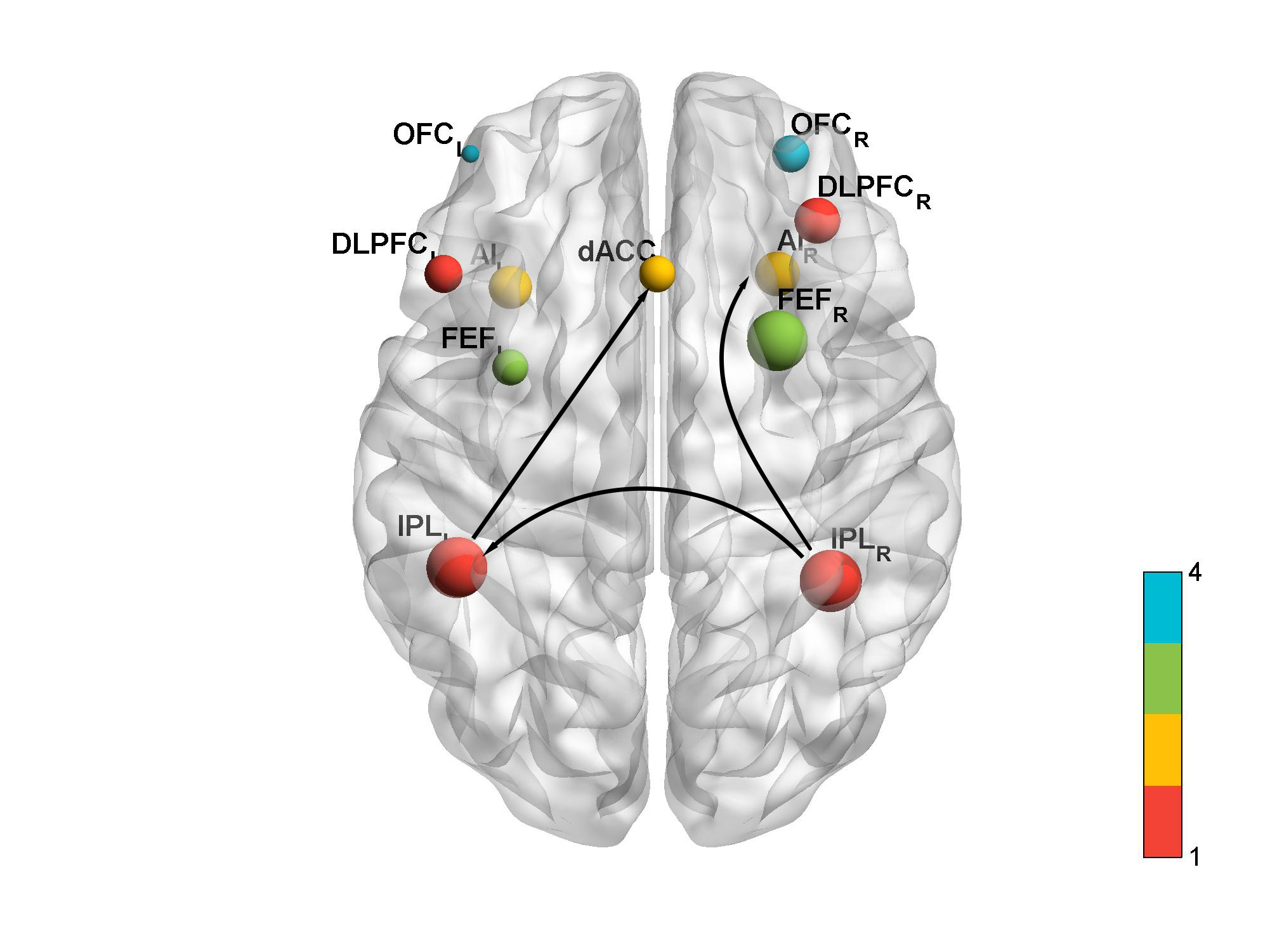
The results of the Grander causality analysis are shown in figure 3. After 11 weeks, intervention group presents significantly increased casual flow than control group from rigth inferior parietal lobule (IPL) to left IPL (2.32 ± 1.20 vs. 1.30 ± 1.10, p = 0.050); RIPL to right anterior insular (RAI ) (2.18 ± 1.10 vs. 1.04 ± 0.75, p = 0.009) and LIPL to dorsal anterior cingulate cortex (dACC) (2.43 ± 1.25 v s. 1.58 ± 0.81, p = 0.018).
Discussion and Conclusions
Our result was agreed with our primary and secondary hypothesis, aerobic exercise intervention could improve working memory performance in reaction time and mean accuracy rate accompanied by increased casual flow connectivity. Both the reaction time and mean accuracy rate showed significant improving in aerobic exercise intervention group than control group, this evidence could support better task-related WM performance after aerobic exercise intervention in deaf children [6]. To our knowledge, the characters of enhanced casual flow have been detected in deaf adults with a history of hearing aid use from 1.5 to 21 years of age than hearing controls [7]. In our researchers, the improvement of WM performance is accompanied by the enhancement of casual flows connectivity in multiple regional after aerobic exercise. These results could help us understanding the relationship between intervention and inter-network connectivity remodeling. Which further suggests how the integrate brain functions promote or constrain functional plasticity in high-level cognitive abilities like working memory.To sum up, aerobic exercise intervention is effective in improving working memory. The enhancement of granger causality connectivity between inter networks reflects the remodel pattern of neural plasticity.
Acknowledgements
We confirm that the manuscript has been read and approved by all named authors and there areno known conflicts of interest associated with this publication.All protocols of this study were approved by the ethics committee of the Yangzhou University, Yangzhou, China.References
1. Rauschecker JP: Compensatory plasticity and sensory substitution in the cerebral cortex. Trends Neurosci 1995, 18(1):36-43.
2. Sharma A, Glick H: Cross-Modal Re-Organization in Clinical Populations with Hearing Loss. Brain Sci 2016, 6(1).
3. Smith SL, Pichora-Fuller MK: Associations between speech understanding and auditory and visual tests of verbal working memory: effects of linguistic complexity, task, age, and hearing loss. In: Frontiers in psychology. vol. 6; 2015: 1394.
4. Bavelier D, Neville HJ: Cross-modal plasticity: where and how? Nat Rev Neurosci 2002, 3(6):443-452.
5. Baddeley A: Working Memory: Theories, Models, and Controversies. Annual Review of Psychology 2012, 63(1):1-29.
6. Erickson KI, Banducci SE, Weinstein AM, et al. The brain-derived neurotrophic factor Val66Met polymorphism moderates an effect of physical activity on working memory performance. Psychol Sci. 2013;24(9):1770-1779.
7. Ding H, Qin W, Liang M, Ming D, Wan B, Li Q, Yu C: Cross-modal activation of auditory regions during visuo-spatial working memory in early deafness. Brain : a journal of neurology 2015, 138(Pt 9):2750-2765.
Figures