3342
Altered static and dynamic spontaneous neural activity in adolescent with first episode major depressive disorder and previous suicide attempts1The Affiliated Brain Hospital of Guangzhou Medical University, Guangzhou, China, 2South China University of Technology, Guangzhou, China, 3Guangzhou Integrated Traditional Chinese and Western Medicine, Guangzhou, China, 4Philips Healthcare, Guangzhou, China
Synopsis
Keywords: Brain Connectivity, Adolescents, Major depressive disorder; suicide; frontal cortex
This study combined dynamic and static amplitude of low-frequency fluctuations (ALFF) approaches to investigate the differences in local spontaneous brain activities between depressed adolescents with and without suicide attempts (SA). Our findings suggest that alterations in brain activities in regions involved in emotional processing, decision-making, and response inhibition are associated with an increased risk of suicidal behaviors in depressed adolescents.Background
Converging evidence has revealed that disturbances in the corticostriatolimic system are associated with suicidal behaviors in adults with the major depressive disorder[1]. However, the neurobiological mechanism that confers suicidal vulnerability in depressed adolescents is largely unknown[2]. The primary aim of the study was to investigate the pattern of local brain activities in depressed adolescents with previous suicide attempts.Methods
Thirty-seven depressed adolescents with prior suicide attempts (MDD-SA), 37 depressed adolescents without prior suicide attempts (MDD-NSA), and 47 healthy controls (HCs) underwent resting-state functional imaging (R-fMRI) scans. The dynamic ALFF (dALFF) variability and static ALFF (sALFF) metrics were measured separately for the three groups.Results
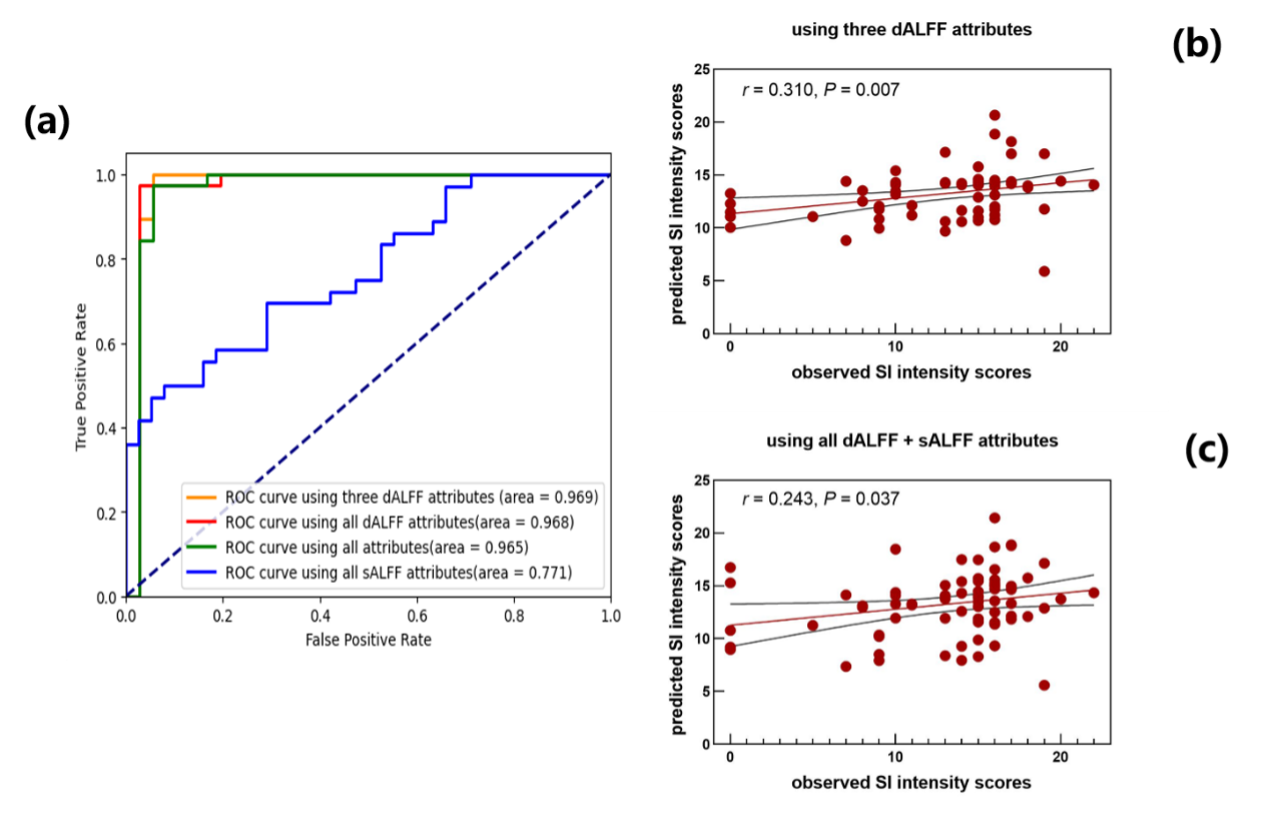
We found altered dALFF variability in the left middle temporal gyrus, left inferior frontal gyrus, left middle frontal gyrus, bilateral superior frontal gyrus, right supplementary motor area (SMA), and right insula in depressed adolescents with prior suicide attempts (Figure 1). The main findings of sALFF and dALFF approaches were highly consistent. Notably, combining the altered sALFF and dALFF variability could be used to generate diagnostic models in discriminating MDD-SA from MDD-NSA with high accuracy, and some features could predict the severity of suicide ideation (SI) (Figure 2).Discussion
This study found lower brain dynamics primarily located in the ventrolateral prefrontal cortex, dorsolateral prefrontal cortex, and SMA, which are associated with cognitive control, decision-making, and response inhibition[2]. As indicated by previous studies[3, 4], a dynamic brain is important for cognitive functioning while less dynamic brain activity is related to worse performance on cognitive tasks. The insula cortex is a key hub of the salience network that possibly facilitates the transition from SI to attempt[2], the current study suggests that the insula may also underlie the neural mechanism of suicidal behaviors in depressed adolescents.Conclusions
Our findings suggest that alterations in spontaneous neural activity in regions involved in emotional processing, decision-making and response inhibition are associated with an increased risk of suicidal behaviors in depressed adolescents. Furthermore, dALFF variability could serve as a sensitive biomarker for revealing the neurobiological mechanisms underlying suicidal vulnerability.Acknowledgements
This research was supported in part by the National Natural Science Foundation of China [81771466]; the Natural Science Foundation of Guangdong Province, China [2021A1515011288]; Science and Technology Program of Guangzhou [202102010020]; High-tech and Major Featured Project of Guangzhou [2019TS46]; Health Science and Technology Project of Guangzhou [20211A010037]; Science and Technology Program of Guangzhou, China [202102080665].References
[1] ALACREU-CRESPO A, OLIE E, LE BARS E, et al. Prefrontal activation in suicide attempters during decision making with emotional feedback [J]. Transl Psychiatry, 2020, 10(1): 313.
[2] SCHMAAL L, VAN HARMELEN A L, CHATZI V, et al. Imaging suicidal thoughts and behaviors: a comprehensive review of 2 decades of neuroimaging studies [J]. Mol Psychiatry, 2020, 25(2): 408-27.
[3] ZALESKY A, FORNITO A, COCCHI L, et al. Time-resolved resting-state brain networks [J]. Proc Natl Acad Sci U S A, 2014, 111(28): 10341-6.
[4] SCHUMACHER J, PERAZA L R, FIRBANK M, et al. Dysfunctional brain dynamics and their origin in Lewy body dementia [J]. Brain, 2019, 142(6): 1767-82.
Figures