3315
Predictive value of baseline functional connectivity to the effect of transcranial magnetic stimulation on Alzheimer's disease1The Second Clinicall Medical College of North Sichuan Medical College, Nanchong, China, 2Clinical Science, Philips Healthcare, Chengdu, China
Synopsis
Keywords: Alzheimer's Disease, Alzheimer's Disease
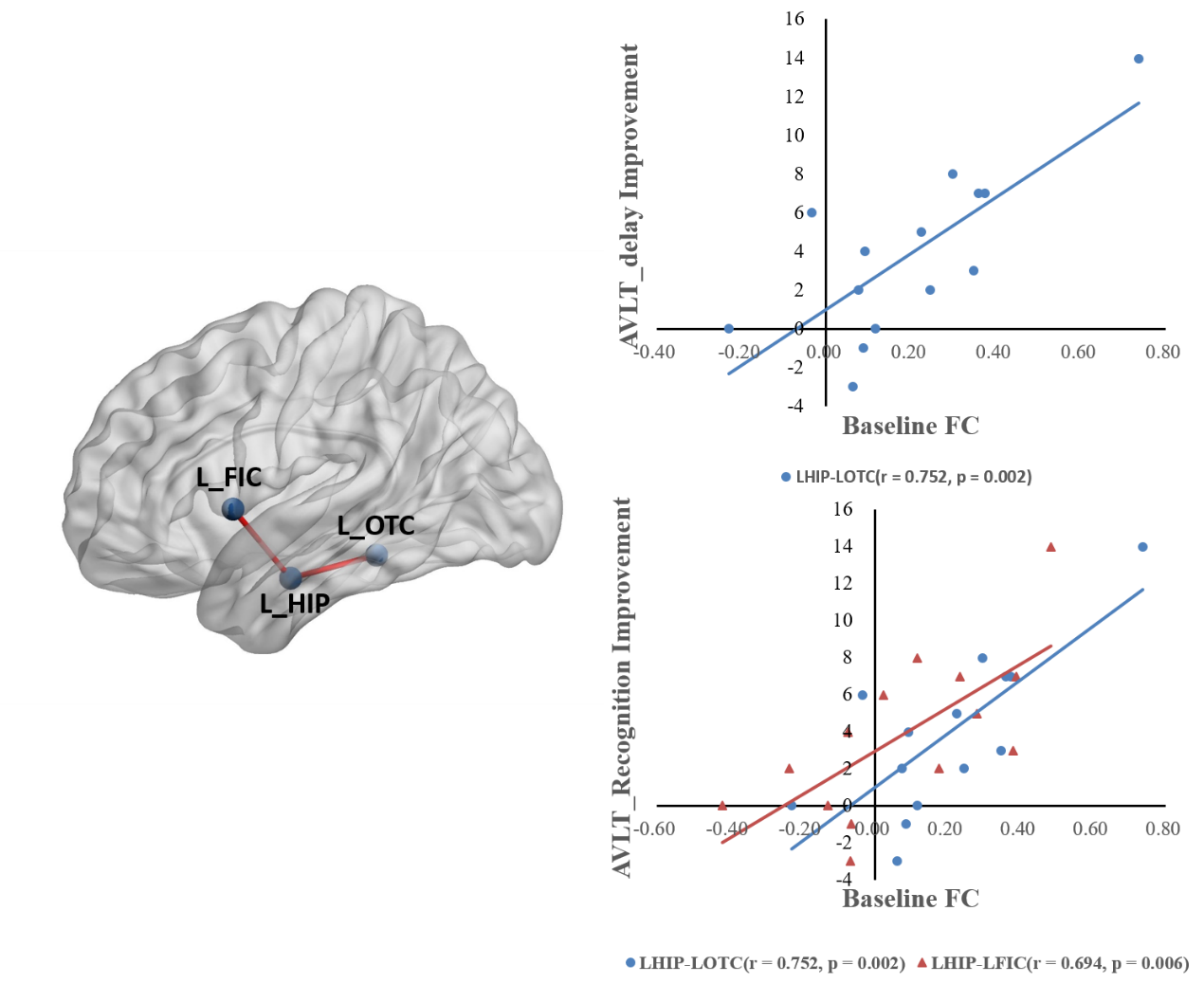
Repetitive transcranial magnetic stimulation (rTMS) may lead to a significant improvement in general cognitive function and memory function of Alzheimer's disease (AD). Several related functional connectivity may contribute to the effectiveness of rTMS. Besides, the baseline functional connectivity between the left hippocampus and left occipitotemporal cortex, left frontoinsular cortex were significantly positively correlated with the improvement of memory recognition function. The baseline functional connectivity between the left hippocampus and left occipitotemporal cortex was significantly positively correlated with the improvement of delayed recall function of memory.
Purpose
To evaluate the possible effects of repetitive transcranial magnetic stimulation (rTMS) on the cognitive function and to explore the correlation between the baseline functional connectivity of Alzheimer's disease (AD) and the improvement of the cognitive assessment scales.Methods
Twenty-nine AD patients were randomly assigned to two groups: one group (n = 14) received high-frequency (20Hz) rTMS over left dorsolateral prefrontal cortex (DLPFC) for four weeks, and the other (n = 15) received sham stimulation. Neuropsychological assessments of general cognitive function, memory function, language function, executive function, and resting-state functional magnetic resonance imaging examination were conducted at baseline and after finishing four weeks of intervention. Cognition-related functional network and the possible relationship between functional connectivity and cognitive performance were evaluated.Results
After 20 days of intervention, significantly improved and better general cognitive function and recognition memory function were detected in the rTMS group relative to baseline and sham group. Significantly increased functional connectivity related to these functions was found between left hippocampus (HIP) and left DLPFC, left frontoinsular cortex (FIC), right lingual gyrus (LG), and between left occipitotemporal cortex (OTC) and right supramarginal gyrus (SMG) in the real group. Relative to the sham group, significantly higher connectivity was detected between the left DLPFC and left OTC, left HIP, between bilateral posterior cingulate cortex (PCC) and right SMG, between left OTC and right SMG, left middle occipital gyrus (MOG), left inferior temporal gyrus (ITG), and between left HIP, and right SMG, left MOG after intervention. Increased functional connectivity were also detected in the sham group as well, which were shown between left DLPFC and right LG, and between bilateral PCC and left ITC. Altered functional connectivity between left DLPFC and left HIP revealed significant correlation with improved delay recall memory function. Besides, the baseline functional connectivity between the left HIP and left OTC, left FIC were significantly positively correlated with the improvement of recognition function of memory. The baseline functional connectivity between the left HIP and left OTC was significantly positively correlated with the improvement of the delayed recall function of memory .Conclusion
Our findings indicate that rTMS may lead to a significant improvement of general cognitive function and memory function. Several related baseline functional connectivity may could used to predict the effectiveness of rTMS on different AD patients.Acknowledgements
This work was supported by the Bureau of Science and Technology Nanchong City (22SXHQT0345) and Sichuan Medical Association (Q20043).References
[1] an Lin, Wen-Jing Jian, et al. The role of repetitive transcranial magnetic stimulation (rTMS) in the treatment of cognitive impairment in patients with Alzheimer's disease: A systematic review and meta-analysis. Journal of the Neurological Sciences. 2019. 398: 184–191.
[2] Ying-hui Chou, Viet Ton That, et al. A systematic review and meta-analysis of rTMS effects on cognitive enhancement in mild cognitive impairment and Alzheimer’s disease. Neurobiology of Aging. 2020. 86: 1-10.
[3] Liao X, Li G, Wang A, Liu T, Feng S, Guo Z, et al. Repetitive transcranial magnetic stimulation as an alternative therapy for cognitive impairment in Alzheimer’s disease: a meta-analysis. J Alzheimer’s Dis. 2015; 48:463–72.
[4] Thomas Platz, John C. RothwelBrain stimulation and brain repair--rTMS: from animal experiment to clinical trials--what do we know? Restor Neurol Neurosci. 2010; 284(4): 387-398.
[5] Jiu Chen, Nan Ma, Guanjie Hu, et al. rTMS modulates precuneus-hippocampal subregion circuit in patients with subjective cognitive decline. Aging. 2020. 12:1-18.
[6] Gayatri Devi, Henning U. Voss, et al. Open-Label, Short-Term, Repetitive Transcranial Magnetic Stimulation in Patients with Alzheimer’s Disease with Functional Imaging Correlates and Literature Review. Current Topics in Research. 2014, 29(3): 248-255.
[7] Arianna Menardi, Lisa Dotti, Ettore Ambrosini, et al. Transcranial magnetic stimulation treatment in Alzheimer's disease: a meta-analysis of its efficacy as a function of protocol characteristics and degree of personalization. J Neurol.2022. Online ahead of print.
[8] Xin Wang, Zhiqi Mao, et al. Repetitive transcranial magnetic stimulation for cognitive impairment in Alzheimer’s disease: a meta‑analysis of randomized controlled trials. Journal of Neurology. 2020.
[9] L Gu, H Xu, F Qian. Effects of Non-Invasive Brain Stimulation on Alzheimer's Disease. J Prev Alzheimers Dis. 2022; 9(3):410-424.
[10] Alcalá-Lozano R, Garza-Villarreal EA, et al. Overlap of large-scale brain networks may explain the similar cognitive improvement of single-site vs multi-site rTMS in Alzheimer's disease. Brain Stimul. 2018; 11(4): 942 – 944.
[11] Lili Wei, Yingchun Zhang, Jintao Wang, et al. Parietal-hippocampal rTMS improves cognitive function in Alzheimer’s disease and increases dynamic functional connectivity of default mode network. Psychiatry Research. 2022; 315:114721.
Figures
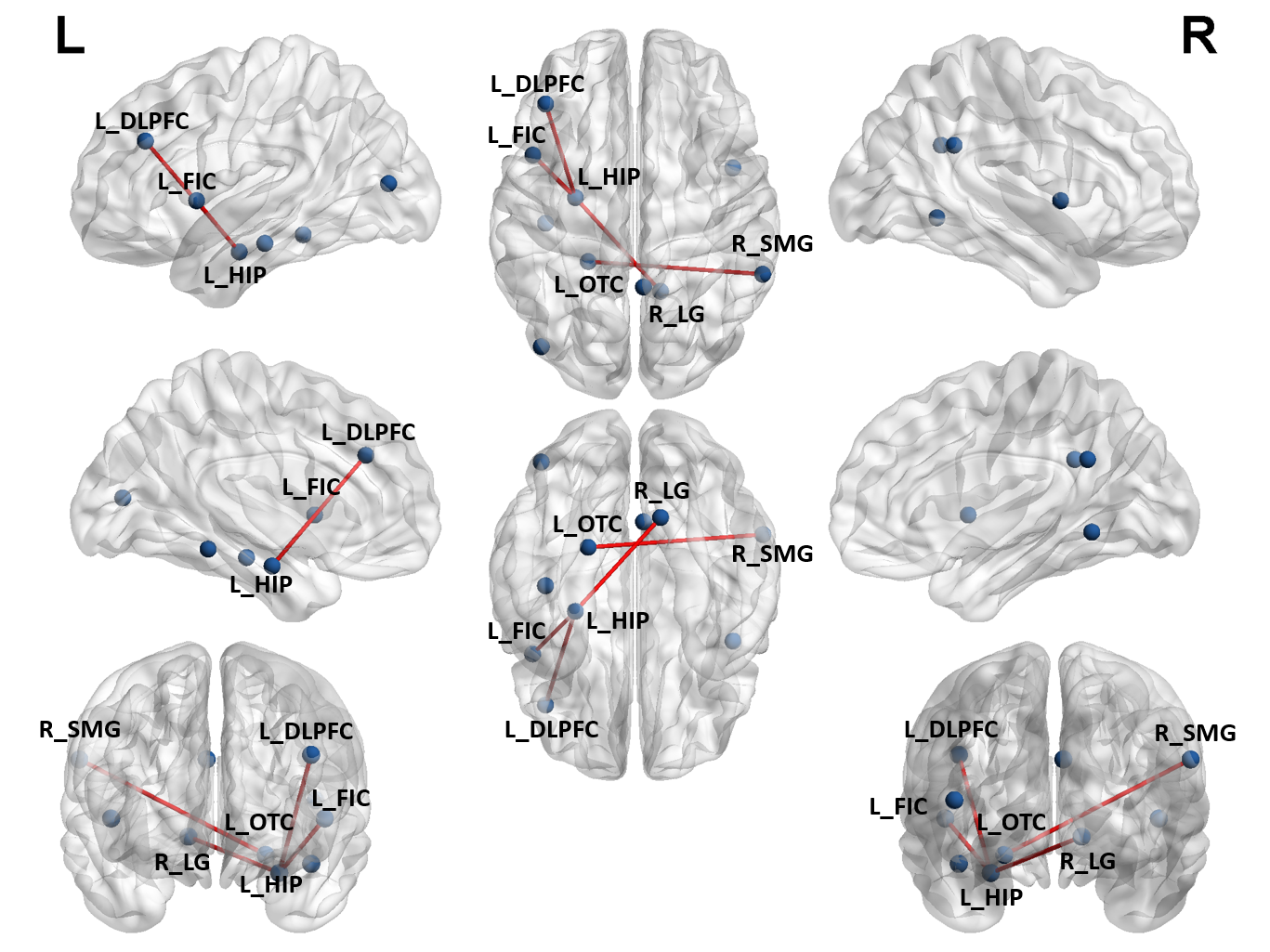
Figure 1. The connected network shows significantly increased functional connectivity after rTMS therapy compared to baseline in real group.
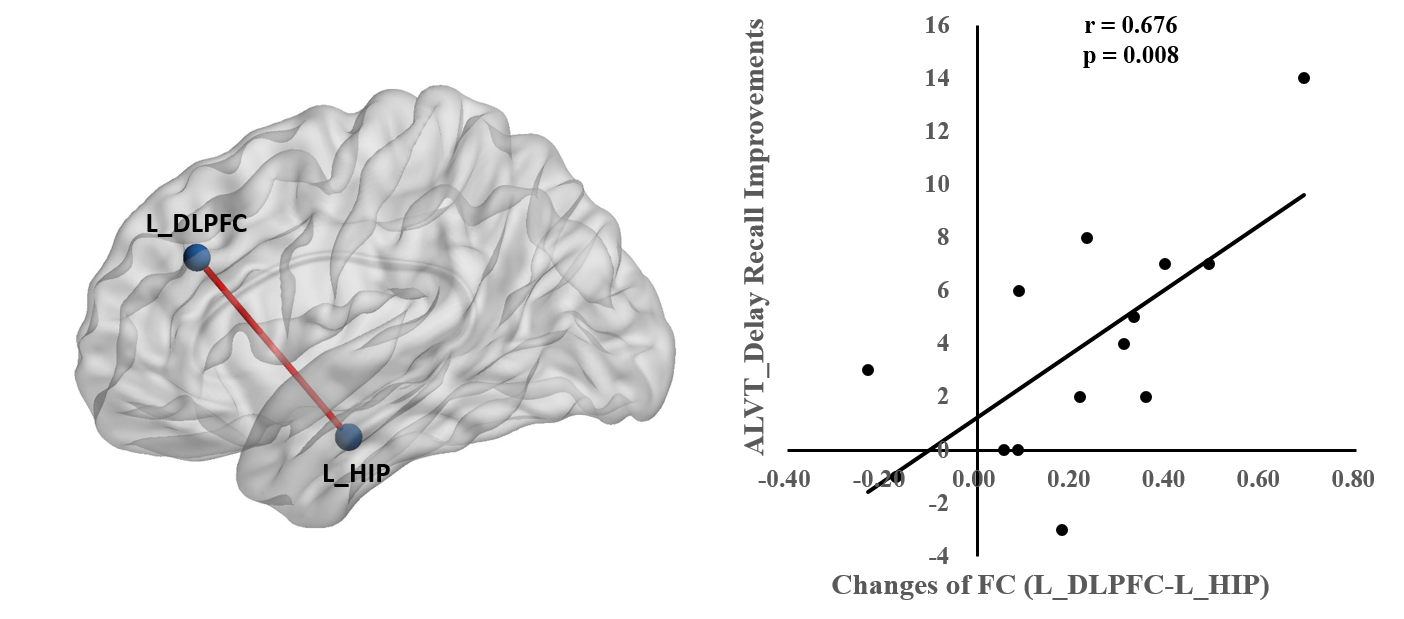
Figure 2. Correlation between the change of functional connectivity (between left DLPFC and left HIP) and improvement of memory function.