3037
White matter integrity and structural connectivity disruption in cognitive impairment T2DM patients with cerebral small vessel disease
Huang ming ming1, Yu Hui1, Li Xiao Bao1, Liu Jian Tao2, Zhang Aaron3, and Gao Bo4
1Department of Radiology, Affiliated Hospital of Guizhou Medical University, Guiyang, China, 2Philips Healthcare China, Xi an, China, 3Philips Healthcare China, Guangzhou, China, 4Affiliated Hospital of Guizhou Medical University, Guiyang, China
1Department of Radiology, Affiliated Hospital of Guizhou Medical University, Guiyang, China, 2Philips Healthcare China, Xi an, China, 3Philips Healthcare China, Guangzhou, China, 4Affiliated Hospital of Guizhou Medical University, Guiyang, China
Synopsis
Keywords: White Matter, Diffusion Tensor Imaging, type 2 diabetes mellitus
DTI provides an effective way to investigate the white matter integrity and white matter connectivity. In this study, almost the white matter integrity was injured in cognitive impairment T2DM patients with CSVD , which were accompanied with reduction of FA value and increasing of λ∥、λ⊥ and ADC values . These results suggested that axonal injuries and demyelinating diseases maybe exist and induce the network connectivity disruption in these patients. More over, In patients with T2DM, network parameters were associated with memory and attention, significantly correlation were found between network parameters and cognitive assessment scores. These findings may provide new insights into how white matter abnormalities and white matter network disruption can affect cognitive function in patients with diabetes.Introduction
Cerebral small vascular disease (CSVD) is a common accompaniment of type 2 diabetes mellitus(T2DM), when present, may probably contributes to cognitive dysfunction. Many documents also showed that white matter (WM) play a irreplaceable role in keeping cognition status[1]. So, In the present study, we were aimed , 1) to identify whether CSVD present in T2DM will indeed contribute to cognitive impairment and whether induce changes of micro/macrostructure, especially cerebral white matter integrity and structural connectivity, 2) to investigate the potential relationship between WM integrity, cerebral structural connectivity and cognitive impairments.Materials and methods
20 T2DM with CSVD patients and 20 age matched healthy older controls were recruited, They were all underwent 3 Tesla high- resolution structural and diffusion-tensor (DTI) MRI scanning, a detailed cognitive assessment was also performed for every participants. The PANDA toolbox based on FMRIB Software Library v5.0 was applied to assess white matter microstructure changes and reconstruct white matter tracts[2]. We obtained the global topological parameters including the small-world [gamma, sigma, lambda, and global shortest path length (Lp)], global efficiency (Eg), and local efficiency (Eloc) by using the GRETNA toolbox[3].Results
From the Tract-based spatial statistic analysis(TBSS), almost the white matter integrity was injured, which were accompanied with reduction of FA value(Fig.1) and increasing of λ∥、λ⊥ and ADC values. Compared to controls, T2DM patients with CSVD showed significantly reduced Eg (p =0.024) , Eloc (p =0.017) and increased Lp (p =0.005)(Fig.3). Reduced connection efficiency between nodes were found between ORB supmed.L and PUT.L, SMG.L and IPL.L, INS.L and HIP.L, PHG.L and IFGoperc.L, HIP.L and OLF.L , REC.L and INS.L, ORBsup.R and OLF.R,IFGoperc.R and INS.RDCG R as well as CUN.R and PCUN.R(fig.2). More over, significantly positive correlation between MMSE scores and Eloc (r=0.374, p=0.042) , Cp (r=0.411, p=0.024); correlations between memory scores and Eloc(r=0.395, p=0.031), Cp(r=0.405, p=0.026), attention scores and gamma(r=-0.361, p=0.050), sigma (r=-0.400, p=0.029) were found (table.4).Discussion
DTI provides an effective way to investigate the WM integrity and WM connectivity. In this study, almost the white matter integrity was injured in cognitive impairment T2DM patients with CSVD, which were accompanied with reduction of FA value and increasing of λ∥、λ⊥ and ADC values. This findings suggested that axonal injuries and demyelinating diseases maybe exist and result in the network connectivity disruption in these patients. More over, In patients with T2DM, network parameters were associated with memory and attention, significantly correlation were found between network parameters and cognitive assessment scores. These results consistent with many other studies[4,5]. It can provide new insights into how white matter abnormalities and white matter network disruption can affect cognitive function in patients with diabetes.Acknowledgements
Acknowledgements This work is supported by grants from the Natural Science Foundation of China (81560281) and Science and Technology Department of Guizhou Province-Guizhou medical university, Qiankehe LG [2012]024.References
References [1] Sanjari Moghaddam, H, et al. Front Neuroendocrinol 2019 10;55.[2] Cui Z, et al. Front Hum Neurosci , 2013,7:1-16. [3] Wang J, et al. Front Hum Neurosci, 2015, 9:386. [4] Reijmer, Yael D, et al. Diabetes, 2013, 62: 2112-15. [5] Huang H, et al. Clin Neuroradiol 2022 Sep 16.Figures
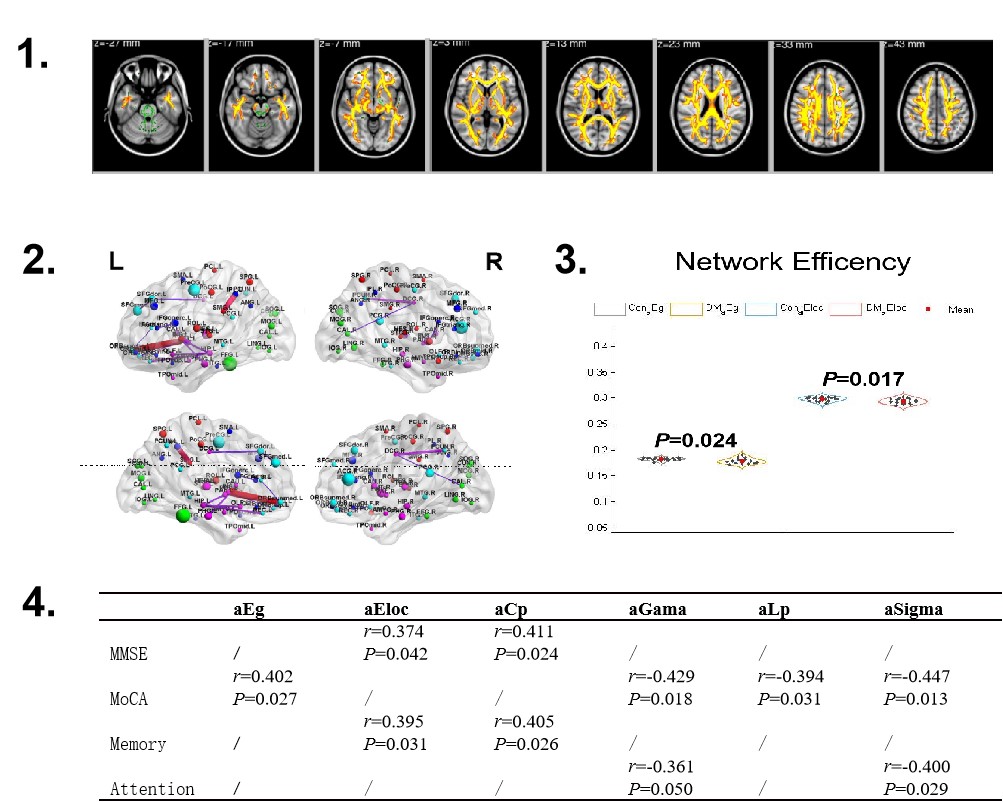
1:TBSS results of FA value; 2: Demonstrate the reduced connection efficiency between nodes; 3: Network efficency; 4: Correlations between memory scores and Network parameters.
DOI: https://doi.org/10.58530/2023/3037