3009
Evaluation of reproducibility of diffusion tensor image analysis along the perivascular space index using a reorientation technique1Department of Diagnostic and Interventional Radiology, Osaka Metropolitan University, Osaka, Japan
Synopsis
Keywords: Neurofluids, Diffusion Tensor Imaging, ALPS index; glymphatic system;
Diffusion tensor image analysis along the perivascular space (DTI-ALPS) index is expected to reflect the glymphatic function of the brain, however, head rotation may reduce reliability. This study evaluated whether a reorientation technique, which registers image and vector information of DTI data, improves the reproducibility of the calculation of the ALPS index. A total of 234 cognitively normal subjects were selected from the OASIS-3 dataset. In the evaluation of the intra- and inter-reliability, the reorientation technique enabled to show good to excellent reproducibility (intraclass correlation coefficients > 0.85) in calculating ALPS index even when head rotation existed.Background and purpose
Diffusion tensor image analysis along the perivascular space (DTI-ALPS) index was expected to reflect the glymphatic function of the brain, however, head rotation may reduce reproducibility and reliability1. In the current study, we used a technique that registers image and vector information of DTI data to another space and creates reoriented diffusivity maps. This technique may easily calculate ALPS index with a high reproducibility even for subjects who obtained DTI with inappropriate head position or imaging plane. Therefore, this study aimed to evaluate whether the reorientation technique of DTI improved the reproducibility of the ALPS index using a large open-source dataset.Materials and methods
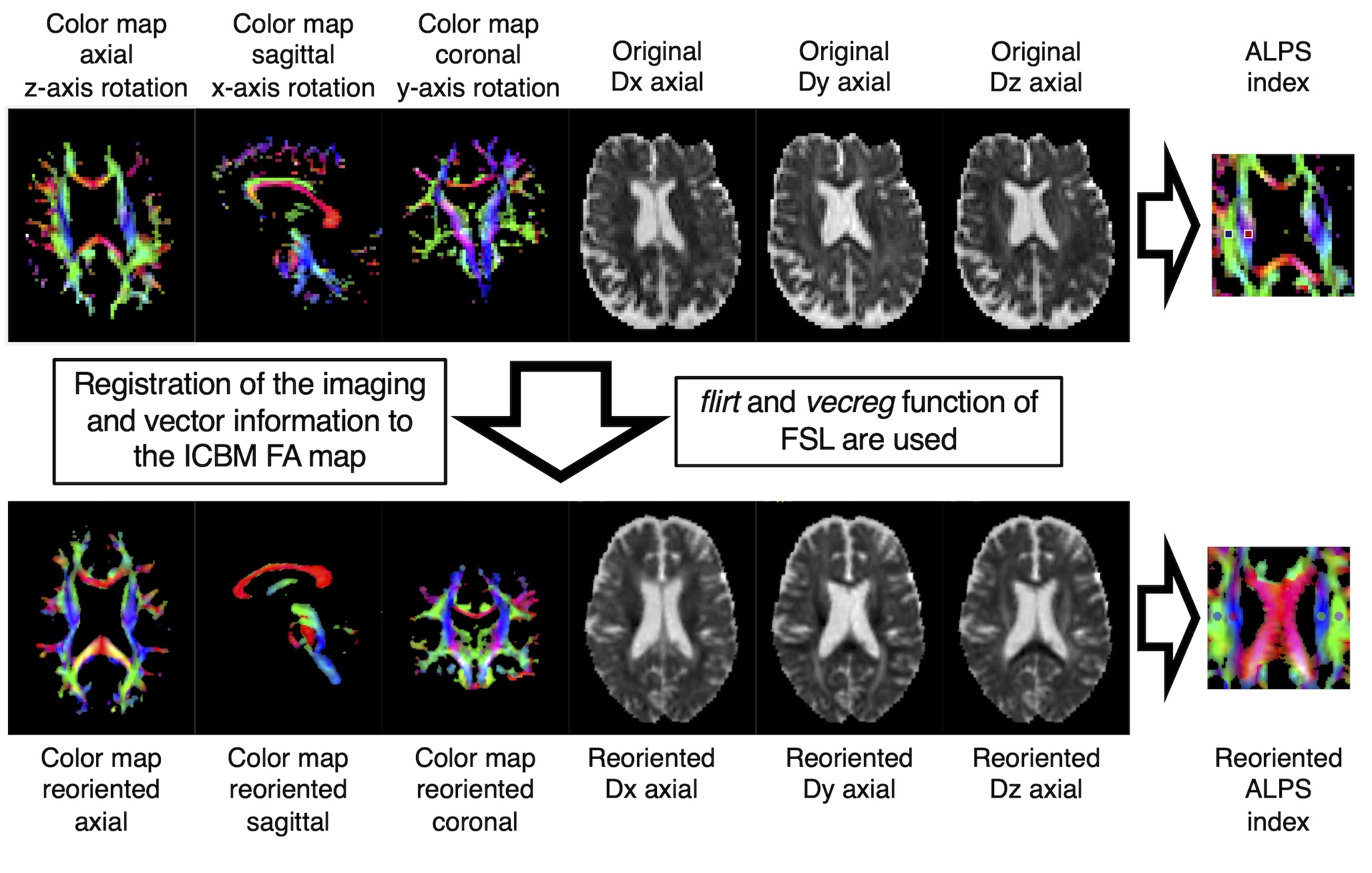
A total of 234 cognitively normal subjects were included from the OASIS-3 dataset. To calculate reoriented ALPS index, a new technique, vecreg function of FSL, which could register vector information of DTI to another space and create reoriented diffusivity maps, was used (Fig. 1). The “vecreg” function is a command-line tool and can be applied to the V1 (1st eigenvector), V2 (2nd eigenvector), V3 (3rd eigenvector), and diffusivity maps of DTI data. This technique, therefore, possesses sufficient function for calculating the reoriented ALPS index. 5-mm spherical ROIs were manually placed on the region of the projection and association fibers adjacent to the medullary veins at the level of the lateral ventricle body on the original and reoriented color maps. The DTI-ALPS index measures the ratio of the mean of the bilateral x-axis diffusivity in the area of projection fibers and bilateral x-axis diffusivity in the area of association fibers to the mean of bilateral y-axis diffusivity in the area of projection fibers and bilateral z-axis diffusivity in the area of association fibers as follows 1, 2:$$ALPS index = mean(Dx,proj, Dx,assoc)/mean(Dy,proj, Dz,assoc)$$
To compare between original and reoriented ALPS indices, paired t-test and F-test were used to evaluate the difference and variance. Then, subjects with head rotation around z-axis (inferior-superior, n = 43) or x-axis (right-left, n = 25) and matched subjects with neutral head position were selected for the evaluation of the intra- and inter-rater reliability. Intraclass correlation coefficients (ICCs) of the original and reoriented ALPS indices for subjects with head rotation and neutral head position were separately calculated. The Bland–Altman plot between the original and reoriented ALPS indices was also evaluated.
Results
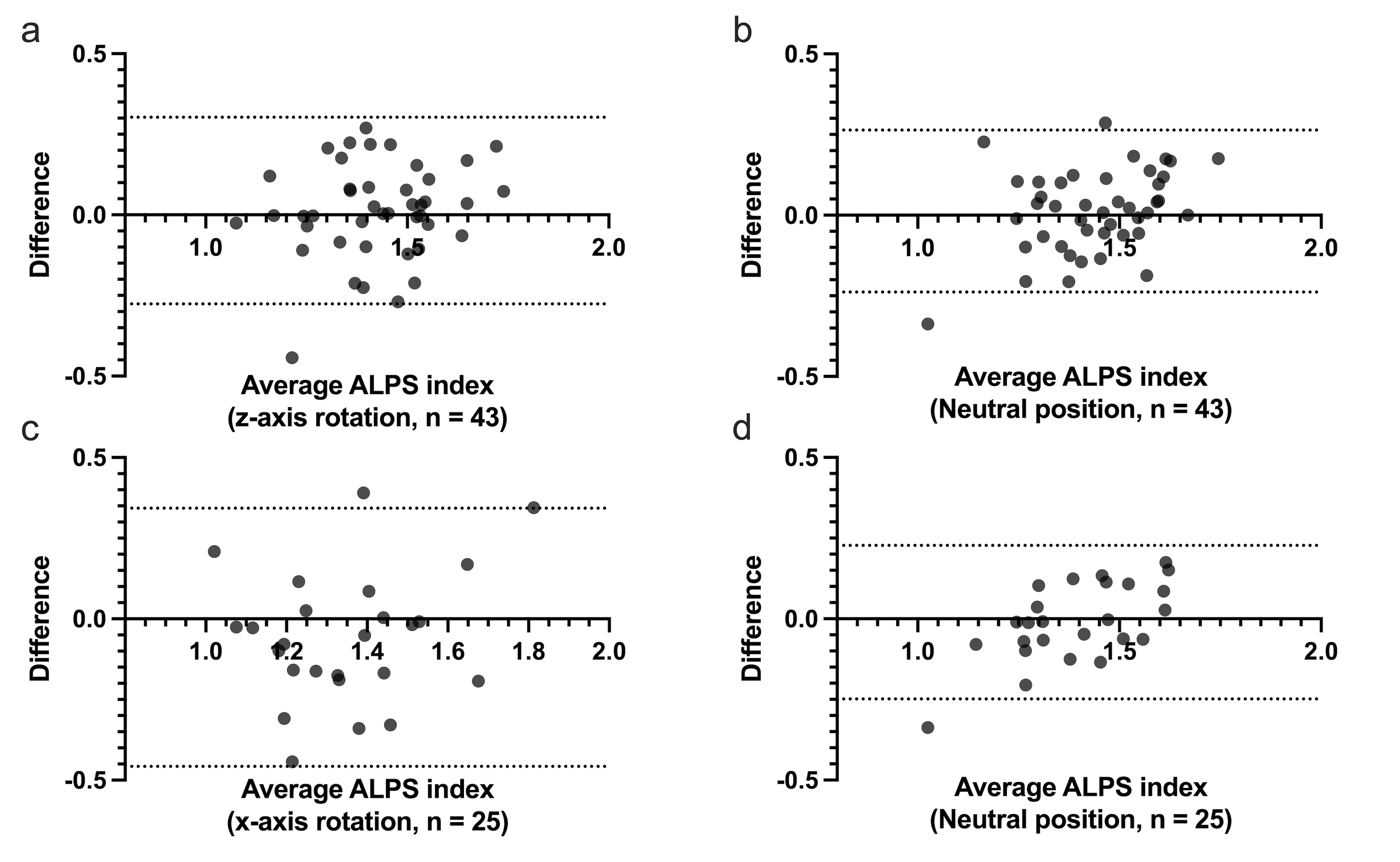
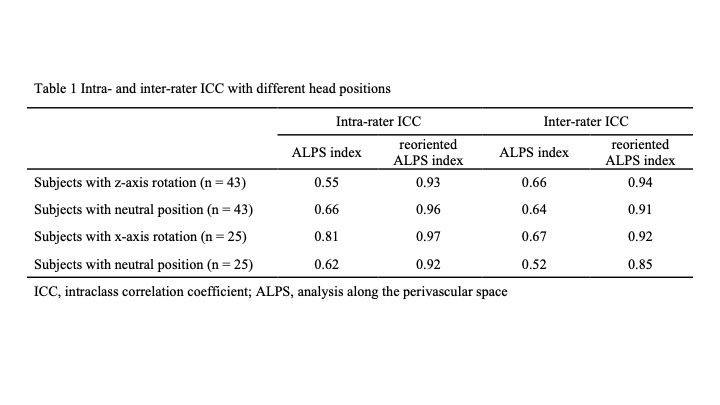
Reoriented ALPS index showed a significantly smaller variance compared with original ALPS index (mean ± standard deviation, 1.45 ± 0.20 and 1.45 ± 0.16 for original and reoriented ALPS indices, respectively; paired t-test, p = 0.80; F-test, p < 0.001). For the evaluation of the intra- and inter-reliability, the reorientation technique enabled to show good to excellent reproducibility in calculating ALPS index even when head rotation existed (Table 1; ICCs of original ALPS index, 0.52–0.81; ICCs of reoriented ALPS index, > 0.85). A wider range of 95% limit of agreement of the Bland–Altman plot for subjects with x-axis rotation was identified, indicating that x-axis rotation may affect remarkably in calculating ALPS index (Fig. 2).Discussion
The registration technique in this study enabled to create reoriented diffusivity maps along the x-, y-, and z-axes in relation to the reoriented head position and improve the reproducibility to calculate the ALPS index even when the head position or imaging plane was inappropriate. This technique may have mainly two advantages in calculating ALPS index: 1) the best regions for ROI placement at the projection and association fibers can be easily identified, which may lead to excellent intra- and inter-rater reliabilities; 2) reoriented diffusivity map, which corrects the x-, y-, and z-directions of diffusivity fitted to each brain, can be created, leading to a smaller variance of reoriented ALPS index.Conclusion
The technique used in this study would be useful for improving intra- and inter-reliability in calculating the ALPS index and will be beneficial in future studies to estimate glymphatic function of the brain.Acknowledgements
This work was supported by the Takeda Science Foundation.
Data were provided by OASIS (OASIS-3, Longitudinal Multimodal Neuroimaging: Principal Investigators: T. Benzinger, D. Marcus, J. Morris, were supported by NIH Grants: NIH P30 AG066444, P50 AG00561, P30 NS09857781, P01 AG026276, P01 AG003991, R01 AG043434, UL1 TR000448, and R01 EB009352).
References
1. Taoka T, Ito R, Nakamichi R, et al. Reproducibility of diffusion tensor image analysis along the perivascular space (DTI-ALPS) for evaluating interstitial fluid diffusivity and glymphatic function: CHanges in Alps index on Multiple conditiON acquIsition eXperiment (CHAMONIX) study. Jpn J Radiol 2022;40:147-1582.
2. Taoka T, Masutani Y, Kawai H, et al. Evaluation of glymphatic system activity with the diffusion MR technique: diffusion tensor image analysis along the perivascular space (DTI-ALPS) in Alzheimer's disease cases. Jpn J Radiol2017;35:172-178
Figures